
Fundraising for Membership Organizations: Beyond Dues Guide

Here is a scenario almost every membership leader has lived through.
You send a fundraising email to your members. Within a few hours, replies trickle back with some version of the same question: "Wait, I already paid my dues. Why are you asking me for money again?"
It is not hostility. It is honest confusion. And it is the single most common reason membership fundraising underperforms.
Members already feel like they support your organization. So when a donation ask lands in their inbox without context, it feels repetitive at best and tone-deaf at worst. The problem is not your members. The problem is a missing explanation.
Dues and donations fund completely different things. Once your members understand that distinction, the awkwardness disappears, and fundraising starts feeling like community investment rather than a second billing cycle.
This guide walks through how fundraising for membership organizations actually works: from building your first recurring giving program to running a GivingTuesday campaign, with strategies designed for nonprofits, clubs, associations, booster clubs, churches, and alumni groups of every size.
Key Takeaways
- Dues and donations are not the same thing. Dues fund operations and access. Donations fund mission growth, scholarships, and community impact. Members need to understand both before you ask.
- Growing total dollars while losing donors is not a win. The "more money from fewer donors" pattern makes fundraising fragile and harder to sustain over time.
- The second gift matters more than the first. Most first-time donors never give again without a deliberate, timed follow-up system in place.
- Every fundraising event has three revenue layers: registrations, donations, and sponsorships. Most membership organizations only capture one.
- Donation add-ons during signup and renewal are the lowest-friction fundraising opportunity most membership organizations never fully use.
- Recurring giving is the closest thing to subscription revenue in fundraising. Build it early, give it a name, and tie each amount to a specific outcome.
- Peer-to-peer fundraising works when members are equipped with copy, pages, and a simple goal. Asking without equipping is just asking.
- Join It is rated Excellent on Trustpilot, connects memberships, donations, and events in one system, and helps membership organizations run campaigns, collect recurring gifts, and track every donor without spreadsheets.
What Is Fundraising for Membership Organizations?
Fundraising for membership organizations is the process of raising additional financial support from members, donors, sponsors, event attendees, and community partners to fund mission work, programs, scholarships, equipment, outreach, or special campaigns beyond regular dues.
It includes one-time donations, recurring giving programs, donation add-ons at checkout, annual appeals, GivingTuesday drives, year-end campaigns, event-based fundraising, peer-to-peer campaigns, and sponsorship initiatives.
This is separate from your membership revenue model, which covers dues, renewals, pricing tiers, and member benefits. Fundraising is the mission-support layer that sits on top of that foundation.
What Is the Difference Between Fundraising and Membership Dues?
Dues support belonging. They fund access, member benefits, administration, communications, and the day-to-day operations that keep your organization running.
Donations support mission growth. They fund scholarships, outreach programs, new equipment, building projects, community initiatives, and the work that makes your organization genuinely impactful beyond keeping the lights on.
Understanding what dues actually cover in your specific organization is step one. You cannot make a compelling donation ask until your members understand exactly where their dues go and why additional support creates something their dues cannot.
The IRS treats these categories differently. For U.S. tax-exempt organizations, dues, event income, and charitable contributions are reported separately on Form 990, which affects how you communicate donation receipts to donors.
Why Does Fundraising Feel Different in Membership Organizations?
Because members often assume dues already cover everything, leaving no clear reason to give more.
The fix is not a better fundraising pitch. The fix is better framing.
"Your membership keeps us running. Your donation helps us grow." That one sentence, placed clearly in every campaign, changes the entire conversation.
Why Fundraising Matters Beyond Membership Dues
Here is the broader picture that makes this conversation urgent right now.
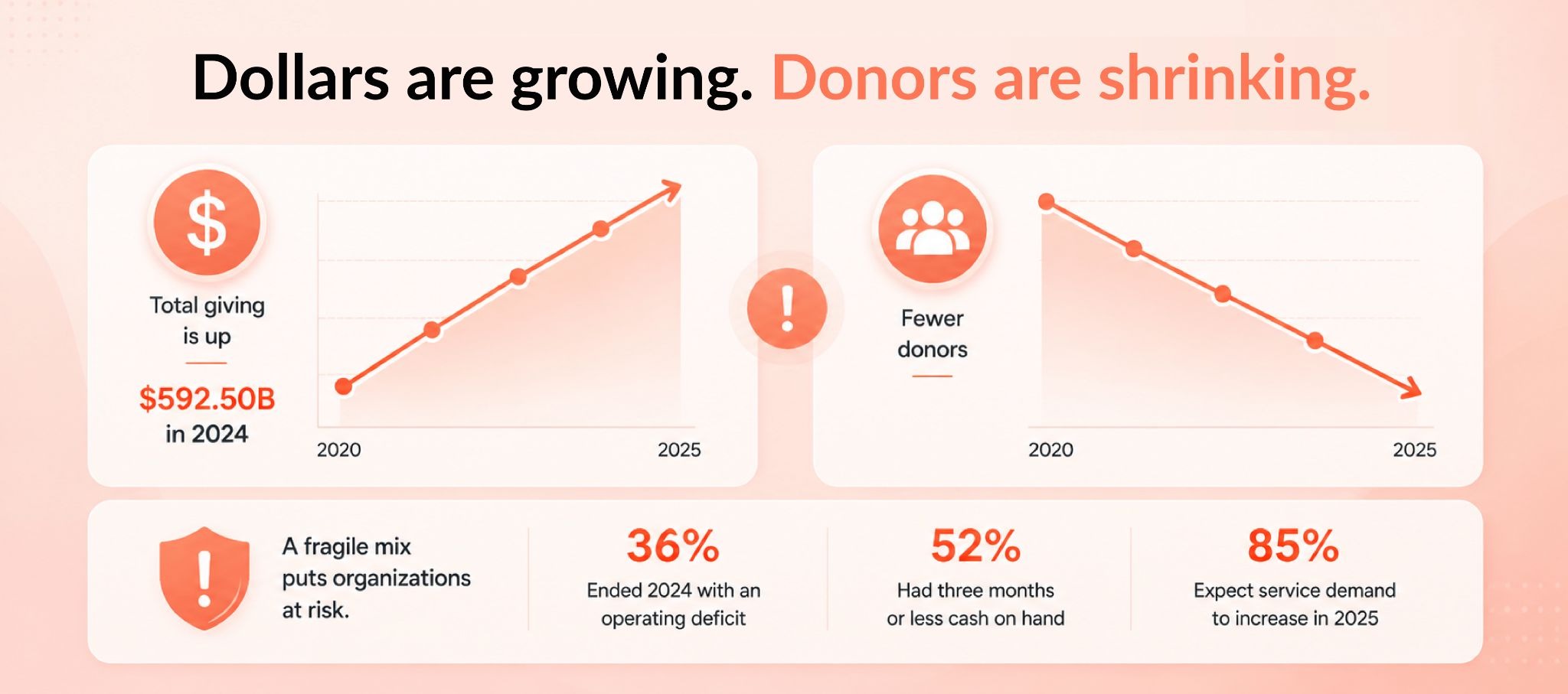
Giving USA reported that total U.S. charitable giving reached $592.50 billion in 2024. Dollars are growing. But while total dollars raised continued to grow in 2025, donor counts kept falling.
More money. Fewer donors. That combination is quietly dangerous for membership organizations, because your donor base is already limited to a defined community. Revenue can look healthy while donor retention quietly suffers and the supporter base gets thinner and more fragile.
The Nonprofit Finance Fund's 2025 State of the Sector survey adds a sharper edge to that picture: 36% of surveyed organizations ended 2024 with an operating deficit, 52% had three months or less cash on hand, and 85% expected service demand to increase in 2025.
Building a real fundraising strategy is not optional for most membership organizations. It is the financial cushion between "we are surviving" and "we are actually doing the work." Your members are already your warmest audience. They believe in what you do. They just need to understand what their donation makes possible.
The Fundraising Revenue Mix for Membership Organizations
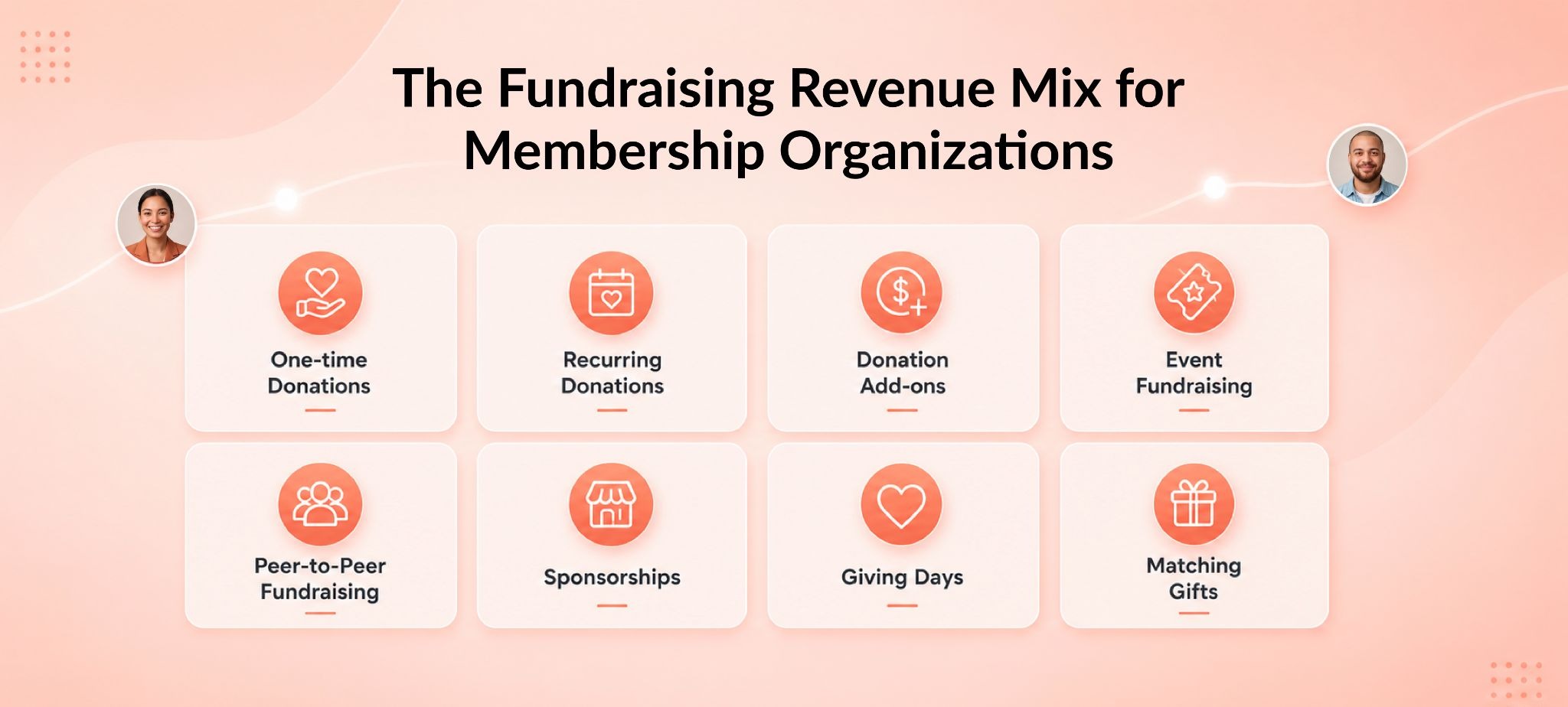
Before running any campaign, map out which fundraising revenue streams are available to you. This is your starting toolkit for non-dues revenue ideas beyond what dues already bring in.
Not every stream is right for every organization. Your fundraising plan depends on audience size, staff capacity, existing member engagement, your event calendar, and your relationships with local businesses.
Start with the stream that creates the least friction and fits most naturally into where your members already are.
How to Ask Members for Donations Without Confusing Them
This is where most membership fundraising breaks down.
A generic donation request like "Please support us" does not work because it does not answer the question your member is silently asking: "I already pay dues. Why do you need more?"
Here is the framework that resolves it.
Separate Dues from Donations in Every Message
Be explicit. Use language like this in every campaign:
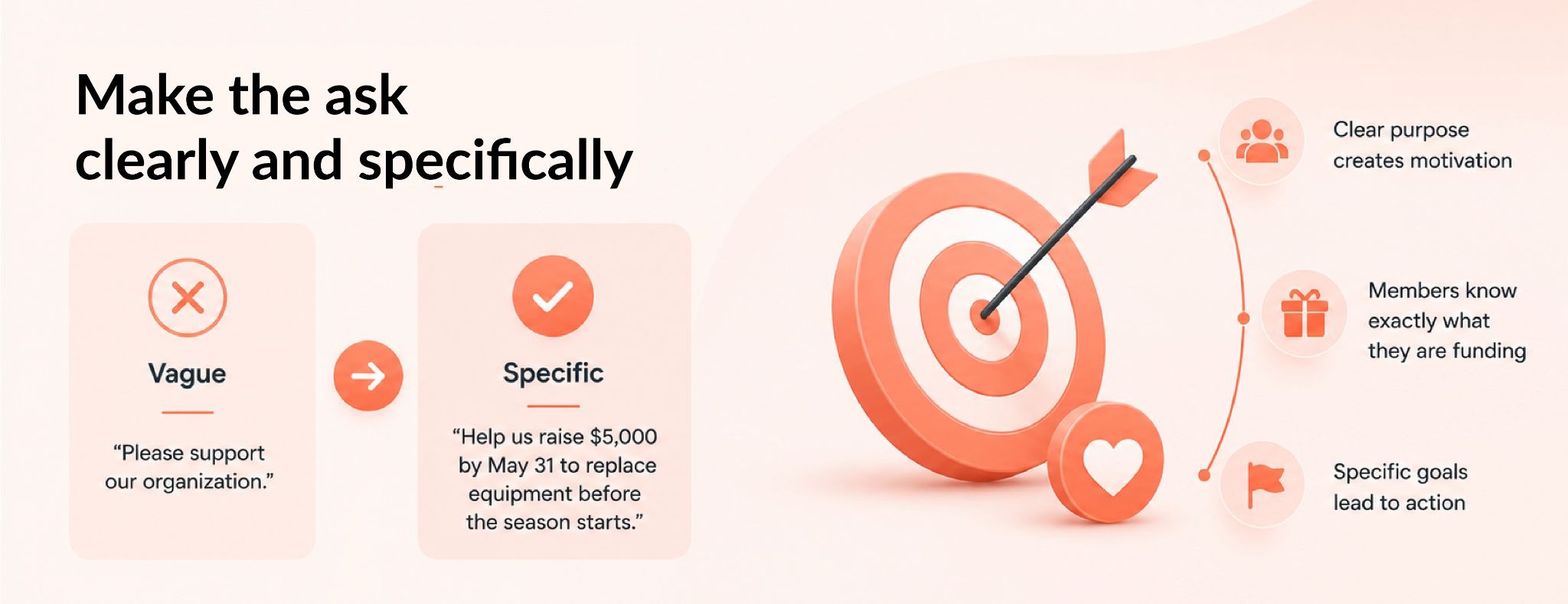
Use Campaign-Specific Asks, Not Vague Support Language
Weak: "Please donate to support our organization."
Strong: "Help us raise $5,000 by May 31 to replace equipment before the season starts."
Stronger: "Add $25 today to fund one student scholarship this year."
A specific fundraising appeal creates specific motivation. Vague asks create silence.
Give Members More Than One Way to Help
Not every member can write a check. But most can do something. When you run a fundraising campaign, offer multiple on-ramps:
- Donate directly through your campaign page
- Share the campaign link on social media
- Create a personal peer-to-peer fundraising page
- Introduce a local business as a potential sponsor
- Volunteer at a fundraising event
- Donate items for an auction or prize drawing
The more paths you create, the more members participate. And participation builds the habit of giving.
The Member-to-Donor Ladder
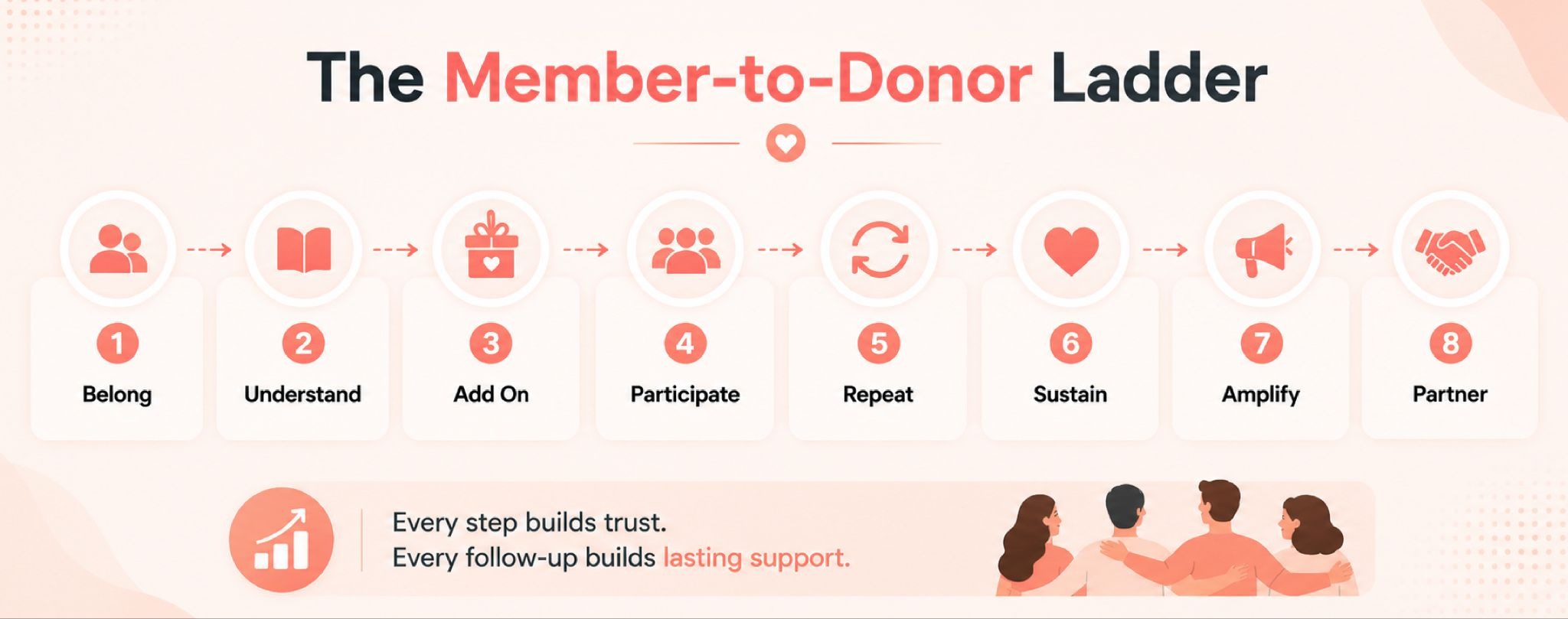
This is the framework that turns a membership roster into a reliable, repeatable fundraising base. It is not about pressure. It is about progression.
Step 1: Belong. The person joins as a member. Relationship and trust begin here.
Step 2: Understand. They learn clearly what dues cover and what donations make possible. This step is skipped by most organizations, which is exactly why donation asks fall flat.
Step 3: Add On. They make a small optional gift during signup, renewal, or event registration. Low friction. High intent. High conversion.
Step 4: Participate. They attend a fundraiser, share a campaign, volunteer, or join a giving day. This is where donor engagement takes root beyond just paying dues.
Step 5: Repeat. They give a second time after receiving a genuine thank-you and an impact update. This is where the real donor relationship begins.
Step 6: Sustain. They become a recurring monthly donor. According to M+R's 2026 Benchmarks, monthly giving accounted for 27% of all online revenue in 2025, and for small nonprofits it represented 22% of online revenue. That is not a fringe strategy. That is foundational, predictable revenue.
Step 7: Amplify. They raise money from their own network through peer-to-peer fundraising, member challenges, or ambassador campaigns.
Step 8: Partner. They become a sponsor, matching gift partner, board supporter, or major donor.
Most organizations treat member fundraising as a single ask and wonder why it feels like a constant grind. The ladder shows why: every step after the first gift compounds the relationship. The real investment is in the follow-up.
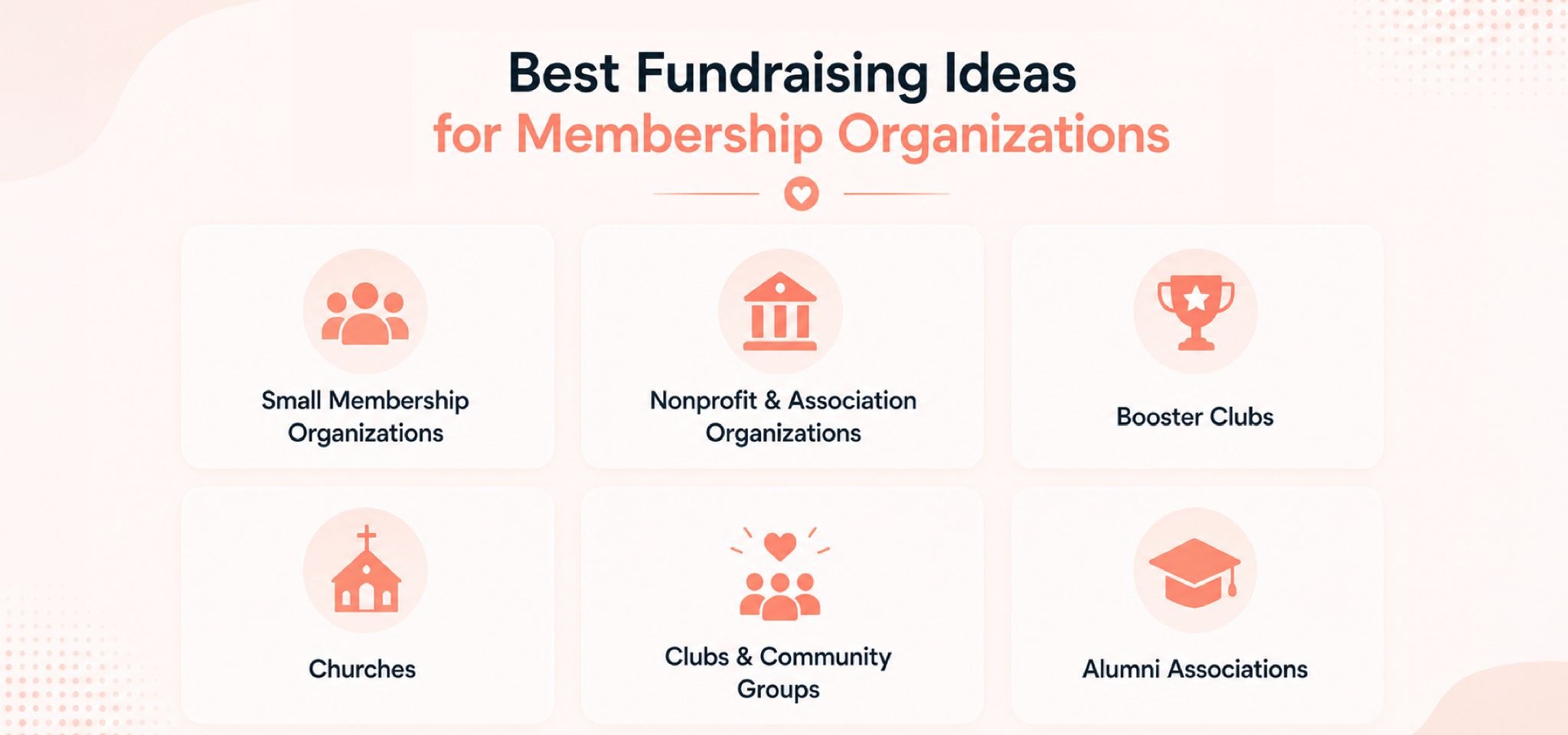
Best Fundraising Ideas for Membership Organizations
Let's get specific. Here are the ideas that work, organized by organization type, with a clear reason for each one.
Easy Fundraising Ideas for Small Membership Organizations
If your team is lean and your budget is tight, start with the lowest-friction options:
- Donation add-on at renewal (highest intent, lowest admin)
- Simple online donation page with suggested round amounts
- Member email appeal tied to one specific goal with a deadline
- Trivia night fundraiser with one or two local sponsors
- QR code donation option at every in-person event
- Local business sponsor wall on your website or at your venue
None of these require a dedicated development team. They require a clear message, a working online donation page, and the willingness to follow up.
Nonprofit and Association Fundraising Ideas
For nonprofits and associations, the fundraising mix typically includes more structured, multi-channel campaigns:
- Annual giving campaign anchored to a named scholarship fund
- GivingTuesday campaign with a specific dollar goal and a countdown
- Year-end appeal with a 3-email minimum sequence
- Corporate sponsorship packages tied to events or programs
- Member challenge campaign backed by a board member match
- Donor-advised fund giving instructions for higher-capacity donors
Associations relying solely on dues and events are increasingly at risk, which makes layered fundraising membership development a strategic priority, not just a nice-to-have.
Booster Club Fundraising Ideas 🏆
Booster clubs have one major asset that most nonprofits would envy: a highly motivated community of parents, families, and local supporters who are personally invested in the outcome.
The best sports fundraising ideas for booster clubs combine personal networks with community visibility:
- Team fundraising pages where each family has a personal dollar goal
- Sponsor-a-player campaign with local business partners
- Equipment drives tied to a specific, visible, urgent need
- Concession stand fundraiser at home games
- Spirit wear sales tied to the season start
- Local business banner sponsorships displayed at every game
When families can see exactly what their donation funds, and when local businesses can see their logo at every event, participation increases naturally on both sides.
Church Fundraising Ideas
Churches have some of the most loyal and mission-connected donor communities of any membership organization. Whether for annual giving or ministry fundraising, the approach here is less about campaigns and more about calling.
The approaches that consistently work include:
- Mission trip fundraiser with personal stories from participants
- Recurring giving program positioned as "ongoing generosity beyond the weekly offering"
- Community dinner with a suggested donation at the door
- Benefit concert featuring local musicians
- Building fund campaign with visible project milestones
For youth ministry programs specifically, there are strong youth group fundraiser ideas that engage families and the broader congregation simultaneously, turning one campaign into a multi-generational giving moment.
Club and Community Group Fundraising Ideas
Clubs thrive on community energy. The most effective approach is channeling that energy into fundraising formats that feel like fun, not obligation.
If you are looking for fundraising ideas for clubs that your members will actually want to participate in, the most reliable are:
- Online auction with items donated by local businesses
- Themed benefit dinner with ticket sales, table sponsorships, and a live appeal
- Member challenge campaign with a friendly progress leaderboard
- Paid workshop or hands-on class where proceeds support the mission
- Raffle fundraiser where legally permitted in your region
Alumni Fundraising Ideas
Alumni association fundraising is one of the most underleveraged opportunities in the membership world. Most alumni organizations reach far more people through communications than they ever convert into donors, meaning the attention exists but the giving bridge does not.
The campaigns that bridge that gap most effectively:
- Alumni giving day tied to a reunion or class anniversary
- Class challenge with friendly competition between graduating years
- Monthly scholarship supporter program with named fund recognition
- Memorial or tribute giving campaign for a beloved faculty member or alumnus
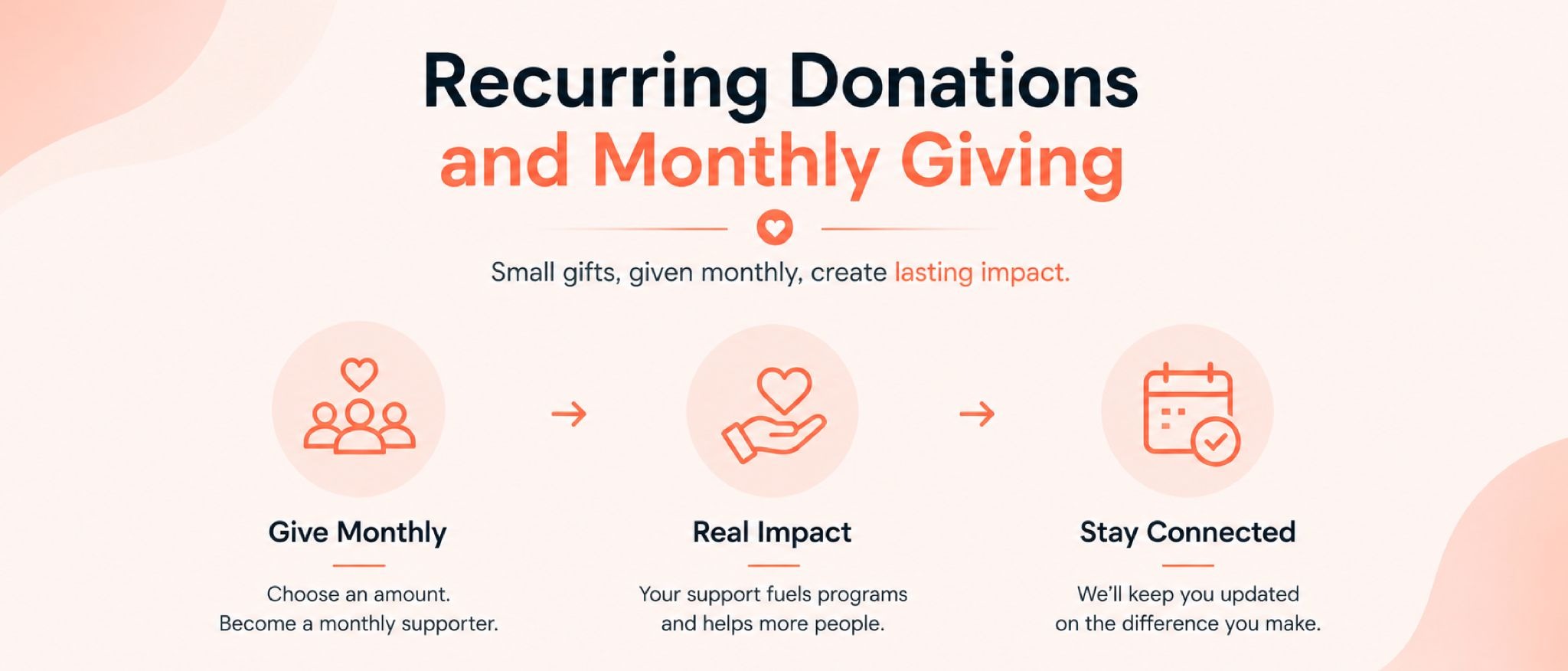
Recurring Donations and Monthly Giving
If fundraising had a subscription model, this is it. Members already understand ongoing financial commitment, which means the framing for recurring giving is built into your culture.
To build a monthly giving program that actually retains donors, give it a name. "Community Supporters." "Monthly Mission Partners." "Friends of the Club." A named program feels more official, more meaningful, and more worth belonging to than a generic recurring checkbox, and it measurably improves your donor retention rate over time.
Then tie amounts to real outcomes: "$10 a month covers materials for two new members. $25 a month supports one participant in our community program for an entire quarter."
Mention the program during renewal. Someone who just renewed their membership is already in a payment mindset. A well-placed monthly giving prompt at that exact moment is not an interruption. It is a natural next step.
Donation Add-Ons During Signup, Renewal, and Event Registration
This is one of the most underused strategies in fundraising membership programs, and one of the most immediately actionable.
A donation add-on is an optional gift prompt added to a transaction the member is already completing. The ask is low pressure by design: they are already paying, and a simple "Add $10 to support our scholarship fund?" fits naturally into that moment.
The highest-converting moments for donation add-ons are:
- New member signup
- Annual membership renewal
- Event registration checkout
- Ticket purchase for a fundraising event
Platforms that let you accept donations during checkout make this seamless. No separate form. No separate email. No separate login. The ask is right there when the member is already saying yes to something.
Keep the add-on optional, always explain what the donation funds, and track add-on revenue separately from membership dues so you can actually measure what is working.
Event-Based Fundraising for Membership Organizations
Every fundraising event has three revenue layers. Most organizations only capture one.
Layer 1: Registration or ticket sales. The most obvious revenue source. Price tickets to cover basic event costs and this layer handles itself.
Layer 2: Donations. This is where most events leave money on the table. A fundraising event registration form that includes an optional donation prompt, a live appeal during the event, or a QR code at every table creates giving opportunities that ticket sales alone do not generate.
Layer 3: Sponsorships. Local businesses and community partners are often willing to sponsor events in exchange for audience visibility. This layer can outperform ticket revenue entirely, especially for galas, silent auction fundraisers, charity golf tournaments, and charity dinners.
What happens after the event matters as much as the event itself. Follow up with attendees who did not donate, invite first-time donors into a monthly giving program, and ask volunteers to create peer-to-peer pages for the next campaign.
When you plan your fundraising event around the goal instead of around logistics, you design for all three revenue layers from the very beginning. That is a fundamentally different approach from "planning a good event."
Peer-to-Peer Fundraising for Members
Most fundraising asks move in one direction: from the organization to the member.
Peer-to-peer fundraising flips the model. Members raise money from their own networks, and your reach multiplies without your team doing all the work.
The Peer-to-Peer Professional Forum reported that the U.S. Top 30 peer-to-peer fundraising programs raised $1.17 billion and engaged 2.63 million participants. The model works at scale because it is personal. People give because someone they trust asked.
For membership organizations, this works especially well for booster clubs, alumni groups, sports clubs, and churches, where personal relationships with potential donors already exist.
To make peer-to-peer work, equip your members:
- Pre-written copy they can customize with their own story
- Individual or team fundraising pages with a simple goal
- Social media graphics ready to share immediately
- A clear, achievable target: "Raise $250 from 10 people"
- Public recognition for top fundraisers
The key word is "equip." A strong peer-to-peer fundraising strategy is not about asking members to fundraise. It is about giving them everything they need to make asking easy.
Sponsorships as Fundraising Support
Sponsorships are among the strongest non-dues revenue streams for membership organizations. But most tiered sponsorship packages are built around the wrong value proposition: logo placement.
Local businesses do not primarily sponsor organizations for logo visibility. They sponsor for audience access, community goodwill, and meaningful association with a group their customers are part of. Your event sponsorship packages need to lead with that value, not with a PNG file and a website listing.
A stronger sponsorship structure looks like this:
Strong packages tell sponsors exactly what they are getting: how many people you reach, what campaign or event they are associated with, and how you will report back after the campaign closes. Vague packages get ignored. Specific packages get signed.
GivingTuesday, Year-End Appeals, and Member Challenges
Three campaign moments every membership organization should plan around.
GivingTuesday is a public giving moment with built-in cultural urgency. According to the GivingTuesday Data Commons, $3.6 billion was donated in the U.S. on GivingTuesday 2024, with 36.1 million people participating. It works best when your organization has one specific dollar goal, a clear deadline, and a concrete follow-up plan for the first-time donors it creates.
Year-end appeals are your most important annual fundraising campaign and the most revenue-dense period in the giving calendar. M+R Benchmarks found that 37% of online revenue arrives in December, with the last day of the year alone accounting for 4% of annual online revenue. Plan your year-end campaign at least 6 to 8 weeks in advance. A single email is not a campaign. A 4 to 5 email sequence with a deadline, a specific dollar goal, and a progress update is.
Member challenge campaigns are underused and highly effective. Find a board member, sponsor, or long-time member willing to fund a matching gift campaign, matching every dollar donated up to a set amount. Announce the match clearly. Give it a hard deadline. Share progress publicly. Challenges create urgency without manufactured pressure, and they give members a concrete reason to act now rather than later.
Donation Page and Fundraising Tool Best Practices
Your donation page and online donation form are part of your fundraising strategy. They deserve the same attention as your campaign message.
M+R's website performance data found that mobile users represented 52% of nonprofit website traffic in 2025, but desktop users generated 72% of donation revenue, with desktop donation page conversion at 11% compared to 8% on mobile.
What that tells you: optimize aggressively for mobile so donors can give anywhere, but build your desktop experience with particular care because that is still where the majority of giving happens.
A strong donation page includes:
- A clear campaign title with a specific dollar goal
- Suggested round amounts tied to real outcomes ($25, $50, $100, $250)
- A recurring gift option that is visible and easy to select
- Trusted payment methods including PayPal, Apple Pay, and Google Pay
- Short form fields with a clear confirmation message
- An automated receipt that arrives immediately after the gift
If you are building or improving your donation experience, there are free fundraising tools designed specifically for small membership organizations. The right fundraising platform does not require an enterprise budget to be effective.
Donor Retention: What Happens After the First Gift
Here is the truth that most fundraising articles skip over.
The first donation is not the win. The second donation is where the real donor relationship begins. And donor appreciation is the bridge between the two.
A strong post-donation workflow addresses this directly:
- Automated receipt delivered immediately
- Personal thank-you email within 48 hours
- Concrete impact update within 7 to 14 days
- Campaign result announcement to all donors
- Invitation to a specific next action: attend, volunteer, share, or renew
- Second gift ask within a defined campaign window
- Monthly giving invitation with a simple on-ramp
This is not a complicated system. But without a clear donor follow-up process in place, most membership organizations manage it through a combination of good intentions and spreadsheets, which is exactly how donors fall through the cracks.
Fundraising Metrics to Track
"How much did we raise?" is a start. But it is not the question that grows fundraising.
The question that grows fundraising is: "Where did it come from, and can we repeat it?"
Tracking your fundraising metrics by source is the difference between learning and guessing. Here are the numbers that actually tell the story:
The organizations that grow their fundraising campaign results year over year are almost always tracking by source, not just by total. Revenue growth can mask donor decline. Watch both.
Common Fundraising Mistakes Membership Organizations Should Avoid
Running campaigns without follow-up. An event that generates attendance but no repeat donors is an expensive acquisition that produced nothing lasting. A GivingTuesday campaign that goes silent after the thank-you email wastes the donor engagement opportunity it just created.
Mixing dues and donation messaging. The dues vs donations distinction must be clear across every touchpoint. When members cannot tell the difference between paying dues and making a gift, they get confused. Confused people do not give. Keep your join page, donation page, and renewal flow clearly labeled.
Making vague asks without explaining the outcome. "Support us" is not a campaign. "Help us fund 10 new scholarships by December 31" is a campaign.
Building sponsorship packages around logos. Sponsors buy audience access and community association. Lead with that, not with a three-tier logo swap.
Tracking only total dollars raised. Watch donor count, first-time donor acquisition, and second-gift conversion alongside total revenue. A growing top line with a shrinking donor base is a warning sign, not a success story.
How Membership Software Reduces Fundraising Leakage
Revenue leaks at five specific points in most membership organizations:
- Ask leakage: Members do not understand why donations are needed beyond dues
- Checkout leakage: Poor mobile experience or missing payment options reduce completed gifts
- Retention leakage: First-time donors receive no path to a second gift
- Admin leakage: Renewals, receipts, and recurring gifts are handled manually and inconsistently
- Attribution leakage: The organization cannot tell which campaigns, events, or emails actually produced revenue
Membership management software reduces leakage by connecting member records, donation history, event data, and renewal information in one place. When everything lives in one system, fundraising automation, segmentation, and attribution all become possible.
Join It is built for exactly this kind of integrated workflow, connecting memberships, donations, and events so organizations can stop managing fundraising across disconnected spreadsheets and start building systems that repeat. That is what good nonprofit software does.
Fundraising Checklist for Membership Organizations
Before your next campaign, walk through this fundraising campaign planning checklist:
- Define clearly what dues cover and what donations fund
- Set one specific campaign goal with a dollar amount and deadline
- Add donation options to your signup, renewal, or event registration flow
- Offer recurring giving on your donation page with named giving levels
- Build at least one simple sponsorship package for local businesses
- Create a 4 to 5 email campaign sequence, not a single blast
- Assign specific board and volunteer roles before the campaign launches
- Automate receipts and thank-you messages immediately after gifts
- Plan the post-campaign follow-up workflow before the campaign opens
- Track revenue by source, not just by total raised
- Ask first-time donors for a second gift within 30 days
Frequently Asked Questions About Fundraising for Membership Organizations
What is fundraising for membership organizations?
Fundraising for membership organizations is the process of raising financial support beyond regular dues from members, donors, sponsors, and community partners. It includes one-time donations, recurring gifts, fundraising events, peer-to-peer campaigns, sponsorships, giving days, and donation add-ons at signup or renewal.
How do you ask members for donations if they already pay dues?
The key is separating the message clearly. Explain that dues fund operations and member benefits, while donations fund specific mission outcomes like scholarships, outreach, or new programs. Use campaign-specific language with a concrete dollar goal tied to a real outcome. Members respond to clarity, not to general appeals.
What are the best fundraising ideas for small membership organizations?
Start with the lowest-friction options: a donation add-on during renewal, a simple online donation page with suggested round amounts, a member email appeal tied to one specific goal, and local business sponsorships. These require minimal staff capacity and work consistently across clubs, churches, associations, volunteer-led organizations, and community groups of every size.
How should membership organizations measure fundraising success?
Track total raised, number of donors, first-time donors, repeat donors, second-gift rate, average gift, recurring donors added, and revenue by campaign source. Total dollars alone can mask a shrinking donor base, so always evaluate breadth alongside depth.
What is the difference between fundraising and non-dues revenue?
Non-dues revenue includes fundraising campaigns and donations, but it also covers income from ticketed events, sponsorships, merchandise sales, paid workshops, and advertising. Fundraising specifically refers to donations and campaigns intended to support the mission. Understanding your full revenue mix helps you see which streams are underbuilt and where the real growth opportunity lives.
Ready to connect your membership data, donations, and events in one place? You can book a call to see how organizations use Join It to build fundraising systems that repeat, or start a free trial and explore the platform yourself.
Sources
- Giving USA. Giving USA 2025: U.S. Charitable Giving Grew to $592.50 Billion in 2024
- Nonprofit Finance Fund. 2025 State of the Nonprofit Sector Survey
- M+R. 2026 Benchmarks: Fundraising
- Peer-to-Peer Professional Forum. 2025 U.S. Top 30 Peer-to-Peer Fundraising Programs
- GivingTuesday. GivingTuesday 2024 Record-Breaking Results
- M+R. 2026 Benchmarks: Website Performance


