
Membership Dues: The Complete Guide


Most membership organizations treat dues like a line item on a budget spreadsheet. Collect money. Fund operations. Repeat.
But here's the thing. Membership dues are not just a fee. They're a value exchange between your organization and the people who choose to belong.
When that exchange works, you get predictable revenue, stronger retention, and a community that actually grows. When it doesn't, you get complaints, churn, and the slow decline nobody talks about until it's too late.
This guide is for associations, nonprofits, clubs, chambers, community groups, and every membership organization trying to set, collect, manage, and improve their membership dues.
Here's what we'll cover:
- What membership dues are (and what they're not)
- How much to charge
- Annual vs monthly dues
- How to collect dues without friction
- How to raise dues without backlash
- Policies, tax, and accounting basics
- What members actually complain about and what to do about it
Let's get into it.
Key Takeaways
What Are Membership Dues?
Membership Dues Definition
Membership dues are recurring payments that members make to maintain their access, status, rights, or benefits within an organization. Whether you call them member dues, membership fees, or simply "dues," the concept is the same. You pay, you belong, you receive value in return.
Unlike a one-time donation, dues create an ongoing relationship. And unlike a ticket or a registration fee, they come with continued access to a membership program and the benefits tied to it.
That distinction matters. Because the way you frame dues shapes how members feel about paying them.
Membership Dues vs Membership Fees vs Donations
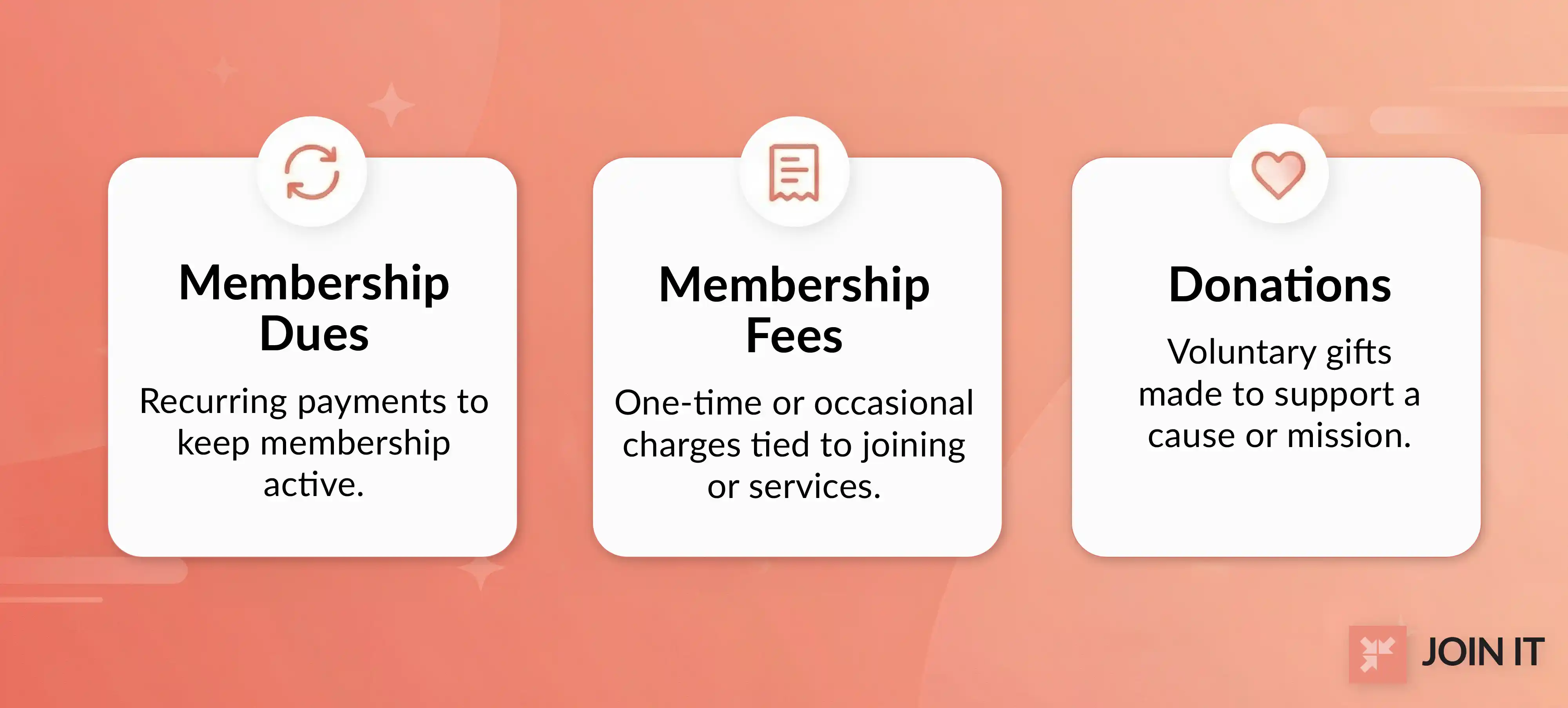
These terms get tossed around interchangeably, but they mean different things.
Membership dues are recurring payments tied directly to membership status. Pay your dues, keep your membership.
Membership fees is a broader term. It can include initiation fees, admin fees, or one-time charges that aren't necessarily recurring.
Donations are voluntary contributions. They support a mission or cause, but they don't typically come with the same structured benefits that dues provide.
The simplest way to think about it: dues are a commitment, fees are a cost, and donations are a gift.
Why Organizations Charge Membership Dues
Organizations charge membership dues because they need predictable revenue to operate. But the real reason goes deeper than that.
Dues fund the benefits members rely on. They support programming, advocacy, events, and community infrastructure. As one membership management blog put it, "membership dues are the invisible infrastructure holding up everything else" in a member-based organization's finances.
When dues are positioned well, members don't see them as a cost. They see them as an investment in something they value.
Why Membership Dues Matter for Revenue, Retention, and Member Value
Membership Dues as Predictable Revenue
Dues are often the most stable revenue stream a membership organization has. A 2024 survey by MemberJungle found that membership fees accounted for an average of 58% of total revenue.
Historically, associations relied even more heavily on dues. Back in 1953, dues made up 95% of revenue. Today that share has settled to around 30 to 45% as organizations diversify into events, sponsorships, and other income sources.
But even with diversification, dues still provide the financial stability that lets organizations plan, budget, and invest with confidence.
Membership Dues and Member Retention
Here's a pattern that plays out everywhere. When members see clear value, they renew. When they don't, dues feel like a burden.
The relationship between dues and membership retention strategies goes well beyond payment processing. It's about benefits, communication, timing, and whether members feel like they're getting a fair deal.
For context, the average first-year churn rate in associations is roughly 43%. That number shows just how critical it is to demonstrate value fast, especially during that first year.
Membership Dues as Part of a Broader Revenue Model
Dues are critical. But smart organizations don't rely on them alone.
Many groups balance dues with events, sponsorships, donations, merchandise, and education revenue. In fact, 63% of association leaders expect non-dues revenue to increase in the near future.
Building healthy non-dues revenue streams doesn't mean dues are less important. It means your organization isn't fragile if membership fluctuates.
How to Set Membership Dues
Start with Cost, Value, and Audience
There is no universal price for membership dues. And copying what a peer organization charges is rarely the right approach.
Instead, setting dues well comes down to three core inputs: what it costs to serve your members, what value those members receive, and what your target audience can realistically afford.
A solid membership pricing strategy treats dues as a value exchange, not an arbitrary number.
How Much Should Membership Dues Be?
This is one of the most searched questions about membership dues, and the honest answer is: it depends.
What shapes fair membership dues includes your organization type, member profile, benefits package, program costs, retention goals, accessibility goals, and the norms in your sector or region. A national professional society with extensive programming can justify higher dues than a small local club.
The key is aligning what you charge with what you deliver. If you can clearly show that your benefits would cost far more than the dues themselves, your pricing will feel justified.
Common Membership Dues Pricing Models
Not every organization should use the same membership dues structure. Here are the most common pricing models and when each works best.
Flat Membership Dues. One price for everyone. Simple to manage, easy to communicate, and works well when your member base is relatively homogeneous.
Tiered Membership Dues. Different membership tiers with different benefits at different price points. This model lets you serve a wider range of members, from students to executives, without leaving money on the table.
Sliding-Scale Membership Dues. Members pay based on what they can afford. This model prioritizes inclusivity and works well for community organizations where accessibility matters most.
Dues Based on Revenue, Employees, or Member Category. Common among chambers, business groups, and professional associations. A company with 100 employees pays more than a solo entrepreneur, and the dues reflect the different value each receives.
How to Choose the Right Membership Dues Structure
The best model depends on your benefits, your member diversity, how much administrative complexity you can handle, and what fairness means in your context.
A flat model is easier to run. A tiered model captures more revenue and serves more member types. A sliding-scale model signals inclusivity but requires more trust.
Whatever you choose, make sure the structure connects clearly to the benefits, categories, and rights defined in your governing documents.
Annual vs Monthly vs Multi-Year Membership Dues
Annual Membership Dues
Annual dues give you budget clarity, fewer transactions, and a stronger upfront commitment from members. The downside? A larger upfront cost can be a real barrier for budget-conscious members.
Monthly Membership Dues
Monthly dues lower the barrier to entry. Members find smaller recurring membership payments easier to absorb, and the subscription-style format feels familiar in 2025.
The tradeoff is more payment events and a higher risk of failed payments if you don't have automation in place.
Multi-Year Memberships and Installment Options
Multi-year options and installment plans can improve retention, simplify administration, and create loyalty. A member who locks in for three years at a slight discount is far less likely to drift away.
This is where multi-year membership options and automated renewals can make a real difference in your renewal rates.
Which Membership Dues Model Is Best?
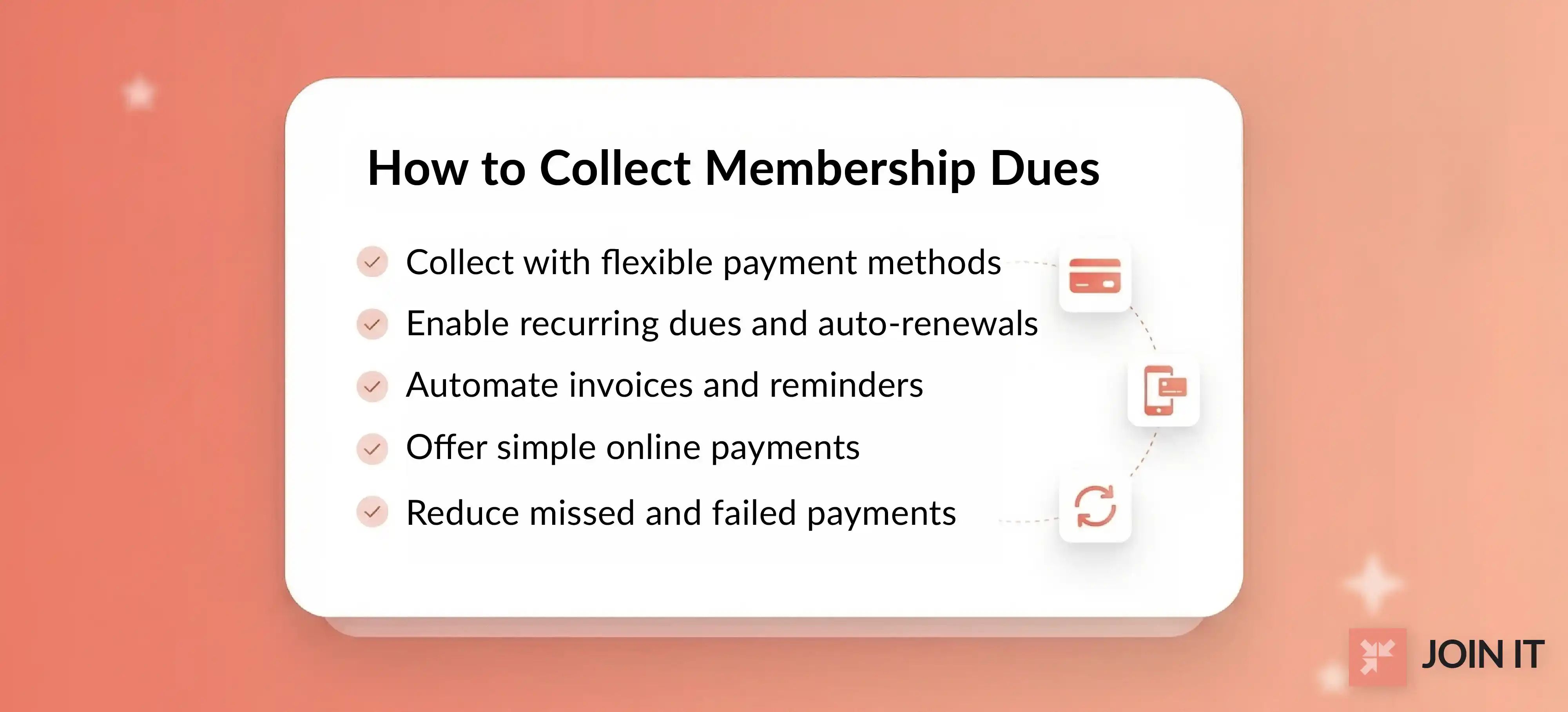
The best model depends on your members' behavior, their budget sensitivity, your admin capacity, and your organization type.
Many organizations are finding that offering both annual and monthly options is the strongest approach. It maximizes accessibility without sacrificing cash flow. Think of it as meeting members where they are financially.
How to Collect Membership Dues Without Creating Friction
1) Payment Methods Members Actually Expect
Modern members expect to pay with a card, set up recurring billing, and handle everything from their phone. If your payment flow still relies on paper forms or a single payment channel, you're creating unnecessary friction.
One Reddit discussion on r/nonprofit told the story perfectly. A nonprofit treasurer described the headache of collecting monthly dues from 135 members through a manual ACH-only process. The community's response was unanimous: offer more payment options. One commenter noted that their organization of 3,000 members accepts everything "from cash to crypto" and that 95% use a card.
The lesson is straightforward. Set up membership payments that give members the flexibility to pay however works best for them.
2) Recurring Membership Payments and Automated Renewals
Automated renewals and recurring billing reduce renewal friction dramatically. When members opt into auto-renewal, they stay enrolled until they actively choose to leave, instead of having to remember to re-enroll each cycle.
A significant share of lost membership revenue comes not from members choosing to leave, but from preventable issues like expired cards and forgotten invoices.
3) Membership Dues Invoicing, Renewal Notices, and Reminders
A strong dues renewal workflow includes clear invoice timing, a well-spaced reminder sequence, grace period communication, and a follow-up process for failed payments.
Automated renewal reminders keep the process running without turning your staff into collections agents. The goal is a process that feels helpful, not nagging.
4) How to Collect Membership Dues Online
A low-friction dues experience looks like this: easy sign-up, a short payment flow, clear confirmation, visible renewal dates, and simple self-service for members who need to update their information.
When you process membership payments through a clean online system, you remove the most common barriers that cause late, missed, or abandoned payments.
5) What Causes Late, Missed, or Abandoned Payments
The usual suspects include failed cards, confusing payment flows, limited payment options, poorly timed reminders, and unclear consequences for non-payment.
Most of these are fixable with the right systems and policies. And fixing them matters, because many lapsed memberships are the result of mechanical failure, not an intentional decision to leave.
Membership Dues Best Practices
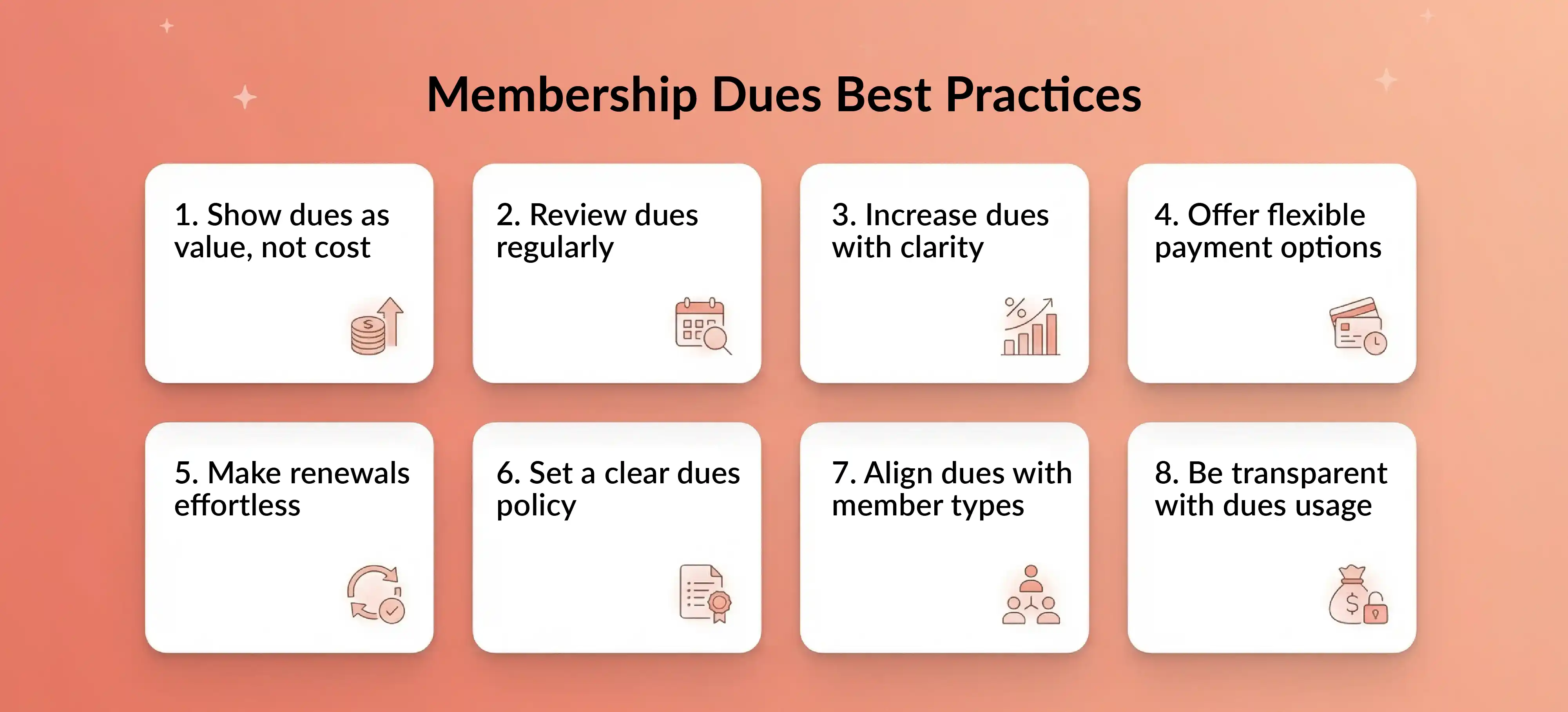
Position Membership Dues as an Exchange of Value, Not Just a Fee
Every communication about dues should connect to specific outcomes, access, and benefits. Vague language like "support our mission" underperforms compared to specific benefit framing. Tell members exactly what their dues fund and what they get in return.
Review Membership Dues Regularly
Long pricing freezes create bigger problems later. Regular review, ideally annual, is healthier than years of inaction followed by a reactive jump.
Use a membership management software guide to help you track the data you need for informed review decisions.
Make Dues Increases Moderate and Well-Explained
Small, predictable increases are easier for members to absorb than infrequent major hikes. According to Marketing General's benchmarking data, the median dues increase among associations is about 5%, and only 14% raised dues by more than 10%.
Communicate the reason, connect it to value, and give members advance notice.
Offer Flexible Payment Structures Where They Make Sense
Not every member can pay the same way. Monthly, annual, installment, and multi-year options each serve different segments. The more flexibility you offer, the fewer members you lose to payment friction.
Make Renewal Easier Than Cancellation
Auto-renewal, simpler payment, timely reminders, and a clean checkout experience all contribute. Organizations using automatic credit card or EFT renewal have seen renewal rates rise by as much as 10 points.
Publish a Clear Written Dues Policy
Your policy should cover due dates, grace periods, suspension rules, cancellation procedures, and refund terms if applicable. Having it in writing removes ambiguity and gives you a fair, consistent framework to enforce.
Tie Membership Dues to Membership Categories and Rights
If you use tiered dues, make those tiers intentional. Each level should connect to defined benefits, rights, and governance logic, not just a different price tag.
Be Transparent About Where Membership Dues Go
Publish an annual breakdown of how dues are allocated. When members can see that their contributions directly fund programs, advocacy, and community infrastructure, dues feel like a contribution, not a tax.
How to Raise Membership Dues Without Hurting Retention
When Should You Increase Membership Dues?
Raise dues when costs have changed, value has expanded, or a review reveals your pricing no longer matches what you deliver. Not every organization should raise dues every year. Keep it conditional and strategic.
How Much Should You Increase Membership Dues?
Data supports moderation. Among associations that raised dues recently, only 9% reported a drop in renewal rates and just 4% saw a decline in new member acquisition. The vast majority saw no negative impact.
Regular and moderate dues increases don't significantly impact retention or acquisition, but they do enhance revenue.
How to Communicate a Membership Dues Increase
This might be the most important part of any increase. Communicate before renewal, explain the reason clearly, connect the increase to value or cost realities, and never surprise members at checkout.
What to Include in a Membership Dues Increase Letter
A good membership dues increase letter covers five things: what is changing, when it takes effect, why it's changing, what members gain or sustain, and what options members have.
Keep it direct, respectful, and focused on value.
Common Membership Dues Challenges and Mistakes
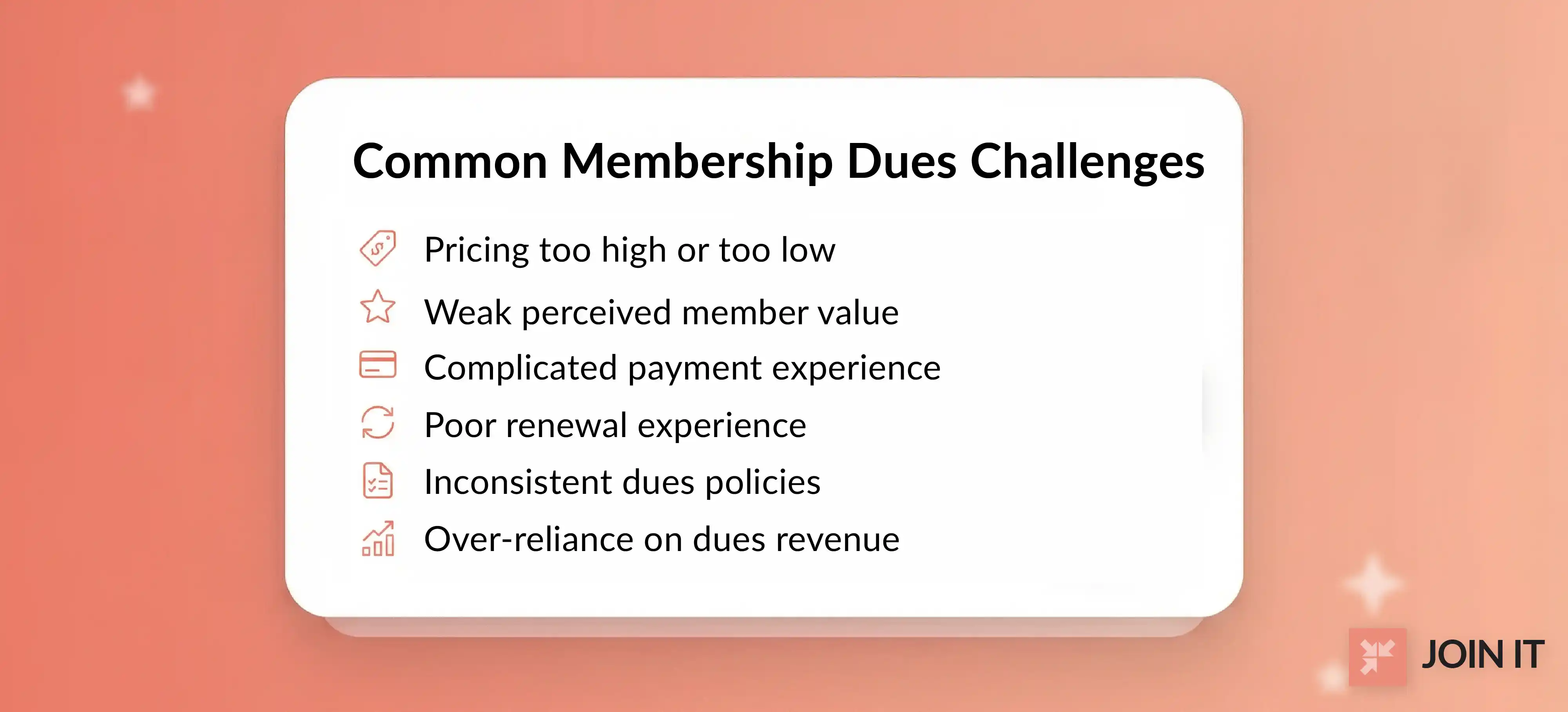
Setting dues too high or too low. Too high means exclusion and churn. Too low means underfunded programs and unsustainable operations.
Failing to show enough value. A survey by MemberJungle found that "membership too expensive for the value provided" and "lack of perceived value" ranked among the top five reasons for non-renewal.
Making payment harder than it should be. Clunky flows, too few methods, and manual processing all cost you members. Another Reddit commenter on r/nonprofit warned that refusing to accept credit cards "makes your org look less reputable."
Treating renewal like a billing event instead of a retention moment. Renewal is your best opportunity to remind members why they belong. Connect it to engagement and benefits, not just an invoice.
Enforcing policies inconsistently. Unclear or inconsistently applied rules create fairness and trust problems that can erode your membership culture.
Relying too heavily on dues alone. Over-reliance makes the organization fragile. Balance dues with other revenue streams to reduce churn and build resilience.
What Members Actually Complain About Membership Dues
These complaints come directly from real forum discussions, not generic assumptions.
"I'm Not Getting Enough Value for My Dues"
This is the number one complaint. In a Reddit thread on r/physicaltherapy, one member considering a $350 association renewal wrote: "Seriously, $350 for what exactly? I let mine lapse years ago and haven't noticed any difference except my wallet being heavier."
Only 40% of millennial and Gen Z members felt their membership experience was worth the dues paid. That's a signal no organization should ignore.
"The Dues Are Too Expensive"
Affordability complaints often reflect a mismatch between price and perceived value. This is why tiered and sliding-scale structures exist, to make sure cost doesn't become the reason someone can't participate.
"I Don't Know Where the Money Goes"
Transparency resolves this complaint almost entirely. When members can see exactly how dues support programs, advocacy, and operations, trust grows.
"Paying Is More Difficult Than It Should Be"
If paying dues feels harder than buying coffee on your phone, something is broken. Members expect card payments, auto-pay, and mobile-friendly checkout. Anything less creates avoidable friction.
"You Raised Dues, But Nothing Improved"
This perception gap between price increases and visible value is common. The fix? Communicate what changed, show results, and close the loop.
What Organizations Should Learn From These Complaints
Every complaint points to the same five things: value, fairness, convenience, transparency, and communication. Improve those, and most dues-related friction disappears.
Membership Dues Policies, Compliance, and Accounting
Membership Categories, Rights, and Bylaws
Your dues structure should align with member categories, rights, benefits, and voting rules. There's no law against charging different amounts for different member categories, and many organizations do so. The key is defining those categories clearly in your bylaws.
Late Payment, Grace Period, Suspension, and Cancellation Rules
A written dues payment policy should cover what happens when members pay late, how long the grace period lasts, when rights are suspended, and when membership is canceled. A nonprofit attorney on Reddit explained that if bylaws set dues requirements, management has a fiduciary duty to enforce them consistently.
Are Membership Dues Tax Deductible?
This depends on the organization type and the benefits provided. Generally, membership dues paid in exchange for benefits are not tax deductible for the member. However, if a portion of the dues exceeds the fair market value of the benefits received, that portion may qualify as a charitable contribution.
501(c)(7) social clubs must be primarily supported by membership dues and assessments. Certain 501(c)(4), 501(c)(5), and 501(c)(6) organizations must notify members about the nondeductible portion related to lobbying and political expenditures, or pay a proxy tax.
Always consult a tax professional for guidance specific to your organization.
Membership Dues for Nonprofits, Associations, and Clubs
Treatment varies by entity type and governing structure. A 501(c)(3) can absolutely have membership dues. A chamber of commerce typically structures dues by company size. And a social club's dues might reflect amenities and usage levels.
Understanding these distinctions matters for both association management and compliance.
Membership Dues Accounting and Revenue Recognition
At a high level, dues are exchange transactions. Under ASC 606, organizations need to identify performance obligations, allocate the transaction price, and recognize revenue over time as benefits are delivered. If your membership year runs January through December and a member pays in full in January, you may need to recognize that revenue monthly as a deferred revenue arrangement.
This is one area where many guides stay surface-level. If your organization has significant dues revenue, proper accounting treatment is worth getting right.
Membership Dues by Organization Type
Membership dues for nonprofits center on sustainability, accessibility, and mission alignment. Fairness and overlap between donors and members are common considerations.
Association membership dues often reflect professional value, advocacy access, and benefits like benchmarking and continuing education. Chapter structures and member categories can add complexity.
Chamber of commerce membership dues are commonly structured around business size, employee count, or exposure level.
Club membership dues depend heavily on usage, amenities, exclusivity, and participation. A Reddit user on r/golf described weighing a nearly five-figure annual club membership against actual usage, noting "I could take a premium golf trip for that money."
Church or community-based membership dues sometimes use voluntary pledge models. A JTA report on synagogues found that congregations switching to voluntary dues saw an average 3.6% increase in membership and a 1.8% increase in pledge revenue. None wanted to go back to mandatory dues.
Membership Dues Trends to Watch
More flexible payment schedules. Annual, monthly, installment, and multi-year options are becoming standard, not exceptions.
More value-driven membership models. Members, especially younger ones, increasingly expect clear outcomes and visible return on their investment.
More personalization and automation. Better renewal timing, payment recovery workflows, and member segmentation powered by data and emerging tools.
Alternative or hybrid dues models. Voluntary contributions and pay-what-you-can models are gaining traction in some sectors, particularly faith-based and community organizations.
How to Improve Membership Dues Over Time
Metrics to Track
Measure what matters: renewal rate, member retention, on-time payments, failed payments, churn rate, revenue per member, and dues forecasting accuracy. If you're not sure where to start, learn how to track membership dues effectively.
How to Review Membership Dues Each Year
Build a simple annual review framework. Look at costs, benefits, retention trends, complaints, payment friction, member feedback, and market changes. Then decide whether to adjust.
How to Refine Your Membership Dues Model
Use real signals. Member feedback, payment behavior, engagement trends, and category performance all tell you whether your model is working or needs to evolve.
What "Better" Looks Like
Smoother collection. Fewer complaints. Stronger retention. Healthier revenue. More trust.
That's the outcome of a dues model that's thoughtfully designed, well communicated, and continuously improved.
Membership Dues FAQ
What are membership dues?
Membership dues are recurring payments members make to maintain their access, benefits, and status within an organization.
How much should membership dues be?
It depends on your organization type, benefits package, member profile, and what your audience can afford. There is no universal number, but your dues should reflect the value you deliver.
Should membership dues be monthly or annual?
Both have advantages. Annual provides budget stability. Monthly improves accessibility. Many organizations now offer both.
How often should membership dues be reviewed?
At least annually. Regular review prevents the need for large, disruptive increases down the road.
What payment methods should we offer for membership dues?
Card payments, ACH/EFT, digital wallets, and auto-renewal options at minimum. The easier it is to pay, the more members will pay on time.
Should we offer different membership levels with varying dues?
In most cases, yes. Tiered dues let you serve diverse member types while capturing appropriate revenue from each segment.
How should we address late or non-payment of membership dues?
With clear policies. Define grace periods, communicate consequences, automate reminders, and enforce rules consistently.
Are membership dues tax deductible?
Generally not for the member if benefits are received in return. However, amounts exceeding the fair market value of benefits may qualify as deductible. Consult a tax professional.
Can a 501(c)(3) have membership dues?
Yes. There is no legal prohibition. It's an internal policy matter defined by your bylaws and organizational structure.
How can we collect membership dues online?
Through a membership management platform that supports online payments, automated invoicing, and self-service renewal. A clean online system removes most collection headaches.
Final Thoughts on Building a Better Membership Dues Model
Membership dues should be fair. They should be understandable. They should be easy to pay. And they should connect to visible member value.
When those four things are true, dues stop being a friction point and start being the foundation of a thriving membership community.
If you're looking for a simpler way to manage recurring billing, automate reminders, and reduce the admin work around dues collection, Join It can help. You can book a demo or start a free trial to see how it works for your organization.
The organizations that get dues right don't just collect more money. They build stronger communities, earn deeper trust, and create the kind of membership experience that makes people want to stay.
That's the real goal. And it's absolutely within reach. 🎯
References
- Glue Up. Using Data to Improve Membership Dues Collection
- MemberJungle. Membership Survey Results & Lessons We Can Learn
- ASAE. Data: Membership Dues Aren't the Only Revenue Stream
- Alumni Access. The Ultimate Collection of Membership Statistics
- ASAE. The Membership Model Is Breaking Down
- Reddit. Monthly Membership Dues Collections
- Marketing General. Best Practices for Raising Association Membership Dues
- Reddit. Membership Dues and Don'ts
- Wild Apricot. 35 Membership Stats You Must Know
- Reddit. Can Membership Dues Be Different Amounts?
- Reddit. Are 501(c)(3) Members Required to Pay Dues?
- Reddit. Switch From Full to Social Membership at Private Club?
- JTA. Synagogues Upending Old Model for Dues

Guides from the Experts
Through our work with 4,000+ organizations - we’ve put together helpful guides to assist; regardless of where you are on your journey.
.webp)

A Complete Guide to Membership Organizations
Everything you need to know to manage and grow your membership business
.webp)
Maximize Membership Retention: 10 Proven Strategies
Tried and true strategies that not only win membership, but keep them

Build a Membership Website: A Step-by-Step Guide
Your one-stop resource for knowing all the features your modern membership website needs
Ready to start your free trial?
Our membership software is intuitive to use and even easier to test for yourself.