
The Comprehensive Guide to Association Management
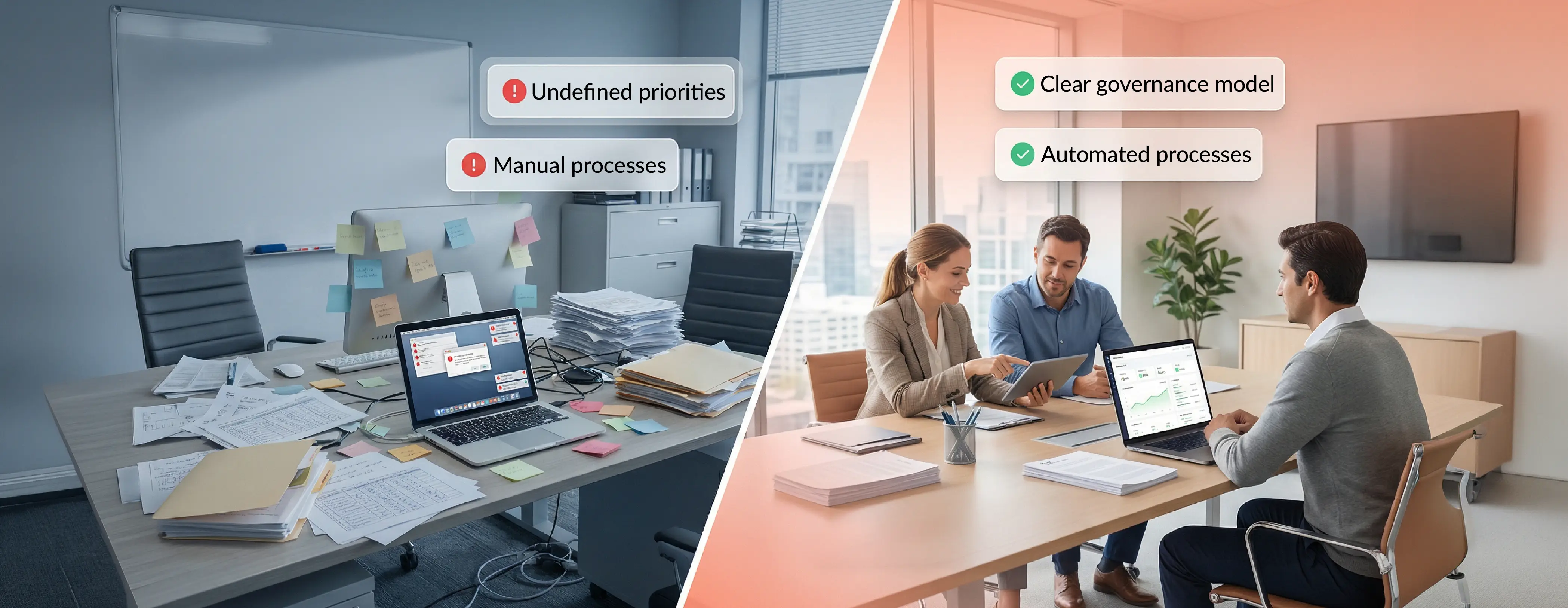
A board member of a professional association on r/nonprofit recently shared a common frustration: "Our chapter is in decline. New leaders keep taking over without understanding how things work. Events are inconsistent. Communications and branding are all over the place. And when we suggest borrowing best practices from stronger chapters, there's resistance."[1]
This scenario plays out in thousands of associations every year.
Association management is how you organize operations to actually achieve your mission. It covers everything from governance and membership services to finances, programs, and daily administration. When it works, your association grows, members stay engaged, and your board focuses on strategy instead of scrambling to fix operational fires.
This guide is for executive directors, boards, membership leads, small staff teams, and association management professionals looking to strengthen their operations.
Association management is the day to day and strategic coordination of a membership based organization so it can deliver member value and achieve its mission. It includes governance, membership operations, finance, programs, communications, and compliance.
In this guide, you'll learn:
- What association management really means (and what it's not)
- Why getting this right matters more than most leaders realize
- Core functions every association must manage well
- Who typically handles management (staff, volunteers, or outside firms)
- The biggest challenges and real complaints from association professionals
- Fundamental best practices that actually work
- A simple 4-week roadmap to get started
Managing an association isn't just about keeping the lights on. It's about creating a membership experience that delivers real value and keeps people coming back.
Key Takeaways
What Is Association Management
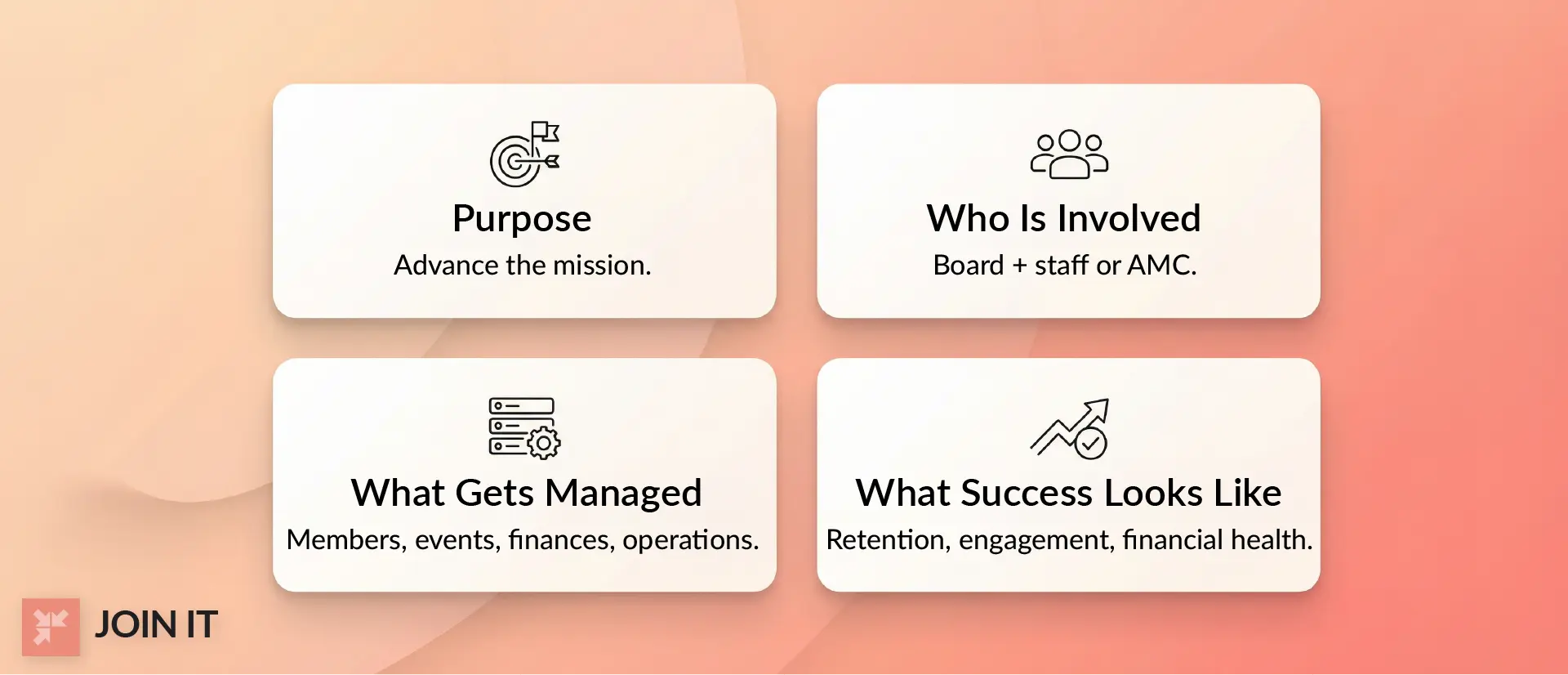
Association management definition
Association management is the process of organizing and administering a membership-based organization's operations to achieve its mission.
It spans governance, membership, finance, programs, communications, compliance, and operations. In practical terms, it means providing leadership, staff, and systems that help an association thrive.
Association management at a glance:
Purpose: To advance the association's mission and deliver value to members through effective operations and programs.
Who is involved: Typically a volunteer board of directors provides governance and strategy, working with paid staff (like an association manager or Executive Director) or a contracted Association Management Company (AMC) for execution.
What gets managed: Membership in organizations, events and educational programs, communications, financial management, governance support, and overall operations.
What success looks like: Growing or stable membership, high renewal rates, engaged members, financial health, and measurable progress toward mission goals.
Association management vs community association management
These terms sound similar but describe completely different worlds.
Association management (what we're covering here) applies to professional associations, trade associations, societies, and membership organizations. Members join voluntarily for professional development, networking, advocacy, or industry standards.
Community association management refers to homeowner associations (HOAs) or condo associations. These manage residential communities, handle property maintenance, and enforce rules.
If you're looking for guidance on running an HOA, our guide on HOA board responsibilities covers that territory.
Common association management use cases
Trade associations
Manage member renewals, events, advocacy communications, sponsor relationships, and board operations.
Professional societies
Coordinate certifications, education programs, annual conferences, committees, and member engagement.
Membership nonprofits
Run member programs, recurring dues or donations, communications, volunteer coordination, and reporting.
Association management can look different by organization type, but the core functions stay the same: governance, membership, finance, programs, communications, and compliance.
What association management is not
Association management is not only software. Technology enables management but doesn't replace strategy and leadership.
It's not just event planning. Events matter, but they're one piece alongside membership strategy, communications, and governance.
It's not "one person does everything forever." Effective associations evolve roles over time to prevent volunteer burnout.
Why Association Management Matters
The association sector is bigger than most people think
Even though associations operate behind the scenes, they represent a significant economic and social force.
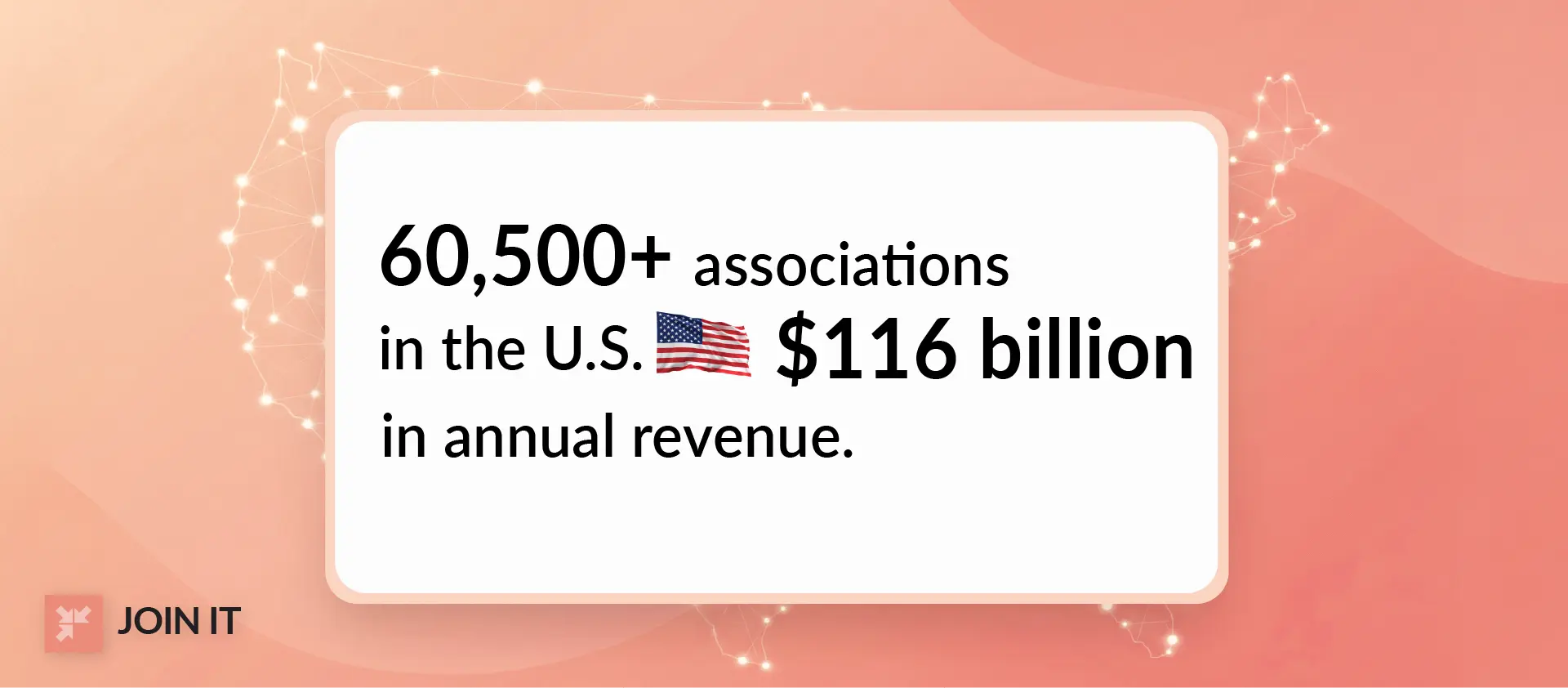
In the U.S. alone, over 60,500 trade and professional associations are registered, generating more than $116 billion in annual revenue.[2] These organizations directly employ hundreds of thousands and collectively maintain a payroll exceeding $20 billion.
Associations mobilize enormous volunteer activity. Nearly 63 million Americans volunteer through an association each year, contributing expertise and community service.
Associations also convene millions. Over 315,000 association-sponsored meetings are held in the U.S. annually, drawing about 59.5 million participants.
These numbers matter for leaders. Members and stakeholders expect a level of professionalism and operational effectiveness commensurate with this impact.
The membership model is under pressure
Traditional membership in organizations faces a mixed reality today.
Recent benchmarking shows that 49% of associations saw their membership counts increase in 2023, but roughly half experienced no growth or a loss.[3]
A key issue is value clarity. Only 11% of association professionals rate their association's value offer as "very compelling" to members.[4]
The result? Membership renewal is no longer automatic. As one analysis put it, "the old model of belonging and renewal by habit no longer works the way it once did."
Associations must focus on engagement cadence, frictionless renewals, and data-driven follow-up discipline.
The "hidden cost" of weak management
Ineffective management can undermine an association's mission in ways that aren't immediately visible.

In one industry survey, association professionals cited lack of member engagement as the #1 reason members don't renew.[5] Yet 63% said engagement levels were flat year-over-year, and 60% admitted they had no written plan to improve engagement.
Poor processes also tax volunteer leaders. When every decision waits on a busy volunteer board, approvals slow and opportunities slip. This leads to volunteer burnout and organizational paralysis.
Data silos and outdated systems create messy reporting and delays. Leadership misses chances to course-correct programs or loses institutional knowledge when a key person leaves.
These hidden costs add up: staff and volunteer time lost to inefficiencies, member frustration with clunky experiences, revenue left on the table from missed renewals.
Core Functions of Association Management
Every association must manage certain core functions well to thrive. Providing professional guidance and assistance to the board of directors is essential for effective association management, ensuring that the board receives the support it needs to make informed decisions.
Core functions table
Governance support (association governance, board management)
Ensuring effective decision-making structures and compliance forms the foundation.
This involves supporting the board of directors with meetings (agendas, minutes, elections), advising on bylaws and policies, and maintaining accountability.
Boards should ensure all members receive training on governance responsibilities and legal obligations. This builds informed leadership and prevents issues like conflicts of interest or mission drift.
Association membership management
Members are the lifeblood of associations, so managing the member lifecycle is a core function.
This includes recruiting new members, maintaining an accurate membership database, processing dues and renewals, and engaging members in programs.
Member self-service has become a core expectation. Members want to log in at midnight and renew their membership, update their profile, or register for an event without needing staff.
Finance and billing (recurring dues)
Overseeing the association's financial health is critical.
This includes budgeting, financial reporting, managing revenue streams, and handling billing for dues or other fees.
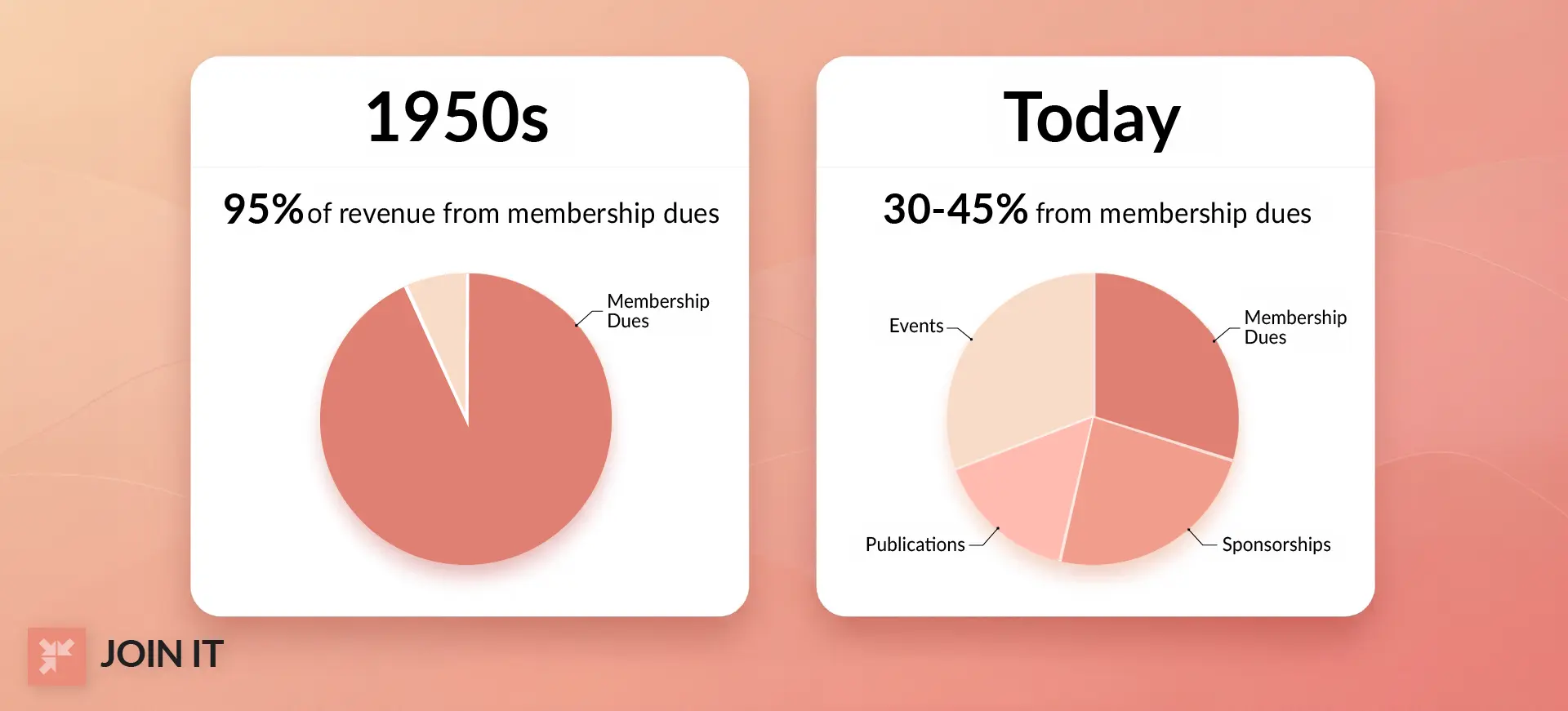
Membership dues have declined from constituting roughly 95% of revenue in the 1950s to about 30-45% today, so associations rely on events, publications, and sponsorships to sustain finances.[6]
Strong financial controls are essential. Alarmingly, 35% of nonprofits have no internal financial controls and 19% lack management review, creating risk of fraud or error.[7]
Events and programs (association event management)
Planning and executing events, conferences, webinars, and certification programs provides tangible member value.
In fact, 88% of associations hold an annual meeting or exhibition, with a median attendance of 803 people.
Modern platforms include event registration capabilities that handle sign-ups, payments, and attendance tracking seamlessly. Many also integrate with Eventbrite to extend functionality.
Communications and marketing
Keeping members informed and engaged through newsletters, email campaigns, social media, and publications is essential.
However, many associations see room for improvement. In one global survey, only 21% of members felt their association did an excellent job providing benefits tailored to their needs.[8]
Segmentation, consistent cadence, and a single source of truth for member lists are critical.
Reporting and analytics
Tracking metrics and providing insights to guide decision-making is increasingly important.
Leaders should quickly answer questions like: What's our membership retention rate? How many people renewed this month? What's our event attendance versus goals?
A 2024 survey found only 17% of associations are using advanced data analytics for decision-making. The majority still rely on basic reports.[9]
Compliance and risk
Ensuring the association meets legal requirements and manages risks responsibly protects the organization.
This includes maintaining tax-exempt status, adhering to data privacy regulations, and implementing policies for ethics and conflicts of interest.
91% of associations consider data security when developing digital strategy, yet half feel not fully prepared for cyber risks.
Who Actually Manages Associations
In-house staff and association management professionals
Many associations employ dedicated staff led by an Executive Director or association manager to manage operations.
Key in-house roles often include a Membership Director, Operations Manager, Finance staff, and Communications staff.
Having in-house staff provides control and deep organizational knowledge. However, it also means the association carries the overhead of salaries, benefits, and the risk of staff turnover.
Volunteer boards and committees
Thousands of smaller associations rely entirely or mostly on volunteers to manage tasks.
Volunteers bring passion and subject-matter expertise. They're especially effective in advocacy or peer-to-peer membership outreach.
However, volunteer-run processes often face limits. Volunteers have day jobs, so tasks can be delayed. Specialized skills may be missing. And there's risk of burnout when a few people carry most of the load.
Association management companies (AMCs)
Association Management Companies are firms that specialize in managing associations' operations for a fee.
An AMC provides professional staff, administrative support, office infrastructure, and technology to multiple association clients.
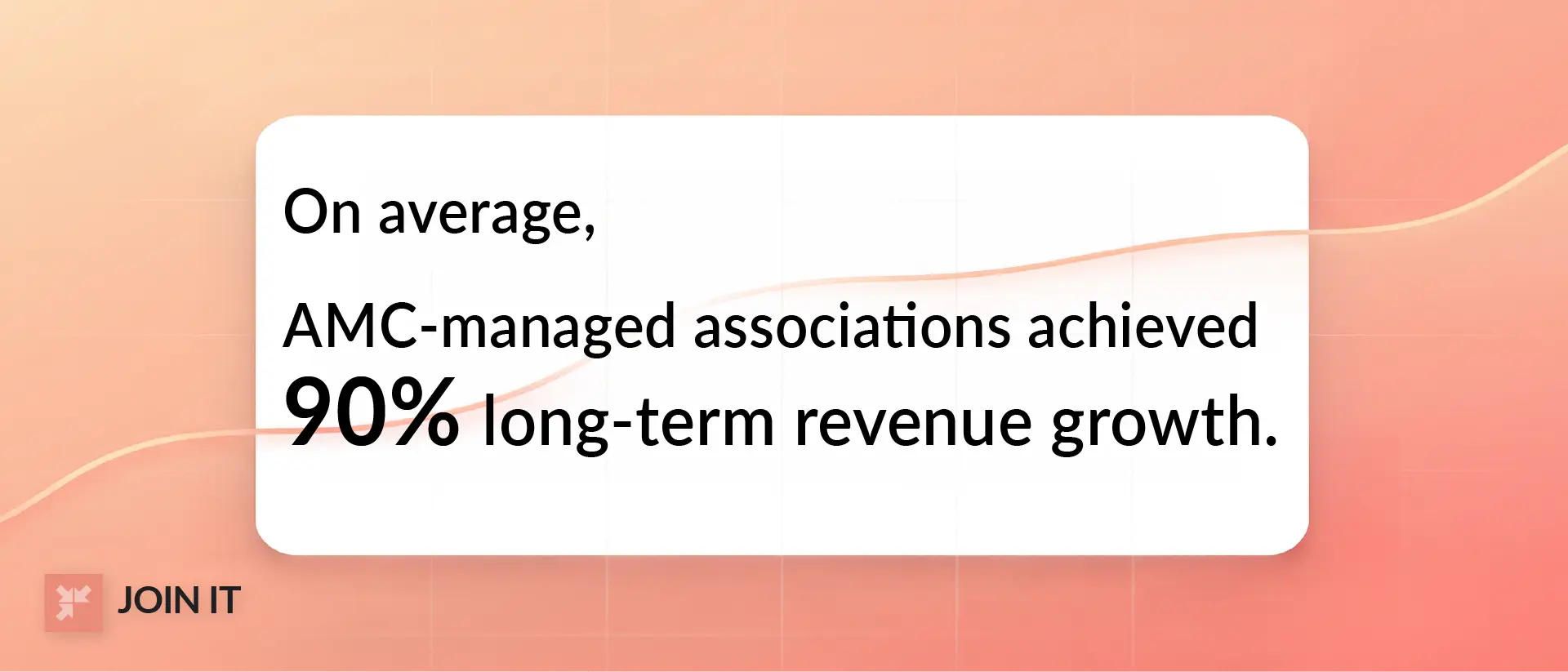
A recent independent study found that associations managed by AMCs grew their gross revenues by an average of 90% over the long term.[10]
An AMC can be an excellent option if an association's volunteer leaders are overwhelmed with administrative duties, if the organization lacks infrastructure, or if it's in a transition.
For a comprehensive comparison of AMC options and pricing models, check out our guide on association management companies.
Key Challenges in Association Management Today
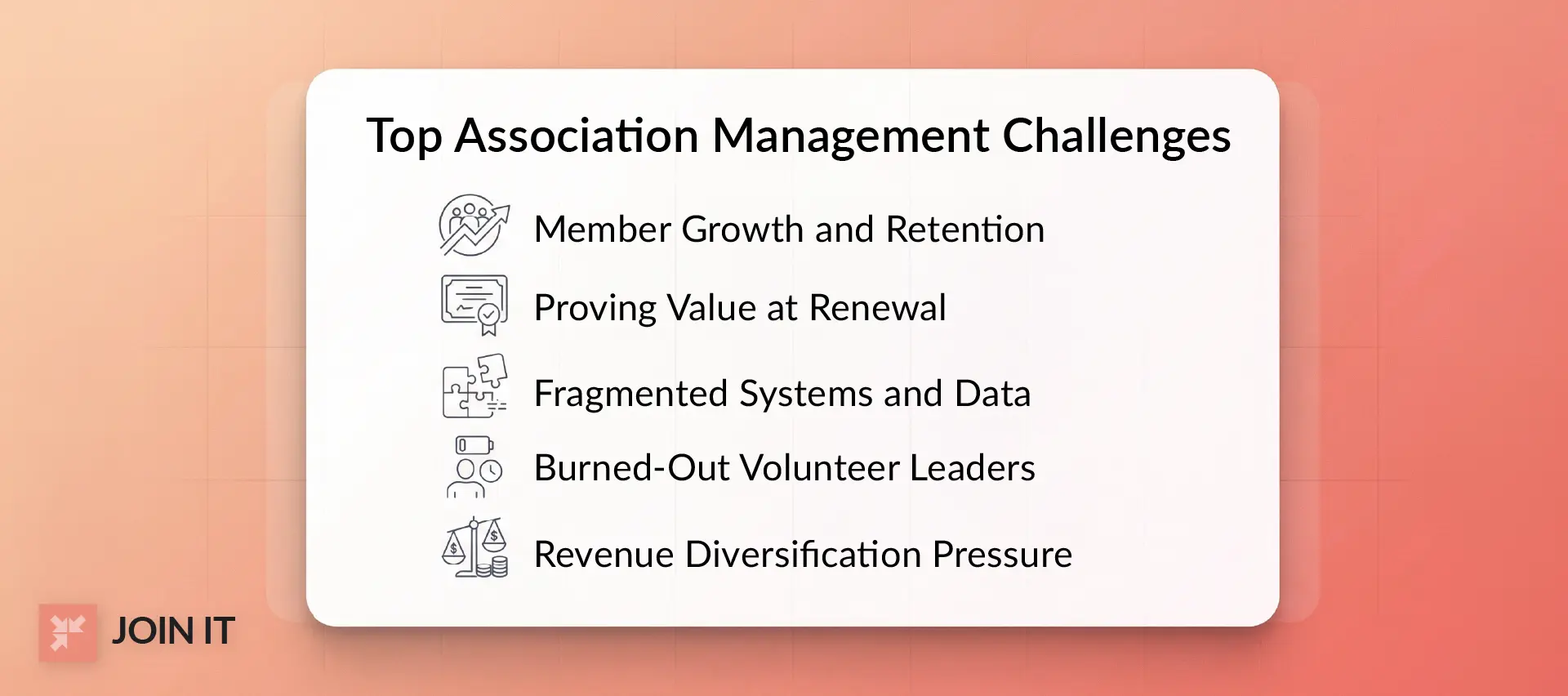
Attracting and retaining members
Growth and retention are perennial issues. Many associations struggle to convince potential members to join and to keep existing members engaged.
A frequent underlying reason is that "value is invisible." Members don't clearly see the benefits of membership, so they hesitate to join or renew.
Associations that overcome this challenge typically have a clear value proposition and an engagement plan that keeps members involved year-round. Rather than focusing only on perks, they emphasize outcomes.
Our membership retention guide explores frameworks that work.
Providing clear value (especially for renewals)
Convincing members to renew year after year requires continuously demonstrating value.
If the value of membership is unclear or front-loaded, renewal becomes a hard sell. Common symptoms: members join only because of a one-time incentive and then lapse, "renewal apathy," or very low participation in association activities.
Leading organizations connect membership to results and implement proactive communication of value throughout the year.
Digital transformation and data silos
Many associations find themselves held back by outdated technology and fragmented data.
Systems that don't talk to each other create inefficiencies and blind spots. Staff might have to perform duplicate data entry or run reports manually, delaying decisions.
A 2024 survey found that 63% of associations acknowledged the importance of a digital strategy, yet an equal 63% said they did not have a formal digital strategy in place.
Disconnected tools, messy lists, and reporting delays plague many organizations.
Governance overload on volunteers
Especially in volunteer-driven associations, the governance process itself can become a bottleneck.
When too many decisions funnel to the board or committees, or when volunteer leaders are expected to micromanage operations, this leads to slow approvals, frequent meeting backlogs, and frustrated volunteers who feel burned out.
The solution is to clarify roles and streamline processes. The board focuses on high-level strategy, policy, and fiduciary oversight, while delegating day-to-day management to staff or committees with clearly defined authority.
Financial sustainability (non dues revenue pressure)
Associations are increasingly challenged to maintain financial stability as traditional revenue sources shift.
61% of associations said generating non-dues revenue is their biggest challenge in one 2025 benchmarking report.[11]
Non-dues areas like conference registrations, exhibition booth sales, sponsorships, certification fees, and publications must grow to keep up with rising costs.
The Biggest Association Management Complaints from Reddit Discussions
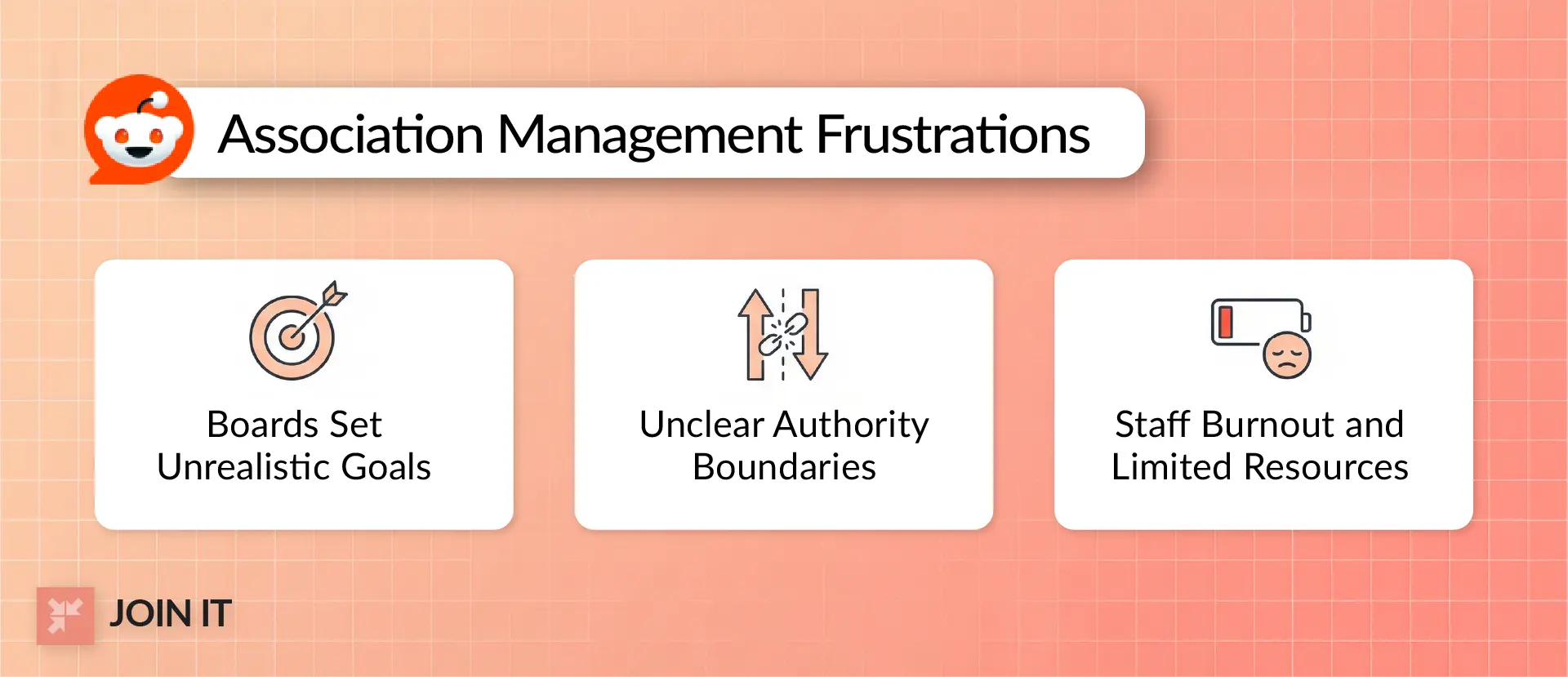
These examples are anecdotal, but they mirror broader patterns discussed throughout this guide, especially governance overload, unclear roles, retention pressure, and staffing constraints.
While software frustrations are real, the deeper challenges often stem from governance dysfunction, unclear roles, and leadership gaps. These issues show up repeatedly in candid discussions among association professionals.
Boards setting unrealistic goals without resources
One of the most common complaints is boards that demand the impossible. In one discussion, association staff describe boards setting "impossible" fundraising targets while feeling apathetic to operational constraints. Some board members assume their outside success automatically translates to running an association.[12]
One ED put it bluntly: their board leadership was pushing priorities that didn't match capacity, didn't understand operations, and left the ED "stuck carrying the consequences while trying to reset expectations."[13]
Unclear authority boundaries
Another persistent issue? Boards and staff don't know where their roles begin and end. One thread captured it perfectly: the board itself disagreed about its own powers, leading to boards getting stuck in minutiae instead of strategy.[14]
When roles aren't crystal clear, everyone suffers. The board can't focus on governance because they're caught in operational details. Staff don't know who to report to. And the ED gets squeezed from both sides.
Staff burnout and resource constraints
The financial reality underpinning many complaints surfaced in a thread about association employee compensation. Staff described being overworked and underpaid with tight budgets. Commenters tied compensation pressure directly to revenue instability and membership challenges around value perception and declining numbers.[15]
The complaints about association management aren't just operational gripes. They're symptoms of misaligned governance, unclear value propositions, and the difficulty of balancing volunteer leadership with professional execution.
The good news? Most of these issues are solvable with clear roles, transparent communication, and realistic expectations.
For associations that are new or operating with tight budgets, a practical initial step to prevent employee burnout is to explore free membership management software.
Association Management Best Practices
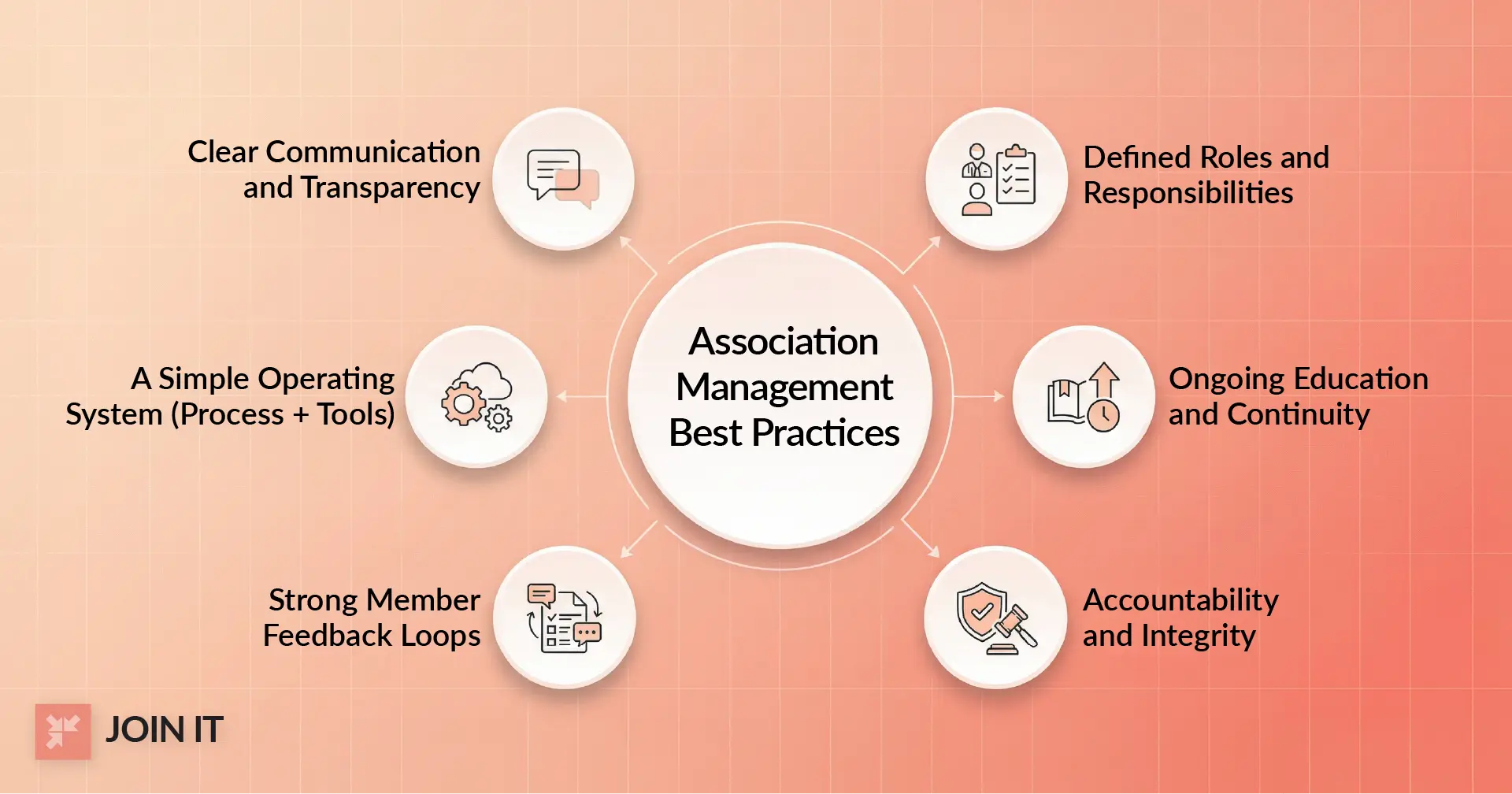
Communication and transparency
Maintain clear, consistent communication and be transparent with stakeholders about decisions and operations.
Establish a regular cadence of updates and predictable communication. Promoting transparency with the board is key to maintaining trust and fostering accountability.
Clear roles and responsibilities
Delineate clearly who is responsible for what. Distinguishing board versus staff roles, committee charters, and individual job descriptions prevents both gaps and conflicts.
Studies of nonprofit governance stress clear roles, transparent oversight, and informed decisions as keys to effective operation.
Education and continuity
Invest in institutional knowledge and succession planning so the association isn't dependent on a single individual.
This means thorough onboarding for new staff, volunteers, and board members, documenting important processes, and mentoring people for key roles.
Accountability and integrity
Uphold strong accountability measures and ethical standards in management.
This means implementing financial controls (segregating duties, regular audits or finance committee reviews, expense policies), establishing conflict of interest and ethics policies for leaders, and setting performance metrics.
Member feedback loops
Continuously listen to members and adjust accordingly, without over-relying on infrequent surveys.
Set up simple, ongoing feedback loops like routine calls or focus groups with members, suggestion boxes, and encouraging anecdotal feedback at events.
A lightweight operating system (process plus tools)
Develop a simple "operating system" for managing the association. The combination of people, processes, and tools that all align and are scaled appropriately.
Good management acknowledges that people, process, and tools are the trio that must function together.
Association Management Software (AMS) and the Modern Tech Stack
What is association management software
Association Management Software (AMS) refers to an integrated software platform that associations use to manage their membership and operations.
In plain terms, an AMS is like the central database and toolset that houses member records, handles dues billing, event registrations, communications, and other core functions.
For a complete breakdown of features and implementation considerations, see our guide on what is association management software and why it's powerful.
What a modern association management system typically includes
Most contemporary AMS platforms offer a common set of features:
- Membership database: A central repository of member information
- Dues billing and subscription management: Tools to set up membership dues levels, billing cycles, and process payments
- Event registration management: Functionality to create event listings and allow members to register and pay online
- Communications and email marketing: Integrated email tool or integration with popular email marketing software
- Reporting and analytics: User-friendly reporting dashboards
- Member portal or self-service: A web-based portal where members can log in to update their profile and manage transactions
And plus modern members expect mobile access to everything. A mobile app for association management delivers this convenience.
Full AMS vs lighter tools (API-friendly tools)
Associations sometimes face a strategic choice: use a full AMS that attempts to handle all functions in one system, or use a combination of lighter, specialized tools connected via integrations.
The lighter, connected tools approach can give you excellent functionality in each area and possibly cost savings by picking only what you need. The trade-off is you must ensure these tools talk to each other.
Association management software selection criteria
Choosing the right AMS is a critical decision. Some high-level criteria to consider include:
- Ease of use: The software should be intuitive for your staff to learn and operate
- Member experience: Does it provide a smooth online experience for joining, renewing, and registering for events?
- Reporting and analytics: Can you easily create custom reports?
- Integrations and extensibility: Can the AMS integrate with your other key systems?
- Support and vendor reliability: What do current users say about response times?
- Total cost of ownership: Look beyond initial license fees
Some associations choose to implement a specialized CRM for associations to manage member data. To explore the wider landscape of membership tools, refer to our guide to the best membership software for associations
Where Join It fits
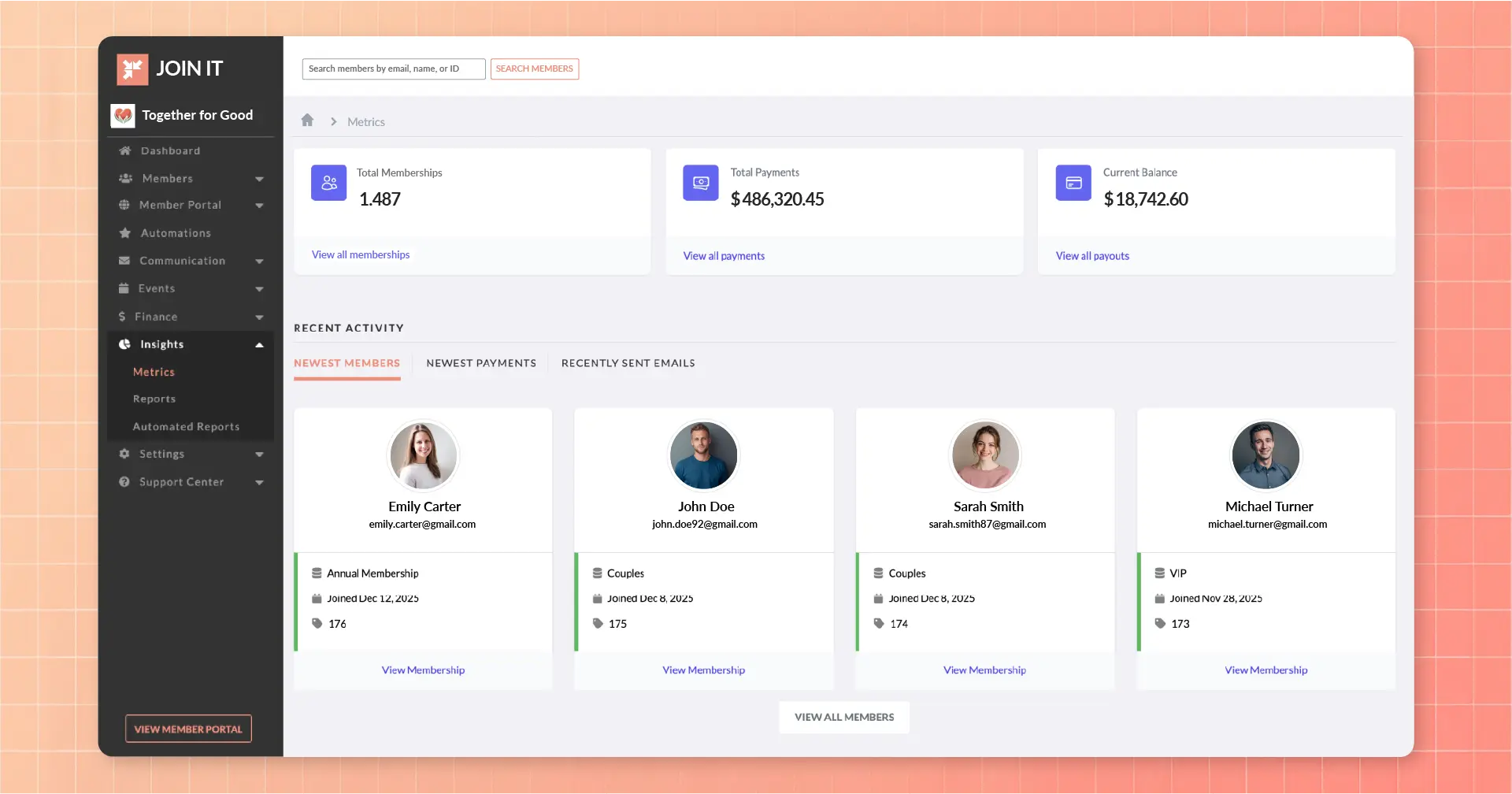
Platforms like Join It focus on core membership management needs, recurring billing, member portals, and self-service, without the complexity of enterprise systems.
This approach serves associations that want professional support scaled to their needs without heavy complexity.
Future Trends Shaping Association Management
Data-informed decision making
There's a growing shift from gut-feel or tradition-based decisions to data-driven strategies.
Many associations are still in early stages, but there's a clear recognition that needs to change. Boards and executives are increasingly asking for dashboards and key performance indicators to monitor success.
AI and automation in associations
Artificial Intelligence and process automation are rising trends promising to augment how associations operate.
Awareness of AI's potential is high. 60% of associations see AI as an essential tool for future success, according to a 2024 digital trends survey.
Yet readiness is low. Only 19% feel "very or extremely" ready to integrate AI into operations.
By 2025, about 41% were exploring AI and 19% had plans to implement.
Recurring billing and flexible membership models
Associations are increasingly moving away from one-size-fits-all annual dues toward more flexible and convenient membership models.
A major trend here is the adoption of recurring billing and auto-renewal. Associations report that auto-renewal participants renew at rates 10-15 percentage points higher than those on manual annual billing.[16]
Member experience expectations (simple, fast, mobile-friendly)
Today's members compare their interactions with associations to the high bar set by consumer apps and services.
Members expect mobile-accessible content and services. This means having a responsive website, possibly a dedicated mobile app, and even offerings like digital membership cards.
Our comprehensive guide to digital membership cards explores this shift in detail.
In-person connection and hybrid programs
Despite the growth of digital engagement, in-person connection remains uniquely powerful.
In late 2023, 35% of members surveyed said they would attend both virtual and in-person versions of major conferences.
The new normal is to offer both. In-person fosters trust and serendipity that is hard to replicate online. However, virtual can dramatically extend reach. The future is leveraging both.
Getting Started With Better Association Management
Week 1: Clarify the basics
In the first week, focus on foundation-setting questions: mission, audience, value proposition, and success metrics.
Revisit your association's mission statement. Identify your core membership segments. Define what value you promise to deliver to members. Determine how you'll know if things are working.
Week 2: Fix the biggest friction points
Turn to quick wins by addressing obvious pain areas in your current operations that frustrate members or staff.
Examine your renewal process from a member's perspective. If you still require manual steps, eliminating those is a priority. Review your event registration experience. Take a pass at cleaning up your email and distribution lists. Set up simple reporting templates.
Week 3: Choose the right operating model and tools
Week 3 is about strategic alignment of your resources and deciding if your current management structure and systems are optimal.
Revisit how your association is managed. Are volunteers burning out trying to handle tasks that an admin staff or AMC could do more efficiently?
Evaluate if your current tech stack meets your needs or if you need to shop for new solutions. Tools like Join It provide a starting point for associations ready to modernize their membership operations.
Week 4: Roll out changes with adoption in mind
In the final week, it's about implementing the changes decided and ensuring buy-in from all stakeholders.
Arrange training sessions. Identify champions or early adopters. Do a pilot or soft launch if possible. Communicate changes to members clearly, focusing on benefits to them.
If you are evaluating tools, our membership management software guide breaks down the critical features, technical requirements, integrations, and setup considerations to review before choosing a platform.
FAQ
What is association management?
Association management is the professional administration of a membership-based organization, handling day-to-day operations and long-term strategy to fulfill the group's mission. It encompasses coordinating governance, managing member services, overseeing finances, organizing programs, and ensuring the association runs efficiently.
What does an association manager do?
An association manager oversees the day-to-day operations of a membership organization. They handle membership administration, event planning, communications, financial management, and support the board of directors with governance tasks. They act as the operational leader while the volunteer board provides strategic direction.
What do association management companies do?
Association management companies (AMCs) are firms that specialize in managing associations' operations on a contractual basis. An AMC provides professional staff, office infrastructure, and management services, handling tasks like membership administration, meeting planning, marketing, and financial management for one or many associations.
What is association management software?
Association management software (AMS) is an integrated platform designed to help associations manage their membership and activities in one system. An AMS typically includes a member database plus tools for dues billing, event registration, mass communications, reporting, and a member self-service portal.
What is the difference between CRM and association management system?
A CRM (Customer Relationship Management) focuses primarily on tracking interactions and managing relationships with contacts. An AMS is specifically designed for membership organizations and includes specialized features like dues management, member tiers, event registration, and governance tools that general CRMs typically lack.
References
- Reddit. captured a familiar pain point
- Power of Associations. over 60,500 trade and professional associations
- Marketing General Inc. Recent benchmarking shows
- ASAE. Only 11% of association professionals
- GrowthZone. In one industry survey
- ASAE. Membership dues have declined
- The NonProfit Times. Alarmingly, 35% of nonprofits
- Associations Now. In one global survey
- .orgSource. A 2024 survey found
- AMC Institute. A recent independent study found
- Naylor. 61% of associations said
- Reddit. In one discussion
- Reddit. One ED put it bluntly
- Reddit. One thread captured it perfectly
- Reddit. a thread about association employee compensation
- Membership Corp. Associations report


