
The Ultimate Guide to Non-Dues Revenue



In 1953, membership dues made up nearly 96% of association income. Today, the most resilient associations earn just 30% from dues. The other 70%? That is non-dues revenue doing the work.
That shift did not happen by accident. It happened because association leaders stopped treating membership fees as their financial ceiling and started building revenue systems that operate independently of whether membership is growing, shrinking, or holding flat.
This non-dues revenue guide covers what it is, why it matters right now, which streams work best, and what the associations generating serious non-dues income are doing differently.
Key Takeaways
- Non-dues revenue now funds the majority of association operations. Membership dues alone cannot sustain a modern association.
- The best non-dues revenue opportunity is often already inside your organization. Most associations simply have not repositioned it yet.
- Treating non-dues revenue like a managed portfolio consistently outperforms chasing a random list of ideas.
- Sponsorships tied to measurable outcomes renew. Sponsorships that only offer logo placement do not.
- Event profitability is measured in net revenue after all costs, not registration totals. A packed room can still be a weak revenue stream.
- Digital education programs produce some of the highest margins in non-dues revenue, often using content organizations already own.
- Over-reliance on one revenue stream is a financial risk. A diversified portfolio protects against membership swings, sponsor pullbacks, and rising costs.
- Member trust is the hidden constraint in every non-dues program. One poorly matched partnership or unlabeled sponsored post can cost years of credibility.
- Join It is rated Excellent on Trustpilot and gives associations a single place to manage members, collect dues, and track non-dues revenue without adding headcount.
What Is Non-Dues Revenue?

Non-dues revenue is any income a membership-based organization earns outside of regular membership fees.
It can come from members, non-members, sponsors, advertisers, exhibitors, partners, or donors. Revenue beyond membership dues takes dozens of forms: event registrations, sponsorships, paid courses, certification programs, job boards, advertising, grants, premium content, or affinity partnerships.
The definition is simple. The strategy behind it is not.
Strong membership management starts with understanding that dues and non-dues income behave as two completely different financial animals. You can track membership dues with relative predictability. Non-dues revenue requires a deliberate and structured approach to generate consistently.
Trade association non-dues revenue typically represents more than half of total operating income, while professional society non-dues income often exceeds 70%.
Why Non-Dues Revenue Matters More Than Ever
Here is a number worth sitting with.
77% of association operating revenue now comes from non-dues activities like exhibits, sponsorships, and custom programs.
That is not a niche finding. That is the financial reality of how modern associations fund their missions.
The pressure to diversify is growing louder. Generating non-dues revenue has ranked as the No. 1 financial concern for associations three years running. 61% of associations named it their biggest challenge over the past three years.
Organizations that solve this problem do not just become more financially stable. They also deliver better member programs, invest in stronger technology, and build tighter communities. Non-dues revenue is one of the most direct drivers of membership retention and long-term financial sustainability for associations, because it funds the programs that make membership genuinely valuable.
Industry benchmarks point to a 40-60% non-dues share as a healthy starting target, though ASAE data shows top-performing associations regularly exceed that, with professional societies averaging 70% non-dues income and trade associations averaging 55%.
63% of association CEOs expect their association non-dues revenue to grow over the next year. That optimism is only justified for organizations with a real plan behind it.
The Portfolio Mindset: Strategy Before Ideas
Most articles about non-dues revenue strategies jump straight to the ideas list. This one takes a different path first.
Here is the honest reality: two associations can try the exact same idea and get completely different results. Tactics do not travel well, because every organization's funding model shapes what growth can realistically look like.
Association revenue diversification is not about having the most programs. It is about having the right ones.
The better frame is to treat non-dues revenue as a managed portfolio, not a wishlist of programs.
The strongest approach keeps roughly 70-80% of effort behind proven sources, with 20-30% reserved for new higher-margin pilots. Use this four-part model to evaluate everything you run:
- 🛡️ Protect - Proven streams like your flagship event or core sponsorships. Keep investing here.
- 🔧 Improve - Underperforming programs with real potential. Fix pricing, packaging, or promotion before walking away.
- 🧪 Test - New ideas with low resource requirements. Run small pilots before committing real budgets.
- 🗑️ Retire - Programs that drain staff time and produce thin margins. End them quickly and without sentiment.
Before you add anything new, audit what you already have. List every revenue stream. Separate dues from non-dues income. Track gross revenue, direct costs, staff time, net margin, buyer type, and renewal likelihood for each one.
Your best non-dues revenue idea may already exist inside your organization. It is just underutilized.
Common Non-Dues Revenue Streams and Examples
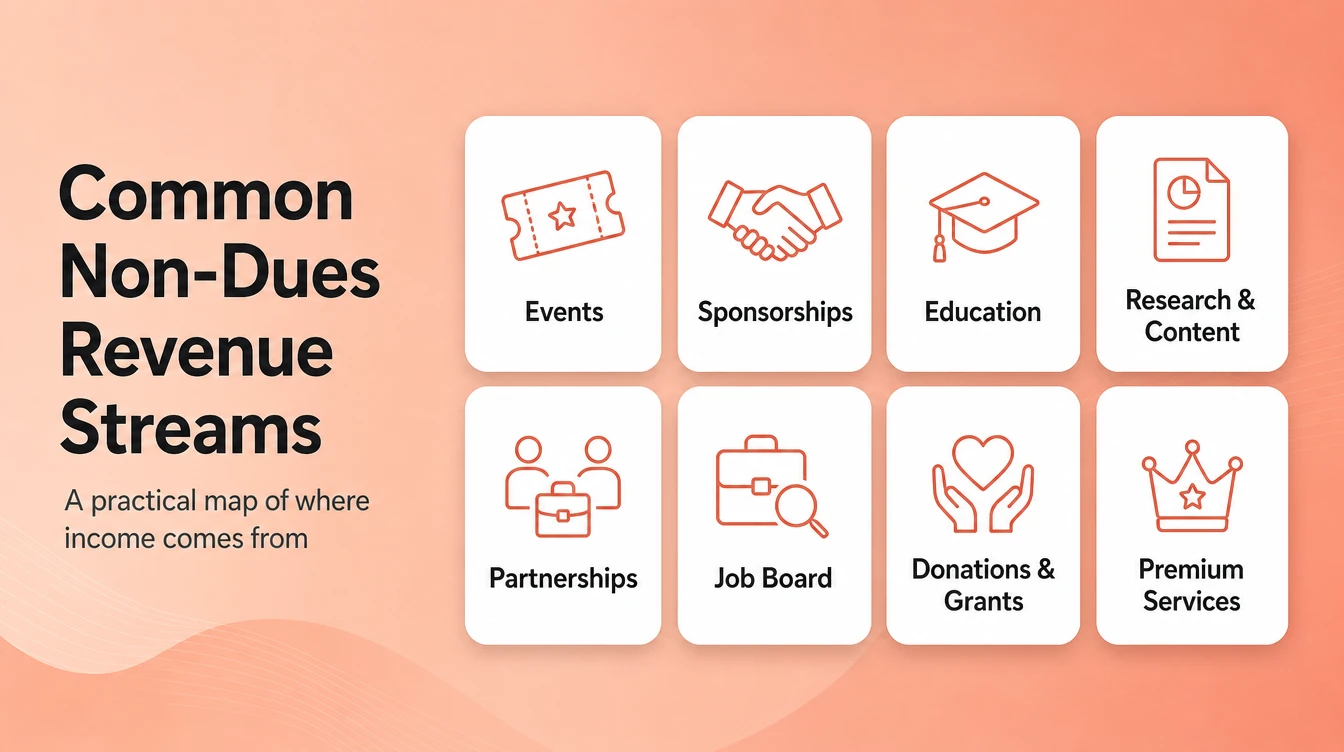
Non dues revenue ideas for associations span more categories than most organizations realize. Here is a practical map of where the income actually comes from.
🎟️ Events Registration fees, exhibitor booths, VIP access tiers, virtual event passes, and post-event recordings. A well-structured program of events for members builds recurring revenue for associations with real compounding value over time. Clean event registration infrastructure is the operational foundation that makes event revenue scalable.
🤝 Sponsorships and Advertising Year-round sponsor packages, newsletter placements, website advertising, sponsored webinars, sponsored research reports, and exhibitor fees. Event sponsorship is consistently one of the highest-value non-dues streams for associations with engaged and specialized audiences.
🎓 Education, Certification, and Digital Learning Continuing education revenue through paid webinars, online courses, certification programs, CE credits, on-demand content libraries, and learning subscriptions. Digital education can generate 50-70% profit margins once platform costs are covered, making it one of the strongest long-term pillars for association revenue diversification.
📊 Content, Research, and Media Industry benchmarking reports, salary surveys, buyer guides, sponsored content, and digital publications. Associations collect unique industry data that non-members will pay serious money to access. This is one of the most consistently under-monetized asset categories in the sector.
🔗 Partnerships and Affinity Programs Vendor partnerships, revenue-share programs, member discount programs, and co-created education initiatives. The guiding principle here is non-negotiable: member value comes first, revenue second. A poorly matched affinity program earns income once and loses member trust for years.
💼 Job Boards and Career Services Paid job postings, employer packages, resume database access, salary surveys, and virtual career fairs. Professional associations have a natural audience advantage here. Employers pay to reach niche professionals they cannot efficiently find anywhere else.
❤️ Donations and Grants Annual giving programs, corporate donations, foundation grants, and scholarship fundraising. The donations stream fits especially well for nonprofits and mission-driven organizations. For membership management for nonprofits, combining earned and contributed revenue builds a more resilient financial model overall.
⭐ Premium Member Services Paid communities, private roundtables, mentorship programs, premium directories, and leadership cohorts. These work only when members see unmistakable added value beyond what standard membership already provides.
Non-Dues Revenue Best Practices
Ideas are easy to generate. Execution is where most organizations underperform. Here are the practices separating organizations that consistently grow non-dues revenue from those that just add cost.
Sell Outcomes, Not Logo Space
Sponsorship revenue for associations has fundamentally shifted. Sponsors no longer pay for logo placement at a conference. They pay for measurable outcomes: leads generated, credibility established, education delivered, and audience engagement documented and reported.
The era of selling from a rate card is over. The associations growing sponsor revenue fastest are building consultative packages, not selling preset tiers.
The practical approach: bundle conference presence with sponsored webinars, newsletter placements, and post-event digital exposure into a 12-month partner package. Deliver a sponsor recap report with attendance figures, click data, and engagement metrics. That is how you earn renewals. And renewals are where sponsorship revenue actually compounds into something meaningful.
Measure Event Net Revenue, Not Just Registration Totals
A sold-out event can still be a weak revenue stream.
Venue costs, food and beverage, AV production, speaker fees, staffing, and marketing can consume most of what registration brings in. Event profitability for associations means tracking net revenue by event type and comparing in-person, hybrid, and virtual performance side by side.
Many organizations discover that a mid-sized virtual event outperforms a large in-person conference on margin. The right infrastructure to process payments for membership events and set up membership payments for premium access tiers makes this comparison possible to track with accuracy.
One more thing: do not let event revenue end when the event does. Turn session recordings into paid on-demand content. Bundle CE credits with recorded access. Give sponsors post-event digital visibility that extends their investment. Event revenue has a longer shelf life than most organizations take advantage of.
Turn Education Into Recurring Intellectual Property
The best education revenue comes from solving career pressure, not from creating courses because content happens to be available.
Survey your members. What compliance requirements do they face? What credentials improve their career trajectories? What skills are employers asking for today? Build around those answers, not around what is easy to produce.
Then repurpose relentlessly. Live webinars become on-demand products. White papers become CE-credit quizzes. Member survey results become paid benchmarking reports. Once built, education content generates revenue long after the original production cost is recovered. That 50-70% margin figure becomes a post-platform reality for associations that treat education as a strategic asset, not just programming.
Protect Member Trust Above Everything Else
A non-dues revenue program can generate income and damage your organization at the same time.
The FTC has clear guidance: if content is paid for, it must be labeled. Clearly. Near the headline. Using words like "Sponsored," "Advertisement," or "Paid Content" where readers will actually see them. This is not just legal compliance. It is mission protection.
Members who feel sold to rather than served stop renewing. The best non-dues revenue programs do not just generate income. They make membership more valuable, not more transactional.
Mistakes That Quietly Kill Revenue Programs
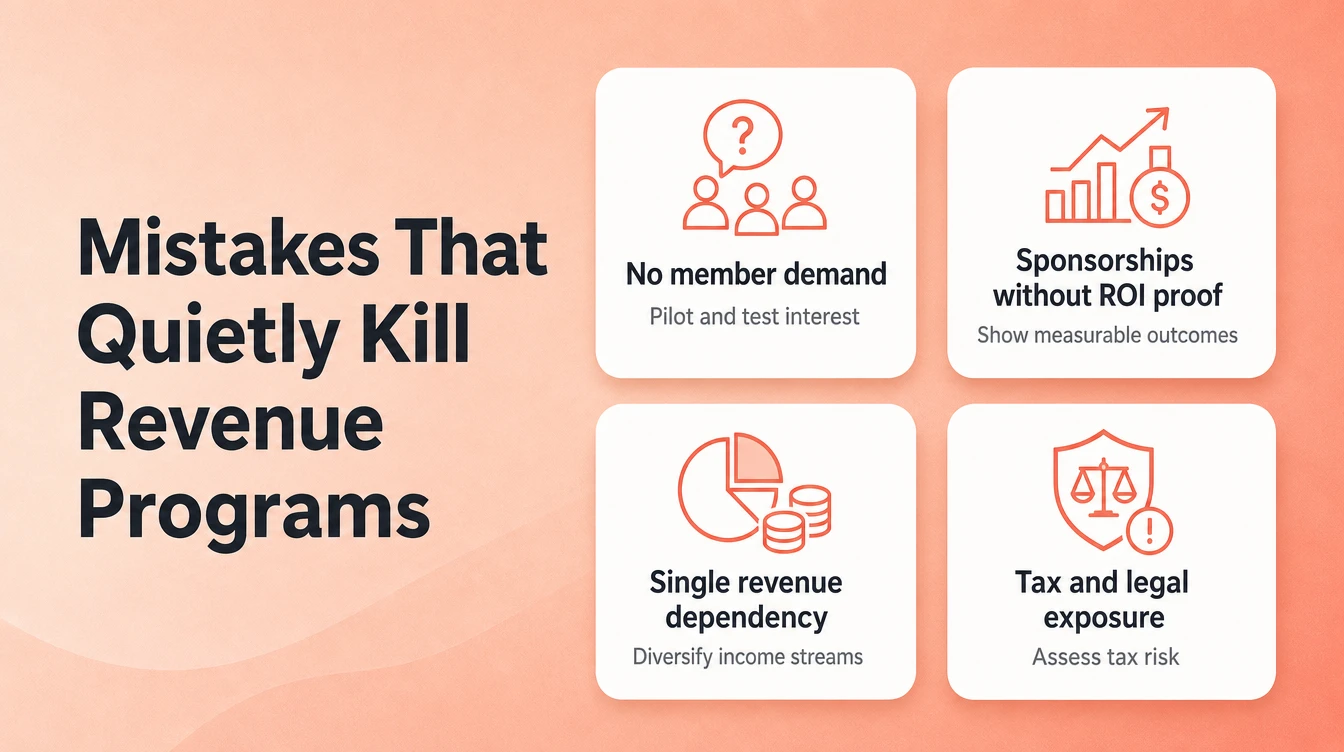
A few patterns appear repeatedly in organizations that struggle to grow non-dues revenue:
Launching without member demand. Building what the organization needs to sell rather than what members want to buy is the most common and most expensive mistake in this category. Pilot first. Survey first. Use early-bird registrations to test interest before committing real resources.
Selling sponsorships without ROI proof. Sponsors need internal justification for every dollar they spend. Without concrete metrics, renewal rates fall. Print advertising revenue declined 25% from 2021 to 2024. The reason is instructive: associations struggled to prove what their media was actually worth to buyers.
Over-relying on a single revenue stream. When the annual conference represents 80% of non-dues income, a venue problem, sponsor pullback, or attendance drop creates a financial crisis. Diversification is not just strategic ambition. It is financial risk management.
Ignoring tax and legal exposure. The IRS distinguishes between qualified sponsorship payments and advertising income. Unrelated business income can trigger tax obligations for exempt organizations. Before launching a new revenue program at scale, get qualified advice from a finance or tax professional who understands nonprofit and association structures.
Real Organizations, Real Results
These are not thought experiments.
AARP created a B2B marketing division from scratch and generated $43 million in new revenue over three years starting from zero. The asset was not a new product. It was a trusted audience with massive reach that had been undermonetized.
SAE International packaged its existing technical expertise into paid industry consortia and watched consortium revenue grow 10 times in three years.
ACRP reimagined its Clinical Trials Day event by deepening sponsor integration and produced a 200% increase in sponsorship sales alongside a 476% jump in social video views year over year.
The pattern across all three is identical. None of them invented something from scratch. They looked at what they already had, restructured how it created value, and executed with discipline.
The most important non-dues revenue insight in association management: your most valuable revenue asset probably already exists inside your organization. It is just waiting to be repositioned.
Your 90-Day Starting Point
You do not need a perfect strategy to begin. You need a first move.
Days 1-30: Audit every revenue stream you currently run. Separate dues from non-dues income. Score each program by net margin, staff time required, member demand, and growth trend. Identify your single most underutilized existing asset.
Days 31-60: Run one small pilot. A paid webinar. A premium sponsor package. A gated benchmarking report. Set pricing before launch. Define what success looks like before you start. Vague success criteria produce vague results.
Days 61-90: Measure honestly. Review revenue, costs, member feedback, and renewal signals. If demand is strong, increase investment. If demand is weak, retire the pilot without ego and try something better informed by what you learned.
Technology Is the Revenue Infrastructure
Growing non-dues revenue without the right operational foundation is like trying to scale a restaurant without a point-of-sale system. It works until it does not.
A connected membership management software platform centralizes your members, payments, renewals, and non-dues revenue tracking in one place. That connectivity makes revenue trackable, scalable, and manageable without multiplying your staff headcount.
Join It is built for exactly this. Membership organizations of all sizes use it to manage member data, process transactions, and track the revenue streams that sustain their programs and communities. The goal is making non-dues revenue operational rather than overwhelming.
Build a revenue dashboard that tracks income by stream, net margin, sponsor renewal rate, and repeat purchase behavior. Track member versus non-member purchase patterns separately. Revenue you cannot see clearly is revenue you cannot grow deliberately. Predictable revenue for associations starts with data visibility, not with better ideas.
Frequently Asked Questions
What is non-dues revenue? Non-dues revenue is income earned by a membership organization outside of regular membership fees. Common examples include event registrations, sponsorships, paid education programs, advertising, job boards, grants, and premium member services.
What are the best non-dues revenue ideas for associations? The best ideas depend on your specific member demand, staff capacity, and profit margin potential. Events, sponsorships, education, and content monetization consistently perform well across association types. The most important first step is always auditing existing assets before building new programs.
How can chambers of commerce generate non-dues revenue? Non-dues revenue ideas for chambers of commerce include event sponsorships, business directory advertising, member benefit partnerships, local business workshops, and community sponsorship programs. The same portfolio strategy principles apply regardless of organization type. For a deeper look at what works in this space, explore resources built specifically for chambers of commerce.
How can nonprofits diversify revenue beyond dues and donations? Nonprofits can combine earned revenue (paid programs, events, education) with contributed revenue (donations, grants, foundation support). Pairing these income types creates a more resilient financial model than depending on either category alone.
How do you track non-dues revenue performance? Track gross revenue, direct costs, net margin, staff time, repeat purchase rate, and sponsor renewal rate at the individual program level. A connected membership platform makes this significantly more accurate than managing separate spreadsheets across disconnected tools.
What non-dues revenue streams are the most sustainable long term? Sustainable revenue for associations comes from recurring models, not one-time campaigns. Learning subscriptions, annual sponsorship packages, certification renewal programs, and recurring partner arrangements build compounding income. Sponsor renewal rates and repeat purchase rates are the two metrics most predictive of sustainable non-dues revenue growth.
Non-Dues Revenue Quick Reference Checklist
Before you move on, here is a practical summary you can return to:
- Audit your current dues vs. non-dues revenue mix
- Score new ideas by member demand, margin, capacity, and trust risk
- Package sponsorships around measurable outcomes, not logo placement
- Track event net revenue, not just registration totals
- Turn education content into repeatable, on-demand products
- Label all sponsored content clearly and near the headline
- Vet every partner for genuine relevance to your members
- Build a revenue dashboard that shows performance by stream
- Review every program's performance every quarter
- Protect member trust as the foundation of every revenue decision
Every association leader asking how to increase association non-dues revenue eventually reaches the same answer. The associations winning at this right now are not the ones with the longest ideas list. They are the ones that identified two or three streams that genuinely fit their members, their capacity, and their mission, and then executed those streams with real discipline.
Ready to build the operational foundation that supports it? Book a call with the Join It team or start a free trial and see what a connected membership platform makes possible for your non-dues revenue strategy.
Sources
- ASAE. Data: Membership Dues Aren't the Only Revenue Stream
- MCI. Revenue Realities Report
- Naylor. 2025 Association Benchmarking Report
- Associations Now. Non-Dues Revenue: Your Association's Key to Sustainability
- i4a. Non-Dues Revenue Ideas for Associations
- ASAE. The Membership Model Is Breaking Down
- Intuto / .orgCommunity. 2026 Non-Dues Revenue Playbook
- Sequence Consulting. How AARP Built a $43 Million Non-Dues Revenue Business
- Sequence Consulting. Non-Dues Revenue Case Study: SAE's 10X Growth
- Professionals for Association Revenue. Non-Dues Revenue Is Crucial for Association Sustainability

Guides from the Experts
Through our work with 4,000+ organizations - we’ve put together helpful guides to assist; regardless of where you are on your journey.
.webp)

A Complete Guide to Membership Organizations
Everything you need to know to manage and grow your membership business
.webp)
Maximize Membership Retention: 10 Proven Strategies
Tried and true strategies that not only win membership, but keep them

Build a Membership Website: A Step-by-Step Guide
Your one-stop resource for knowing all the features your modern membership website needs
Ready to start your free trial?
Our membership software is intuitive to use and even easier to test for yourself.