
How to Run a Successful Membership Committee in 2026


How to Run a Successful Membership Committee in 2026
Four years ago, Women Business Leaders in Health Care faced a familiar challenge: flat membership, volunteers stretched thin, and no clear system for welcoming new members.
Their solution? A focused membership committee with clear responsibilities and simple workflows.
The result: membership doubled, volunteer prep time dropped to roughly one day per month, and members actually noticed the difference.
That's the power of a well-run membership committee.
Recent data backs this up. Marketing General Inc.'s 2023 benchmarking found that 49% of associations saw membership grow, with half reporting more new member acquisitions. Meanwhile, a Community Brands study revealed why members leave: 34% said dues were too costly, and 26% said the organization provided little value.
This membership committee guide covers the proven system for running a membership committee that actually moves the needle: charter templates, role definitions, meeting rhythm, onboarding workflows, recruitment strategies, retention tactics, and reporting frameworks.
Key Takeaways
Membership Committee Best Practices: 10 Proven Moves for 2026
Before diving deep, here are the ten membership committee best practices that separate high-performing committees from the rest:
- Start with a clear charter - Define purpose, scope, metrics, cadence, and term lengths so the committee doesn't drift into random busywork.
- Own the membership pipeline - Track prospects through applicants, new members, engaged members, and renewals. Not just ideas.
- Run a structured welcome + first 30 days - Email on day 0-2, welcome call by day 10, first-timer event by day 30. Big retention win.
- Make feedback recurring - Quarterly pulse surveys, monthly lapsed outreach, and top 3 insights shared at every meeting.
- Tie member value to real offers - Keep a "Member Value Backlog" of 10 ideas, test one per quarter, keep what works.
- Run meetings like an execution machine - Five-part agenda: numbers, insights, decide 2 actions, risks, report-out plan.
- Define roles clearly - Chair sets priorities and reports. Outreach Lead owns calls. Research Lead tracks insights.
- Recruit committee members like a product team - Diverse segments, rotating terms, lightweight onboarding pack.
- Use a committee playbook - Shared folder with scripts, templates, outreach lists, and report formats.
- Build continuity with staggered terms - Rotate one-third yearly to preserve institutional memory and prevent yearly resets.
Now let's break down exactly how to implement these.
What is a Membership Committee?
Membership Committee Definition
A membership committee is a group of volunteers (and sometimes staff) responsible for recruiting new members, engaging existing ones, and improving retention. This membership committee description applies to associations, nonprofits, clubs, chambers, and community organizations.
It's not a "random ideas" group. It owns measurable outcomes.
What Does a Membership Committee Do?
The membership committee responsibilities fall into four main buckets focused on recruitment and retention:
- Recruitment - Running campaigns, outreach, and member-get-a-member programs
- Onboarding - Welcome calls, orientation events, first 30 days tracking
- Engagement - Networking events, recognition programs, volunteer opportunities
- Retention - Renewal messaging, lapsed outreach, satisfaction surveys
For a broader framework the committee can align to, the membership experience guide helps you think beyond sign-ups and focus on the full lifecycle.
Membership Committee Purpose
The membership committee purpose centers on three outcomes: member value, growth, and retention.
When these three align, organizations see what the data shows: higher renewal rates (often above 81-85%), increased event attendance, and revenue growth from timely dues collection.
One membership software expert puts it simply: "A good membership committee means a solid membership base, leading to increased engagement by the members and more revenue for the organization."
Membership Committee Responsibilities (and Who Owns What)
Membership Committee Duties and Responsibilities
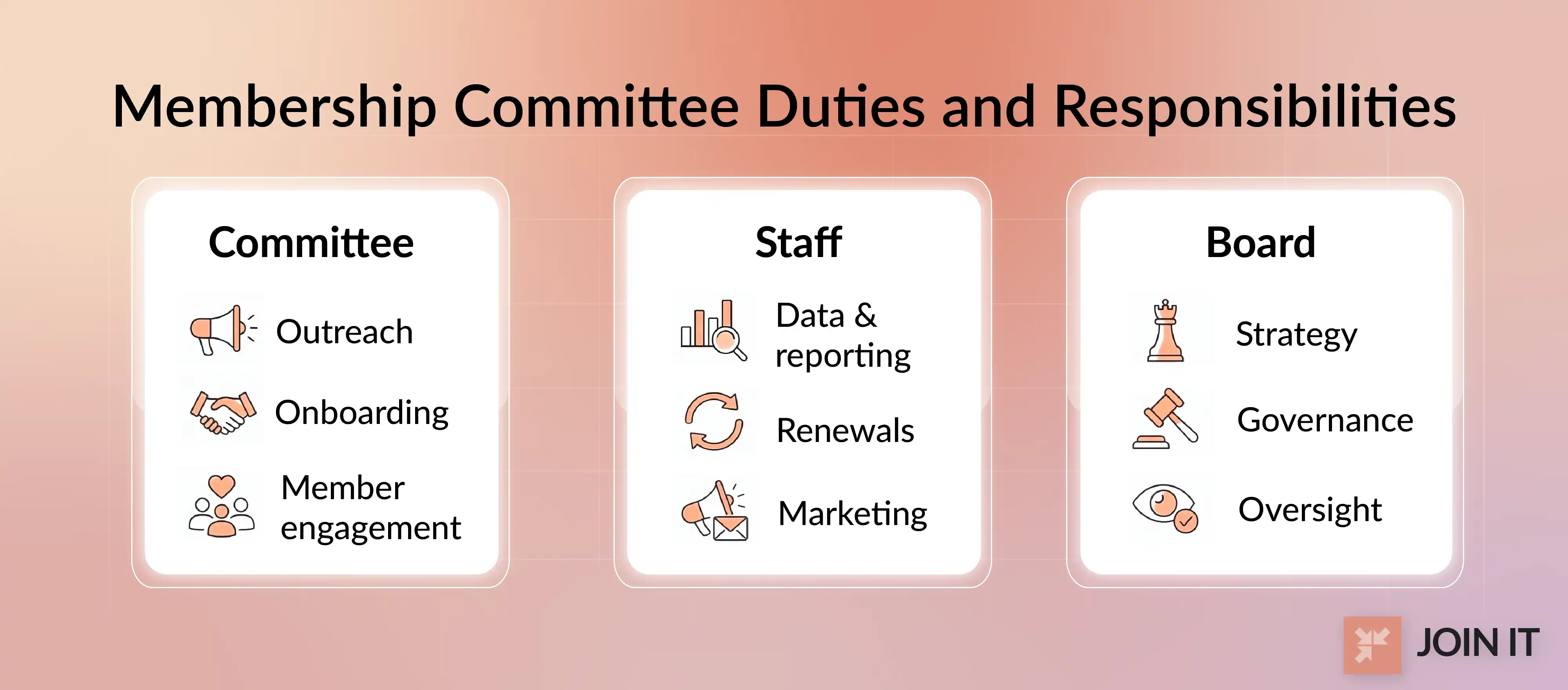
Here's how successful organizations typically split membership committee duties between committee, staff, and board:
Committee Owns:
- Welcome calls and new member outreach
- Member-get-a-member campaigns
- Lapsed member re-engagement
- Feedback collection and insights
- Event attendance at orientations
Staff Owns:
- Database management and reporting
- Renewal processing and invoicing
- Marketing email campaigns
- Website and join page updates
Board Owns:
- Setting strategic membership goals
- Approving dues structure changes
- Receiving quarterly committee reports
Clear boundaries prevent overlap and frustration.
Membership Committee Job Description (Copy/Paste)
If you're recruiting committee members, here's a ready-to-use membership committee job description:
- Attend monthly committee meetings (1 hour, virtual or in-person)
- Complete 2-3 welcome calls per month to new members
- Participate in one member recruitment event per quarter
- Review monthly membership reports and provide insights
- Support annual membership drive with outreach tasks
- Serve a 1-year term (renewable once)
- Time commitment: 3-5 hours per month
Membership Committee Roles and Responsibilities
Membership Committee Positions
The minimum viable membership committee? A chair plus 1-2 active members.
The ideal committee structure includes these membership committee positions:
- Chair - Sets priorities, delegates tasks, reports to board
- Outreach Lead - Manages welcome calls and lapsed outreach
- Onboarding Lead - Coordinates orientation events and first-timer experiences
- Research Lead - Runs surveys and compiles insights
- Partnerships Lead - Manages referral programs and community partnerships (if relevant)
Membership Committee Chair Responsibilities
Think of the chair as the "mini CEO of member outcomes."
The membership committee chair responsibilities include:
Weekly:
- Check membership dashboard (new joins, renewals, lapses)
- Follow up on action items from last meeting
Monthly:
- Run the committee meeting
- Assign 2 priority actions with owners and deadlines
- Communicate with staff liaison
Quarterly:
- Report results to the board
- Review and adjust the annual plan
- Celebrate wins and recognize committee members
A Membership Committee of Three is Formed
For small organizations, when a membership committee of three is formed, here's how to split the work:
- Person 1 (Chair): Recruitment pipeline and outreach campaigns
- Person 2: Onboarding, welcome calls, and first-timer events
- Person 3: Renewals, lapsed outreach, feedback, and monthly reporting
Keep scope tight. Each person owns 1-2 actions per month, not a laundry list.
As one volunteer described on Reddit, being the "sole member" of a membership committee with no handover feels like "eating an elephant" without a plan. Breaking tasks into small, focused actions prevents burnout.
Membership Committee Charter (Template + How to Write It)
What to Include in a Membership Committee Charter
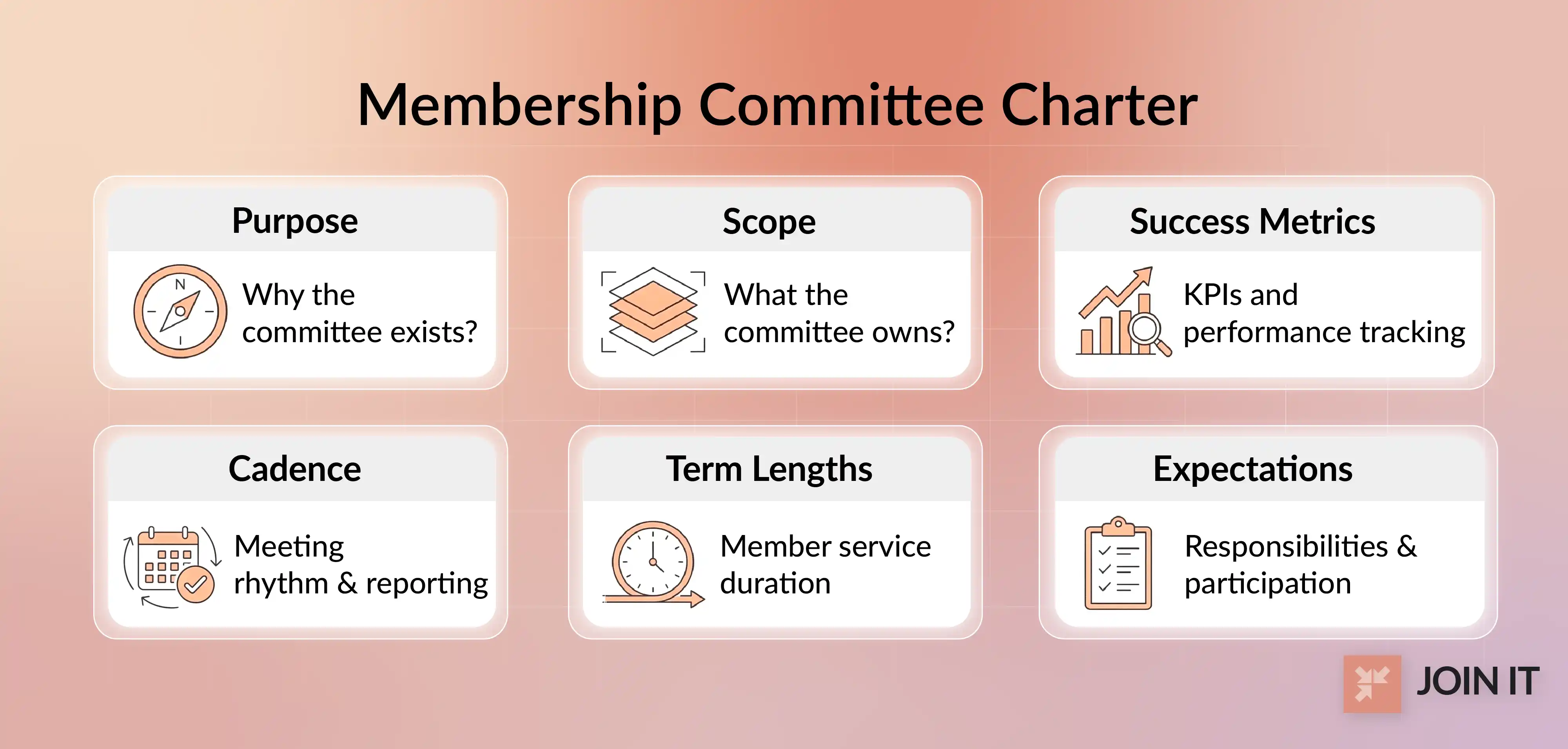
A membership committee charter keeps everyone aligned. Include these six fields:
- Purpose - Why this committee exists (one sentence)
- Scope - What you own vs. what staff/board owns
- Success metrics - KPIs you'll track (joins, renewals, survey scores)
- Cadence + reporting - Meeting frequency and how you report to the board
- Term lengths - How long members serve (e.g., 1 year, renewable once)
- Expectations - Attendance, response time, confidentiality
Membership Committee Charter Template
Here's a fill-in template you can adapt:
Membership Committee Charter
Purpose: To grow and retain membership by improving member value, streamlining onboarding, and maintaining strong engagement.
Scope: The committee owns recruitment campaigns, welcome calls, lapsed outreach, and feedback collection. Staff owns database management and renewal processing.
Success Metrics:
- Net membership growth of [X]% annually
- Renewal rate above [X]%
- New member welcome call completion rate above 80%
Cadence: Monthly meetings (1 hour). Quarterly reports to the board.
Term Lengths: 1-year terms, renewable once. Staggered so 1/3 rotate annually.
Expectations: Attend 10 of 12 meetings. Complete assigned actions. Maintain member confidentiality.
Annual Plan:
- Q1: Launch new member welcome workflow
- Q2: Run spring membership drive
- Q3: Survey members + refine value proposition
- Q4: Lapsed member win-back campaign
Membership Committee Goals, Objectives, and KPIs
Membership Committee Goals
Effective membership committee goals are measurable, not vague. Here are examples:
- Increase net membership by 15% in the next 12 months
- Improve renewal rate from 78% to 85%
- Complete welcome calls with 90% of new members within 10 days
- Re-engage 25% of lapsed members through quarterly outreach
- Achieve an average member satisfaction score of 4.2/5
Membership Committee Objectives
Objectives break goals into actionable steps. Here's the difference:
Weak Objective: "Improve member engagement" Good Objective: "Host 2 networking events per quarter with 30+ attendees each"
Weak Objective: "Get more members" Good Objective: "Run a member-get-a-member campaign in Q2 generating 20 referrals"
Membership Committee KPIs
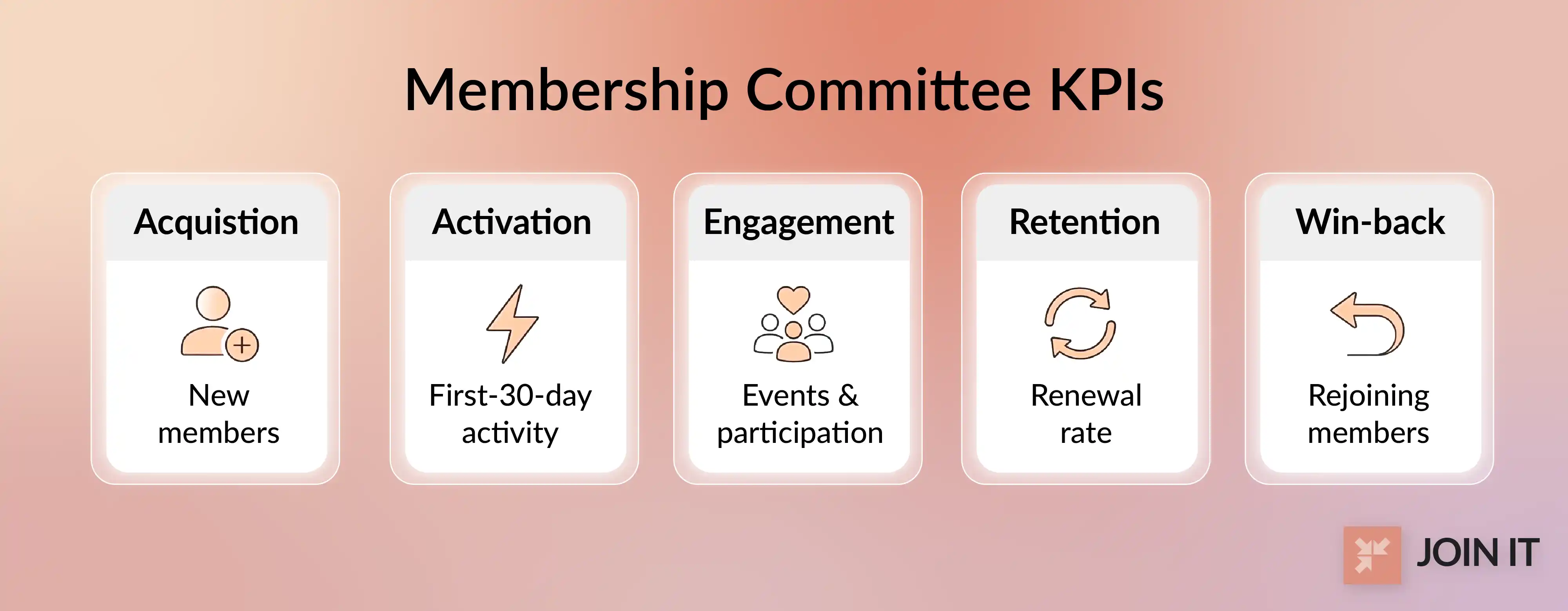
Track these membership committee metrics monthly:
- Acquisition: New members added
- Activation: % of new members who attend an event or use a benefit in first 30 days
- Engagement: Event attendance rates, volunteer participation
- Retention: Renewal rate percentage
- Win-back: % of lapsed members who rejoin
Membership Committee Mission Statement
A clear membership committee mission statement keeps the team aligned. Here are templates for different organization types:
- Association: "To grow our professional community by attracting qualified members, delivering exceptional value, and maintaining strong retention through engagement and support."
- Nonprofit: "To expand our mission's reach by welcoming new supporters, fostering meaningful connections, and ensuring every member feels valued and engaged."
- Club: "To build a thriving membership through personal outreach, inclusive events, and a welcoming culture that encourages participation."
Membership Recruitment Plan (How the Committee Grows Membership)
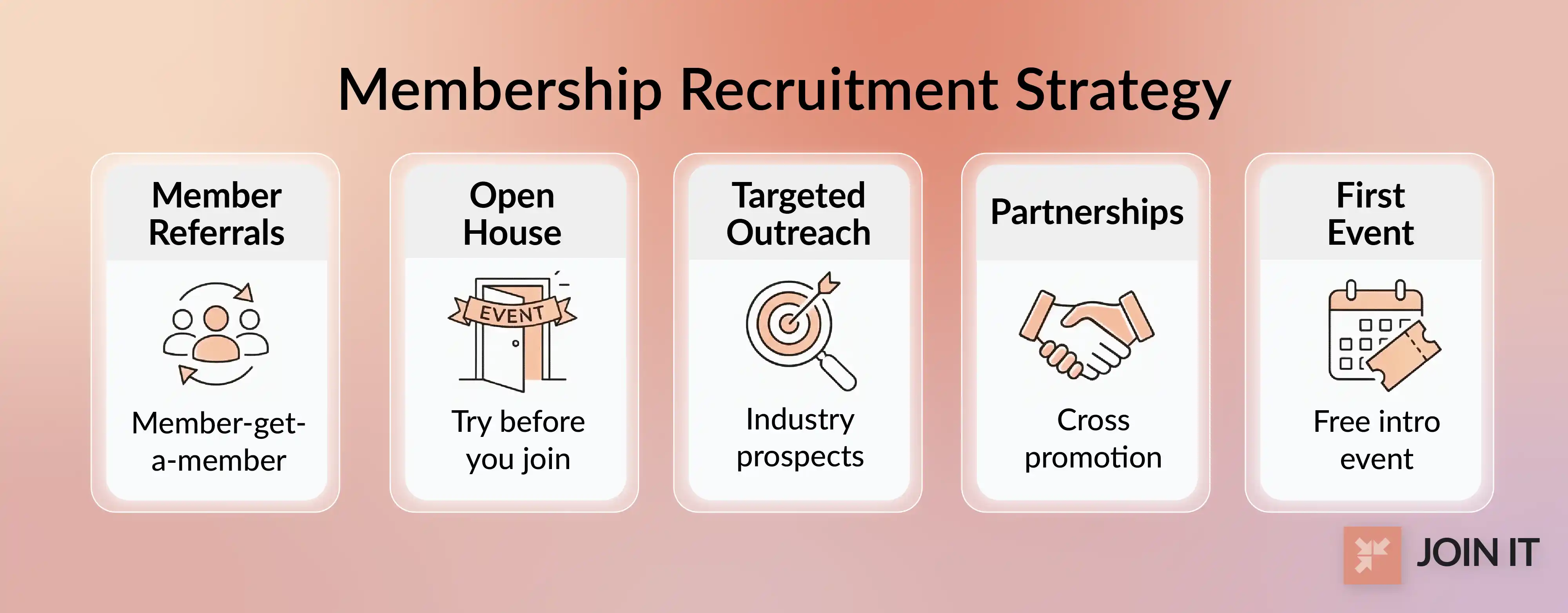
Membership Recruitment Strategy
Strong membership recruitment strategies combine multiple plays into an effective recruitment campaign:
- Member-get-a-member campaign - Current members refer friends, get recognition or perks
- Membership open house - Low-barrier "try before you join" events
- Targeted outreach - Identify prospects in specific industries or demographics
- Partnerships - Cross-promote with aligned organizations
- "First event" welcome path - Let prospects attend one event free before asking them to join
The key: don't rely on one tactic. Mix several and track which converts best.
Prospective Member Outreach (Scripts)
Here's a simple email template for prospective member outreach:
Subject: You'd be a great fit for [Organization Name]
Hi [Name]
I'm [Your Name], part of the membership committee at [Organization]. We focus on [brief value proposition].
I noticed you [specific detail: attended our event, work in our field, were referred by a member]. I think you'd get a lot from our [specific benefit: monthly workshops, networking community, exclusive resources]
Would you be open to a quick 10-minute call this week? I'd love to share what we're about and answer any questions.
Best, [Your Name]
Membership Drives (Run It Without Burnout)
A successful membership drive follows a 30-day timeline with clear owners and focused recruitment efforts:
- Week 1: Announce the drive, send email to current members asking for referrals
- Week 2: Host an open house or virtual info session
- Week 3: Committee members make personal outreach calls to warm prospects
- Week 4: Final push with deadline messaging, celebrate new joins
The "two actions only" rule: Each committee member completes just two specific tasks during the drive (like 5 calls or 1 event). No one gets overwhelmed.
New Member Onboarding (Welcome + First 30 Days)
New Member Onboarding Checklist
This new member onboarding checklist follows a simple 3-step workflow:
Day 0-2:
- Send welcome email with login info
- Attach "How to Use Your Benefits" one-pager
- Introduce committee member who will call
Day 3-10:
- Committee member makes welcome call
- Ask: "What made you join?" and "What are you hoping to get from membership?"
- Collect 1-2 notes in shared tracker
Day 14-30:
- Invite to first-timer event or intro call
- Introduce to 2-3 members with similar interests
To make sure new sign-ups stick around, pair your committee process with new member onboarding tips that build early momentum.
Welcome Call Script for New Members
Use this simple welcome call script:
"Hi [Name], this is [Your Name] from the membership committee. I wanted to personally welcome you and make sure you know how to get the most from your membership."
Ask 5 questions:
- What made you decide to join?
- What are you hoping to get from membership?
- Have you had a chance to explore [specific benefit]?
- Are you interested in getting involved as a volunteer?
- Any questions I can answer right now?
"Great talking with you. I'll follow up with an email introducing you to [specific resource/person]. Looking forward to seeing you at [upcoming event]."
Follow-up email template: Summarize the call, attach relevant resources, invite to next event.
Member Engagement Plan (Keep Members Active)
Member Engagement Plan
Segment your engagement by member type:
- New members (0-90 days): Onboarding focus, introductions, first event invites
- Active members: Recognition programs, volunteer opportunities, advanced programming
- Silent members: Re-engagement surveys, personal outreach, "we miss you" messages
- At-risk members: Pre-renewal check-ins, feedback calls, value reminders
For ongoing participation beyond onboarding, sprinkle in a few member engagement ideas your committee can run monthly or quarterly.
Member Recognition Programs + Member Networking Events
Here are 10 member engagement ideas grouped by effort level:
Easy (1-2 hours setup):
- Monthly member spotlight in newsletter
- Birthday/anniversary emails
- Social media shout-outs for milestones
Medium (half-day effort):
- Quarterly virtual coffee chats
- Annual awards ceremony
- Member-led skill-sharing sessions
Heavy (multi-week planning):
- Regional networking dinners
- Annual conference or retreat
- Mentorship program launch
- Ambassador or "super-volunteer" program
Membership Renewal Strategy (Retention + Lapsed Outreach)
Membership Renewal Strategy + Membership Renewal Drive
A strong membership renewal strategy and retention plan uses timed messaging touches:
- 60 days before expiration: "Your membership renews soon" email with value recap
- 30 days before: Personal email from committee member highlighting upcoming events
- 7 days before: Reminder with easy renewal link
- Expiration day: "Last chance to renew" message
- 7 days after lapse: "We noticed you didn't renew" check-in
Since committees are often accountable for renewals, link to ways to retain members and reduce churn as your playbook for keeping members longer.
Lapsed Member Outreach
Don't let lapsed members disappear silently. Try:
- Monthly outreach attempts: 5-15 personal emails or calls to lapsed members
- Quarterly pulse survey: Ask why they left and what would bring them back
- "Top 3 insights" in every meeting: Share what you're learning from lapsed feedback
If the committee also re-engages past members, this resource on winning back lost members fits perfectly in a "recruitment + retention" strategy section.
Member Satisfaction Survey + Member Needs Assessment
Use these 8-12 questions in your member satisfaction survey:
Value Questions:
- How satisfied are you with your membership? (1-5 scale)
- Which benefits do you use most often?
- What new benefits would you like to see?
Experience Questions:
- How easy was it to join and get started?
- How well does our organization communicate with you?
- How would you rate our events/programming?
Friction Questions:
- What frustrates you about membership?
- What barriers prevent you from participating more?
Priorities Questions:
- What's the #1 thing we should improve?
- How likely are you to renew? (1-10 scale)
- Would you recommend us to a colleague?
Committees improve faster when they listen. Use methods for collecting member feedback to create a simple feedback loop.
Meetings and Operating Rhythm
Membership Committee Meeting Frequency
Recommended membership committee meeting frequency by organization size:
- Under 100 members: Monthly (1 hour)
- 100-500 members: Monthly with quarterly deep-dives (1.5 hours)
- 500+ members: Monthly meetings + async updates in shared workspace
To keep communications consistent without overwhelming members, this guide to the right member communication cadence is a smart reference.
Membership Committee Meeting Agenda (Template)
Use this 5-part membership committee meeting agenda template:
1. Numbers (10 minutes)
- New joins this month
- Renewals vs. lapses
- Trend vs. last month/year
2. Insights (15 minutes)
- Top 3 things we learned from surveys or outreach
- Patterns in why people join or lapse
3. Decide Next 2 Actions (20 minutes)
- What are the 2 highest-impact actions this month?
- Who owns each? What's the deadline?
4. Risks/Blockers (10 minutes)
- What's preventing progress?
- What do we need from staff or board?
5. Report-Out Plan (5 minutes)
- What goes in the board report?
- Who writes it?
Membership Committee Minutes + Committee Action Items
Keep meeting minutes simple:
- Date and attendees
- Key numbers reviewed
- Decisions made (not full discussion notes)
- Action items with owners and deadlines
- Next meeting date
Use a shared action tracker (spreadsheet or project tool) for committee accountability so nothing falls through the cracks.
Membership Committee Report (and Report Example)
Membership Committee Report (Monthly)
Use this 1-page membership committee report template:
Membership Committee Report - [Month, Year]
Scoreboard:
- Total members: [number] ([+/- X from last month])
- New joins: [number]
- Renewals: [number] ([X]% renewal rate)
- Lapses: [number]
Insights:
- Top 3 things we learned this month
- Why people joined or left
Experiments:
- What we tested (welcome call workflow, referral campaign, etc.)
- Results so far
Risks:
- Concerning trends
- Blockers to progress
Asks from Board/Staff:
- Budget for X
- Approval for Y
- Support with Z
Membership Committee Report Example
Here's what a filled-out membership committee report example might look like:
Scoreboard:
- Total members: 487 (+12 from last month)
- New joins: 18
- Renewals: 34 (89% renewal rate)
- Lapses: 6
Insights:
- 85% of new members who received a welcome call attended an event within 30 days
- Lapsed members cited "too busy" more than cost
- Referrals from current members convert at 3x the rate of cold outreach
Experiments:
- Launched quarterly virtual coffee chat (22 attendees, positive feedback)
- Testing earlier renewal reminders (60 days vs. 30 days)
Risks:
- Renewal rate dipped in Q3 (investigating)
Asks:
- Approve $500 budget for spring membership drive
- Staff support to update join page on website
Common Problems and Dealbreakers (From Real Users)
Volunteer Burnout + "No Handover"
Volunteer burnout is the top complaint in membership committees.
Red flags:
- One person doing all the work
- No documentation when members rotate off
- Vague responsibilities that expand over time
The fix:
- Use scripts and templates for repetitive tasks
- Keep committee scope small (2 actions per month per person)
- Build a shared playbook with everything documented
- Stagger terms so institutional knowledge doesn't vanish
Tooling Mismatch (Spreadsheets, Rotating Volunteers, CRM Friction)
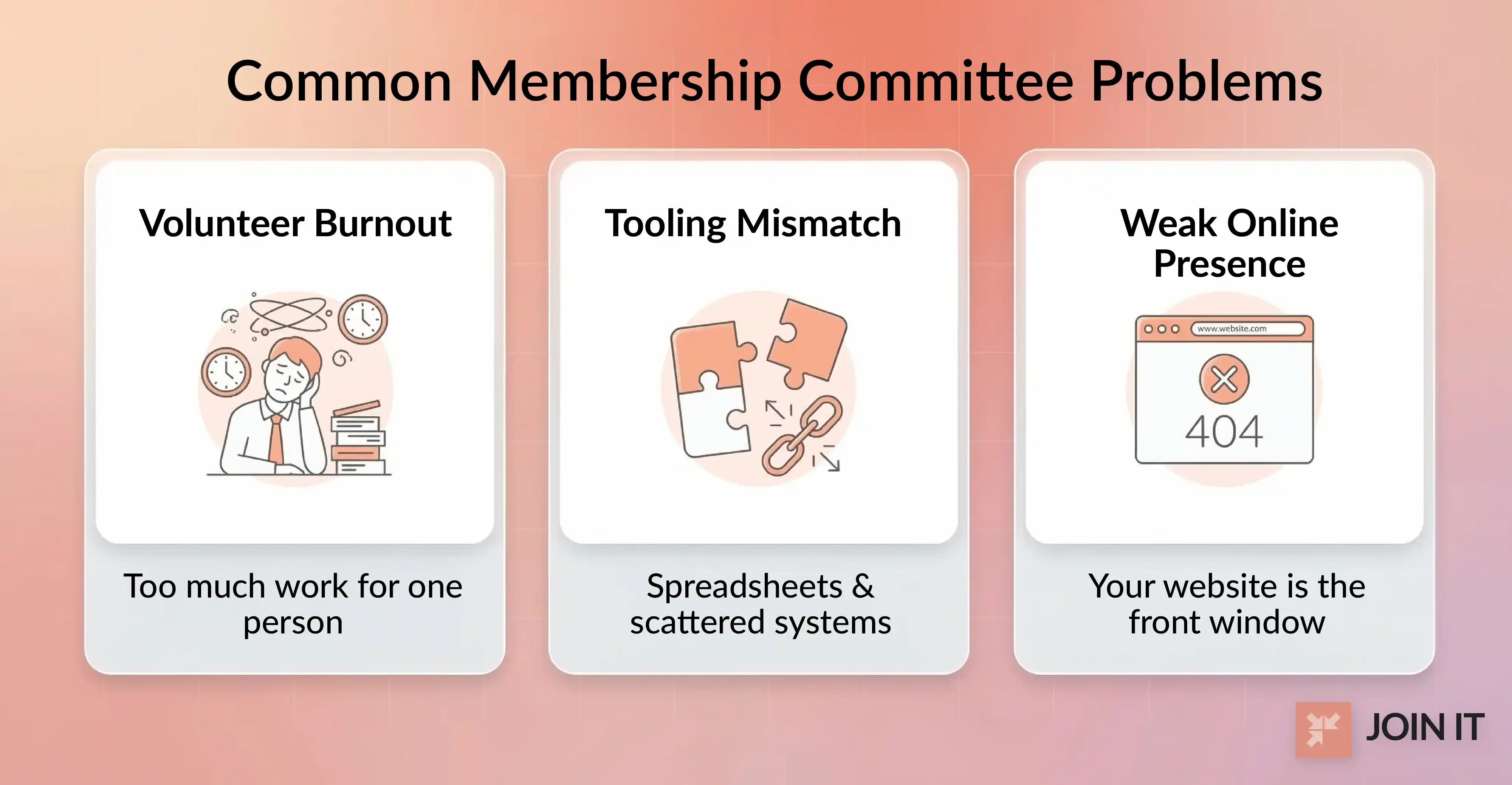
As one volunteer explained on Reddit, professional CRMs often don't fit committees because "volunteers rotate in and out" and per-seat fees don't make sense for low usage.
Meanwhile, another club member said their volunteer-run committee manages everything with spreadsheets and separate tools that "do not work with each other."
This fragmentation frustrates both staff and volunteers.
The fix: Centralize core functions (member list, renewals, email, events) in one lightweight platform designed for volunteer-run organizations. Join It can support this workflow for committees who need simple, affordable tools without enterprise complexity.
Your Website is the "Front Window"
As one church committee member stressed: "I can't overemphasize the importance of an up-to-date online presence. When are services, how do I get there... Having a good 'front window' for them to peek in is so important."
They noted that by the time a prospect visits, people are already "90-95% sure" they'll join based on their online investigation.
The committee's job: Make sure join info is accurate, timely, and welcoming.
Committee Continuity (Recruitment, Rotation, Onboarding)
Recruit Committee Members Like a Product Team
The best committees represent diverse member segments and bring different viewpoints.
When recruiting:
- Set clear terms (1 year, renewable once)
- Recruit from different segments: new members, long-timers, different chapters or locations
- Look for reliability, outreach comfort, and data mindset (not just enthusiasm)
- Create a lightweight onboarding pack: charter, KPIs, scripts, contact list
Committee Onboarding / Induction Pack
A simple committee onboarding and induction pack includes:
- 1-page committee charter
- Current membership dashboard
- Folder of templates (welcome emails, call scripts, survey questions)
- List of current actions and owners
- "Shadow month" where new members observe before leading tasks
Staggered Terms (So the Committee Doesn't Reset)
Rotate one-third of committee members each year to preserve institutional memory.
Why it works: If everyone leaves at once, you lose relationships, momentum, and knowledge. Staggered terms are a widely recommended governance practice to prevent disruption.
Example: A 6-person committee rotates 2 members annually. Always 4 experienced members, 2 new ones.
Organization-Specific Quick Guides
Whether you're running an association membership committee, nonprofit volunteer group, or church welcoming team, core principles remain the same while tactics adjust to your context.
Nonprofit Membership Committee Responsibilities
For nonprofits, membership committees often focus on:
- Volunteer-first recruitment (members as advocates)
- Retention through mission alignment
- Lower-cost engagement tactics (virtual events, peer connections)
- Tracking mission impact alongside membership growth
Church Membership Committee Responsibilities
Church membership committee responsibilities emphasize:
- Hospitality and welcoming newcomers
- Integration into community (small groups, volunteer roles)
- Follow-up after first visits
- Supporting pastoral care and member connection
Club Membership Committee
Club membership committees keep it simple:
- Easy join process (online and offline options)
- Member connection events (social gatherings, activities)
- Tracking attendance and participation
- Lightweight tools (spreadsheets often work for small clubs)
Chamber of Commerce Membership Committee
Chambers tie membership to business value:
- Business networking events and mixers
- Sponsorship and partnership opportunities
- ROI messaging (leads, visibility, connections)
- Committee members as ambassadors at ribbon cuttings and events
Rotary Club Membership Committee Manual
A Rotary club membership committee manual typically includes:
- Clear membership committee roles (chair, sponsors, greeters)
- Monthly outreach cadence expectations
- Onboarding checklist for new Rotarians
- Tracking system for prospects and active members
- Connection to Rotary's membership resources and toolkits
Membership Committee Interview Questions (To Recruit the Right People)
Membership Committee Interview Questions
Use these membership committee interview questions grouped by focus area:
Reliability/Time:
- Can you commit to monthly 1-hour meetings for the next year?
- What's your typical availability for volunteer work?
- Have you served on a committee before? What was your experience?
Outreach Comfort:
- How comfortable are you making phone calls to new or lapsed members?
- Describe a time you successfully recruited someone to join something.
- What would you say to a prospect who asks "Why should I join?"
Communication:
- How do you prefer to communicate with a team (email, Slack, calls)?
- Describe your approach to giving and receiving feedback.
Data Mindset:
- Are you comfortable tracking numbers and identifying trends?
- How would you measure if a membership campaign was successful?
- What membership metrics do you think matter most?
Simple Scoring Rubric
Score each answer 1-3:
- 1 = Weak: Vague, no examples, unclear commitment
- 2 = Good: Clear answer, some relevant experience
- 3 = Strong: Specific examples, enthusiastic, aligned with needs
Red flag answers:
- "I'm not sure I can commit to monthly meetings"
- "I'm not comfortable making phone calls"
- "I don't really like working with numbers"
- "I just want to help but I'm really busy"
Look for people who score 2+ across all categories and show genuine interest.
FAQs
What is a membership committee?
A membership committee is a volunteer group responsible for recruiting new members, onboarding them effectively, keeping them engaged, and improving retention rates. It owns measurable outcomes, not just brainstorming ideas.
What does a membership committee do?
A membership committee handles recruitment campaigns, welcome calls, new member orientation, engagement events, renewal outreach, lapsed member re-engagement, satisfaction surveys, and reporting membership trends to leadership.
What are membership committee responsibilities?
Membership committee responsibilities include running recruitment drives, conducting welcome calls, hosting onboarding events, collecting member feedback, tracking retention metrics, re-engaging lapsed members, and reporting results to the board.
What is a membership committee charter?
A membership committee charter is a 1-2 page document that defines the committee's purpose, scope, success metrics, meeting cadence, term lengths, and member expectations. It prevents mission drift and keeps everyone aligned.
How often should a membership committee meet?
Most membership committees meet monthly for 1 hour. Larger organizations may add quarterly deep-dive sessions or use async updates between meetings. Small committees can meet every 6-8 weeks if needed.
What should a membership committee report include?
A membership committee report should include current membership numbers, new joins and renewals, insights from feedback, experiments or campaigns run, risks or challenges, and specific asks from the board or staff.
Start Here: Your First Month Checklist
If you're launching or revitalizing a membership committee, do these four things this month:
- Draft your charter - Use the template above, fill in the blanks, get board approval
- Pick 2 actions - Don't try to fix everything. Choose welcome calls + renewal messaging, or survey + lapsed outreach. Start small.
- Launch the welcome call workflow - Assign one committee member to call every new member within 10 days. Track completion rate.
- Add the report template - Start tracking numbers monthly so you can show progress in 90 days
The organizations seeing membership growth aren't doing anything magical. They're running structured, accountable committees with clear systems.
You can do the same.
Ready to streamline your membership committee workflow? Get a free demo or start a free trial to see how Join It helps committees manage members, events, and renewals in one simple platform.
References
- ASAE. WBL membership doubled case study
- Associations Now. MGI 2023 membership benchmarking report
- Associations Now. New member acquisition data
- ASAE. Community Brands member lapse study
- Cuseum. MGI renewal rate statistics
- Glue Up. Membership committee value proposition
- Reddit. UU church volunteer burnout discussion
- Reddit. CRM challenges for volunteer committees
- Reddit. Club membership software discussion
- Reddit. Website as front window for prospects
- Reddit. Prospect decision-making behavior

Guides from the Experts
Through our work with 4,000+ organizations - we’ve put together helpful guides to assist; regardless of where you are on your journey.
.webp)

A Complete Guide to Membership Organizations
Everything you need to know to manage and grow your membership business
.webp)
Maximize Membership Retention: 10 Proven Strategies
Tried and true strategies that not only win membership, but keep them

Build a Membership Website: A Step-by-Step Guide
Your one-stop resource for knowing all the features your modern membership website needs
Ready to start your free trial?
Our membership software is intuitive to use and even easier to test for yourself.