How to Win Back Lost Members


Most lost members didn't leave in one dramatic moment.
They drifted. A card failed. They forgot to renew. Or they stopped seeing enough value to bother clicking that link when renewal time came around.
That's the real story behind most membership churn. And it means winning back lost members is less about a perfectly crafted email and more about understanding why someone left before you send anything at all.
This article covers the strategies, messages, and system fixes that help membership organizations win back lapsed members and bring former members back for good. If you're also working on the upstream problem, start here to improve member retention before churn compounds.
Key Takeaways
- Most lost members didn't make a deliberate choice to leave. Forgetfulness, friction, and payment failures cause more lapse than conscious cancellation.
- "Lost member" is not one audience. Inactive, past-due, expired, and canceled members each need a different response.
- The best win-back starts before expiration. Reaching members 60 to 90 days out with value, not an invoice, prevents most avoidable lapse.
- A lapse reason is more valuable than a default discount. Until you know why someone left, every message is a guess.
- 25% of lapsed subscriptions fail because of a payment issue, not a decision. Many are recoverable with a simple card update.
- First-year members and long-tenured members need different messages. One needs orientation. The other needs recognition.
- The return path must be easier than the original signup. Friction at re-entry is one of the most common reasons win-back fails quietly.
- Win-back is a repeatable system, not a one-time email blast. Organizations that treat reactivation as an ongoing motion outperform those that treat it as a campaign.
- Join It is rated Excellent on Trustpilot, giving membership organizations the tools to automate lapsed member outreach, recover failed payments, and bring former members back without the manual follow-up.
How to Win Back Lost Members: The 8-Step Short Answer
Before going deep, here's the fast version:
- Define whether the member is inactive, past due, expired, or canceled
- Ask why they left before you guess
- Segment lapsed members by tenure, engagement, and payment state
- Start the win-back campaign before expiration, not after
- Remove renewal friction and recover failed payments fast
- Send short, personalized win-back emails with one clear CTA
- Add phone or personal outreach for high-value members
- Track reactivation and fix the system that caused the lapse
Simple list. Hard execution. The rest of this article shows you how.
Not All Lost Members Are the Same
Here's where most win-back campaigns fail from the start.
They treat every lapsed member as one audience.
But "lost members" is actually four distinct groups:
- Inactive members who are still technically current but have stopped engaging
- Past-due members whose payment failed but who never consciously canceled
- Expired or lapsed members who missed the renewal window
- Canceled members who made a deliberate choice to leave
An expired card is not a rejection. A canceled membership might be. And an inactive-but-paying member is a retention problem, not a win-back problem yet.
Getting this right before writing a single email is the single most important step. It's how you build and maintain one organized member database that actually tells you who needs what kind of outreach.
Retention prevents the lapse. Renewal is the conversion moment. Win-back happens after someone has already fallen out of your active file. These are related but distinct stages of the member lifecycle, and they are not the same thing.
Why Members Leave (And Why It's Rarely Just One Reason)
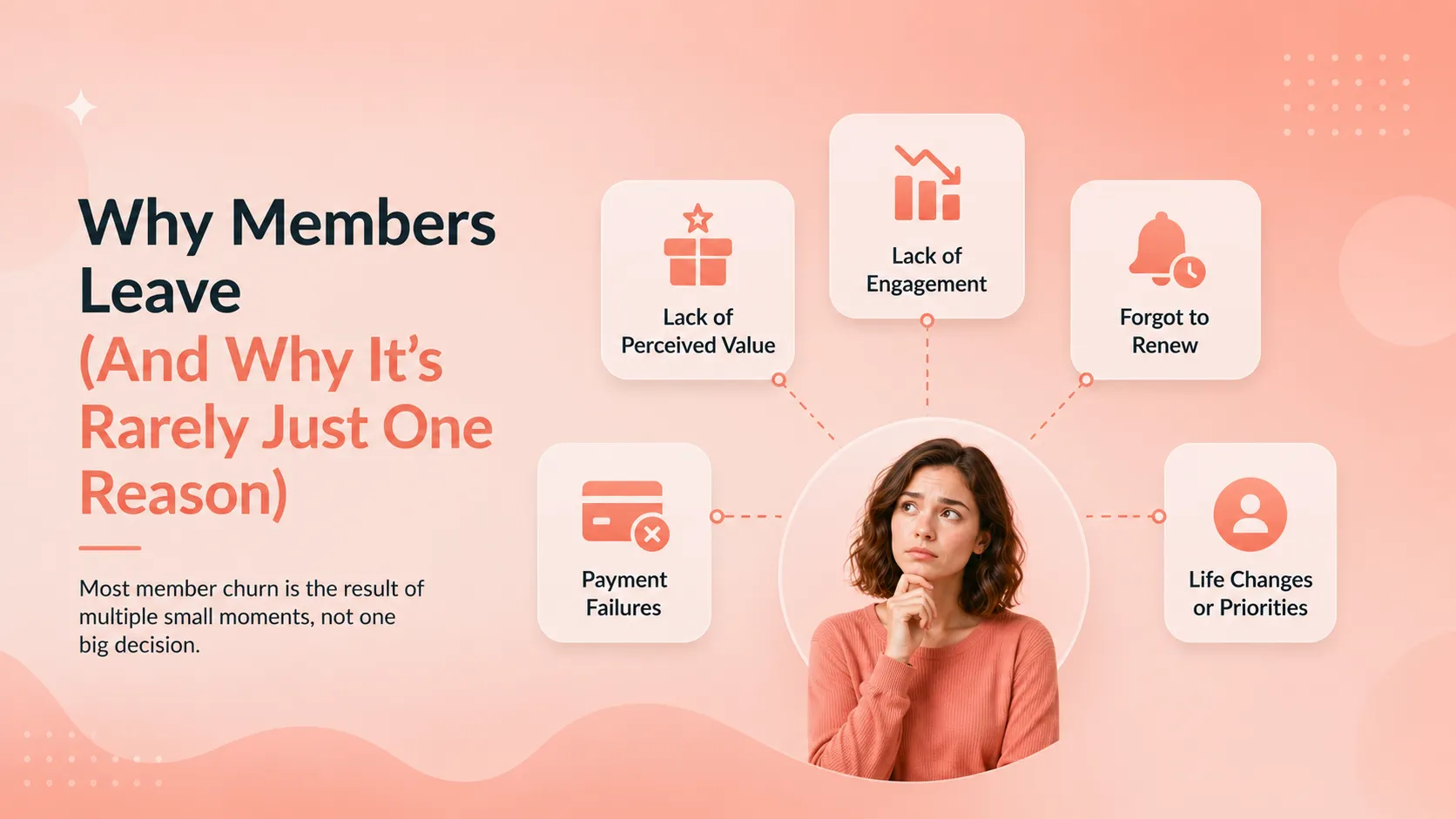
Most organizations guess at why members lapse.
That's a problem, because the reasons vary more than most teams expect.
The most common reasons: lack of engagement, lack of perceived value, forgetting to renew, leaving the field, and employer nonpayment of dues. Those are five different problems requiring five different solutions.
On top of that, 25% of lapsed subscriptions are due purely to payment failures, according to Stripe research on involuntary churn. One in four "lost members" never actually decided to leave. Their card failed and nobody caught it in time.
Then there's the friction problem. Members on WildApricot forums have described renewal experiences with phrases like "I tried to renew online and gave up." That's not a value problem. That's a workflow problem.
The honest breakdown falls into four categories: value and engagement decay, renewal friction, payment failures, and life changes, each one driving member attrition in a different way. If you want to genuinely reduce member churn, you need to know which category is hitting your organization hardest, because the fix is completely different each time.
What High-Renewal Organizations Do Differently
Some organizations consistently hit 80% renewal rates. Others struggle to break 60%.
What separates them?
73% of associations reported overall renewal rates of 80% or higher, per the 2024 MGI Benchmarking Report. The ones hitting those numbers aren't just sending better emails. They're operating differently at a systems level.
They build a membership renewal campaign that starts 60 to 90 days before expiration. They use automated renewal reminders tailored to whether someone is on manual renewal or auto-billing. They segment their lists, send membership benefits reminders to members nearing renewal, and conduct regular member research.
And for their most valuable members? 30% of associations add phone calls from staff, board members, or chapter leaders to their reinstatement campaigns. Organizations with stronger renewal outcomes lean harder on human outreach for the right segments.
The lesson: the best time to win back a lost member is before they are fully gone. 🎯
How to Build a Member Win-Back Campaign That Actually Works
A win-back campaign is not a single email blast. It's a staged system.
The practical timeline looks like this:
Start around 60 to 90 days before expiration with a value-focused message that does not ask for money yet. One discussion in r/marketing captured this well: the biggest missed opportunity is "sending a thank-you or impact email 60 to 90 days before expiry that doesn't ask for anything."
Around 30 days out, move to a direct renewal ask with a clear link and a specific benefit recap. At 7 to 10 days, add urgency without guilt.
When someone lapses, don't go silent. In the first 7 to 14 days post-expiration, send a short note with one renewal button and one feedback link. If there's no response, the next step is to ask members why they left using a single-question lapsed member survey.
Beyond 90 days, shift former members into a lower-frequency reactivation track. Quarterly outreach or event-based invitations work better than continued high-pressure reminders at that stage.
Lapsed member segmentation makes all of this more effective. To segment members by status in a way that drives results, you need engagement history and lapse reason, not just renewal dates.
What to Say to Lapsed Members
Here's the truth about most lapsed member emails: they're generic.
They say "we miss you" without restating the member value proposition or explaining why coming back is worth it.
Subject lines containing "miss you" achieved a 13% read rate, according to the Return Path Email Win-Back Programs Report. Meaningful, but the deeper lesson is about specificity: shorter templates, one clear CTA, personalization using known data, and concrete offers outperform vague emotional appeals every time.
Match the message to the reason:
- Forgot to renew: Direct renewal link, no drama
- Didn't see enough value: Show one specific benefit or outcome they missed
- Stopped participating: Invite them back to a single event, class, or session
- Payment failed: Operational tone, update card, done
- Life change: Offer a lighter re-entry path or pause option
The strongest message framework is "what changed since you left." It's the most natural way to reconnect with former members, because it gives them something new to evaluate rather than a reminder of what they already walked away from.
To send the right message at the right time, your outreach needs to be matched to both the lapse reason and the member's history with your organization.
And if someone was a long-term member, a board volunteer, or a consistent contributor? Pick up the phone. Associations with stronger renewal outcomes use personal outreach strategically, not broadly.
Fix the Renewal System Before You Fix the Email
Great messaging is wasted on a broken renewal path.
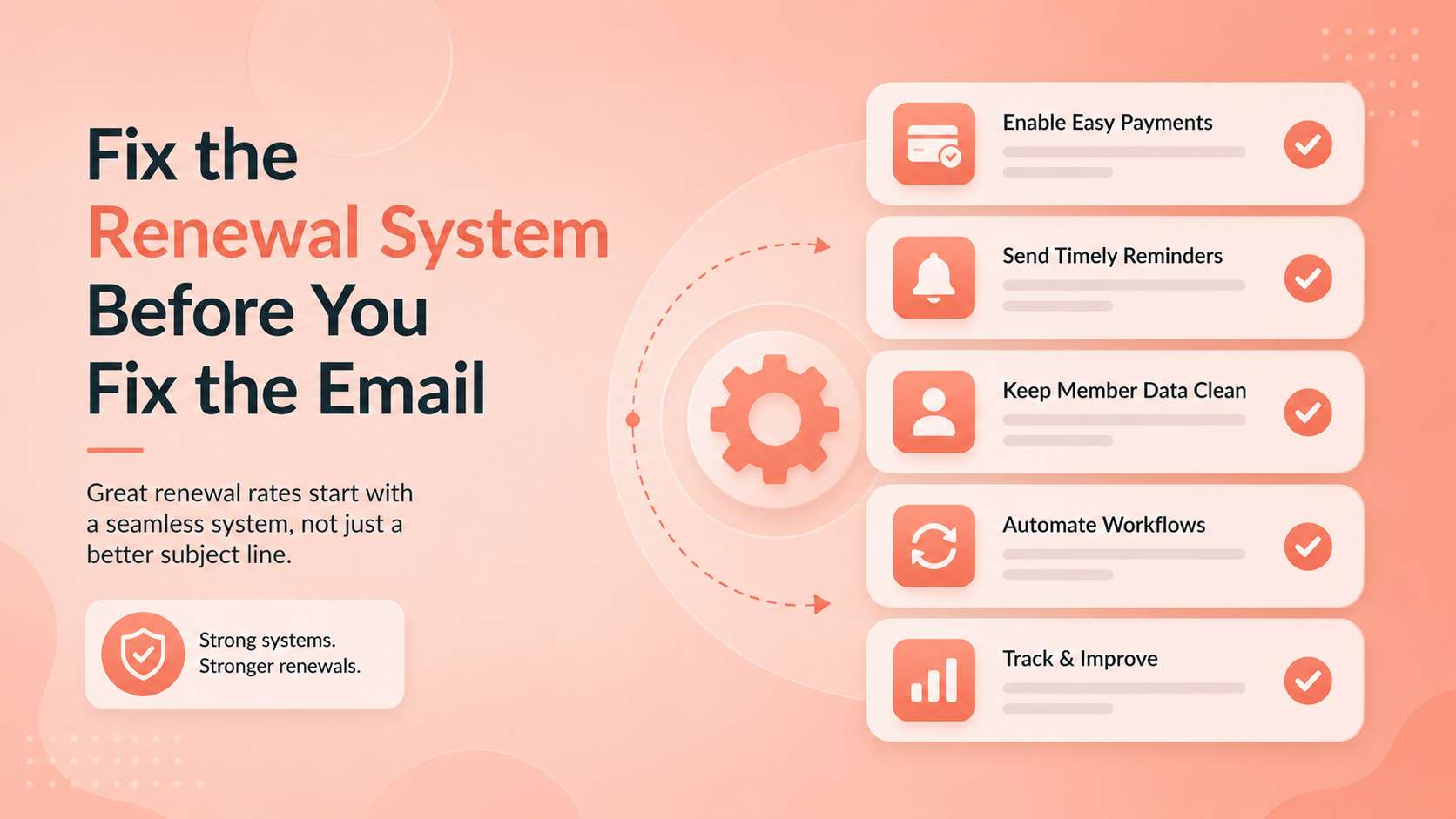
If a member needs to reset a password, fill out multiple forms, or navigate a confusing portal to come back, some of them will give up. Not because they don't want to rejoin. Because friction wins when motivation is only moderate.
Setting up failed payment notifications automatically recovers a meaningful chunk of involuntary churn before it even becomes a win-back problem. Stripe recommends up to 8 retries within two weeks, alongside automated customer emails and card-updater services.
You should also give members an easier way to update their profile and payment details through self-service. Expired membership renewal should always be simpler than the original signup process, not harder.
For stronger membership management routines, you need clean statuses, duplicate-free records, and contact data you can actually trust. If you can't tell an expired member from a canceled one in your database, segmentation and personalization both fall apart downstream.
Thinking about the full membership experience means seeing renewal friction as just one part of the journey. The organizations seeing strong reactivation results think about the whole member relationship, not just the sequence of emails at the end.
Win-Back Strategies by Organization Type
The core playbook is the same. The details change by sector.
Associations tend to lose members through weak value clarity and employer reimbursement issues, making association member retention more of a communication problem than a pricing one. Personal outreach from staff or chapter leaders works especially well for long-tenured former members.
Nonprofits often face a different challenge: members confuse donations and membership. One r/nonprofit thread captured it perfectly: "I thought I already supported you." Clear language and stewardship-based renewal framing help cut through that confusion.
Gyms and studios face a behavioral problem more than a messaging one. 57% of consumers cite social interaction and community as the primary reason they join a fitness community, per ABC Fitness research. A class invitation or coaching check-in often works better than a price reduction.
Alumni groups should prioritize alumni engagement before asking about dues. Communication, events, volunteering, and philanthropy are all distinct re-entry points worth exploring before any financial ask appears.
Chambers and clubs lose members most often when cost isn't justified by visible benefit. A concrete value reminder tied to a specific local opportunity outperforms a generic renewal notice almost every time.
When you can email expired or inactive members with messages tailored to their organization type and lapse reason, response rates improve significantly.
Measure Win-Back Like a Funnel, Not a One-Off Campaign
Here's a mistake worth avoiding.
Measuring win-back results by open rate alone tells you almost nothing useful. 64% of all email opens among nonprofits are now machine opens, according to M+R Benchmarks 2025, making open rate an increasingly unreliable primary signal.
What actually matters: reactivation rate by segment, member renewal rate after reinstatement, recovered dues revenue, payment recovery rate, and response rate by lapse reason.
Track what members do after they come back, because a solid member engagement strategy does not end at reactivation. Event attendance, check-ins, volunteer activity, and content usage are the real signals of whether someone has truly rejoined or just renewed on paper.
To keep member data organized in a way that supports this level of measurement, you need a system that tracks lifecycle stages, lapse reasons, and engagement history in one place.
Common Mistakes That Stop Organizations From Winning Members Back
A few patterns show up repeatedly in organizations that struggle with reactivation:
- Treating every lapsed member with one generic "we miss you" message
- Waiting months after expiration before reaching out
- Ignoring payment failures and labeling them as churn
- Leading every win-back offer with a discount before understanding the reason
- Making the rejoin process harder than the original signup
- Over-automating until members feel like database records, not people
One r/nonprofit commenter put it directly: automation had "separated the board from the membership so much that lapsed members got an email or two and then effectively disappeared."
The organizations that run a successful re-engagement campaign consistently catch disengagement early, act on lapse reasons, and make return genuinely easy.
FAQ: Winning Back Lost, Lapsed, and Inactive Members
What is the difference between lost, lapsed, and inactive members? Lost members have canceled or stopped responding entirely. Lapsed members missed renewal but may still be reachable. Inactive members are still current but have stopped participating. Each group needs different timing and tone.
When should you contact lapsed members? A sound lapsed member strategy starts before expiration. The best cadence begins 60 to 90 days out with a value-focused message, then escalates toward the renewal date with direct asks.
Should you offer a discount to win back canceled members? Only when price is genuinely the barrier. A discount doesn't fix low engagement, poor onboarding, or workflow friction. Understand the reason first, then match the offer to that reason.
What should a member exit survey ask? One question: "What is the main reason you didn't renew?" Keep options simple: didn't see enough value, forgot to renew, cost, life change, payment problem, left the field, or other. Short is better. Long exit forms suppress response at exactly the moment you need signal most.
What is the best channel for a member win-back campaign? Email is the default. 77% of associations say email is the most effective reinstatement channel, per the 2024 MGI Benchmarking Report. For high-value or long-tenured members, phone outreach from staff or board members adds meaningful lift.
Your Win-Back Checklist Before the Next Email Goes Out
- Lifecycle statuses defined and accurate in your database
- Inactive, past-due, expired, and canceled members separated into distinct segments
- Exit survey or lapse reason captured where possible
- Members segmented by tenure, engagement history, and payment state
- Win-back sequence starts before expiration, not after
- Each message matched to the likely lapse reason
- Failed payments being recovered through automated retries and card updates
- Renewal path tested for friction on desktop and mobile
- Post-win-back engagement tracked at 90 and 180 days
- Former members kept in a reactivation segment for ongoing quarterly outreach
If this level of member lifecycle management sounds like a lot to handle manually, there is membership management software built for these workflows that makes it significantly easier to automate reminders, recover failed payments, and track reactivation results in one place.
Ready to put this into practice? Start a free trial and see how much of your win-back process you can put on autopilot today.
Sources
- Stripe. Smart Retries
- Marketing General Incorporated. 2024 Membership Marketing Benchmarking Report
- Validity / Return Path. Email Win-Back Programs Report
- ABC Fitness. Fall 2025 Wellness Watch Report
- M+R. Benchmarks 2025: Key Findings

Guides from the Experts
Through our work with 4,000+ organizations - we’ve put together helpful guides to assist; regardless of where you are on your journey.
.webp)

A Complete Guide to Membership Organizations
Everything you need to know to manage and grow your membership business
.webp)
Maximize Membership Retention: 10 Proven Strategies
Tried and true strategies that not only win membership, but keep them

Build a Membership Website: A Step-by-Step Guide
Your one-stop resource for knowing all the features your modern membership website needs
Ready to start your free trial?
Our membership software is intuitive to use and even easier to test for yourself.