New Member Onboarding: 15 Tips That Actually Work



You spent weeks convincing them to join. They said yes. And then you sent one welcome email, went quiet for two months, and wondered why they didn't renew.
That's the new member onboarding problem nobody talks about.
Definition: The structured process of welcoming, guiding, and activating new members from the moment they join through their first weeks and months, until they feel genuinely connected and confident in their membership. The two outcomes you're measuring: new member engagement and first-year retention.
What this covers: 15 practical, research-backed tips ordered from foundation to execution to follow-through, plus a common mistakes table, a measurement framework, and a FAQ built around the questions real members and admins are actually asking.
Who this is for: Membership managers, association staff, club administrators, and community leaders at any organization, whether you're running an association, a club, a nonprofit, a chamber of commerce, or any type of membership group, who wants more new members to stick around past year one.
Key Takeaways
What Is New Member Onboarding?
New member onboarding is the planned sequence of touchpoints, communications, and experiences that carry someone from "just signed up" to "fully engaged member."
It's not a single welcome email. One email is a hello. Onboarding is the entire conversation that follows.
The formats vary. Some organizations build a structured 90-day plan with weekly emails and orientation calls. Others create a digital onboarding hub with videos, checklists, and self-serve access. The best ones do both. Incorporating new member or new hire mentoring into onboarding processes can also help identify early skill gaps and tailor training more effectively.
Success means two things: members who take action early, and members who renew at the end of year one.
Why New Member Onboarding Matters More in 2026
The numbers here are hard to ignore.
According to the MGI 2025 Membership Benchmarking Report, the median overall membership retention rate sits at 84%. But first-year retention drops to just 75%. That gap is where onboarding lives, and it's entirely fixable.
One association study found that organizations with a formal onboarding strategy raised first-year retention from 62% to 68%. Six percentage points sounds modest. Multiply it by your membership count and your average dues, and it starts to look very different.
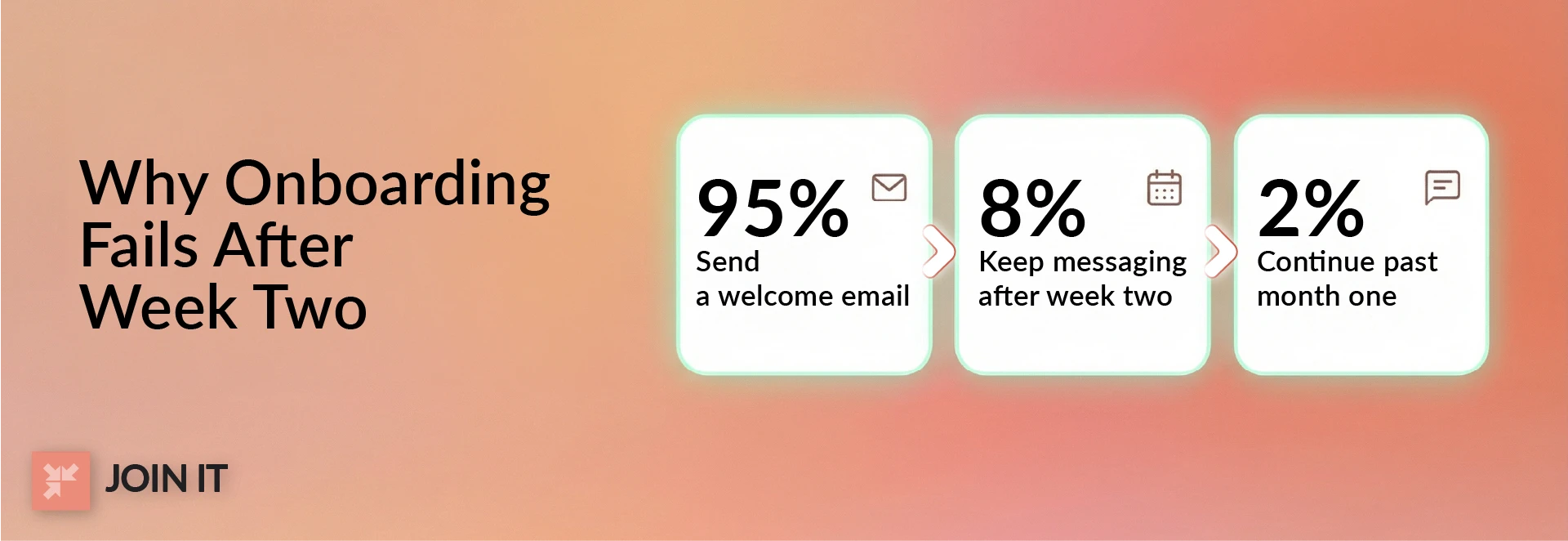
The challenge is that most organizations are still doing the bare minimum. Research shows that 95% send a welcome email, but only 8% continue messaging beyond the second week. A mere 2% are still communicating past the first month.
That's not onboarding. That's abandonment with a friendly subject line.
In 2026, members expect personalization, relevant communication, and a joined-up experience from day one. 84% of association members say personalization is important to them, yet only 18% of associations currently personalize their onboarding. The opportunity is sitting right there.
The 15 tips below cover the best practices for new member onboarding that will help you take it.
15 Tips for New Member Onboarding That Actually Work
These tips follow the natural order of a strong member onboarding journey: foundation first, then execution, then follow-through. Together they form a complete membership onboarding workflow you can adapt to any organization type.
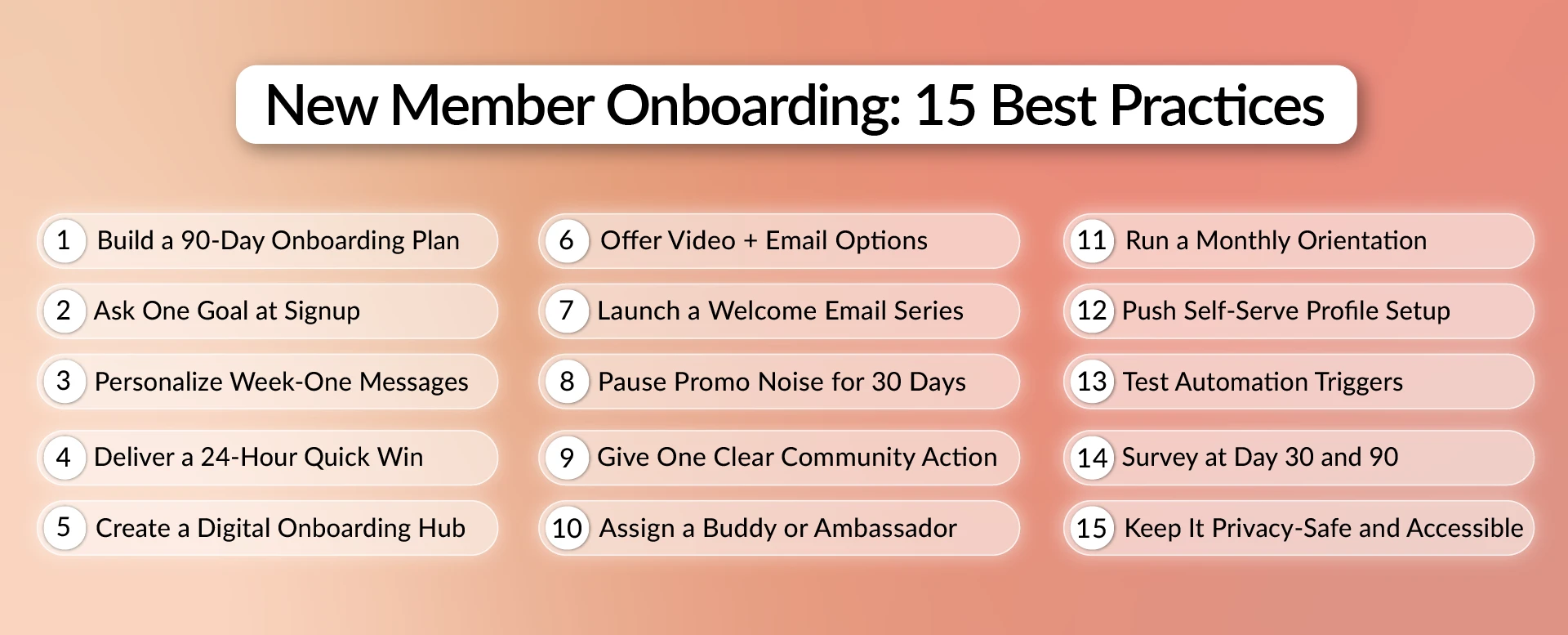
1. Design Onboarding as a First 90 Days Journey
One welcome email is not a strategy. It's a start.
Your new member onboarding plan should map intentional touchpoints across a 30-60-90 day structure: week one, day 30, day 60, and day 90. Engagement within the first 90 days is a critical indicator of first-year renewal.
Think of it less like a checklist and more like a member onboarding journey. Each touchpoint answers a different question in the new member's mind. Week one: "Did I make the right choice?" Day 30: "Am I starting to get value?" Day 90: "Do I belong here?"
Design the answers before they have to ask.
2. Ask One Simple Question at Signup
"What do you want first?"
That single question, asked at signup, gives you the most valuable personalization data you'll have in your entire onboarding process. Store it. Use it. Build your first week communication around it.
ASAE specifically recommends identifying member priorities at the point of joining and using what you already know about them to guide early outreach. This is where your new member onboarding strategy gets personal, and it costs almost nothing to set up.
3. Personalize the First Week Communication
Generic messages feel like newsletters. Personalized messages feel like someone actually read the signup form.
Segment your first week emails by member type, interest area, location, or the goal they shared at signup. Even small adjustments, like addressing someone as "a new early-career member" versus just "a new member," change how the message lands.
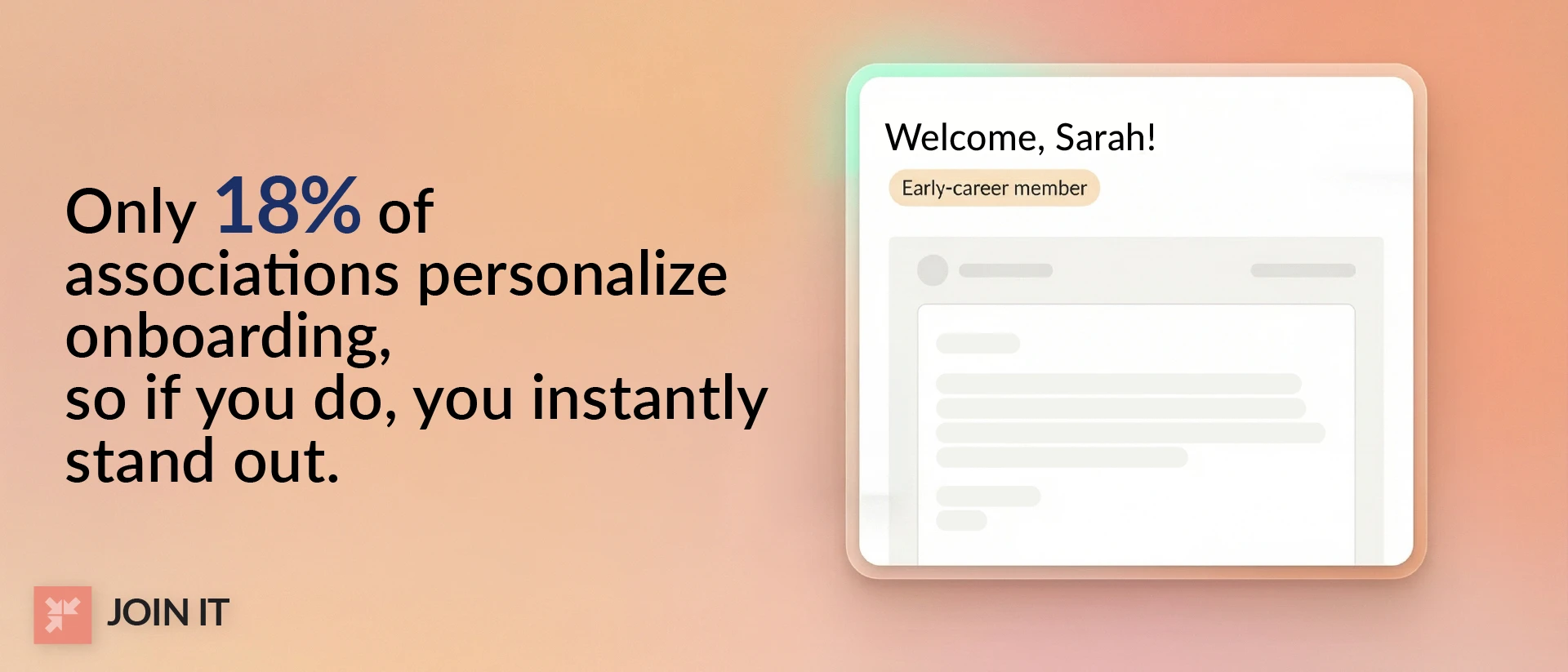
Only 18% of associations currently personalize their onboarding communications, which means if you do it, you already stand out from the crowd. These welcome email templates are a strong starting point if you want messaging that feels human from day one.
4. Deliver Immediate Value in the First 24 Hours
New members are most motivated the moment they join. That motivation fades fast if nothing happens next.
Give them a "quick win" within 24 hours. An exclusive resource, an invitation to a relevant event, or a curated "start here" guide. Something that makes them think: "Okay, this was worth it."
ASAE calls this out directly: delivering immediate value early is one of the clearest signals that membership was the right decision. For inspiration on what that first touchpoint could look like, these ideas to welcome new members are worth a look before you finalize your welcome sequence.
5. Replace the Welcome Packet with a Digital Onboarding Hub 📋
The thick PDF welcome packet is well-intentioned. It's also almost never read.
Replace it with one clean page that answers "What do I do next?" Include a short checklist, links to key benefits, and one place to get help. ASAE highlights the clear shift toward digital onboarding resources in multiple formats, and for good reason. Nobody opens a 40-page PDF on a Monday morning.
A simple member portal gives new members self-serve access to everything they need, without the back-and-forth emails asking where to find things.
6. Offer Onboarding in Multiple Formats
Some members will read every word. Others skip straight to the video. A few want to listen while commuting.
Build your core new member onboarding checklist content in at least two formats. A short email plus a short video covers most people well. The information stays the same. The path to it adapts.
This also makes your onboarding more accessible, which matters for organizations serving diverse member demographics across age groups, locations, and learning preferences.
7. Run a Structured Welcome Email Series
This is one of the highest-leverage things you can do. And most organizations skip it entirely.
The "3-3-6" email cadence is gaining traction: three emails in the first week, weekly for three weeks, then monthly for six months. It keeps momentum without overwhelming anyone. In practice, email automation for membership companies works best when onboarding, segmentation, and renewal messaging are planned as one connected lifecycle.
Your new member onboarding email sequence should cover a welcome and quick win, a benefits overview, a community invitation, an early event or opportunity, and a check-in. Five touchpoints. Set up once. Running automatically from that point forward.
This free new member welcome email template makes it easy to kick off the sequence the right way without starting from a blank page.
8. Reduce Background Noise for Brand New Members
Here's something counterintuitive: sending new members every newsletter, every promo, and every update in their first few weeks is one of the fastest ways to lose them.
ASAE explicitly recommends suppressing new members from your general communication list for a set period. Give them focused, value-oriented messaging first. Everything else can wait.
Think of it as a communication quarantine for the first 30 days. Not silence, just clarity. For guidance on getting the rhythm right, this resource on the right cadence for member communication covers exactly how to balance frequency without overwhelming people.
9. Invite Them Into the Community with One Clear Action
"Join our community!" is not an action. It's a vague suggestion that most people quietly ignore.
Tell new members exactly what to do: "Introduce yourself in this thread" or "Reply to this poll." One specific, low-stakes action. That's the difference between a member who lurks and one who posts, connects, and starts to create a sense of belonging.
ASAE highlights online communities as a core part of early belonging in the new member orientation process. These member engagement ideas include first-week community prompts you can adapt directly into your onboarding flow.
10. Assign a Buddy or Ambassador 🤝
Technology is useful. A real human is better.
A buddy system or member ambassador program removes the friction of not knowing anyone. It gives new members a direct person to ask questions, someone to sit with at the first event, and a face that makes the whole experience feel like a relationship, not a transaction.
This shows up clearly in real community discussions. On r/Toastmasters, members who received a one-on-one orientation and buddy matching were far more likely to stay active. Those who received nothing drifted away within a couple of months.
On the Community Building Stack Exchange, the top-rated answer for onboarding new community members wasn't about software or automation. It was about assigning a "tour guide," someone who makes the newcomer feel they have a friend from day one, someone to ask questions privately without fear of looking uninformed.
11. Host a Recurring New Member Orientation
Make it monthly. Keep it short. Record it.
A live or virtual new member orientation, with a simple agenda shared in advance, gives people a space to ask questions, meet peers, and get the context they need to actually use their membership. One association membership director noted that hosting orientation webinars and pointing new members toward community platforms led to noticeably higher early engagement on their member Facebook group, with newcomers showing up at events sooner.
A recurring format means no one waits six months for the next session. It also means your team builds a repeatable, improvable process rather than a one-off event nobody remembers to schedule.
12. Make Self-Serve Setup Part of Onboarding
During week one, guide new members to complete their profile, set communication preferences, and sort out payment details if applicable.
Encouraging profile completion in week one prevents dozens of admin emails later. It also significantly increases the chance members actually find and use what they paid for. A well-configured event registration experience, for example, becomes much smoother when members have already set up their profiles correctly.
For organizations using Join It integrations with their existing tools, much of this setup process can be automated so nothing slips through the cracks during a busy intake period.
13. Test Your Automation Triggers So Welcomes Actually Send
This one sounds obvious. It isn't.
A classic failure is tying your welcome email to the wrong date field. On the CiviCRM Stack Exchange, someone discovered their welcome emails weren't sending because they were tied to a formal "membership start date" of January 1st, not the actual signup date. New members joining mid-year never received a welcome at all.
Test your full automation flow end to end. Send yourself through it. Check every trigger, and if you're using a CRM for member onboarding, verify that all data fields sync correctly across integrations. Add it to your launch checklist and check it every few months.
14. Collect Feedback Early and Act on It
Send a short member onboarding survey around day 14 or day 30, then again around day 90.
This isn't about vanity metrics. It's about catching confusion before disengagement becomes non-renewal. If a new member is frustrated, a proactive check-in at 30 days can fix it. If you wait until renewal time, it's already too late. One membership consultant put it clearly: "We send the welcome email and then eight months later a renewal notice. No wonder they lapse."
This guide on how to collect member feedback walks through the right questions to ask and when to ask them. Keep it short. Two or three questions. Easy to complete in under a minute.
15. Build Onboarding That Is Privacy-Safe and Accessible
For organizations with EU or UK members, your onboarding messages and preference handling need to align with GDPR and ICO guidelines. This means a clear lawful basis for contact, documented opt-in permissions for member communications, visible opt-out options, and transparency about how member data will be used.
Beyond compliance, make sure your onboarding pages and core flows meet WCAG accessibility principles. Accessible onboarding isn't just ethical. It ensures more members can actually complete the process, regardless of how they access your content or what device they're using.
Build it right once, and it works for everyone.
Free vs. Paid Membership Onboarding: Where the Emphasis Shifts
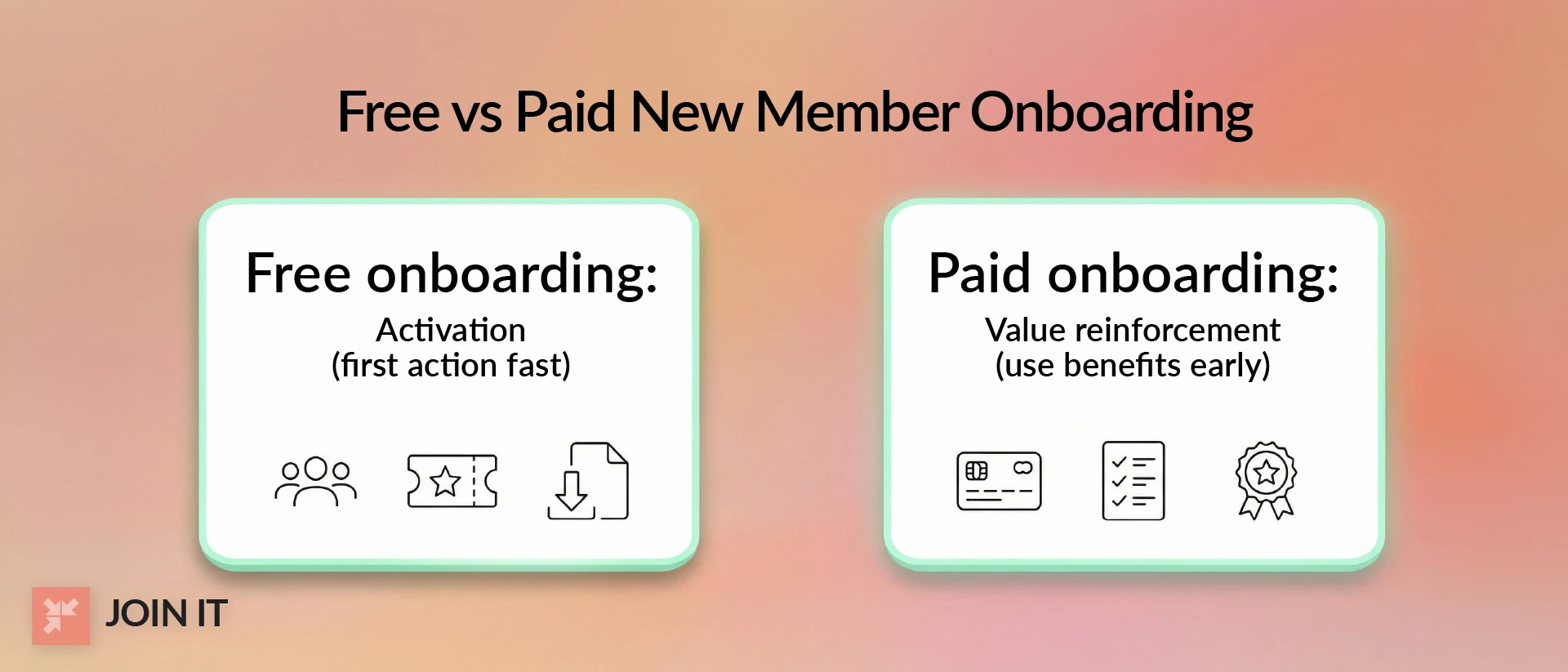
These 15 tips apply broadly, but the focus changes depending on your membership model.
Free membership onboarding is about activation. Get new members to their first meaningful action fast: a community introduction, their first event, their first resource download. Then show them clearly what upgrading unlocks, especially if you offer multiple membership tiers.
Paid membership onboarding is about value reinforcement. What did they pay for? How do they use it? What should they expect in year one? A digital membership card is a small but tangible first touch that reinforces member status from the moment someone joins. For a full breakdown of how to implement this well, the digital membership card guide walks through it step by step.
For a broader framework that ties your onboarding into the full picture, the membership experience section of the membership guide is worth exploring.
Common New Member Onboarding Mistakes (and How to Fix Them)
These aren't unusual problems. They're the norm. Fixing even two or three of them puts you ahead of most organizations trying to manage new member onboarding today.
How to Measure New Member Onboarding Success
You can't improve what you don't measure. Here are the metrics worth tracking:
- First-year retention rate, aiming to close the gap between the 75% new-member benchmark and your overall 84% retention
- Time to first action: how quickly does a new member do something meaningful?
- Email open and click rates across your onboarding sequence
- Event or orientation attendance among new members specifically
- Profile completion rate in your member portal
- Survey response rate at day 30 and day 90
Run a quick check weekly during a new cohort's first month. Do a full debrief at the 90-day mark. Use what you find to improve the next round.
Long-term, a strong onboarding process drives new member engagement and feeds directly into retaining members and reducing churn. The connection between day one and renewal day is more direct than most organizations realize.
FAQ About New Member Onboarding
What is new member onboarding? New member onboarding is the structured process of welcoming, orienting, and activating new members after they join. A strong new member onboarding process covers the first 90 days and combines automated communication, personal touchpoints, and clear guidance on how to make the most of the membership.
How do you create a new member onboarding checklist? Start with the essentials: welcome email, profile setup, community introduction, orientation invitation, and a 30-day check-in. Build each step into a repeatable sequence rather than a one-off event. The goal is a membership onboarding workflow that runs consistently for every new member who comes through the door.
What should a new member welcome email include? A thank-you, one clear next step, a brief overview of what to expect, and a direct way to get help. Keep it short. Save the full benefits walkthrough for your second or third email in the sequence. The welcome email's job is to reassure, not to educate everything at once.
How long should new member onboarding last? The first 90 days are the most critical window for first-year member retention. Many organizations continue a lighter communication cadence through the full first year, gradually shifting the tone from onboarding guidance to regular engagement and community participation.
What is the difference between free and paid membership onboarding? Free membership onboarding focuses on activation and showing the path to an upgrade. Paid membership onboarding focuses on immediate value delivery and reinforcing that the investment was the right decision. The tactics are similar, but the emotional goal is different.
Start Building an Onboarding Experience Members Actually Remember
New member onboarding isn't a box to tick after sign-up. It's the first real test of the relationship you're building.
Get it right, and members stick around. They attend events, refer friends, volunteer, and renew without needing a hard sell. Get it wrong, and they quietly disappear, often without ever telling you why.
If you want to explore everything that's possible for different membership organization types, the resources are there whenever you need them. And when you're ready to build your own onboarding workflow, Join It makes it straightforward to manage the full member journey in one place. You can explore the full range of Join It features, start a free trial, or book a free demo to see how it fits your organization.
The members are joining. The question is whether your onboarding gives them a reason to stay.

Guides from the Experts
Through our work with 4,000+ organizations - we’ve put together helpful guides to assist; regardless of where you are on your journey.
.webp)

A Complete Guide to Membership Organizations
Everything you need to know to manage and grow your membership business
.webp)
Maximize Membership Retention: 10 Proven Strategies
Tried and true strategies that not only win membership, but keep them

Build a Membership Website: A Step-by-Step Guide
Your one-stop resource for knowing all the features your modern membership website needs
Ready to start your free trial?
Our membership software is intuitive to use and even easier to test for yourself.