Top Responsibilities of a Membership Chair



Top Responsibilities of a Membership Chair: Duties, Role Description, and Best Practices
Most people think a Membership Chair is the person who "gets more members."
That's not the full picture.
The role is bigger, more strategic, and a lot more interesting than that. A strong Membership Chair owns the entire member journey: who you invite in, how you welcome them, how you keep them engaged, how renewals get handled, and what leadership actually hears about the member experience.
In other words, the job is less about chasing signups and more about owning member growth and member experience as a system.
This article walks through what a Membership Chair really does, the responsibilities that show up across associations, clubs, chambers, churches, and nonprofits, and the best practices that separate a struggling chair from one who actually moves the needle.
If you're stepping into the role, leading a committee, or just trying to get clearer on what the position should look like, you're in the right place.
Key Takeaways
- A Membership Chair owns the full member journey, not just recruitment. The role covers welcoming, engaging, renewing, and reporting too.
- Recruitment without onboarding creates churn. The strongest chairs treat both ends of the journey as one connected system.
- The first 90 days of membership are the highest-leverage window for retention. Welcome packets, orientation, and early check-ins matter most here.
- Renewals work best as a year-long workflow, not a last-minute reminder blast. Define ownership, send reminders early, and follow up personally with at-risk members.
- Member engagement is built on real connection, not communication volume. Personal invitations and inclusion outperform mass reminders almost every time.
- The Membership Chair leads the committee. The committee carries out recruitment, onboarding, and outreach under the chair's direction.
- Strong board reports show trends and member satisfaction, not just headcount. Counts answer "how many." Trends answer "what's changing."
- The role shifts by organization type. Volunteer-led groups put the chair closer to the daily work; staff-supported groups move the chair toward strategy and oversight.
- Join It is rated Excellent on Trustpilot and gives Membership Chairs one place to manage recruitment, onboarding, renewals, member records, and reporting, so the chair can spend more time on member experience and less time on admin.
What Is a Membership Chair?
A Membership Chair is the volunteer or board leader responsible for turning membership goals into repeatable systems for recruitment, onboarding, engagement, renewals, and feedback.
Titles vary. Some organizations call this role the Vice President of Membership. Others use Membership Director, Chapter Membership Chair, or simply Board Chair of Membership. The label shifts, but the core function stays the same.
What unites all of these versions is ownership. The Membership Chair is the person accountable for the membership function, even when staff handle the daily operations.
What Does a Membership Chair Do?
In one sentence: a Membership Chair recruits new members, welcomes them in, keeps them engaged, supports renewals, leads the membership committee, tracks the trends, and reports member realities back to leadership.
In practice, that usually means:
- Recruiting new members and reaching out to prospects
- Running orientation and welcome processes for new joiners
- Following up on renewals and reactivating lapsed members
- Improving member engagement and experience
- Chairing the membership committee
- Tracking membership data and presenting reports
- Connecting member feedback to board and staff decisions
That list captures most of the role. The next section breaks each one down.
Why the Role Matters More Than "Getting More Members"
If recruitment is the only thing a Membership Chair focuses on, the math gets ugly fast.
You can bring in 50 new members in a year and still shrink if 70 of them quietly walk away. Recruitment without onboarding creates churn. Engagement without renewal follow-up produces activity but not stability. Reporting without action just creates dashboards no one reads.
The most useful framing is this: the Membership Chair owns the member journey, not just the member list.
That shift, from "list manager" to "journey owner," is what separates a routine chair from a great one.
The Top Responsibilities of a Membership Chair
Here's the part most readers come for. These are the responsibilities that show up again and again across official role descriptions, primary-source charters, and real-world chair duties.
I'll cover each one with what it includes, why it matters, and the kind of actions a chair should actually take.
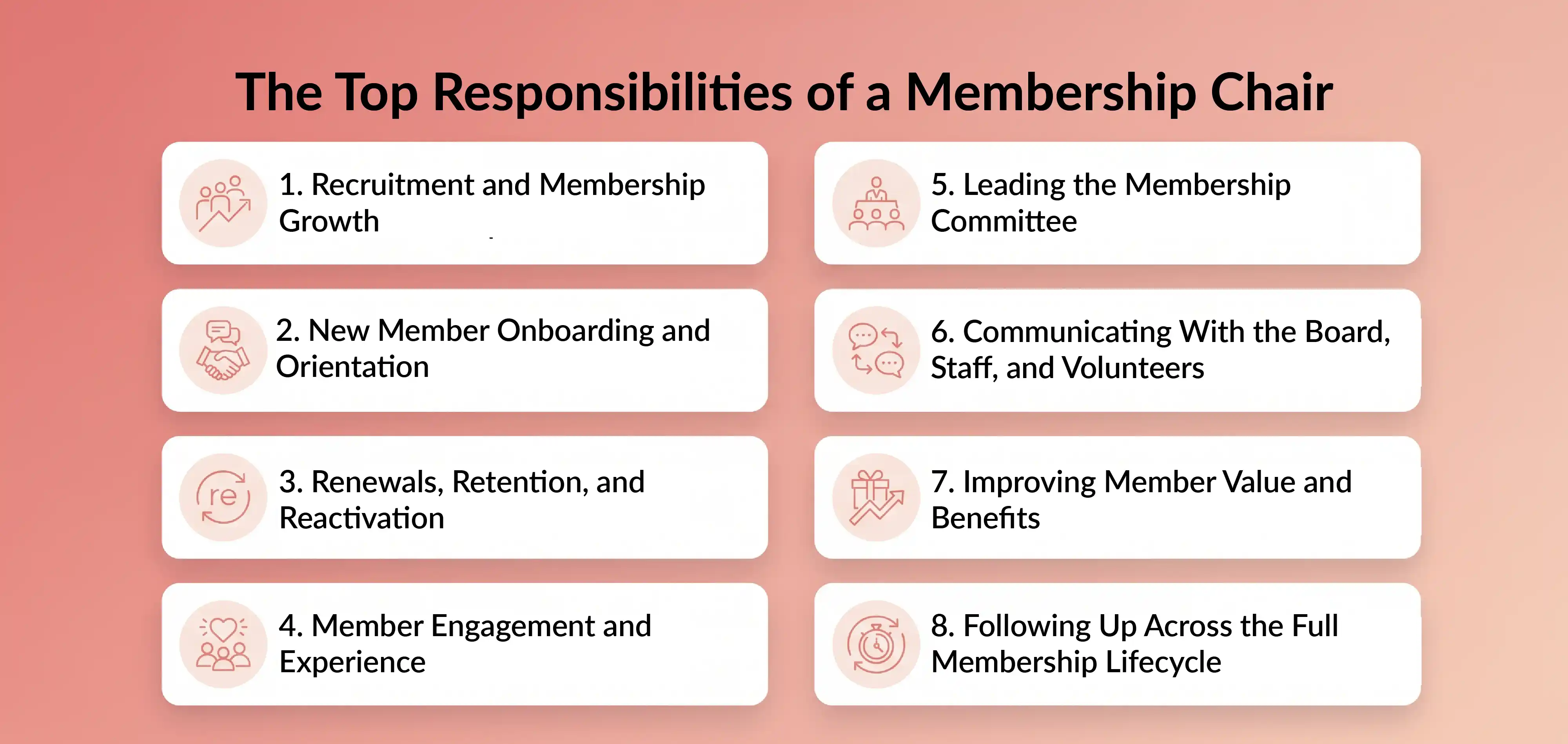
1. Recruitment and Membership Growth
Membership recruitment is the most expected duty, and one of the most misunderstood.
It isn't just about running a membership drive once a year and hoping new members appear. It's about building a steady, repeatable engine: recruitment goals, prospect identification, referral systems, outreach events, and reconnecting with former members.
Lions Clubs International, in its club membership chair guide, expects the chair to develop and execute an annual membership development plan, encourage every member to invite prospects, and help recapture former members who have drifted away.
Real recruitment work usually includes:
- Setting clear annual recruitment goals
- Identifying prospective members
- Running an annual campaign, an open house, or other special recruitment events
- Asking current members for referrals
- Reactivating lapsed members
- Following up quickly with anyone who shows interest
The lesson from the strongest sources is simple. A chair who treats recruitment as a year-long plan, rather than a one-time drive, almost always outperforms the chair who scrambles every quarter.
2. New Member Onboarding and Orientation
This is where weaker articles tend to stop short. It's also where strong Membership Chairs separate themselves.
Onboarding is the process that turns "I joined" into "I'm glad I joined." Orientation is the structured part of that process. A great chair owns both.
The IAPSC committee charter goes as far as requiring a quarterly new-member orientation webinar and a mentor pool, while Lions Clubs explicitly ties new member success to whether they participate in orientation at all.
Strong new member onboarding usually includes:
- A prompt welcome (email, packet, or both)
- A clear new member welcome letter
- An explanation of member benefits and expectations
- An orientation session or webinar
- A mentor or ambassador where possible
- Public recognition when appropriate
The first 90 days is the highest-leverage window in the entire member lifecycle. If you want a simple frame, it looks like this:
- First week: confirm the welcome, explain next steps, make a personal touchpoint
- First month: orientation, mentor introduction, first event invitation
- First quarter: check in on the experience, ask about barriers, guide deeper involvement
This is also a great place to think practically about how to welcome new members in a way that feels personal rather than robotic.
3. Renewals, Retention, and Reactivation
Membership growth without retention is misleading.
A Membership Chair who focuses only on signups will eventually realize the bucket is leaking faster than they can fill it. That's why the official sources treat renewals and retention as central job content, not side tasks.
The IAPSC charter is especially direct on this. It assigns the chair responsibility for annual renewal letters, special follow-up with first-year members, and follow-up with members who don't renew. CAPTA's membership chair description reinforces the same with a year-long campaign view.
Practitioners feel the friction here too. In the Wild Apricot wishlist forum, users have repeatedly asked for simpler, one-click renewal flows because their existing process feels like a login maze.
Solid member retention strategies include:
- Starting renewal outreach before the deadline, not after
- Personally contacting first-year members, expiring members, and at-risk renewers
- Following up with members who don't renew to learn why
- Reactivating lapsed members with a tailored, human reach-out
- Tracking patterns of attrition, not just totals
The chair who treats renewal as a workflow, not a last-minute email blast, almost always sees stronger numbers.
4. Member Engagement and Experience
Member engagement strategies are the system of touchpoints that turn signups into long-term members.
The Greater Bloomington Chamber of Commerce describes its membership committee as "the face of the chamber," helping members build meaningful connections, mentoring through their first year, and strengthening retention through real human contact.
Notice the framing. It isn't "send more emails." It's "create real connection."
That insight gets reinforced by community discussions too. In a Reddit retention thread for a college club, experienced responders agreed that personal invitations and informal post-event social time mattered more for retention than reminders ever did. Belonging beats nudges, almost every time.
Useful member engagement ideas for chairs include:
- Welcoming members at events by name
- Connecting them to committees or volunteer roles
- Creating networking opportunities and mentorship pairings
- Recognizing contributions publicly
- Surfacing concerns before members quietly disengage
A few signals that engagement is slipping: low event attendance after joining, unused benefits, first-year drop-off, and recurring "what do I get out of this again?" questions. Catch those early, and the rest of the role gets easier.
5. Leading the Membership Committee
Membership work that lives in one person's memory is fragile. Membership work that runs through a committee is durable.
According to the National PTA governance policy manual, committee chairs set agendas, facilitate meetings, work with staff liaisons, monitor progress, and submit status reports to the board. That template applies neatly to a Membership Chair leading a membership committee.
The chair leads the mechanism. The committee carries the work.
Membership committee chair responsibilities usually include:
- Setting agendas and leading meetings
- Assigning follow-ups and tracking completion
- Coordinating volunteers and any staff liaison
- Monitoring progress against recruitment, onboarding, and retention goals
- Reporting committee activity to the board
BoardSource recommends that committees have a clear job description, defined goals, and a written charter that explains the committee's role, goals, and accountability. That kind of clarity is what turns a committee from a meeting on the calendar into an actual operating engine.
6. Tracking Membership Data, Trends, and Reports

A Membership Chair who can't see what's happening will always react too late.
That's why every serious role description in the research assigns reporting as a core duty. Lions, IAPSC, CAPTA, and most chamber-of-commerce models all expect the chair to bring real numbers to the board, not vibes.
The trouble is that, in practice, this is hard. In the CiviCRM community forum, users have asked for better trend reports because retention rates are surprisingly difficult to calculate from scratch. The chairs who succeed don't necessarily have fancier tools or deeper membership analytics. They have a simple, consistent set of numbers they look at every month.
A practical Membership Chair scorecard usually includes:
- Total members and new members recruited
- New members who actually completed orientation
- Renewal follow-ups completed
- Lapsed members contacted
- Engagement metrics like event attendance or committee participation
- Member satisfaction survey results when available
- Membership trends across quarters
The point isn't to drown the board in dashboards. The point is to bring them member reality. Counts answer "how many." Trends answer "what's changing." Satisfaction answers "why."
7. Communicating With the Board, Staff, and Volunteers
This is the connector function of the role, and it's often where great chairs become indispensable.
A Membership Chair sits between members and leadership. The chair carries member realities, satisfaction signals, renewal friction, and engagement gaps back to the board. They also align volunteers and staff around shared membership goals.
Upward communication usually covers recruitment progress, onboarding participation, retention trends, satisfaction themes, and recommended changes to processes or benefits.
Across the organization, the chair coordinates volunteer outreach tasks, event welcome responsibilities, staff-handled workflows, and committee follow-up. Done well, this turns the role into the voice of the member at the leadership table.
8. Improving Member Value and Benefits
The most strategic chairs don't just promote benefits. They help shape them.
The IAPSC charter explicitly assigns the membership chair role to identify and develop member benefits, review categories of membership and dues structure, and recommend changes to the board. That's a meaningful step beyond operational follow-up.
Improving the offer can include:
- Reviewing whether members actually understand current benefits
- Identifying underused member benefits
- Gathering feedback on what members really need
- Recommending updates to dues structure or membership categories
- Surfacing gaps between what's promised and what's delivered
This responsibility tends to matter most for professional associations, chambers, and organizations with formal tiered benefits. But every chair benefits from regularly asking: does this membership actually feel valuable right now?
9. Following Up Across the Full Membership Lifecycle
Most membership problems are really follow-up problems.
A prospect didn't get a callback. A new member never got guided in. A renewing member got stuck and gave up. A lapsed member was never contacted.
These tiny gaps add up to most of the membership friction in any organization. That's why follow-up deserves to be treated as its own discipline, rather than something tacked onto every other responsibility.
The lifecycle follow-up points worth protecting are:
- Prospective member follow-up within days, not weeks
- Post-join welcome outreach
- First-year check-ins
- Pre-renewal reminders
- Non-renewal outreach
- Lapsed member reactivation contact
This is the unglamorous work that actually keeps the numbers moving.
Membership Chair vs Other Leadership Roles
One reason this role gets confused is that the title overlaps with several others. Let's clarify where the boundaries sit.
Membership Chair vs Membership Committee. The chair leads. The committee carries out the work. The chair sets agendas, prioritizes, and reports. The committee runs outreach, ambassadors, onboarding, and assigned tasks under the chair's direction.
Membership Chair vs Membership Manager or Director. In staff-supported organizations, the manager is usually a paid operations role handling the membership database, workflows, notices, and daily campaigns. The chair owns strategy, accountability, and member insight. The titles can overlap, so the actual duties matter more than the label.
Membership Chair vs Board President. The board president owns the broader board and governance of the whole organization. The Membership Chair owns the membership domain inside that structure. For more on how board roles fit together, this overview of nonprofit board responsibilities is a useful reference.
Membership Chair vs Secretary. The secretary owns minutes, notices, and recordkeeping integrity. The chair may rely on membership records but isn't the official keeper of governance records.
Membership Chair vs Treasurer. The treasurer owns financial oversight and budget. The chair may influence renewals or dues strategy, but doesn't own the financial function.
The cleanest mental model: the Membership Chair owns the membership journey. Everyone else owns adjacent functions that touch it.
How the Role Changes by Organization Type
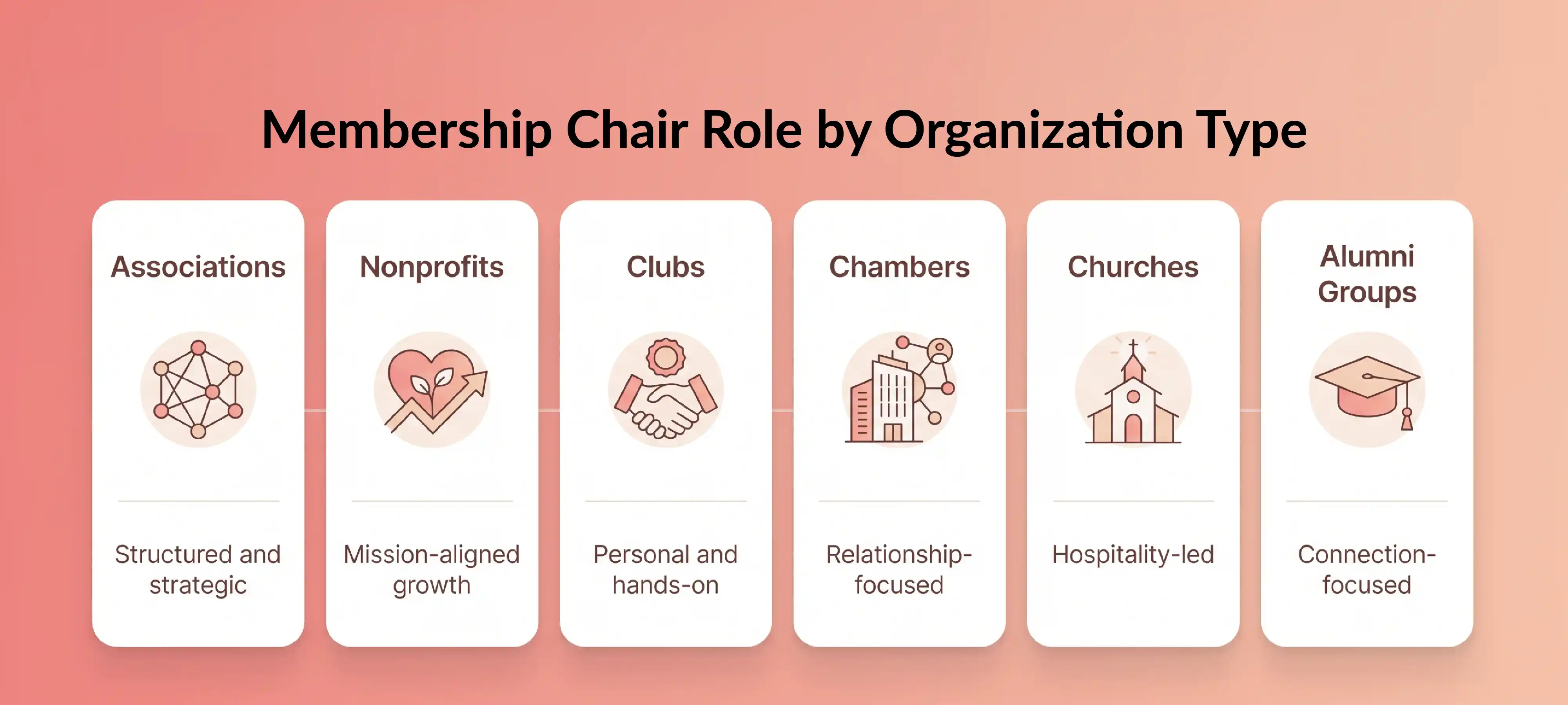
The job description shifts depending on where the chair is serving.
Associations
In professional associations, the role is more structured. Annual campaigns, formal renewals, board reporting, and oversight of member benefits are common. In larger associations, the chair may also weigh in on dues structures and satisfaction trends. For a deeper view of how this fits into broader operations, see this guide to association management.
Nonprofits
In nonprofits, the chair blends member growth with mission alignment. Smaller nonprofits often run hands-on chair roles. Larger ones lean toward oversight and committee leadership. Many groups choose membership software for nonprofits to handle the operational side so the chair can focus on strategy and member experience.
Clubs
In service clubs (think Lions, Rotary, and similar community-driven groups), the role is personal. Inviting prospects, welcoming new members, helping people feel included, and reconnecting with lapsed members is the core. This version of the chair role is closest to the actual member journey.
Chambers of Commerce
For chambers of commerce, the chair often leads or supports an ambassador model: welcoming new businesses, mentoring through the first year, and creating visible touchpoints across events. With staff backing, the chair tends to focus more on strategy and relationship-building than admin.
Churches and Congregational Settings
In churches, the role often combines hospitality with membership-process stewardship: greeting visitors, explaining membership responsibilities and privileges, running orientation classes, reviewing membership applications, and coordinating recognition. Many congregations now use church membership software to keep the operational pieces tidy so the chair can focus on the relational work.
Alumni and Chapter-Based Groups
Here the chair is often a liaison: answering inquiries, encouraging participation, and connecting the member base with the board. It's lighter on operations, heavier on relationship maintenance.
Volunteer-Led vs Staff-Supported Organizations
The biggest distinction across all organization types is this: volunteer-led groups put the chair closer to the actual work, while staff-supported groups shift the chair toward strategy, oversight, and committee leadership.
The Dayton Area Chamber's committee handbook makes this explicit. Volunteer time should not get burned on tasks that staff or systems can handle more efficiently.
Best Practices and Membership Chair Ideas That Actually Work
A few practices show up again and again across the strongest examples.
Build an annual membership plan. Goals, calendar, deadlines, and budget inputs should sit on one page. CAPTA, Lions, and most strong association sources all push for a year-long plan rather than a string of one-off pushes.
Formalize onboarding. Treat the welcome, orientation, mentor pairing, and first-quarter check-in as a defined sequence. The Council of Nonprofits' guidance on board orientation makes a similar argument for governance, and the same logic applies to members. Practitioner discussions on Reddit, including a recent r/nonprofit thread on onboarding templates, echo the same pattern: clear role expectations and welcome materials upfront save retention pain later.
Treat renewals as a workflow. Define ownership, send renewal reminders well in advance, and reach out personally to at-risk members.
Run a small, real scorecard. Pick five or six numbers, watch them every month, and bring trends (not just totals) to the board.
Protect volunteer time. A healthy membership operation doesn't burn its chair out on tasks better handled by staff, a CRM, or a good membership management software platform. The chair's energy should go where judgment matters most.
A Practical Cadence for the Role
Here's a simple way to break down the work by rhythm.
Weekly: Review new members and prospect activity. Make sure follow-ups are happening. Check on urgent renewal issues.
Monthly: Look at membership statistics and trends. Contact at-risk members. Run or support orientation touchpoints. Meet with the committee or staff liaison. Pull together the board report.
Quarterly: Review recruitment and retention against goals. Evaluate engagement and satisfaction. Check first-year experience. Recommend changes to leadership.
Annually: Refresh the membership plan. Set goals and campaign dates. Review benefits and value proposition. Plan committee succession.
This cadence keeps the work distributed across the year, instead of crammed into renewal season.
How to Measure Whether a Membership Chair Is Effective
Effectiveness isn't measured by how busy the chair looks. It's measured by whether the membership function is actually working.
The clearest indicators:
- Members are recruited intentionally
- New members are oriented consistently
- Renewals get followed up proactively
- Member concerns reach leadership
- Committee work happens on schedule
- Reporting drives action
- The system improves year over year
Real-world outcomes show what disciplined membership work can support. The West Volusia REALTORS Association reported about a 20% gain in communication efficiency after improving its membership workflows, with onboarding new members becoming faster and easier in the process.
That outcome is organization-wide rather than a chair-only achievement. But it reflects exactly the disciplines a strong Membership Chair owns: clear systems, real reporting, and intentional follow-up.
Frequently Asked Questions About the Membership Chair Role
What does a Membership Chair do? A Membership Chair leads the membership function: recruiting new members, welcoming and orienting them, supporting renewals, leading the membership committee, tracking membership data, and reporting back to leadership.
What are the duties of a Membership Chair? The core duties are recruitment, onboarding, retention, engagement, committee leadership, reporting, and member feedback to the board.
Is a Membership Chair a volunteer role or a staff role? Usually volunteer or board-level. In staff-supported organizations, paid staff handle daily operations while the chair owns strategy and oversight.
What metrics should a Membership Chair track? A simple scorecard: new members, members oriented, renewals followed up, lapsed members contacted, engagement signals, and satisfaction trends.
What's the difference between a Membership Chair and a membership committee? The chair leads. The committee carries out the work assigned by the chair.
What should a membership chair job description include? A clear membership chair job description usually covers recruitment, onboarding, retention, committee leadership, reporting, and the chair's role in carrying member feedback to the board.
What should a Membership Chair include in a board report? Counts, trends, satisfaction findings, renewal status, and recommended actions. Not just totals.
Final Thought: Own the Member Journey
The best Membership Chairs aren't the ones who chase the most signups.
They're the ones who own the member journey end to end: bringing the right people in, making them feel welcome, keeping them engaged, supporting renewals with care, and carrying the voice of the member back to leadership.
When the role is treated that way, the numbers usually take care of themselves.
If you want to see how the right tools can take the operational weight off your plate so you can focus on the higher-value parts of the role, you can book a demo or start a free trial to explore what fits your organization.
Sources
- Lions Clubs International. Club Membership Chairperson Guide
- IAPSC. Membership Committee Charter
- CAPTA. Membership Chair Job Description
- Wild Apricot. Simplify Membership Renewal Process
- Greater Bloomington Chamber of Commerce. Membership Committee
- Reddit r/Fencing. Member Retention for a College Club
- BoardSource. Structuring Board Committees
- CiviCRM. Membership Trend Reports Discussion
- Dayton Area Chamber of Commerce. 2025 Committee Handbook
- Council of Nonprofits. Board Orientation
- Reddit r/nonprofit. Onboarding Templates and Tips
- GrowthZone. West Volusia REALTORS Success Story

Guides from the Experts
Through our work with 4,000+ organizations - we’ve put together helpful guides to assist; regardless of where you are on your journey.
.webp)

A Complete Guide to Membership Organizations
Everything you need to know to manage and grow your membership business
.webp)
Maximize Membership Retention: 10 Proven Strategies
Tried and true strategies that not only win membership, but keep them

Build a Membership Website: A Step-by-Step Guide
Your one-stop resource for knowing all the features your modern membership website needs
Ready to start your free trial?
Our membership software is intuitive to use and even easier to test for yourself.