Social Media for Nonprofits: 15 Expert-Backed Tips for Success



Most nonprofits treat social media like a digital donation jar. Post an ask. Wait. Repeat. Then wonder why engagement is flat and followers quietly disappear.
Here is the reality: social media for nonprofits works when it stops imitating what brands do and starts doing what nonprofits do best — telling real stories, building real communities, and inspiring real action around a real mission.
This article walks through 15 proven social media tips for nonprofits, covering platform selection, content planning, storytelling, fundraising, volunteer recruitment, community building, and measurement. Whether you lead a small local charity, a membership association, or a national advocacy organization, these principles apply.
Key Takeaways
- Posting on every platform at once is one of the most common nonprofit social media mistakes. One or two platforms done well always beats five done poorly.
- Follower count is not a success metric. Donations, volunteer signups, event registrations, and membership joins are.
- The 70/20/10 content mix prevents follower fatigue: 70% value and education, 20% community recognition, 10% direct asks.
- A shared content calendar is what separates teams that post consistently from those that only post when something urgent comes up.
- Every ask post needs one clear CTA and a dedicated landing page that matches the post's promise. Sending supporters to a generic homepage loses conversions every time.
- Social media drives discovery. Email deepens the relationship. Neither channel replaces the other, and both work best when they feed each other.
- UTM links on every campaign are the only way to prove which social posts actually drove donations, signups, or registrations, not just likes.
- Join It is rated Excellent on Trustpilot and helps nonprofits and membership organizations turn social media followers into paying members, with dues collection, event sign-ups, and member management all in one place.
What Is Social Media for Nonprofits?
Social media for nonprofits is the strategic use of platforms like Facebook, Instagram, LinkedIn, TikTok, and YouTube to build brand awareness, earn trust, and drive action around a mission. It covers donor communication, volunteer recruitment, event promotion, advocacy campaigns, and community growth.
What separates nonprofit social media marketing from commercial marketing is the driving force behind every decision. The mission comes first. Engagement is a means, not the end.
Posting is only one part of the work. The full function includes planning, storytelling, community management, conversion, and measurement. Get that right, and social media becomes one of the most cost-effective tools in your communication strategy.
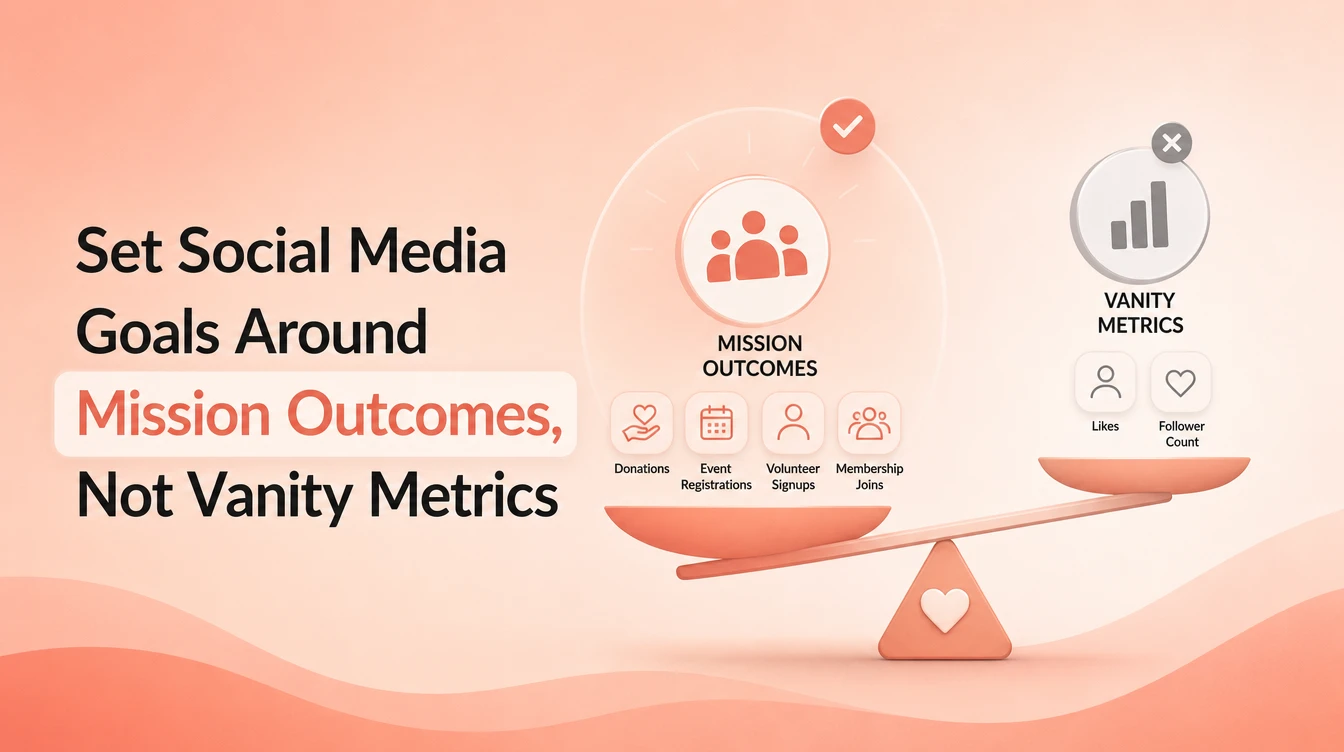
1. Set Social Media Goals Around Mission Outcomes, Not Vanity Metrics
Before posting anything, answer one question: what action do you want supporters to take?
Every social media goal for nonprofits should map to a real mission outcome. Awareness campaigns build discovery. Fundraising posts drive donations. Event content drives RSVPs. Volunteer posts fill your roster.
Follower count tells you who showed up. Conversion rate tells you who cared enough to act. Build your nonprofit social media strategy around the second number.
2. Choose Platforms Based on Your Audience, Not the Latest Trend
Small teams cannot do everything well. Trying to maintain five platforms simultaneously leads to burnout and forgettable content everywhere.
The smarter move is to identify the best social media channel for nonprofits based on where your specific audience already spends time, not where marketing trends say you should be.
Facebook serves local community building, event promotion, and older donor segments well. Instagram is strong for visual storytelling, searchable hashtags, and reaching younger volunteer audiences. LinkedIn fits thought leadership and corporate partnerships. TikTok and YouTube Shorts offer discovery reach for cause education and campaign storytelling with personality.
For social media for small nonprofits especially, picking one or two platforms and doing them well beats being forgettable on five.
3. Build a Nonprofit Social Media Content Calendar You Can Actually Sustain
Inconsistent posting is one of the most predictable nonprofit social media failures. As the American Bar Association noted in a panel on member communications, "cohesiveness in messaging is a challenge," and without a shared calendar, teams produce disjointed, last-minute content that confuses supporters.
A nonprofit social media content calendar does not need to be elaborate. Plan by month, layer in campaigns and awareness days, build your posting schedule around team capacity, and leave space for real-time moments.
Repurpose what you already have. A donor email becomes a post. An annual report quote becomes a graphic. An event photo becomes a story. One strong asset can feed multiple platforms and save hours each week.
Consistency over time builds the trust that sporadic brilliance never will.
4. Create 4-6 Content Pillars So You Always Know What to Post
Content pillars are repeatable categories tied to your mission and your audience's interests. They eliminate the blank-page panic by giving you ready-made social media content ideas for nonprofits that keep your feed purposeful week after week.
Good examples include:
- Impact stories: What changed because of your supporters
- Volunteer and donor spotlights: Recognition that builds loyalty and repeat action
- Behind-the-scenes content: What the daily work actually looks like
- Educational posts: Cause awareness, myth-busting, and issue explainers
- Event and campaign updates: Momentum, milestones, and social proof
Having these categories ready means you are never starting from scratch, and your audience starts to recognize your voice.
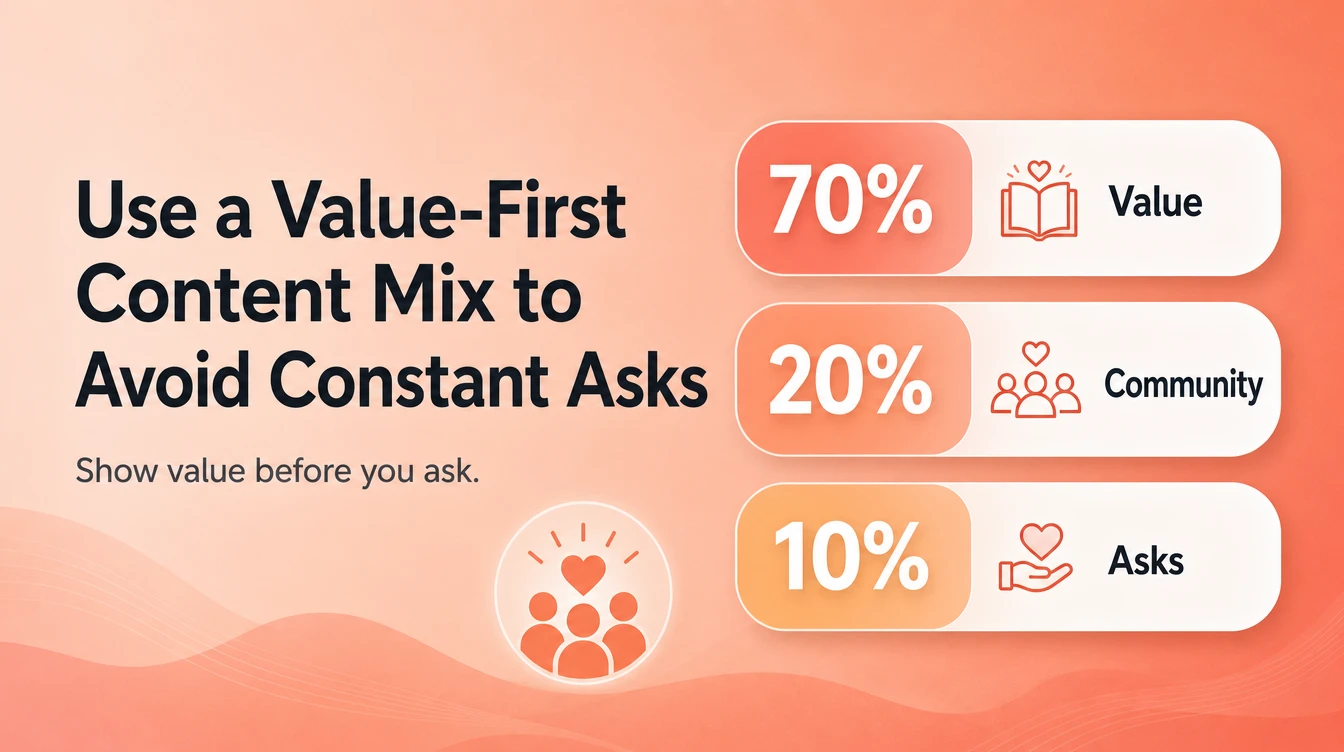
5. Use a Value-First Content Mix to Avoid Constant Asks
If your social feed reads like a perpetual fundraising campaign, your audience will tune out. This is not a theory. CSAE research on membership retention trends found that associations with declining membership consistently struggled with improper communication outreach and failure to convey the value and benefits of membership between asks.
A practical guideline is the 70/20/10 content mix:
- 70% value content: stories, education, impact updates
- 20% community content: partner appreciation, supporter recognition
- 10% direct asks: fundraising, event RSVPs, volunteer calls
A case study from Association Headquarters on NADCA shows what consistent value demonstration can achieve: a 94% renewal rate in 2020. The principle translates directly to social media: show your value before you ask for anything.
Treat the 70/20/10 ratio as a guide, not a rigid rule. During social media campaigns like Giving Tuesday, the mix will naturally shift toward more direct asks. The core principle stays the same.
6. Tell Nonprofit Stories That Respect the People in Them 💛
Authentic storytelling is the engine of nonprofit social media engagement. According to DonorPerfect's nonprofit marketing research, authentic storytelling that highlights staff, volunteers, beneficiaries, and supporters builds trust "far more effectively than polished promotional language."
A simple structure that works for nonprofit storytelling on social media:
- Challenge: What problem existed before?
- Action: What did your organization do?
- Result: What changed because of that action?
- Proof: A quote, number, or real image that makes it tangible
- Next step: What can the reader do right now?
The non-negotiable: show agency, not just need. Stories should honor the people in them, which means getting consent, being accurate, and avoiding framing that reduces beneficiaries to passive recipients.
7. Use Short-Form Video to Reach More People With Less Budget
Nonprofit video content consistently outperforms other content formats across platforms. According to data from TechSoup and DonorPerfect, Facebook videos generate approximately 135% more organic reach than image posts.
For most nonprofit teams, the good news is this: production quality matters far less than authenticity. Phone-first, short-form video is enough to make a real impact.
Instagram Reels for nonprofits work well for quick mission moments, event reminders, and volunteer appreciation clips. TikTok for nonprofits and YouTube Shorts open doors to audiences who have never heard of your organization. A short, honest clip of your team doing real work will always outperform a polished branded graphic with no personality.
A few practical rules: add captions to every video (most social video is watched without sound), frame vertically for mobile, and keep it under 60 seconds when you can.
8. Segment Content by Audience and Supporter Stage
A new follower needs awareness content. An active donor needs stewardship and proof of impact. A lapsed volunteer needs a reason to re-engage.
The same message aimed at everyone tends to resonate with no one. Early impressions matter enormously, meaning the first content a new supporter sees from you carries real weight.
Thinking about the membership experience you create at each stage helps you match the right message to the right moment. A post that converts a brand-new follower looks very different from the content that re-activates someone who went quiet six months ago.
9. Treat Social Media as a Community Channel, Not a Broadcast Tower
The most common nonprofit social media mistake is posting at an audience instead of building with them.
According to data cited by Clowder in their member communication guide, 55% of associations saw increased participation in public social groups in 2025. Community features like Facebook Groups for nonprofits, Instagram polls, Q&A stickers, and LinkedIn discussions create the two-way interaction that turns passive followers into active advocates.
Building community engagement strategies that go beyond the main feed, through private volunteer groups, ambassador programs, or supporter campaigns, creates the kind of online community and belonging that outlasts any single post.
The simplest starting point: ask questions. Invite responses. Thank people publicly. Respond like a real human, not a press release.
10. Use Social Media Fundraising Strategically, Not as the Default Goal
Social media is powerful for fundraising awareness, urgency, and amplifying a donation campaign to audiences well beyond your existing reach.
A strong donation post for nonprofits has one clear reason to give, one proof point, one call to action, and a direct link to collect donations from supporters on a page that matches exactly what the post promised. Every extra step between post and donation page costs conversions.
For peer-to-peer campaigns and community-centric fundraising, social media shines because supporters can share their personal story with their own networks. That kind of authentic amplification reaches audiences no paid ad budget can replicate.
11. Recruit Volunteers, Promote Events, and Grow Memberships With Social Content
Every conversion-focused post needs one thing above everything else: clarity on what happens next.
For volunteer recruitment on social media, state the role, the expected time commitment, and the emotional payoff. This is the foundation of real volunteer engagement: vague "come volunteer with us!" posts underperform specific, honest asks every single time.
For social media event promotion, build a posting sequence: save the date, benefit teaser, reminder, last call, live coverage, and recap. Link every post directly to a dedicated event registration page that matches the post's exact promise. If you need event ideas that engage members, start with what your community already values and build the programming around that.
For associations and member-based organizations, social content can also drive sign-ups, renewals, and chapter participation. A platform like Join It is built to serve as the conversion destination when the goal is to join, renew, or RSVP, making it a natural fit for teams focused on membership management for nonprofits.
12. Connect Social Media to Email, SMS, and Your Website
Social media is a rented channel. Your email list is owned. Your website is owned. The strongest nonprofit communication strategy treats social as the top of the funnel and owned channels as where the relationship deepens.
Neon One's nonprofit email benchmarks show the average nonprofit raises $1.11 per email contact. Social media builds the awareness that earns that inbox access in the first place.
Build paths that move supporters from a post to a landing page to an opt-in. Use nonprofit email marketing and member communication to follow up on social moments with deeper storytelling, stewardship, and context. Use SMS for urgency and last-minute reminders. Use your website for conversion.
To keep members updated consistently across all of these channels, your tools need to connect rather than compete with each other.
13. Reply Fast, Listen Often, and Use Social as a Research Tool
Social listening and social media monitoring are among the most underused nonprofit social media tools available. Comments, mentions, polls, and direct messages give you real-time access to what your community actually cares about.
Set clear response standards. Who owns replies? What tone matches your brand? When does a public comment escalate to a private phone call or email? Having a simple playbook prevents the two most common failures: ignoring messages entirely, or responding with corporate-sounding boilerplate.
Fast, human responses signal presence and trustworthiness. Silence signals the opposite.
14. Measure Social Media ROI With UTM Tracking and Real Metrics
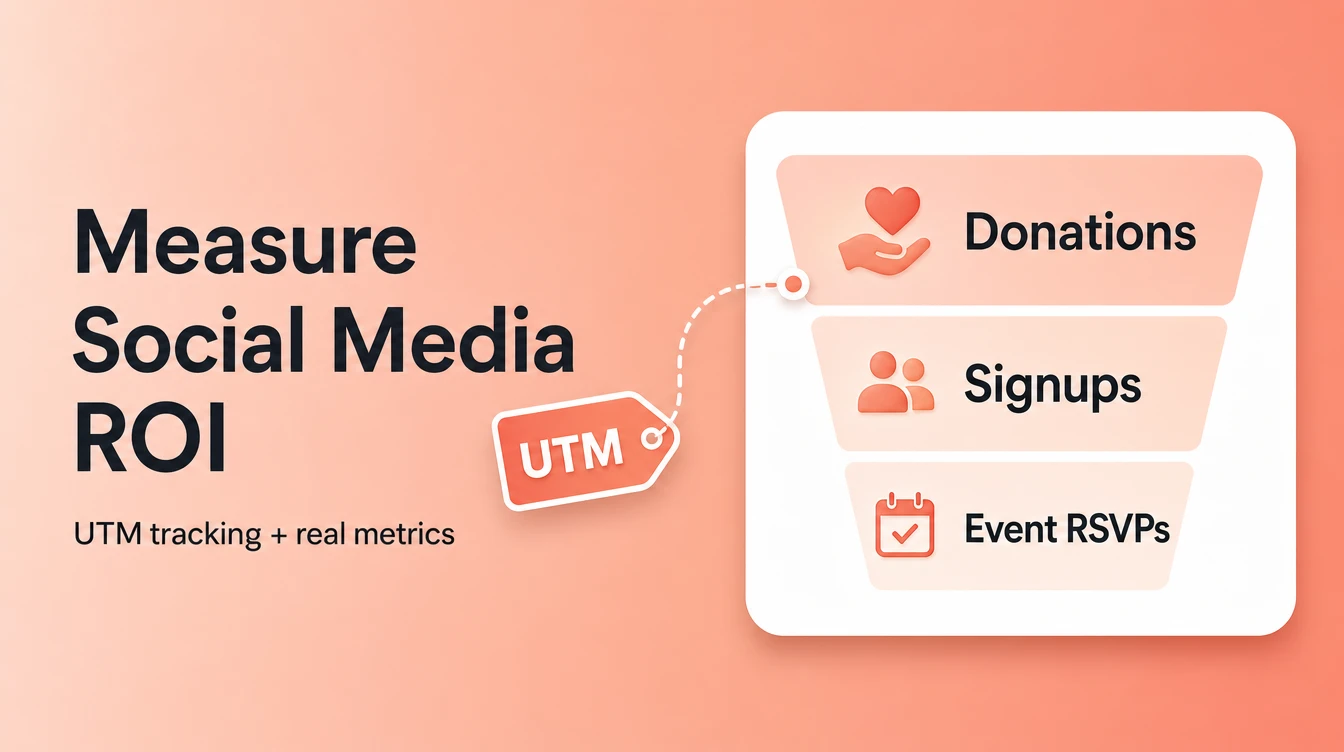
Likes are not a strategy. Every campaign needs trackable links.
UTM tracking for nonprofits connects specific social posts to specific outcomes, including donation conversions from social media, event registrations, volunteer form completions, and website traffic from social. Without it, you are guessing which posts drove real results and which ones just looked good.
Build a monthly report around clear fundraising metrics and mission-relevant outcomes: campaign performance, platform traffic, signups, and conversions. Present those numbers as a clean board report that leadership can act on, not just raw platform data. Broad industry benchmarks are useful context, but your own historical data is the most honest measure of whether you are improving.
15. Document Your Workflow and Policy So Consistency Outlives Staff Changes
A social media strategy that lives inside one person's head is one resignation away from collapse. Neon One puts it plainly: a documented content plan means the rest of the team can step up if the primary person is unavailable.
Document who drafts content, who approves it, who publishes it, and who responds to comments and messages. Keep social media guidelines, image permission policies, and crisis response protocols somewhere every team member can find them.
For teams experimenting with AI-assisted content or evaluating social media tools for nonprofits, use AI for first drafts and repurposing long-form material. For visual content, GPT Image 2 can also help nonprofit teams draft campaign graphics, story visuals, and post variations before final brand and privacy review. Always apply human review for tone, factual accuracy, mission sensitivity, and privacy considerations. AI can reduce workload. Human judgment protects your mission.
Common Social Media Mistakes Nonprofits Should Avoid
- Posting only donation asks and event flyers, with nothing in between
- Attempting to manage every platform with an under-resourced team
- Ignoring comments, DMs, and community moderation entirely
- Sending supporters to a generic homepage instead of a dedicated conversion page
- Measuring follower growth while ignoring actual mission outcomes
- Forgetting captions, alt text, and mobile-first design
- Letting multiple team members post without a shared calendar or clear ownership
Social Media for Nonprofits: FAQ
What should nonprofits post on social media? A mix of impact stories, volunteer and donor spotlights, educational content, behind-the-scenes moments, and event updates. The 70/20/10 framework provides a useful structure for balancing the mix across any given month.
How often should nonprofits post on social media? Posting frequency is a common concern, but the answer is simple: consistently, at whatever pace your team can sustain with real quality. There is no universal best posting cadence. Use your own analytics and honest team capacity to find the right rhythm, then protect it.
How can small nonprofits manage social media with limited time? Focus on one or two platforms. Repurpose existing content like donor emails, blog posts, and event photos into social posts. Use a content calendar to plan ahead, and document a simple approval workflow so nothing falls through when someone is out.
Should nonprofits use paid social media ads? Yes, strategically. Boost high-performing organic posts, support time-sensitive campaigns, and run small-budget tests before scaling. Track every spend against a clear outcome.
How do nonprofits measure social media success? By connecting social activity to real outcomes: website traffic, donations, event registrations, and volunteer signups. UTM links and a simple monthly reporting habit make this measurable and repeatable.
Do nonprofits need a social media policy? Yes. Even a simple one-page document covering brand voice, image permissions, moderation rules, and crisis response can prevent costly mistakes, especially on teams with multiple contributors.
Build a Nonprofit Social Media Plan You Can Actually Sustain
The best social media marketing strategy for nonprofits is not the most ambitious one. It is the one your team can execute consistently, measure honestly, and improve over time.
Start with the essentials: choose one or two platforms, define four to six content pillars, set one conversion goal per campaign, add UTM links to every key link, and build a simple monthly report. If you are ready to connect your social media presence to real membership growth, the next step is to build a membership website that turns followers into signed-up, engaged supporters.
Ready to see how it works in practice? Start a free trial and explore how Join It supports membership organizations from first social post all the way to sign-up. Or if you want to talk through your specific goals first, book a call with Join It and find out exactly how it fits your mission.
Sources
- American Bar Association. Don't Spam Your Members: Communicators Share Tips on Email Marketing
- CSAE. Top Membership Recruitment, Engagement and Retention Trends 2024
- Association Headquarters. Demonstrating Value Drives Membership Growth
- Clowder. How to Create a Member Communication Plan
- Neon One. Nonprofit Email Benchmarks

Guides from the Experts
Through our work with 4,000+ organizations - we’ve put together helpful guides to assist; regardless of where you are on your journey.
.webp)

A Complete Guide to Membership Organizations
Everything you need to know to manage and grow your membership business
.webp)
Maximize Membership Retention: 10 Proven Strategies
Tried and true strategies that not only win membership, but keep them

Build a Membership Website: A Step-by-Step Guide
Your one-stop resource for knowing all the features your modern membership website needs
Ready to start your free trial?
Our membership software is intuitive to use and even easier to test for yourself.