Understanding Member Satisfaction and Retention
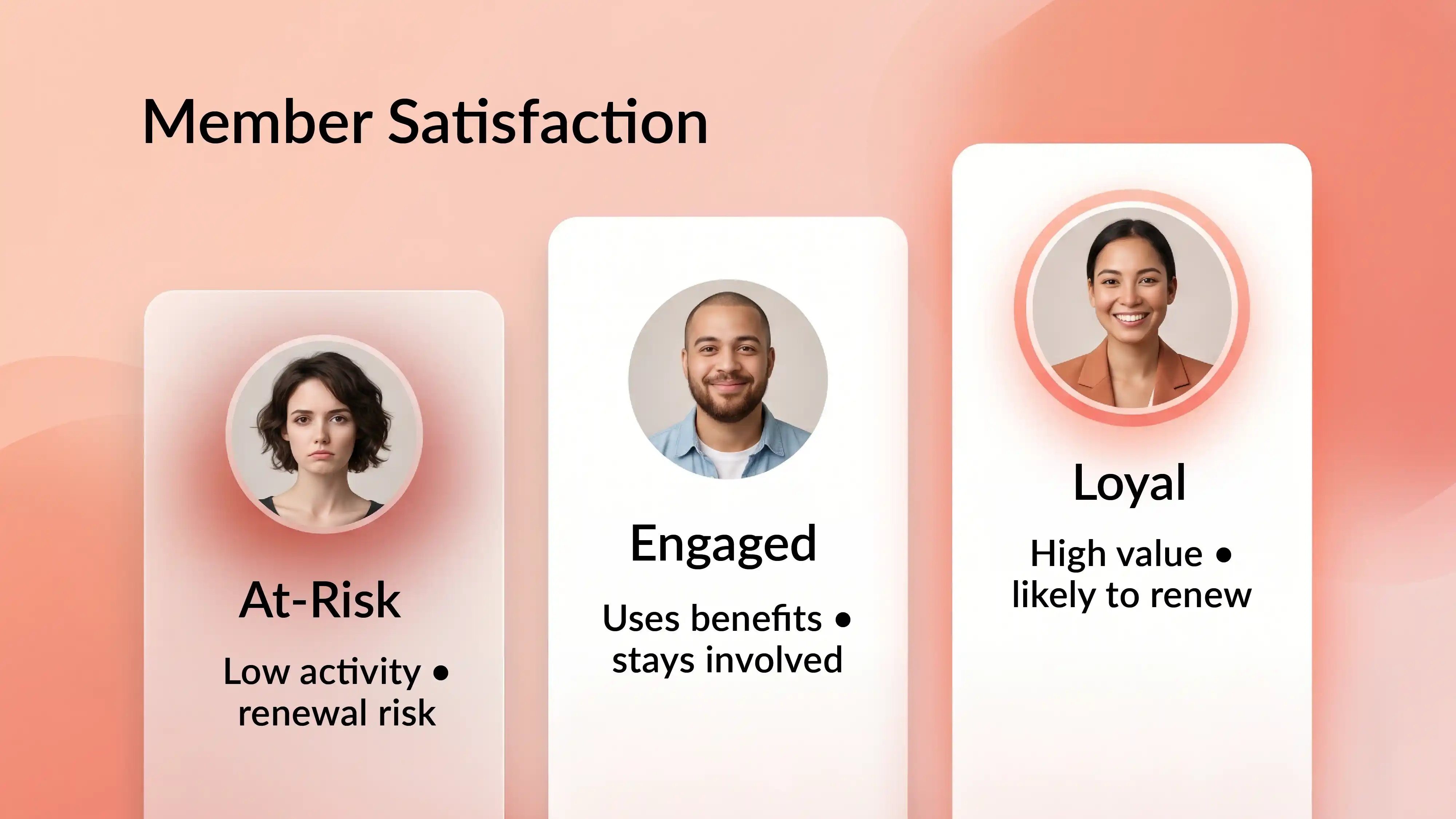


Most membership organizations track renewals religiously. Fewer track the early signals that predict whether renewal will happen at all.
Member satisfaction is that signal. And most organizations measure it too late, too rarely, or with tools that only tell them what already went wrong.
This article covers what member satisfaction actually means, why it matters beyond the renewal number, and how to build a measurement approach that gives you something useful before members start drifting away.
Key Takeaways
- Member satisfaction is a cumulative judgment across the full member journey, not a score from a single event or survey.
- Satisfied members still leave. Satisfaction tells you what members say they feel. Behavioral data tells you what they actually do.
- Low benefit satisfaction has two very different causes: weak benefits, or poor awareness. The right diagnosis changes everything about the fix.
- The first 90 days are the highest-risk window. Members who never activate, never attend, and never use a core benefit rarely renew.
- Silent members are more at risk than complaining ones. A complaint is still engagement. Silence is often a decision already made.
- A single satisfaction score misleads more than it guides. A compact dashboard of relationship, journey, behavioral, and outcome metrics predicts retention far better.
- Closing the feedback loop, showing members what changed after they gave input, is itself a powerful driver of satisfaction.
- Join It is rated Excellent on Trustpilot and is built specifically for membership organizations that want to connect satisfaction signals, renewal data, and member records in one place.
What Is Member Satisfaction?
Member satisfaction is the member's cumulative judgment that your organization delivered the quality, value, and outcomes it promised, across the entire member journey.
Not just at the annual conference. Not just in the welcome email. Across everything, the full arc of what it feels like to belong.
The American Customer Satisfaction Index describes satisfaction through three core drivers: expectations, perceived quality, and perceived value. Members arrive with expectations shaped by your marketing and word of mouth. They experience quality through your programs, events, and support. And they judge value against what they're paying in dues, time, and attention.
When all three align, satisfaction rises. When one falls short, the cracks show up quickly.
ASAE research adds a nuance that matters especially in nonprofits, churches, and mission-driven associations: members evaluate both personal ROI and the broader value of belonging to something larger. Advocacy, cause, community, and mission all factor in. That's why overall membership satisfaction is richer, and harder to reduce to a single score, than standard customer satisfaction.
Member Satisfaction vs. The Terms People Confuse It With
These four concepts live in the same neighborhood. They are not the same house.
The membership experience shapes satisfaction at every touchpoint, which means measuring satisfaction well requires following the same path members actually take.
The Nuance That Changes Everything
Survey data shows what members say. Behavioral data shows what members do.
The Journal of Marketing Research found that many satisfied customers still defect. The same pattern holds in membership organizations. A member who rates their experience 8 out of 10 can still choose not to renew. Satisfaction is necessary. It is not sufficient. And understanding that distinction is what separates organizations that measure well from those that get blindsided every spring.
Why Member Satisfaction Matters (And What It Cannot Do Alone)
The numbers tell an interesting story.
According to the iMIS 2025 Membership Performance Benchmark Report, 73% of membership organizations reported above-average member satisfaction, and 75% said retention was steady or increasing.
But ASAE also found that only 11% of associations say their value proposition is "very compelling," and event attendance dropped from 62% of associations reporting steady growth in 2023 to just 53% in 2024.
That gap between "generally satisfied" and "genuinely valued" is exactly where member churn lives.
How Satisfaction Connects to Renewal Intent
When member satisfaction rises, complaints drop, member loyalty strengthens, renewal intent improves, and members become more willing to recommend your organization to colleagues. The relationship between satisfaction and long-term member retention is real, but it works through behavior, not directly through feeling.
A member who feels satisfied and uses three key benefits regularly is likely to renew. A member who feels satisfied but has attended nothing in six months? Much less certain.
Why Satisfied Members Still Sometimes Leave
This is the part most organizations skip, and it is the most important part.
ASAE cites lack of engagement and community as one of the top reasons members do not renew. Not dissatisfaction. Disengagement. The member liked you fine. They just didn't feel connected enough to prioritize renewal when the reminder arrived.
Renewal failures also come from benefits losing relevance over time, the renewal process feeling confusing or inconvenient, life changes pulling attention elsewhere, and the quiet sense that membership ROI no longer justifies the dues.
Member satisfaction measurement that ignores these factors will always miss a meaningful portion of churn.
What Actually Drives Member Satisfaction
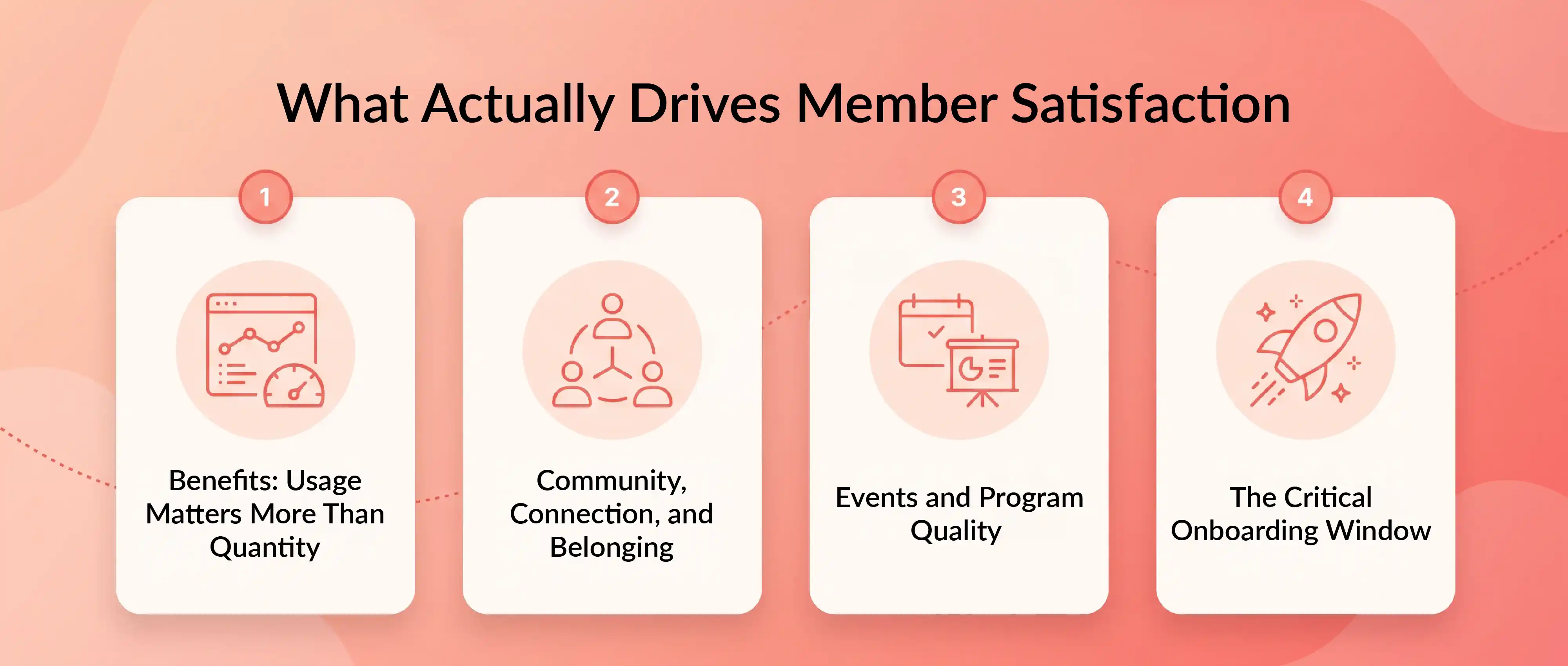
Satisfaction doesn't happen at one moment. It builds, or erodes, across the full member lifecycle.
Benefits: Usage Matters More Than Quantity
Members who use multiple benefits consistently report higher satisfaction, according to FineHaus benchmarking research. But here's what that finding actually implies: benefit awareness is half the battle.
ASAE recommends benefit-usage audits that track member benefits awareness and member benefit usage, to understand which offerings truly deliver on what members joined for. Low satisfaction with benefits can mean one of two things that require opposite responses. Either the benefits are weak. Or members simply don't know they exist.
Too many low-impact benefits dilute perceived value. A focused, relevant benefit set consistently outperforms a sprawling catalog nobody reads.
Community, Connection, and Belonging
People join professional associations, gyms, churches, and clubs for the community experience as much as for resources. When members form real peer relationships inside your organization, leaving becomes personal rather than transactional. Networking opportunities, professional development connections, and local chapter gatherings all contribute to that sense of belonging.
This is also why targeted emails for members matched to member interests and lifecycle stage matter so much. Generic broadcasts feel invisible. Communication that acknowledges who a member is and what they care about builds the sense of being genuinely known, which is one of the most underrated drivers of satisfaction in any membership context.
Events and Program Quality
Events for members are one of the most visible expressions of what membership is actually worth. A great event reminds members exactly what their dues buy. A disorganized one raises the opposite question.
The ASAE data showing event attendance decline from 62% to 53% of associations between 2023 and 2024 is worth examining carefully. Members are becoming more selective about where they invest their time, not less engaged with the concept of membership. The bar is rising.
Event feedback and program satisfaction should be measured separately from overall satisfaction. Conflating the two masks where the real problems are.
The Critical Onboarding Window
ASAE research shows that the onboarding experience window is narrow: member attention is highest immediately after joining and drops significantly within the first 90 days. Organizations using seven or more onboarding touches report meaningfully better first-year retention.
The goal of onboarding isn't to send welcome content. It's to drive one early action: completing a profile, attending a first class, joining a community group, or using a first core benefit. Early value realization is the strongest predictor of first renewal. Members who experience a quick win after joining are far more likely to stick around for year two.
How to Measure Member Satisfaction: Build a Listening System 🎧
Running one annual survey and calling it "measuring member satisfaction" is like checking your blood pressure once a year and concluding you're in perfect health.
Satisfaction unfolds continuously. Your measurement approach should too.
The Core Approach
ASAE recommends combining three things. An annual membership survey tracks overall membership satisfaction and core metrics over time. Post-touchpoint surveys, sometimes called pulse surveys, capture experience at key moments: after onboarding, events, support interactions, and renewal. And behavioral data from your CRM and membership records shows what members actually do between surveys.
The American Association for Public Opinion Research (AAPOR) specifically recommends combining surveys with administrative records when surveys alone cannot answer the full question. That combination is where the most actionable insights consistently emerge.
Well-tested membership survey questions give you a starting point for building a core question set that stays consistent year over year, which matters more than most organizations realize.
The Consistency Rule
AAPOR warns that changing survey wording or scales breaks your ability to compare results over time. ASAE identifies these four questions as the non-negotiable core to keep stable:
- Overall satisfaction with membership
- Likelihood to renew
- Likelihood to recommend
- Benefit awareness and usage
If these drift between years, trend data becomes worthless. And trend data is what actually tells you whether things are genuinely improving or just fluctuating.
Connecting Survey Data to Member Behavior
The full picture only appears when survey responses are linked to what members actually do. Who responded with low satisfaction, and when did their participation drop? Who said they'd likely renew, and did they follow through?
Organizations that connect member data with SurveyMonkey or similar feedback tools can answer those questions systematically rather than hunting through spreadsheets.
Member Satisfaction Metrics That Actually Matter
A single satisfaction score tells you almost nothing by itself.
A peer-reviewed study by de Haan et al. found that no single feedback metric consistently predicts retention across industries. Combining measures improves prediction significantly. Top-2-box satisfaction and NPS performed strongest together. Customer Effort Score was weak as a standalone KPI.
That's the research-backed case for building a dashboard rather than chasing a single north-star number.
A membership CRM that connects satisfaction data with engagement history, renewal records, and communication notes makes that dashboard possible and genuinely actionable.
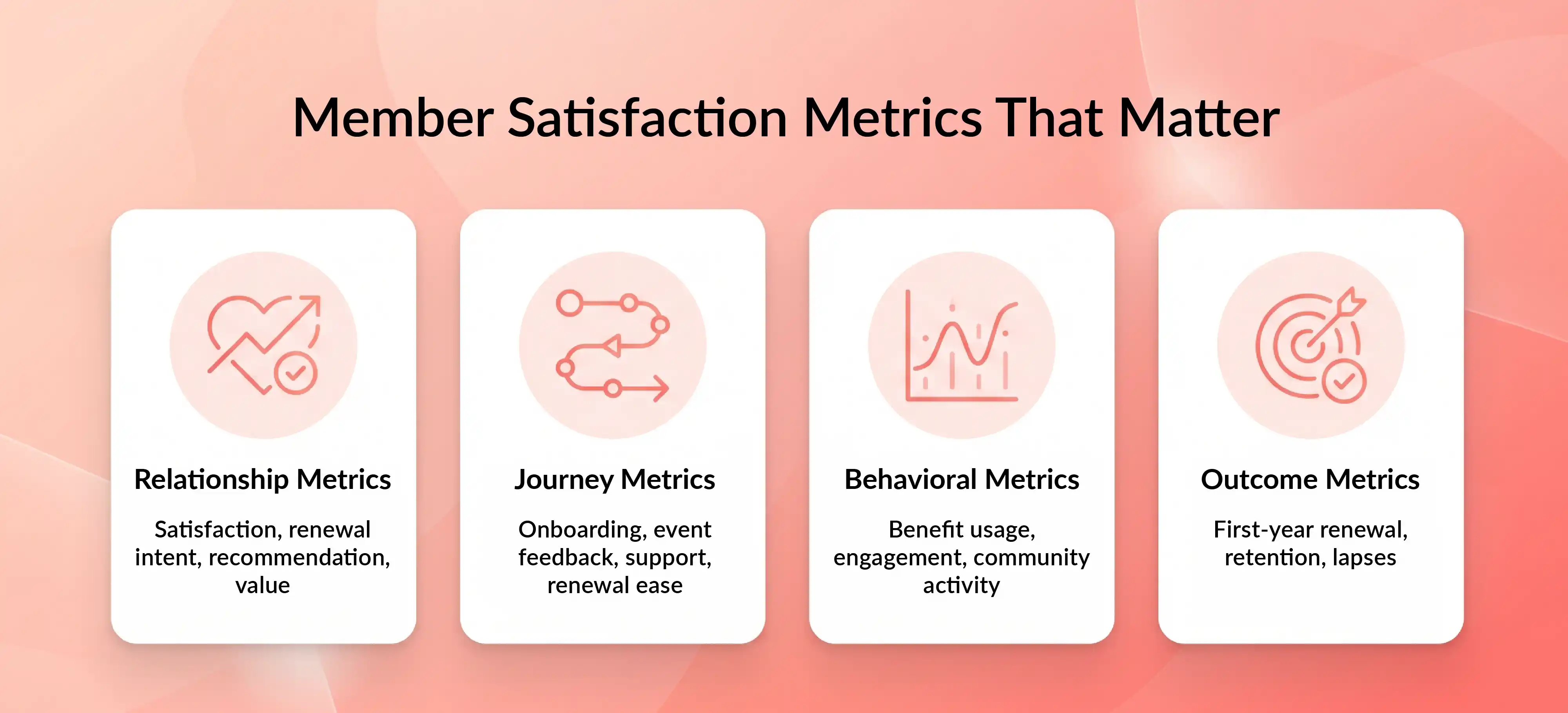
Here's a four-part framework worth building:
Relationship metrics: Overall satisfaction score, renewal intent, willingness to recommend, perceived value of membership
Journey metrics: Onboarding activation rate, post-event satisfaction, support satisfaction, renewal ease score
Behavioral metrics: Benefit usage rate, high-value engagement count, community and digital activity
Outcome metrics: First-year renewal rate, retention by segment, lapse and non-renewal trends
On benchmarks: Mariner Management research shows general associations average around +21 NPS, professional bodies around +32, and trade groups around +20. Per Bain's framework, an NPS above +20 is considered favourable and above +50 is excellent. Most member satisfaction scores for associations cluster between 7 and 9 on a 10-point scale, with 8 as the de facto average.
What's a "good" member satisfaction score? The most honest answer: better than your score last year, trending upward, and supported by renewal data that confirms members are actually staying.
When all of that data lives in a centralized member database, connecting the dots between survey responses, activity history, and renewal outcomes becomes a daily practice rather than an annual scramble.
How to Identify At-Risk Members Before They Disappear
The most at-risk members are usually the quietest ones.
Complaining members are still engaged. They believe something can be fixed. Silent members have often already made their decision. They're just waiting for the membership to expire.
ASAE identifies the first 90 days as the highest-risk window for new members. Members who never activate, never use a core benefit, and never attend anything in their first three months rarely renew. The signal is in the absence of behavior, not in what anyone says on a survey.
Watch for these patterns before renewal arrives:
- Declining logins or portal visits over consecutive months
- Dropped RSVPs or growing participation barriers like scheduling conflicts and access issues
- Reduced chapter participation or community activity
- No response across multiple communication touchpoints
- Benefit usage that was present and then suddenly stopped
The most reliable way to prevent member churn is to explore ways to improve member engagement proactively, before disengagement hardens into departure.
Automatic renewal reminders also eliminate one specific and entirely avoidable category of churn: the member who fully intended to renew and simply forgot when life got busy.
How to Improve Member Satisfaction Systematically
Improving member satisfaction is not a campaign. It is a culture.
The organizations that do it consistently share one habit: they close the loop. They collect feedback, act on something visible, and tell members what changed. That responsiveness, on its own, becomes one of the most powerful satisfaction drivers available.
Research on complaint management published in ScienceDirect identifies six steps that drive effective recovery: encourage complaints as a quality signal, resolve problems quickly, maintain a complaint database, identify recurring failure points, track trends, and use that data to improve processes. When something goes wrong, a real person responding matters in ways that a templated email simply cannot replicate.
A few principles that hold across associations, churches, gyms, chambers, and clubs alike:
Simplify before you add. ASAE warns that too many low-impact benefits dilute perceived value. A benefit audit that surfaces the top three to five genuinely valued offerings does more for overall membership satisfaction than launching two new programs nobody finds.
Reduce friction in the digital member experience. ASAE Foundation research found that members highly satisfied with association technology are nearly 20% more likely to renew. Login, registration, payment, and renewal flows should feel frictionless on every device. A smooth member self-service portal isn't a nice-to-have. It's a retention lever.
Make satisfaction cross-functional. Member satisfaction isn't just a membership team metric. Programs, events, marketing, finance, IT, and leadership all shape the member journey. Sharing survey findings and behavioral patterns across those teams, from one shared evidence base rather than department-by-department anecdotes, is how organizations actually move the needle.
The practical challenge is that satisfaction is far easier to improve when member data, payments, renewals, and communications all live in connected membership management software, rather than scattered across siloed spreadsheets and disconnected tools.
Join It is one platform built specifically for membership organizations that want connected data to track satisfaction signals, manage renewals, and act on early warning signs without stitching together a dozen separate systems.
Common Mistakes That Keep Satisfaction Scores Stuck
Even well-intentioned organizations fall into predictable traps.
Surveying only active members. If your survey only reaches people who regularly attend events and open every email, you're measuring the satisfaction of your most engaged members. The members you most need to understand are the quiet ones.
Treating engagement and satisfaction as the same thing. Understanding the difference between member satisfaction vs member engagement is more consequential than most leaders realize. A member who attends every event but feels undervalued will leave. A member who hasn't attended in months but feels strong mission alignment might renew without hesitation. They're different problems.
Changing questions every year. New questions feel productive. They destroy trend data. If you don't know where you were, you can't know whether you're improving.
Collecting feedback without reporting back. Members who take a survey and never see anything change will stop taking surveys. Closing the loop, even with a simple "here's what we heard and here's what we're doing," keeps response rates healthy and trust intact.
Member Satisfaction FAQ
What is member satisfaction? Member satisfaction is the member's cumulative judgment that your organization delivered the quality, value, and outcomes it promised across the full member journey.
How do you measure member satisfaction? Through a combination of an annual relationship survey, post-touchpoint surveys after key moments, and behavioral data from your membership records. No single survey is sufficient on its own.
What is a good member satisfaction score? Most associations score between 7 and 9 on a 10-point scale, with 8 as the de facto average. The most useful benchmark is your own trend over time, confirmed by whether your renewal data moves in the same direction.
How do you calculate member satisfaction? Common approaches include mean score, top-box percentage, and top-2-box percentage. Consistency in method matters more than which formula you choose.
How often should you survey members? Annually for the core relationship survey. Post-touchpoint surveys should trigger after key moments throughout the year. Survey when the results can lead to a decision, not purely out of habit.
What should a membership exit survey or lapsed member survey ask? Why the member chose not to renew, which benefits they used and valued, what barriers to participation existed, and what would have changed their decision.
What member benefits are most valuable? The most valuable benefits are the ones members know about, use, and can connect to the outcome they joined for. A benefit that solves a real problem for a specific member is worth more than five benefits that sound good on paper.
The Bigger Picture
Member satisfaction is not a metric to optimize in isolation. It's a signal to understand in context.
The organizations that build real listening systems, connect what members say to what members actually do, act on the findings, and close the loop with honest communication are the ones that consistently turn satisfied members into loyal ones.
That's the real goal. And it starts long before the renewal reminder goes out.
If you want to see how cleaner member data and connected systems can help your organization track satisfaction signals at scale, book a call with the Join It team to walk through what that looks like in practice. Or, if you're ready to explore on your own, start a free trial and see how everything connects.
Sources
- American Customer Satisfaction Index. The Science of Customer Satisfaction
- Chandrashekaran et al., Journal of Marketing Research. Satisfaction Strength and Customer Loyalty
- iMIS. 2025 Membership Performance Benchmark Report
- ASAE. The Membership Model Is Breaking Down
- FineHaus. Key Drivers of Member Engagement
- AAPOR. Best Practices for Survey Research
- de Haan, Verhoef, and Wiesel. Predictive Ability of Different Customer Feedback Metrics for Retention
- Mariner Management. What's a Good Net Promoter Score for Associations?
- ScienceDirect. The Role of Complaint Management in the Service Recovery Process

Guides from the Experts
Through our work with 4,000+ organizations - we’ve put together helpful guides to assist; regardless of where you are on your journey.
.webp)

A Complete Guide to Membership Organizations
Everything you need to know to manage and grow your membership business
.webp)
Maximize Membership Retention: 10 Proven Strategies
Tried and true strategies that not only win membership, but keep them

Build a Membership Website: A Step-by-Step Guide
Your one-stop resource for knowing all the features your modern membership website needs
Ready to start your free trial?
Our membership software is intuitive to use and even easier to test for yourself.