35 Membership Survey Questions to Improve Satisfaction and Retention
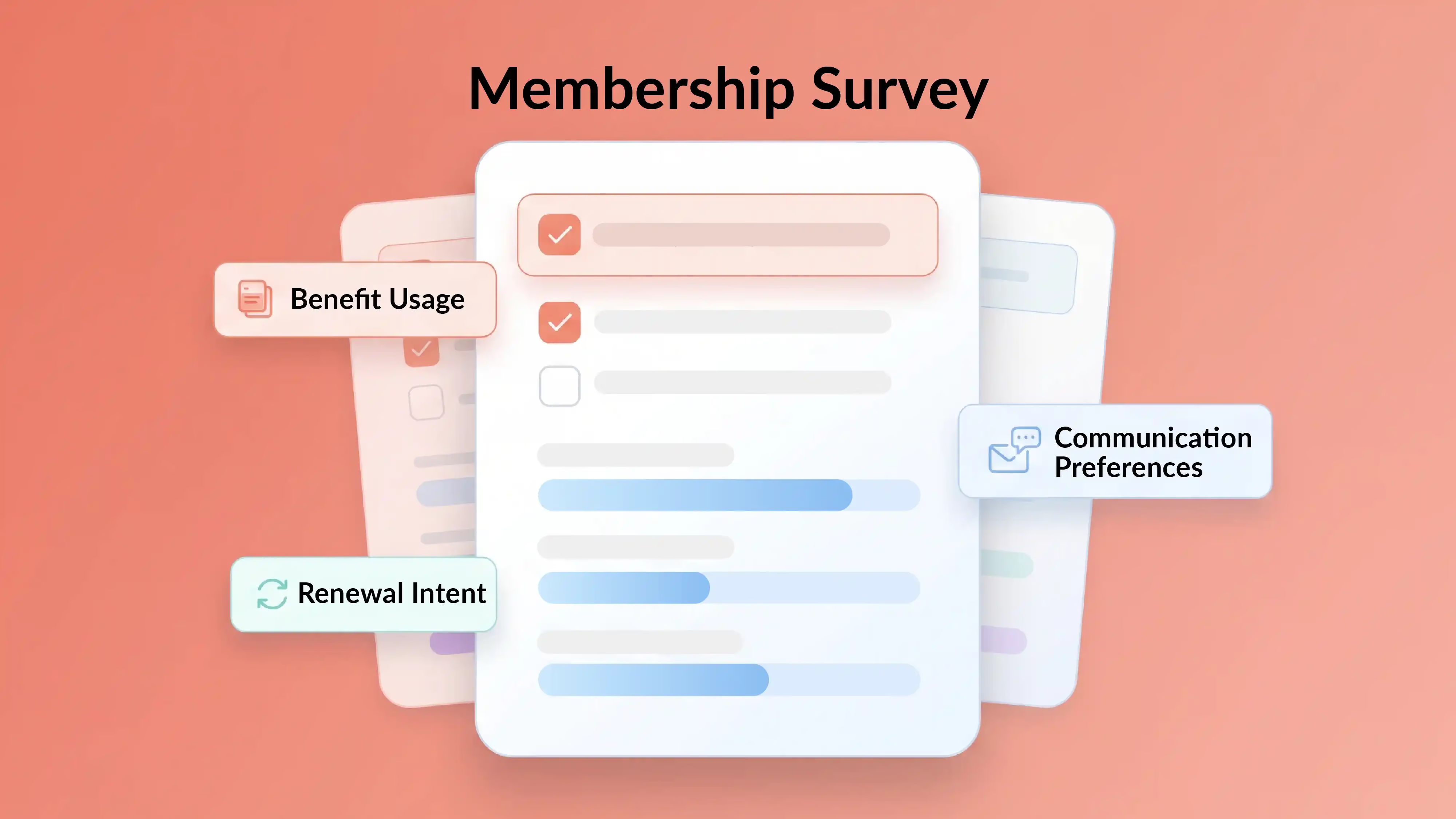


Most membership organizations send a survey once a year, skim the results, and then file them away.
Meanwhile, members quietly disengage. They stop showing up. They forget to renew. And by the time anyone notices, they're already gone.
Here's the thing: a membership survey is one of the most powerful tools you have for understanding what members actually value, where the experience breaks down, and what would keep them around longer. But only if you ask the right questions, and only if you do something with the answers.
In the Marketing General 2024 Membership Marketing Benchmarking Report, associations that conduct member research regularly were more likely to report membership growth. More than half said research helped them articulate their value proposition better, and 41% said it led to new products or services.
That is a strong case for making membership surveys a habit, not a checkbox.
What is a membership survey? A membership survey is a structured questionnaire sent to current, new, or former members of an organization to measure satisfaction, engagement, perceived value, communication preferences, and renewal intent. Variations include the member satisfaction survey, member feedback survey, membership retention survey, annual membership survey, pulse survey, and exit survey.
This guide is for associations, nonprofits, clubs, chambers of commerce, churches, gyms, and any membership organization that wants to listen better and act faster.
The 35 questions below are a question bank of sample membership survey questions, not a recommendation to ask all 35 at once. Pick the subset that matches your goal, preserve a small benchmark set year over year, and rotate the rest based on what you need to learn right now.
Three things worth knowing before you start:
- The top reported reasons members do not renew are lack of engagement (47%), lack of value (32%), and forgetting to renew (29%), according to that same 2024 benchmarking report. Your survey should help you diagnose all three.
- ASAE Foundation research found members most highly valued sharing current knowledge and data (81%), professional development and education (65%), and networking (58%). If your survey doesn't ask about these, you're probably missing what matters most.
- Survey participation is harder than it used to be. Pew Research Center documents a long-term decline in survey response rates, and a 2024 study found that households recently surveyed for one project had measurably lower response to the next one. Shorter, more targeted surveys are not optional anymore.
Now let's get into the questions.
Key Takeaways
35 Membership Survey Questions You Can Copy, Customize, and Use
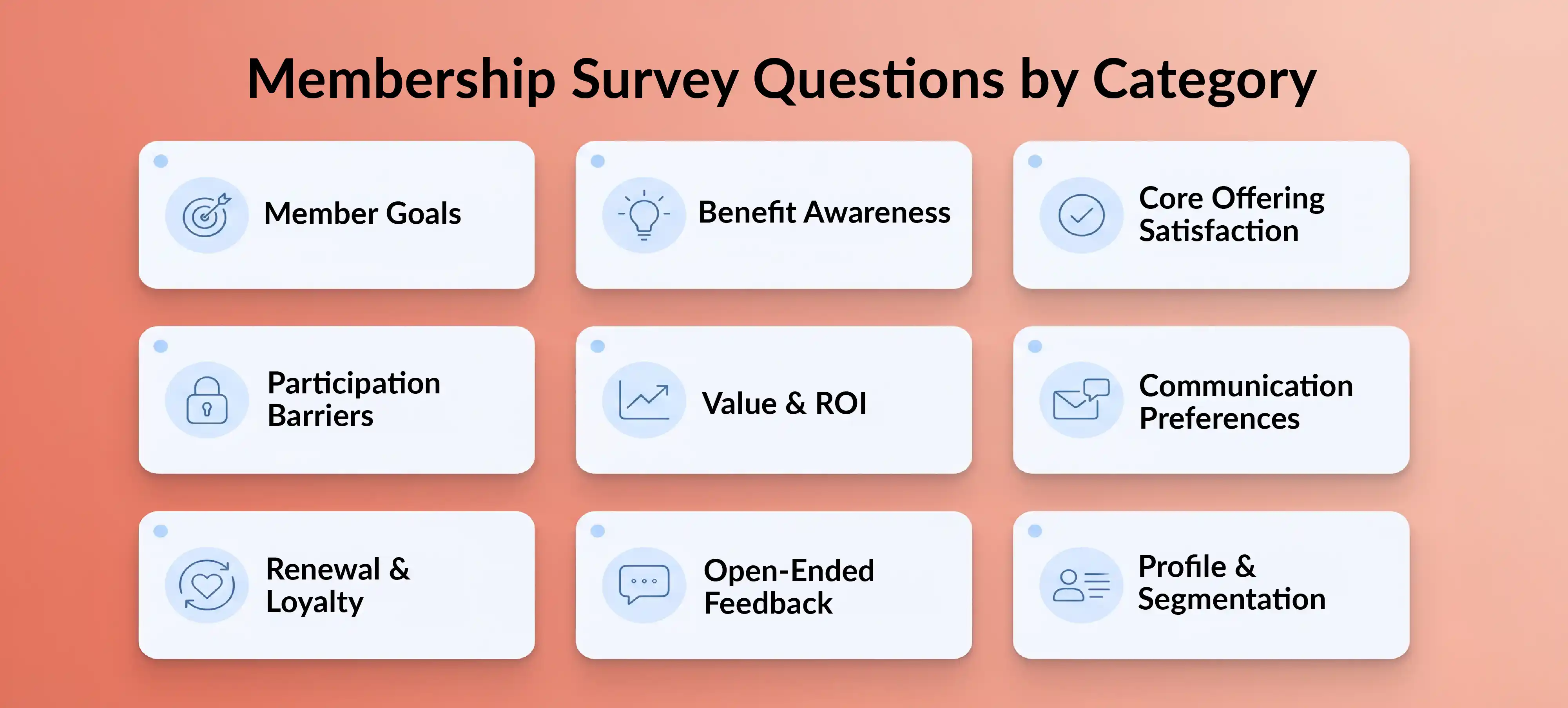
Choose the subset that matches your goal rather than sending one long survey to everyone. A good annual membership survey might use 10 to 15 of these. A pulse survey or exit survey might use four or five.
Here is how the 35 questions break down by category:
Member Goals and Reasons for Joining
If you don't know why people joined or what their needs and expectations are right now, every other answer is harder to interpret. These questions are especially useful for new member onboarding and member needs assessment.
1) What was the main reason you joined our organization? Format: Single-select + "Other." This establishes the reasons members join and helps you understand whether your acquisition messaging matches the experience you deliver.
2) Which membership benefit matters most to you right now? Format: Single-select. Present-day priorities often differ from the reason someone originally joined. This question helps you prioritize member benefits by segment.
3) What do you most want your membership to help you achieve in the next 12 months? Format: Single-select or short list. Turns vague "member satisfaction" into a future-oriented outcome you can plan around.
4) What topic, service, or opportunity would you like more of from us? Format: Single-select list + "Other." Surfaces unmet demand for continuing education, networking opportunities, events, advocacy, or professional development.
Benefit Awareness and Usage
Members cannot value benefits they don't know about. A member satisfaction survey without awareness and usage data is incomplete.
5) Before this survey, which member benefits were you aware of? Format: Checklist or item-by-item yes/no. Identifies awareness gaps before you draw conclusions about value.
6) Which member benefits have you used in the past 12 months? Format: Checklist. Shows actual usage, not assumed usage. This is where you find underused benefits that might need better promotion or retirement.
7) How often have you participated in our events, programs, classes, services, or meetings in the past 12 months? Format: Frequency scale. Gives a behavioral baseline and flags members at risk of disengagement.
8) Which member benefit or resource has been most useful to you? Format: Single-select + "Other." Identifies your strongest "hero" benefit for renewal messaging and investment decisions.
9) What is the main reason you have not used more member benefits? Format: Single-select barrier list (time, cost, relevance, access, didn't know about them, schedule conflicts). Gets beyond "low use" into causes.
Satisfaction with Core Offerings
Measure satisfaction at the offering level, not just as one overall score. Ask about the experience drivers that actually matter to your members, whether that's events, education, community, staff support, or digital access.
ASAE's technology study found that member satisfaction with specific experience drivers was directly related to overall membership satisfaction, renewal likelihood, and willingness to recommend.
10) How satisfied are you with the quality of our events, programs, or classes? Format: 5-point satisfaction scale. Events and programs are a core experience driver for most membership organizations.
11) How satisfied are you with the quality of our educational, informational, or training resources? Format: 5-point scale. Ties directly to the knowledge-sharing and professional development value that members rank among their top priorities.
12) How satisfied are you with the networking, community, or peer connection opportunities we provide? Format: 5-point scale. Community belonging is one of the strongest reasons members stay.
13) How satisfied are you with the support you receive from our staff, leaders, or volunteers? Format: 5-point scale. Measures service quality and the human side of the member experience.
14) How satisfied are you with how easy it is to access the benefits and services included in membership? Format: 5-point ease scale. This distinguishes quality problems from access problems. If members can't find or reach the benefit through your member portal, even great offerings will feel invisible.
Engagement and Participation Barriers
"Lack of engagement" was the number one reason members didn't renew in the 2024 benchmarking report. But engagement isn't just about interest. It includes behavior, constraints, and opportunity fit.
One community-building discussion on Stack Exchange put it well: many more people say they will participate than actually show up. So your member engagement survey questions should probe barriers, not only intentions.
15) How easy is it to find opportunities that are relevant to you? Format: Ease scale. Measures discoverability of engagement opportunities, not just satisfaction with what exists.
16) Which barrier most often prevents you from participating more? Format: Single-select (time, cost, location, schedule, relevance, accessibility, employer support). This is one of the most actionable questions you can ask.
17) How likely are you to participate in at least one event, program, or activity in the next 12 months? Format: Likelihood scale. Captures forward-looking engagement intent for forecasting and re-engagement planning.
18) Which one change would make you more likely to participate more often? Format: Single-select + "Other." Turns barrier data into a solution shortlist.
Value, Dues Fairness, and ROI
Perceived value is a retention issue, not just a pricing issue. These membership survey questions connect value to usage, dues, and renewal risk.
19) Overall, how would you rate the value of your membership relative to the cost? Format: 5-point value scale. This is a core signal. Organizations with a compelling value proposition were more likely to report better growth and renewal in the 2024 benchmarking data.
20) Which one benefit best justifies your membership dues or fees? Format: Single-select. Reveals what members think they are really paying for. Essential for renewal copy and membership pricing strategy.
21) Compared with when you joined, is the value you receive from membership increasing, staying about the same, or decreasing? Format: 3-point trend choice. Adds a trajectory layer to your value data and flags mid-tenure retention risk.
22) If membership does not feel fully worth the cost, what is the main reason? Format: Single-select (not using enough benefits, content isn't relevant, employer stopped paying, better alternatives exist, price increased). Diagnoses value erosion so you can respond before it becomes a cancellation.
Communication Preferences, Deliverability, and Digital Experience
Some members aren't receiving your messages at all. IUSSP's membership survey found that while most members felt email frequency was "just about right," some reported not receiving emails at all. So start with deliverability before asking about preferences.
23) Are you receiving the emails, texts, or updates you expect from us? Format: Yes / No / Not sure. Diagnoses deliverability and list hygiene issues before anything else.
24) How would you rate the amount of communication you receive from us? Format: Too much / About right / Too little. Simple, fast, and directly actionable.
25) Which communication channels do you prefer for news, reminders, and announcements? Format: Single-select or ranked choice. Captures member communication preferences so you can match the channel to the audience.
26) How easy is it to find what you need on our website, app, or member portal? Format: Ease scale. Digital findability is an urgent pain point in many organizations. If members can't navigate your site, satisfaction suffers regardless of how good the content is.
Renewal, Loyalty, and Advocacy
These are your outcome questions. They work best near the end of the survey, after the driver questions have already provided context.
27) Overall, how satisfied are you with your membership experience? Format: 5-point satisfaction scale. Your topline benchmark for year-over-year tracking.
28) How likely are you to renew your membership when it comes due? Format: 5-point likelihood scale. The most direct retention signal in your entire survey. Pair this with membership churn insights to see which segments are most at risk.
29) How likely are you to recommend our organization to a friend, colleague, or peer? Format: 0–10 scale for NPS-style tracking, or 5-point likelihood scale. Measures advocacy and word-of-mouth potential.
30) Which improvement would most increase your likelihood of renewing? Format: Single-select + "Other." Converts renewal intent data into a concrete action lever for your membership retention guide.
Open-Ended Feedback and Improvement Suggestions
Keep open-ended questions few but meaningful. They surface blind spots and give you the exact language your members use, which is gold for messaging.
Open text is valuable, but only if you have a plan to review and code it. A 2026 article in Public Opinion Quarterly argues that LLMs can help scale the analysis of open-ended survey responses, while a 2024 study by Mellon et al. found modern language models can approach human agreement levels in open-text coding tasks. This is a real and growing option, with appropriate human review.
31) What do you value most about your membership? Format: Open text. Reveals strongest perceived value in the member's own words.
32) What is the one thing we should improve first? Format: Open text. Forces prioritization and gives your membership committee a clear starting point.
33) What do you need from us that we do not currently offer? Format: Open text. Surfaces unmet needs and new service opportunities.
Profile and Segmentation Questions
Segmentation and demographics are what make survey results usable, not just interesting. Without them, you're looking at averages that hide real problems.
34) How long have you been a member? Format: Mutually exclusive tenure bands (less than 1 year, 1–3 years, 4–7 years, 8+ years). Tenure often explains differences in awareness, satisfaction, and renewal patterns.
35) Which best describes your member type, role, or career/life stage? Format: Single-select. Helps reveal segment-specific priorities. ASAE research shows that career advancement and job opportunities are especially important for earlier- and mid-career members, a demand association professionals often underestimate.
Membership Survey Template: How to Build the Right Survey From These 35 Questions
Sending all 35 questions to every member at once is a mistake. Different moments in the member lifecycle call for different question sets.
A 2024 study by Eggleston tested whether repeated survey requests reduce response and found that recently surveyed households had measurably lower participation in the next survey. The takeaway: fewer, smarter surveys will outperform one annual blast every time.
Here is how to build purpose-specific surveys from the question bank:
For renewal surveys, reach members before renewal comes due, not after they've already lapsed. For event and program feedback, target only actual attendees when your tools allow it. This is a real pain point in many membership platforms. Users in WildApricot's forum have asked for post-event surveys tied to registrants rather than blunt membership-group targeting.
If you need membership form templates for collecting member data at signup, those forms can complement your survey strategy by capturing baseline profile information before you survey
Membership Survey Best Practices for Better Questions and Better Data
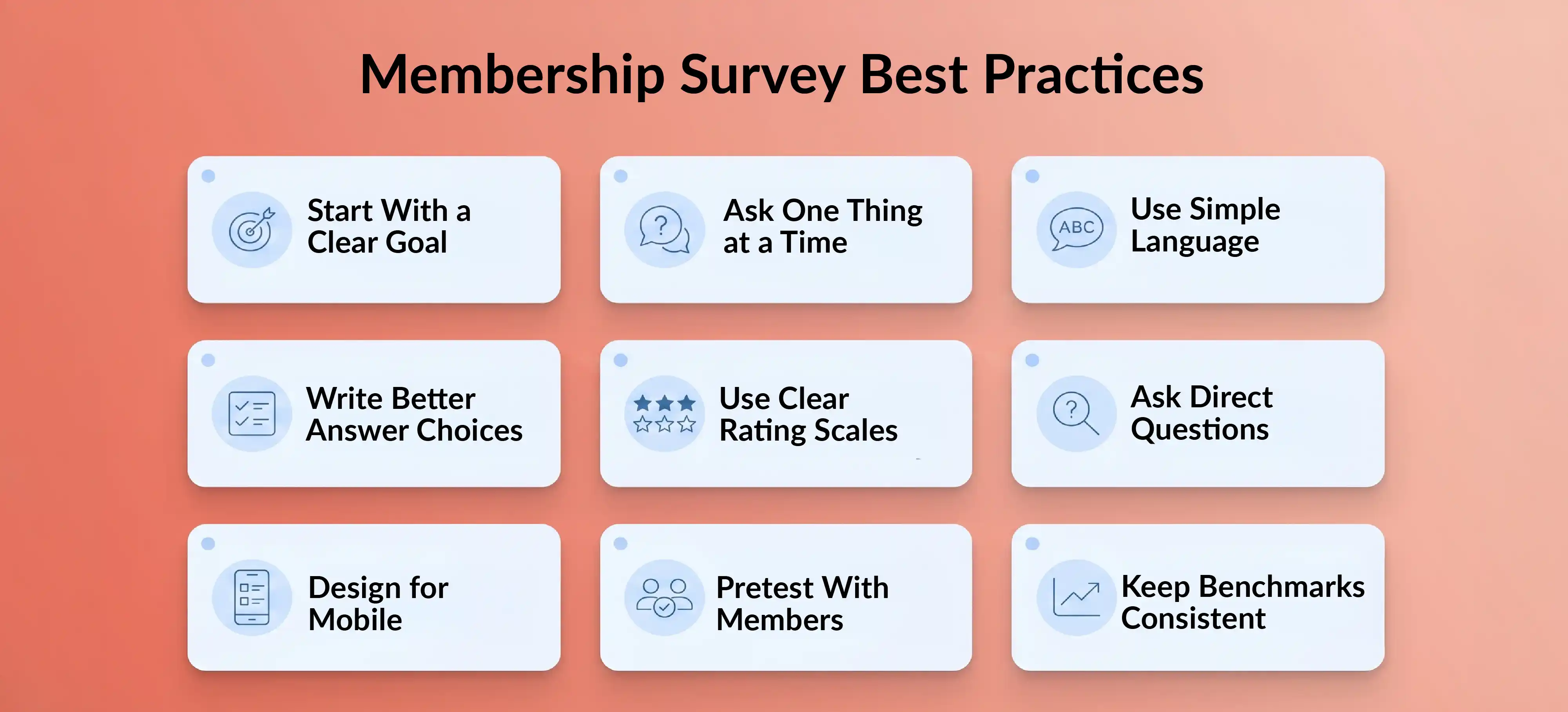
Good questions produce good data. Bad questions produce noise that feels like data. Here are the practices that matter most, grounded in survey research standards.
Start with the decision your survey needs to inform. AAPOR recommends defining specific, unambiguous objectives before writing a single question.
Ask one thing at a time. Pew Research Center warns against double-barreled questions like "How satisfied are you with our events and communications?" Split them.
Use simple language. Pew also recommends avoiding jargon, abbreviations, double negatives, and emotionally loaded wording. Use the words your members use, not your internal department terms.
Make response options exhaustive and mutually exclusive. Include "Not applicable" when a member may not have used a benefit. Separate "Don't know" from the main scale.
Use balanced, fully labeled rating scales. U.S. Census web survey guidelines recommend 5-point or 7-point scales with fully worded labels and consistent direction throughout.
Avoid agree/disagree as your default. Pew explicitly warns these are prone to acquiescence bias. Ask direct evaluative questions like "How satisfied are you with…?" or "How easy is it to…?" instead.
Build for mobile and accessibility. Government Analysis Function guidance recommends smartphone-first, inclusive design. One question per page can reduce cognitive overload, especially for members with mixed digital comfort levels.
Pretest with real members. AAPOR recommends pretesting with people similar to your target respondents before fielding widely. Even a handful of real member reviews can catch confusing wording.
Keep benchmark questions stable year over year. If you change wording, scales, or context, you lose the ability to track trends. Preserve a small core set and rotate the rest.
What Is a Good Membership Survey Response Rate?
There is no single "good" benchmark. Response rates in membership surveys vary wildly depending on the audience, the length of the survey, and whether members trust that something will happen with the results.
AAPOR advises reporting response rates using a standard formula, but also warns against treating response rate alone as a reliable quality indicator. A high response rate doesn't guarantee unbiased data, and a low one doesn't automatically mean useless results.
Here's what real membership organizations have reported:
IUSSP surveyed current and former members and saw a 51% response rate from current members, 44% from current student associates, and just 20% from former members and students. The gap confirms what most organizations already suspect: former members are significantly harder to reach.
BACP reported that 5.3% of its full membership participated in its annual membership survey. That sounds low, but it was still enough to surface the top challenges members face in their profession, proving that even modest response can produce useful intelligence.
WBT Lake Association emailed roughly 440 surveys and received about 140 back, a 32% response rate. What stood out was their transparency: a clear denominator and a public commitment to work on actionable items.
CTPA collected 136 responses that generated 571 total comments and reported 96% satisfied or very satisfied. The comment volume shows that depth of engagement can matter as much as the response count itself.
The most important thing is not hitting a specific number. It's designing your survey so the results are segmentable, actionable, and paired with visible follow-through.
If your member records live in membership management software like Join It, you can segment responses by active, new, or lapsed status, member type, or renewal stage before deciding what to fix first.
How to Increase Membership Survey Response Rates and Trust
Members often ignore surveys because they feel over-asked, unclear about confidentiality, or convinced that nothing will change.
Explain why the survey matters. State the decision being informed. "We are using this survey to decide which programs to expand and which to redesign" is better than "Please help us improve."
Set clear expectations in the invitation. RCPCH's 2026 survey invitation reads like a trust-building playbook: defined survey length (~15 minutes), ability to save progress, personalized links, reminders, explicit anonymity commitments, and details on encryption and data handling.
Your invitation should include why you're asking, how long it takes, who is invited, the deadline, and what members can expect after the survey closes.
Be honest about anonymity and confidentiality. Anonymous means you cannot identify who responded. Confidential means you can, but you won't share individual responses. If you're using personalized links and sending reminders to non-responders, the survey is likely confidential, not anonymous. Say so clearly.
One Reddit thread in r/patreon shows a subscriber asking whether a creator can see "Other" responses on an exit survey. That kind of concern is common and real.
Reduce friction in the experience. No unnecessary forced login. Mobile-friendly layout. Progress that can be saved. A confirmation page after submission. Users in WildApricot's forum have specifically requested polls usable without a login requirement. And in a Constant Contact community thread, an organizer reported members losing responses due to submission errors, which damages trust for future surveys.
Send fewer surveys, but send smarter reminders. Target reminders to non-responders where possible, rather than blasting everyone again. Members on a Club Pilates Reddit thread described constant rating requests as "ridiculous."
Close the loop. After the survey, publish a short member-facing summary: top findings, top three actions, and a realistic timeline. RCPCH uses a "You said, we did" model that directly attributes actions (like launching 30 new webinar topics) to member feedback. This is the single best thing you can do to improve response rates for the next survey.
How to Analyze Membership Survey Results and Turn Feedback Into Action
A survey becomes useful when outcome metrics, driver questions, and open-ended "why" data are read together.
Use the outcome + driver + why framework. Questions 27–29 are your outcomes (satisfaction, renewal, recommendation). Questions 5–26 are your drivers (what explains those outcomes). Questions 31–33 are your "why" (in the member's own words). Reading them together prevents shallow reporting.
Build an importance vs. satisfaction matrix. For each core benefit, compare how important it is to members with how satisfied they are. Prioritize high-importance, low-satisfaction items first.
Segment everything. Use Q34 and Q35 to break results by tenure, member type, and career stage. Averages hide real problems. A new member who can't find anything is a completely different issue from a ten-year member who feels the value is declining.
Separate stated interest from actual behavior. Compare Q7 (participation frequency) with Q17 (future intent). Use Q16 and Q18 to explain the gap.
Compare member responses with staff assumptions. Run a short internal staff version of the same survey and compare. ASAE's technology study found that staff can underestimate member satisfaction or misjudge what members most want. The gap analysis is often where the most important insights live.
Turn findings into a "You said, we did" roadmap. For each finding, document the evidence, the affected segment, the action, the owner, the timeline, and how you'll communicate it back to members.
Membership Survey Examples: What Real Organizations Learned and Changed
RCPCH used member survey feedback to develop 30 new webinar topics, launch a help centre, and build a digital hub. They published all of it back to members in a "You said, we did" format.
ICAS connected annual member survey results to strategic planning, a new website shaped by member feedback, and programmatic workstreams including AI working groups and portal upgrades.
CIH Northern Ireland found that over 80% of respondents rated free webinars as important or very important, and over 75% used events for learning and networking. They designed specific event series based on those signals.
IUSSP uncovered that some members were not receiving emails at all, a diagnostic insight that led directly to deliverability and list hygiene actions.
CTPA generated 571 comments from 136 responses and reported 96% satisfied or very satisfied, demonstrating that depth of feedback can matter as much as volume.
How to Customize These Membership Survey Questions by Organization Type
The framework is the same. What changes is vocabulary and emphasis.
Association and nonprofit membership survey questions: Swap in terms like professional development, networking, advocacy, chapters, conferences, and resources. Emphasize goals, usage, value, and renewal. If your members welcome new members through onboarding programs, add Q5 and Q14 early.
Chamber of commerce membership survey questions: Use terms like business events, visibility, referrals, local advocacy, and member resources. Emphasize usage, value, communication preferences, and renewal.
Club and church membership survey questions: Use terms like groups, activities, classes, gatherings, ministries, volunteer opportunities, and member services. Emphasize participation barriers, communication, community experience, and overall satisfaction.
Gym membership survey questions: Use terms like classes, sessions, visits, member support, and digital experience. Emphasize usage frequency, barriers, value, communication, and renewal intent.
Common Membership Survey Mistakes to Avoid
Using one generic survey for current, new, at-risk, and exiting members. Different lifecycle stages need different question sets. A first-year member survey and a membership exit survey are solving different problems.
Asking only overall satisfaction without diagnosing value, usage, and barriers. A score without context is a number without a decision.
Writing leading or agenda-driven questions. A museum professional on Reddit described receiving a "really sloppy" member survey and feeling it was "asking towards answers someone wanted." That perception destroys trust.
Over-surveying members and ignoring earlier feedback. Survey fatigue is real, but "inaction fatigue" is worse. Members stop responding when they believe nothing will change.
Letting your survey tool dictate bad design. Forced logins, no attendee targeting, no non-responder reminders, and broken submission flows are all documented complaints in membership platform forums. If your current tool can't support good survey design, you can send member surveys with SurveyMonkey as an alternative.
Failing to publish what changed. If members never hear what happened after the last survey, expect fewer responses next time.
FAQ About Membership Survey Questions
What questions should be in a membership survey? A well-designed membership survey questionnaire covers member goals, benefit awareness and usage, satisfaction with core offerings, engagement barriers, perceived value and dues fairness, communication preferences, renewal and advocacy intent, open-ended feedback, and segmentation. Choose the categories that match your survey objective.
How do you measure member satisfaction? Combine an overall satisfaction question (Q27) with driver questions about specific offerings (Q10–Q14), renewal likelihood (Q28), and willingness to recommend (Q29). A single satisfaction score without drivers tells you very little.
How often should you survey members? Most organizations benefit from one annual membership survey for benchmarking, plus shorter pulse surveys for specific events or lifecycle moments. Avoid over-surveying, which can measurably reduce future participation.
How many questions should a membership survey have? This article provides a 35-question bank, but most live surveys should use 10 to 15 questions. The right number depends on the survey's purpose, audience, and how much time you're asking members to invest.
What is a good membership survey response rate? There is no single benchmark. Published examples range from about 5% to over 50%, depending on the organization and audience. Focus on making results segmentable and actionable rather than chasing a specific percentage.
Should a membership survey be anonymous or confidential? Anonymous means you cannot identify who responded. Confidential means you can, but you won't share individual answers. Be clear about which one your survey is, especially if you're using personalized links.
What should a membership exit survey ask? Focus on the main reason for leaving, perceived value, participation history, likelihood to return, and what could have prevented the exit. Frame questions neutrally and explain who sees the responses.
What member benefits are most valuable? ASAE Foundation research found members most highly valued sharing current knowledge and data, professional development and education, and networking. But validate with your own members, because what matters most will differ by organization type and career stage, and the best way to improve the membership experience is to ask.
Conclusion: Use Your Membership Survey as a Decision Tool, Not a Checkbox
The best membership survey is short, specific, trustworthy, and tied to a decision you're actually going to make.
Even a low-response survey can be useful if the results are segmented carefully, interpreted honestly, and acted on visibly.
Start with the question bank above. Pick the subset that fits your goal. Send it to the right members at the right moment. And when you get the results, tell your members what you learned and what you're going to do about it.
If your member data lives in a platform like Join It, keep your survey segments, follow-up actions, and renewal work tied to the same member records so survey insight becomes operational, not just informational. You can start a free trial or book a demo to see how it works with your membership.
Your members already have opinions about you. A good survey is how you make sure you hear them before they leave.
Here are all external links anchored in the content, in exact order of first appearance:
Sources
- Marketing General. 2024 Membership Marketing Benchmarking Report
- ASAE Foundation. Rising Expectations for Association Impact
- Pew Research Center. Response Rates in Telephone Surveys Have Resumed Their Decline
- Eggleston 2024. Repeated Survey Exposure and Response
- ASAE Foundation. Tech Success for Associations
- Community Building Stack Exchange. How to Survey for Real Participation
- IUSSP. Membership Survey: Preliminary Results and Clarifications
- Public Opinion Quarterly 2026. Scaling Open-Ended Survey Responses Using LLM-Paired Comparisons
- Mellon et al. 2024. Coding Open-Text Survey Responses at Scale
- ASAE. Give Members the Career Resources They Want
- WildApricot Forum. Event Survey Wishlist
- AAPOR. Best Practices for Survey Research
- Pew Research Center. Writing Survey Questions
- U.S. Census Bureau. Web Survey Design Guidelines
- Government Analysis Function. Inclusivity and Accessibility in Survey Development
- AAPOR. Response Rates
- BACP. Results of the 2025 BACP Membership Survey
- WBT Lake Association. Membership Survey Results
- CTPA. Membership Survey 2025 – Thank You
- RCPCH. Your Voice Matters: Help Shape Your Member Experience
- Reddit r/patreon. Exit Survey Visibility Discussion
- WildApricot Forum. Open Poll Without Login Wishlist
- Constant Contact Community. Survey Responses Could Not Be Submitted
- Reddit r/ClubPilates. Instructor Reaching Out After Negative Feedback
- ICAS. Results of Our 2024 Member Survey
- CIH Northern Ireland. You Said, We Did: Insights from the CIH NI Membership Survey
- Reddit r/MuseumPros. Member Survey Critique Discussion
- WildApricot Forum. Free-Text Answer Open-Ended Question Wishlist

Guides from the Experts
Through our work with 4,000+ organizations - we’ve put together helpful guides to assist; regardless of where you are on your journey.
.webp)

A Complete Guide to Membership Organizations
Everything you need to know to manage and grow your membership business
.webp)
Maximize Membership Retention: 10 Proven Strategies
Tried and true strategies that not only win membership, but keep them

Build a Membership Website: A Step-by-Step Guide
Your one-stop resource for knowing all the features your modern membership website needs
Ready to start your free trial?
Our membership software is intuitive to use and even easier to test for yourself.