
Membership Revenue Guide: Dues, Renewals, and Non-Dues Income

Most membership organizations are not losing revenue because they lack ideas. They're losing it because they're treating membership revenue as a single number when it's actually an entire system.
This guide breaks that system down, layer by layer, so you can see exactly where your revenue stands and where it's quietly leaking.
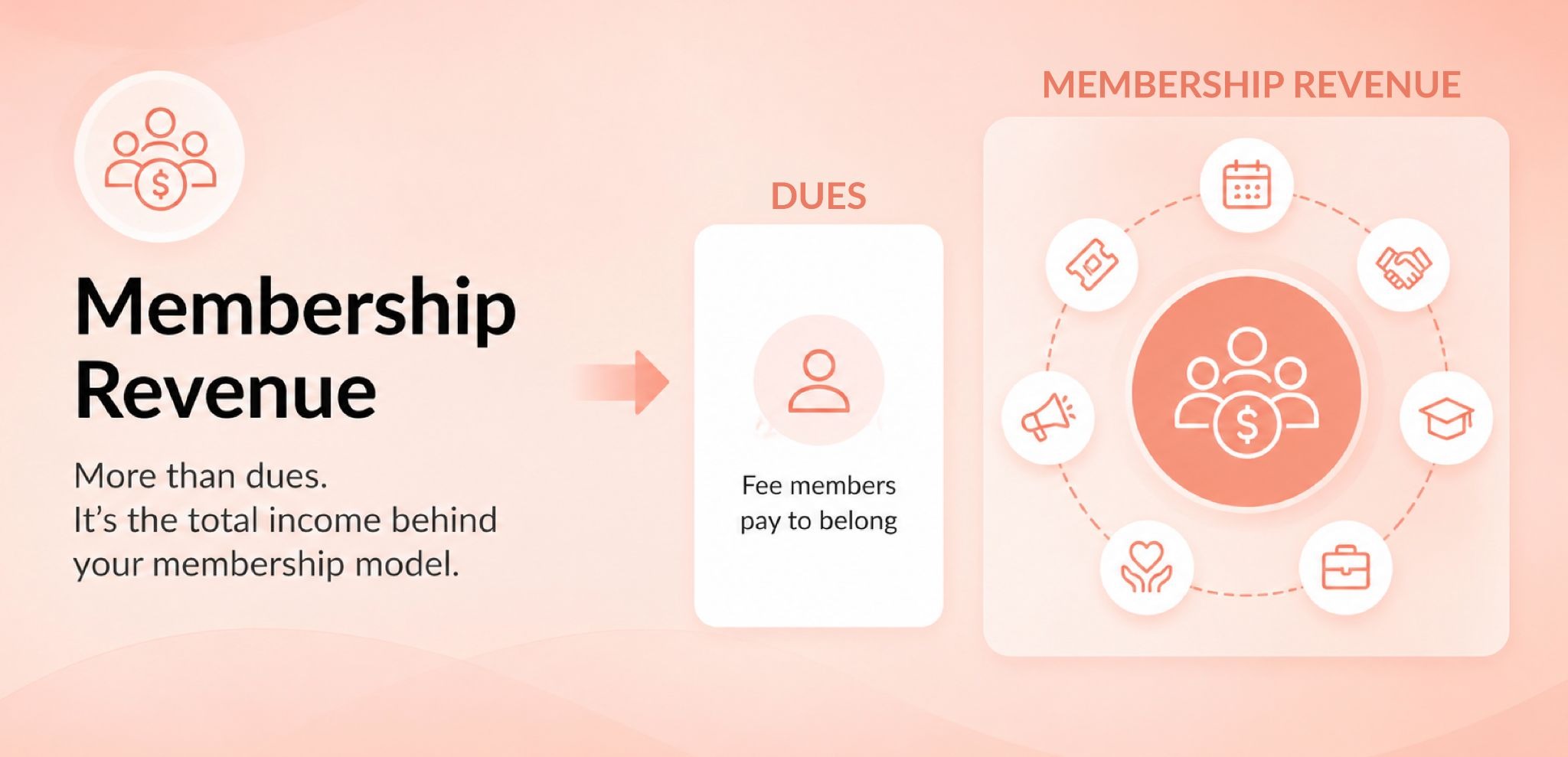
Membership revenue is the total income a membership organization earns from members, supporters, sponsors, partners, and related buyers. It includes dues, renewals, recurring payments, event registrations, sponsorships, education programs, donations, and other member-connected transactions. It is the complete financial model behind a sustainable membership organization, not just the dues line on a balance sheet.
What you'll learn:
- Why dues alone can no longer sustain most membership organizations
- How the Membership Revenue Stack works as a five-layer framework
- Where revenue is most commonly leaking right now
- How to price, protect, and diversify membership income
- The formulas and metrics that actually matter
Key Takeaways
- Membership revenue covers dues, events, sponsorships, education, donations, and more. Most organizations formally track only half of what they actually earn.
- Most revenue loss is operational, not relational. Expired cards and missed renewal notices end memberships for members who intended to stay.
- The overall renewal rate and the first-year renewal rate are two separate problems that require two separate strategies.
- Dues represented just 30% of professional association revenue as far back as 2016. Treating dues as the whole model is already a decade behind.
- Small, predictable annual increases protect renewal rates better than long price freezes followed by large catch-up jumps.
- Non-dues revenue is not a side project. For most membership organizations, it is the difference between financial resilience and financial fragility.
- Join It is rated Excellent on Trustpilot and helps membership organizations collect dues, automate renewals, recover failed payments, and build non-dues revenue from one platform.
What Is Membership Revenue?
Membership revenue and membership dues are not the same thing. Understanding the difference changes how you plan, measure, and grow income across the full organization.
Membership Revenue vs Membership Dues
What Are Examples of Membership Revenue?
The full picture includes far more than most organizations formally track:
- Membership dues and renewal payments
- Monthly or annual subscription-style memberships
- Multi-year and lifetime memberships
- Event registration and ticket revenue
- Sponsorship and advertising income
- Education, certification, and training programs
- Job board and career center revenue
- Donations and recurring giving
- Merchandise and premium digital resources
- Affinity and strategic partnerships
Most organizations can name five or six of these streams. The ones they can't name are often where the most untapped potential sits.
The Membership Revenue Stack
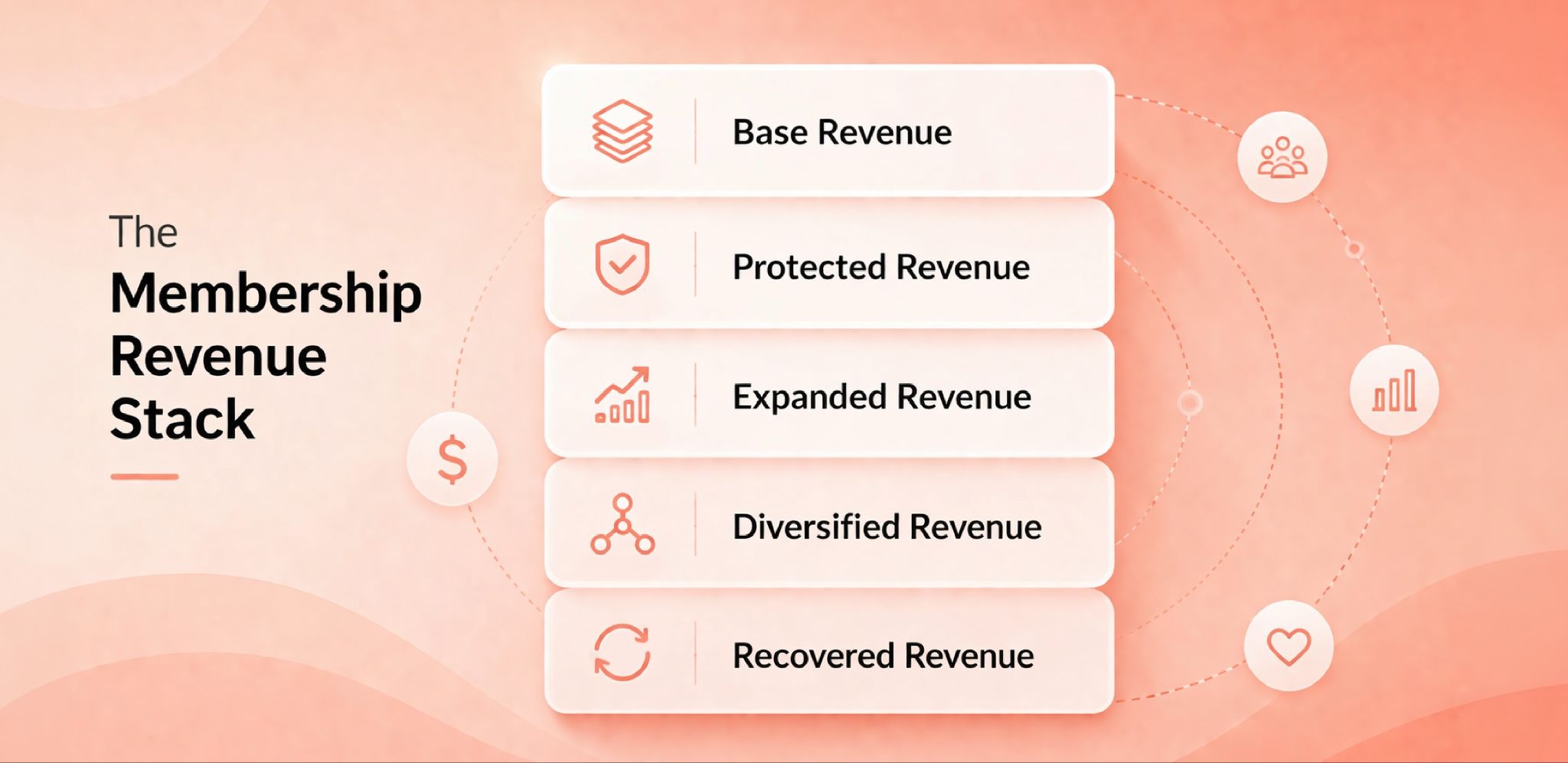
Think of membership revenue not as a list of line items, but as a membership revenue model with five distinct layers. Each layer has a specific job to do.
Most organizations only manage two or three of them well. The layers they skip are usually leaking the most money.
This framework changes the conversation from "What revenue ideas should we add?" to "Which layer is currently our weakest?" That single question is more useful than any brainstorming session.
Base Revenue
The foundation. Annual dues, monthly fees, organizational memberships, family tiers, and student or senior pricing all live here.
This layer matters enormously because it is the predictable core everything else builds on. But treating it as the whole model is the single most common mistake in membership financial planning.
Protected Revenue
This is the income you keep by not letting it slip away through operational gaps.
Renewal reminders, automatic billing systems, clear expiration paths, and payment recovery workflows all belong here. Most organizations underinvest in this layer and then wonder why renewal rates plateau despite strong member satisfaction.
One nonprofit staffer described the challenge plainly: "running after" members to complete renewals was "tiring and error-prone." That's not a marketing problem. That's a protection problem with clear operational solutions.
Expanded Revenue
More revenue from the members you already have.
Premium tiers, paid workshops, certification access, VIP event experiences, and member-only reports are all expansion plays. The trust already exists. The barrier to a paid upgrade is lower than most organizations assume.
The core principle: expanded revenue should increase the value of membership, not just attach a price to something that used to be free.
Diversified Revenue
Revenue that doesn't depend on dues and doesn't disappear when renewal rates dip.
Sponsors, advertisers, event partners, job board buyers, and recurring donors build diversified revenue streams that don't depend on your annual renewal cycle. According to ASAE's 2026 State of Associations report, more than 60% of associations are actively diversifying revenue, and nearly two-thirds are pursuing partnerships in direct response to financial pressure.
The strategic purpose isn't just more income. It's resilience when dues come under pressure.
Recovered Revenue
The money that almost walked out the door and still can be brought back.
Expired cards, failed payment retries, missed renewal notices, and confusing checkout flows are all recovery opportunities hiding in plain sight. Most organizations treat these as inevitable losses. The financially disciplined ones treat them as an operational problem with a technical solution.
Main Types of Membership Revenue Streams
Dues Revenue
Dues provide the predictable base that everything else builds on. But "dues" is not one number.
It includes annual membership dues, monthly membership fees, organizational membership dues, individual dues, and tiered structures for families, students, seniors, and hardship cases. Getting clarity across all of these starts with a reliable system for tracking membership dues. Without it, even healthy dues income looks murky on paper.
Recurring Membership Revenue
Recurring membership revenue separates financially stable organizations from ones that scramble through every renewal season.
Monthly memberships, auto-renewals, and subscription-style models create income predictability and reduce the frantic end-of-year renewal push. Setting up reliable recurring membership billing is one of the highest-leverage operational decisions a growing organization can make. Revenue becomes forecastable and recoverable when a payment fails, rather than silently disappearing.
Non-Dues Revenue
Non-dues revenue is every dollar earned outside the base membership fee.
It deserves its own strategy, its own budget line, and its own growth plan. For a full practical breakdown, the guide to non-dues revenue ideas covers the complete landscape across sponsorships, content, job boards, and more.
Sponsorship and Advertising Revenue
Sponsorship is audience access, not logo placement.
Organizations that build packages around member demographics, channel reach, and measurable business outcomes consistently earn more than those selling "brand exposure." For U.S. tax-exempt organizations, the distinction between sponsorship and advertising also carries real tax implications. Advertising indicators like comparative language, pricing claims, or endorsements can shift non-taxable sponsorship income into unrelated business income territory. A tax professional review before finalizing large packages is worth the cost.
Education, Certification, and Resource Revenue
Members pay for what solves real and pressing problems. This stream includes:
- Paid workshops and continuing education credits
- Certification prep and training programs
- Online learning programs and professional development content
- Premium guides, templates, and toolkits
The best ideas surface from what members already ask for. Turn the recurring conference topic into a paid workshop. Turn the template every new member requests into a premium download. The demand already exists.
Donations and Fundraising Revenue
For nonprofits and mission-driven organizations, donations are a revenue layer, not a separate universe.
Donation add-ons at renewal, sustaining membership tiers, year-end fundraising campaigns, and recurring giving options all belong inside the model. The key is keeping the donation ask clearly separate from the membership ask so neither creates confusion at checkout or in year-end reporting.
The ability to collect member donations cleanly, without tangling the checkout experience, prevents the kind of problem one nonprofit described: expired members giving during a year-end campaign created "allocation and tax-treatment ambiguity" that required significant time to untangle well after the campaign had closed.
Dues Revenue and Membership Pricing Strategy
How to Set Membership Dues
Membership pricing is not a number you pick once and defend for a decade. It should reflect:
- Member value proposition: What tangible and intangible benefits does the membership deliver?
- Cost to serve: What does it actually cost to deliver value at scale?
- Market benchmarks: What are comparable organizations charging?
- Audience type: Are you serving professionals, businesses, families, or students?
- Willingness to pay: What does member behavior and renewal data actually tell you?
A thoughtful membership pricing strategy weighs all of these inputs together rather than anchoring to a single peer organization's pricing page and hoping it holds for another few years.

Membership Pricing Models
Monthly vs Annual Membership Fees
Both billing cycles have real advantages. The right answer depends on your audience.
- Monthly fees lower the entry barrier and work well for younger members, smaller budgets, and mission-driven organizations
- Annual fees improve cash flow and reduce churn risk for established membership bases
The real question isn't which cycle to choose as a default. It's whether your recurring membership payments system handles both cleanly without creating separate manual tracking processes for staff.
Multi-Year and Lifetime Memberships
Multi-year memberships reduce annual renewal friction and improve revenue predictability. Lifetime memberships eliminate the renewal conversation for that member entirely.
Both options carry deferred revenue accounting considerations worth modeling before making either a standard offering. Around 18% of associations offer multi-year renewals and 17% offer lifetime memberships. Test a membership price lock offer with a small cohort before scaling either model.
How to Raise Membership Dues Without Damaging Trust
The goal is not to avoid raising dues. It's to raise them in a way that feels expected rather than alarming.
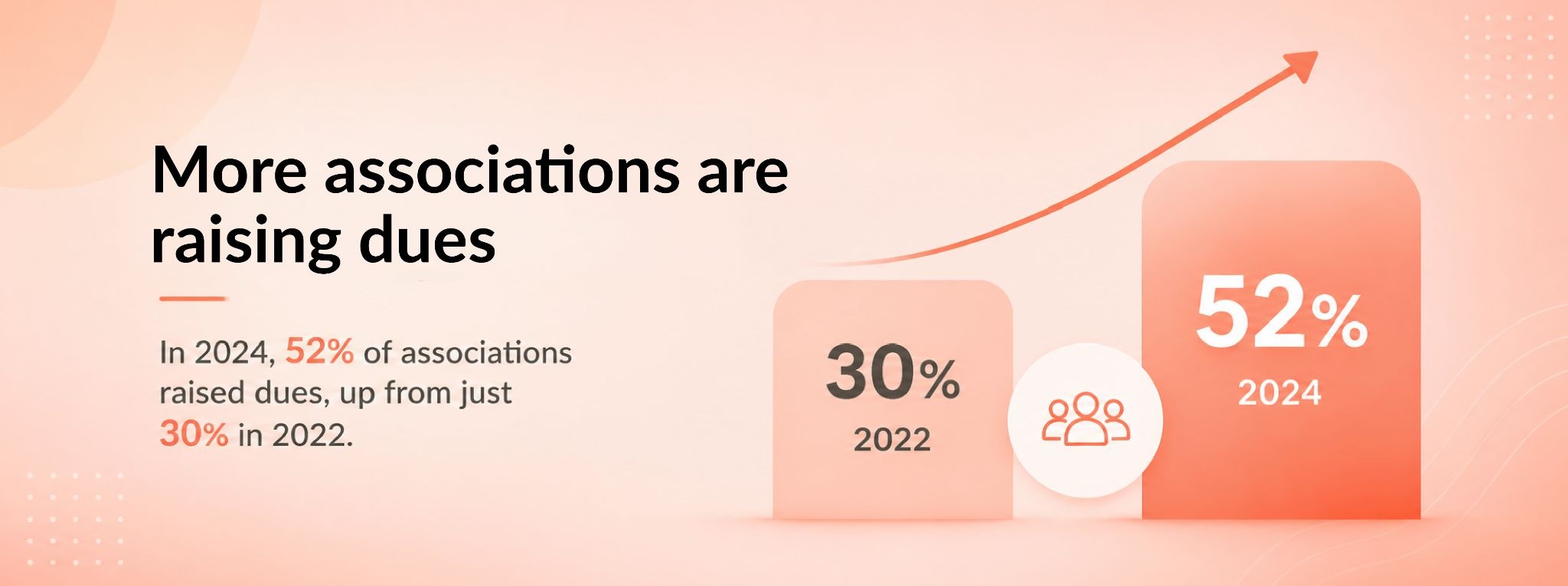
In 2024, 52% of associations raised dues, up from just 30% in 2022. Critically, organizations with renewal rates of 80% or higher are more likely to raise dues annually. Predictable micro-increases and strong renewal rates work together, not against each other.
Best practices for increasing dues:
- Run an annual dues review, not only when costs force the conversation
- Communicate member value clearly before invoices go out
- Explain specifically what changed and why it changed
- Keep increases modest and consistent over time
- Avoid long price freezes followed by sharp catch-up increases
In a community forum about dues increases, members described the appeal of tying annual adjustments to a formula rather than reopening the full debate each time. That replaces episodic pricing drama with a transparent, predictable policy members can anticipate.
Dues vs Non-Dues Revenue
What Is Non-Dues Revenue?
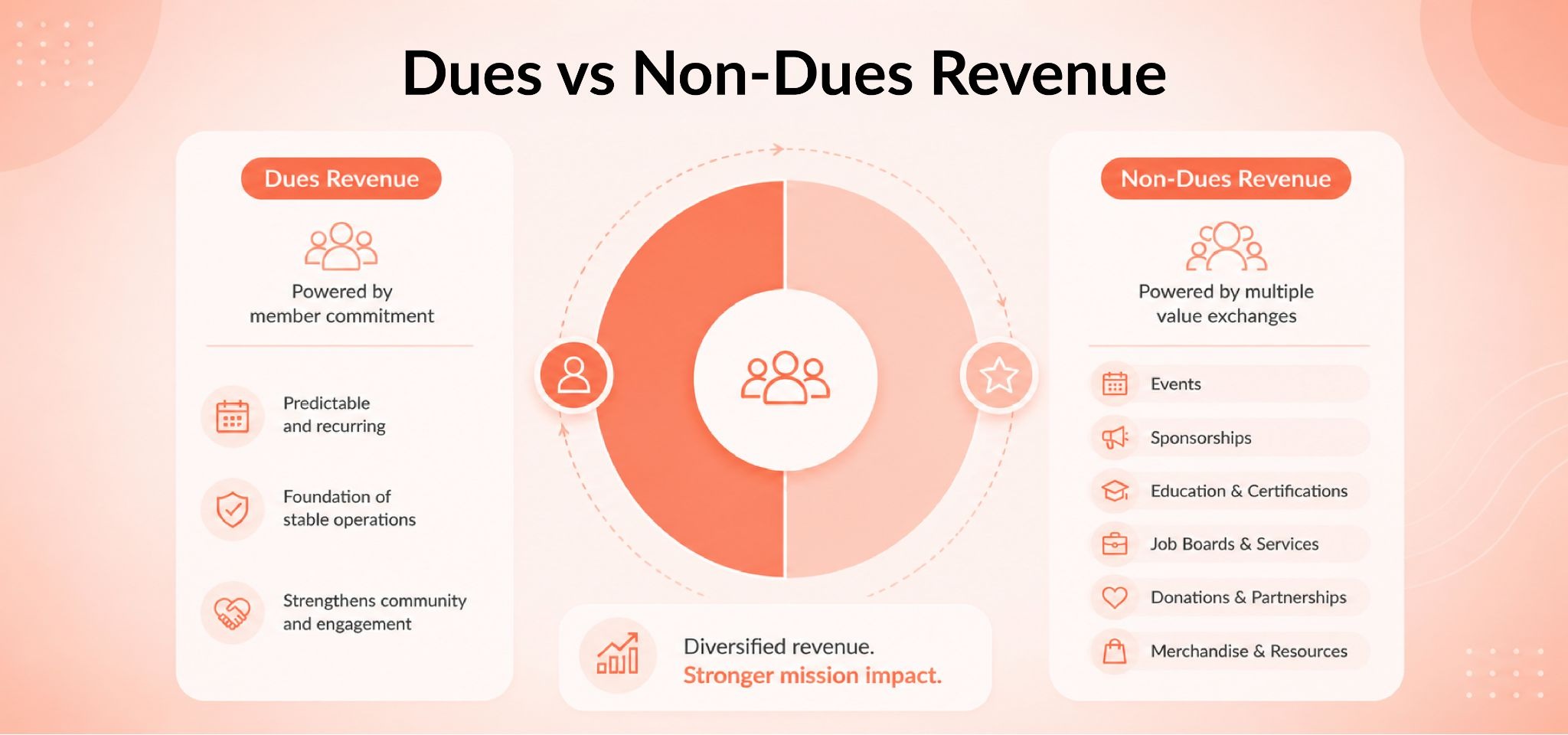
Non-dues revenue is income earned outside the base membership fee. It includes events, sponsorships, education, certifications, job boards, merchandise, strategic partnerships, donations, and premium resources.
The important word is "income," not "supplement." Dues represented just 30% of professional association revenue as far back as 2016, down from nearly 96% in 1953. The model has been shifting for decades.
Why Non-Dues Revenue Matters
Dues-only models create concentrated financial risk. One weak renewal season, one sector downturn, and the whole model comes under pressure simultaneously with no buffer.
Non-dues revenue enables revenue diversification across multiple buyer types, timing cycles, and income categories. It also opens the organization to sponsors, donors, and attendees who want to support the work without becoming formal members, expanding the financial base without requiring membership growth first.
According to ASAE's 2026 State of Associations report, more than 60% of associations are actively diversifying revenue. That is financial survival strategy deployed at sector scale.
Dues vs Non-Dues Revenue Comparison
How Much Should Come From Dues vs Non-Dues?
There is no universal ratio that fits every organization. What matters is whether your current mix builds sustainable membership revenue or creates concentrated dependency on a single income type.
- Smaller clubs may rely heavily on dues and that's appropriate for their scale
- Associations often build significant non-dues income through events and certifications over time
- Chambers earn substantially from sponsorships, directories, and business services
- Nonprofits blend membership with recurring giving and donation campaigns
Membership Revenue Models by Organization Type
Different membership organizations are built around very different revenue realities. The right model depends on who your members are and what buyer types exist beyond the membership base itself.
Association Membership Revenue Model
Associations typically combine:
- Individual and organizational dues
- Certification and continuing education programs
- Annual conferences and events
- Job boards and career centers
- Sponsorships and publications
The certification and education streams are often the highest-margin non-dues revenue sources for associations because they address direct professional needs and scale through digital delivery without proportional cost increases.
Chamber Membership Revenue Model
Chambers lean on tiered business dues by company size, then layer in:
- Event sponsorships and exhibitor fees
- Directory placements and advertising
- Business services and affinity programs
Chamber sponsorship revenue works especially well here because member businesses are simultaneously buyers and sellers. A member pays dues to belong and sponsors events to reach other members as potential customers.
Nonprofit Membership Revenue Model
Nonprofits blend:
- Membership dues and sustaining membership tiers
- Recurring giving and donation add-ons at renewal
- Event revenue, grants, and sponsorships
The line between "member" and "donor" often blurs here. That's why non-dues revenue for nonprofits requires especially clean revenue architecture and separate checkout flows for both operational clarity and accurate year-end reporting.
Club and Alumni Membership Revenue Model
Clubs and alumni groups combine:
- Individual memberships with family membership pricing options
- Events, merchandise, and premium access tiers
- Annual support add-ons and lifetime memberships
Alumni associations have built hybrid models that blend one-time payments, recurring gift commitments, and optional annual add-ons, treating membership and giving as connected channels rather than competing ones.
The common thread across every model: dues are the starting point of the revenue conversation, not the destination.
How to Protect Recurring Membership Revenue
Most membership revenue conversations focus on growth. The smarter conversation starts with protection.
Revenue you already earned but failed to collect is the most expensive kind of loss. It came with zero acquisition cost and represents a member who intended to stay.
Renewal Revenue
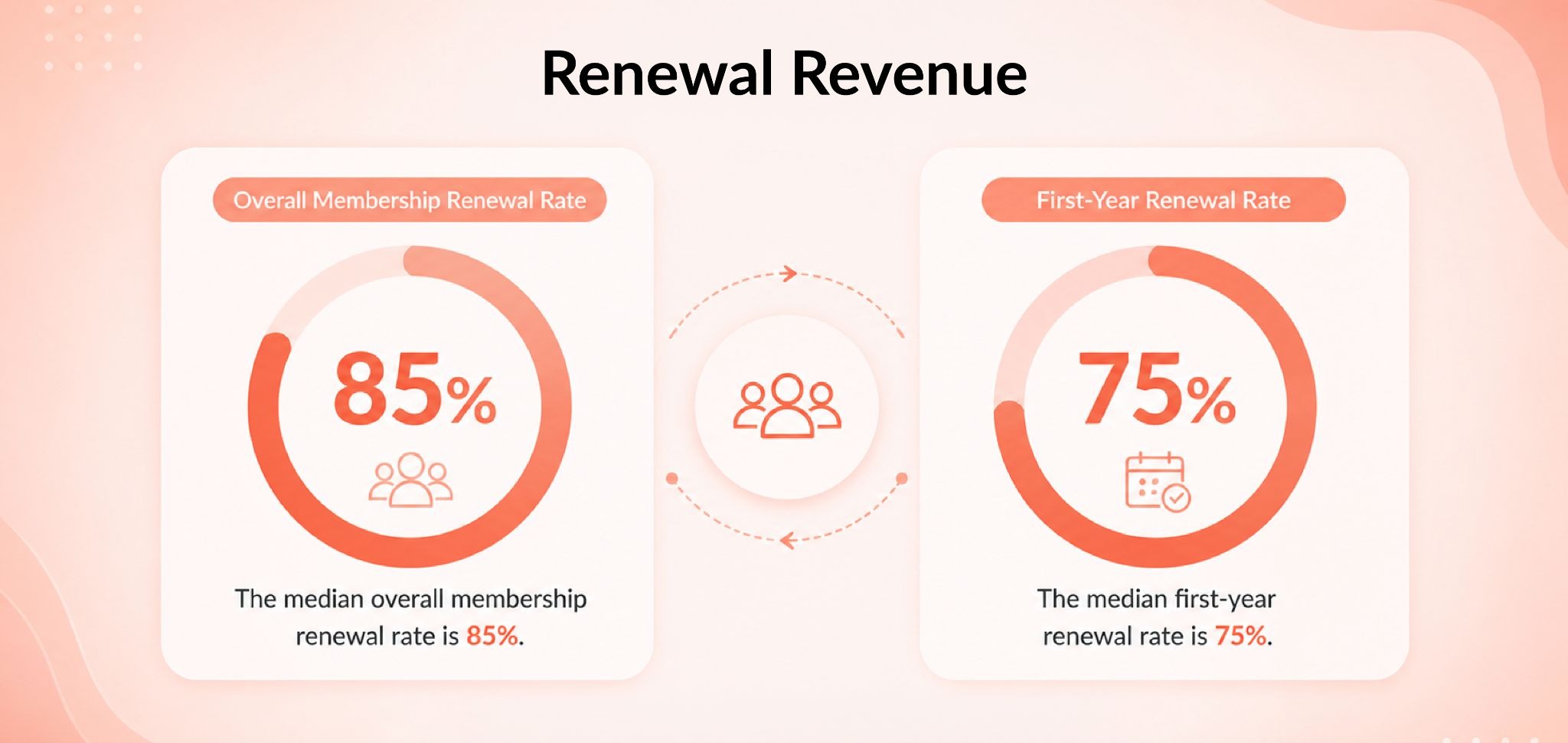
The median overall membership renewal rate is 85%. The median first-year renewal rate is 75%. Those two numbers are not the same problem.
- Overall renewal reflects your ability to retain established members who have formed habits around the organization
- First-year renewal reflects your ability to deliver on early promises before belonging becomes routine
Both need separate strategies, since reactivating lapsed members requires a very different approach than retaining active ones. The tactics around membership retention differ significantly depending on which member cohort you're addressing. Improving first-year renewal by even five percentage points creates a compounding revenue effect that far exceeds most single-campaign membership drives.
Automatic Membership Renewal
Around 38% of associations currently offer automatic annual credit-card renewal. High-renewal organizations tend to favor automatic EFT options as well, which are more stable since bank account numbers change less frequently than card expiration dates.
Auto-renewal works when the experience is fully transparent:
- Opt-in consent from the member upfront
- A clear reminder sent before the charge processes
- Easy cancellation that doesn't require a phone call
- A clean receipt sent immediately after
It fails when members feel surprised by a charge. Setting up reliable automatic renewal reminders before every billing cycle prevents exactly that outcome and protects both the revenue and the member relationship.
Failed-Payment Recovery
Here is the number that changes how most organizations think about churn: failed and declined payments are a major source of lost recurring revenue that has nothing to do with member dissatisfaction.
Members aren't choosing to leave. Expired cards and failed retries create involuntary member churn, ending memberships silently before anyone on staff catches it. Stripe's recovery tools collect 55% of failed payments on average. That is not a growth tactic. That is revenue already earned, almost lost, and still collectible with the right workflow.
Setting up failed payment notifications that reach members quickly after a declined transaction is one of the smallest operational investments with some of the largest financial returns available to most organizations that haven't addressed this yet.
Revenue Leakage Map
How to Increase Membership Revenue Without Only Raising Dues
Raising dues is one lever. It is not the only one, and it's often not the fastest.
Increase Average Revenue Per Member
Member engagement and revenue per member tend to rise together when upgrade offers align with moments of demonstrated value. Without changing the base price, you can grow per-member revenue through:
- Premium membership tiers with additional access or benefits for members who want more
- Paid add-ons like certification access, directory upgrades, or VIP event tickets
- Premium digital resources sold separately from core membership benefits
When you can cleanly process membership payments across all of these channels in one system, average revenue per member becomes a metric worth actively managing rather than a byproduct discovered at year-end.
Package Existing Value Into Paid Offers
Most organizations are sitting on unpaid revenue without realizing it:
- The webinar 200 members attended for free is a paid workshop with the right framing
- The spreadsheet every new member requests in their first week is a premium download
- The networking demand before the annual conference is a paid cohort or mentorship program
The goal isn't to charge for everything. It's to recognize when consistent demonstrated demand justifies a price.
Add Mission-Aligned Revenue Streams
Running events for members with tiered sponsorship packages, affinity programs, paid educational content, and giving prompts at the right moments can generate meaningful income while increasing member value simultaneously.
The test for any new revenue stream is simple: does it make membership more valuable, or does it only add noise? If the answer is the former, it belongs in the model.
Membership Revenue Metrics and Formulas
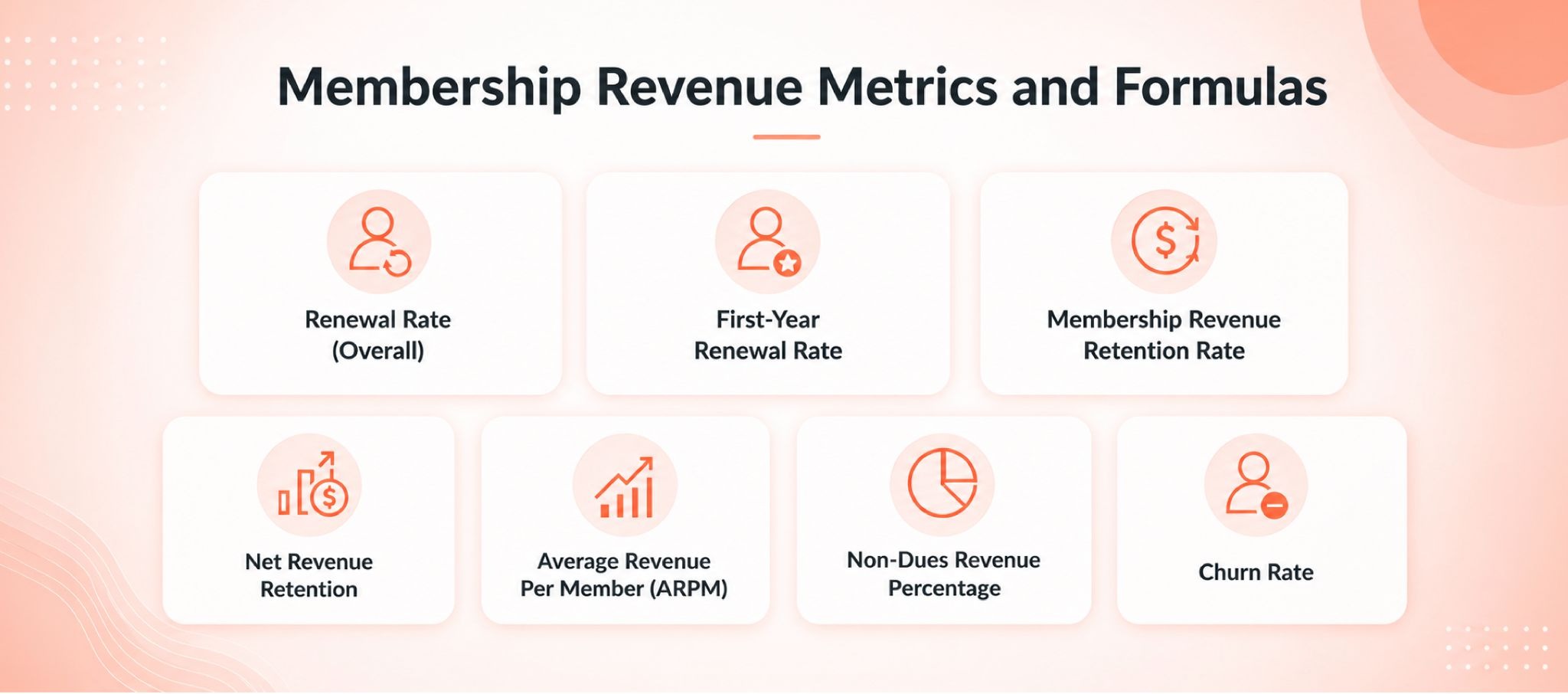
If you cannot measure it, you cannot improve it. These are the formulas that matter most.
Total membership revenue = dues revenue + non-dues revenue + recurring giving + sponsorships + event revenue + other member-related income
Dues revenue = number of paying members × average dues paid
Revenue per member = total membership revenue ÷ total active members
Member lifetime value = average annual revenue per member × average membership tenure
Non-dues revenue share = non-dues revenue ÷ total membership revenue
Failed-payment recovery rate = recovered failed payments ÷ total failed payments
Sponsorship renewal rate = renewed sponsors ÷ sponsors up for renewal
A growing member count alongside declining revenue per member is not a success story. It is a warning signal worth catching early through regular membership revenue forecasting and attention to retention economics.
The dashboard worth building:
90-Day Membership Revenue Action Plan
You don't need to fix every layer at once. Start somewhere specific and build momentum from real results.
Days 1 to 30: Audit the Revenue Model
- List every revenue stream your organization earns from, including informal ones
- Formally separate dues income from non-dues income in financial reporting
- Calculate revenue per member for the most recent complete fiscal year
- Identify your top three revenue leakage points using the map above
- Compare current pricing to two or three directly comparable organizations
Days 31 to 60: Fix Pricing and Revenue Protection
- Review your full dues structure tier by tier and flag any underpriced levels
- Improve renewal reminder timing and segment messaging by member type and tenure
- Add or strengthen automatic renewal options for members who are willing
- Set up a failed-payment recovery workflow for declined transactions
- Separate any mixed donation and membership checkout flows
Days 61 to 90: Pilot One New Revenue Stream
Choose one: a paid workshop, a tiered sponsor package, a premium resource, a multi-year membership option, or a recurring giving prompt added to the renewal flow.
Define the audience, the price, and the success metric before you launch. One well-executed pilot tells you more than any forecast.
Board-level questions worth asking before your next meeting:
- Do we know our revenue per member for the current year?
- Do we track first-year renewal separately from overall renewal?
- Do we have a formal annual dues review process?
- Do we know our top three revenue leakage points by name?
- Do members clearly understand what they're paying for?
If your organization wants a clearer picture before committing to changes, you can book a call with someone who works with membership revenue models every day.
Frequently Asked Questions About Membership Revenue
What is membership revenue?
Membership revenue is the total income a membership organization earns through dues, renewals, events, sponsorships, education, donations, and other member-connected transactions. It is far more than just the annual membership fee.
What are membership revenue streams?
The main streams include dues and renewal payments, event registrations, sponsorship and advertising income, education and certification programs, job board revenue, donations, recurring giving, premium digital resources, merchandise, and affinity partnerships.
What is the difference between dues and non-dues revenue?
Dues revenue is the core fee members pay to belong. Non-dues revenue is every other dollar earned through sponsors, events, education, donations, and other sources that don't require a formal membership.
How do membership organizations make money?
Associations earn through dues, certifications, conferences, and sponsorships. Chambers earn through tiered business dues, event sponsorships, and directories. Nonprofits combine dues with recurring giving. Clubs earn through memberships, events, and merchandise. Most financially stable organizations use several streams simultaneously.
How do you increase membership revenue without raising dues?
Improve payment recovery to stop involuntary churn, strengthen renewal rates through better segmentation, offer premium membership tiers, build non-dues revenue streams, clean up checkout flows, and package existing value into paid products. These moves often yield more revenue than a dues increase without the member trust friction that comes with one.
Should membership fees be monthly or annual?
Monthly fees lower the entry barrier and appeal to budget-conscious members. Annual fees improve cash flow and reduce churn risk. Many organizations benefit from offering both and letting members choose based on their own situation.
How do you calculate member lifetime value?
Multiply average annual revenue per member by average membership tenure. The result shows the long-term financial value of each member relationship and helps set appropriate investment levels for acquisition and retention.
What is deferred dues revenue?
Deferred dues revenue is income collected for a future membership period not yet earned under accrual accounting. When a member pays annual dues upfront, the portion covering future months sits deferred on the balance sheet until that period arrives.
What is membership revenue recognition?
Membership revenue recognition refers to when and how an organization records membership income on its financial statements. Under accrual accounting, dues paid upfront are recognized gradually over the membership period rather than all at once, which is why deferred dues revenue appears as a liability until the period is served.
What is non-dues revenue for associations and nonprofits?
For associations and nonprofits, non-dues revenue includes sponsorships, event registrations, certification programs, continuing education, job boards, advertising, premium publications, donations, and affinity partnerships. It is increasingly the difference between financial stability and financial fragility for organizations that have relied too heavily on dues alone.
Membership revenue is not a single number. It never was.
The organizations achieving consistent membership revenue growth are not always the ones with the largest rosters. They're the ones who know their revenue per member, treat first-year renewal as its own problem, recover failed payments before they become lost members, and build non-dues income that strengthens the mission rather than straining it.
That kind of financial clarity doesn't require a large team or an expensive consultant. It requires the right framework, the right metrics, and simple membership management software that brings dues, renewals, payments, events, and donations into one place rather than across five separate spreadsheets.
If you're ready to see how your current revenue model stacks up, the fastest way to find out is to start a free trial and build a clearer picture of where your organization stands today.
Sources
- ASAE. State of Associations Report, 2026
- Marketing General. Best Practices for Raising Association Membership Dues
- Stripe. Stripe Billing


