
Guide to Membership Pricing Strategy: Models, Tiers, Renewals


Here's something that surprises most membership managers:
Raising your dues doesn't have to cost you members.
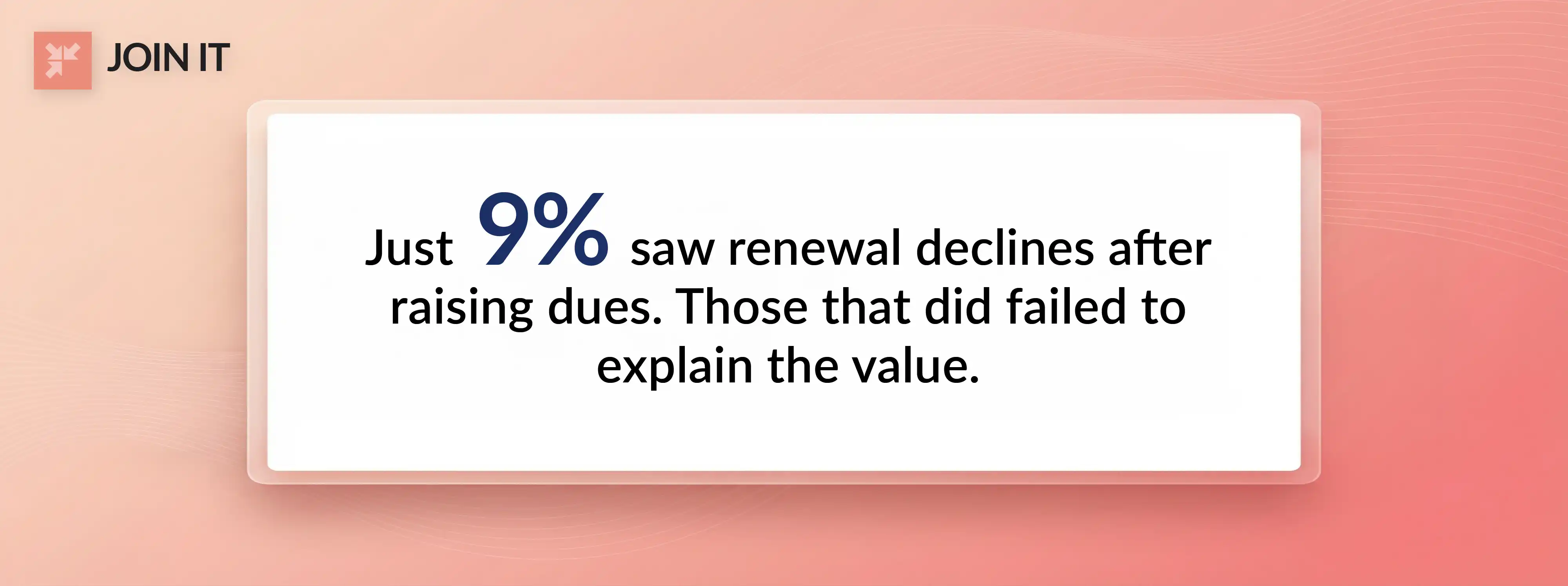
According to MGI's benchmarking research, 72% of associations raised dues in the past four years. Only 9% saw any drop in renewal rates afterward. Most saw nothing change, or things actually improved.
That's what a real Membership Pricing Strategy looks like in action. Not just a number on a page, but a deliberate system connecting price to value, structure to behavior, and billing to long-term retention. It includes your membership pricing models, your membership fee structure, your billing cadence, and how you communicate every decision to your members.
This guide covers the models, the benchmarks, the psychology, and the 10 strategies working right now. Whether you're running an association, nonprofit, club, gym, or online community, there's something here worth taking home.
Pricing at a glance:
- Always choose your model before your number
- Keep tiers simple (2-3 max)
- Every discount needs a rule behind it
- Billing is part of pricing strategy
- Small, predictable increases beat surprise jumps every time
What Is a Membership Pricing Strategy?
A membership pricing strategy is the deliberate system behind how you set, structure, and communicate your dues. It controls more than just the price tag. It shapes how members join, how long they stay, how they upgrade, and whether they quietly disappear when their card expires.
"Strategy" is the key word here. It includes your price level, fee structure, billing cadence, discount policy, upgrade path, and renewal approach. All of these decisions, taken together, form your strategy.
Subscriptions are transactional. Memberships are relational. Members expect to belong, not just to consume. That psychological difference matters every time you set a price or write a renewal email.
For a broader look at how pricing fits into the bigger picture, the membership management guide from Join It covers the full operational context worth understanding before you set any numbers.
Membership Pricing Benchmarks: What the Data Actually Says
Good pricing starts with knowing where you stand.
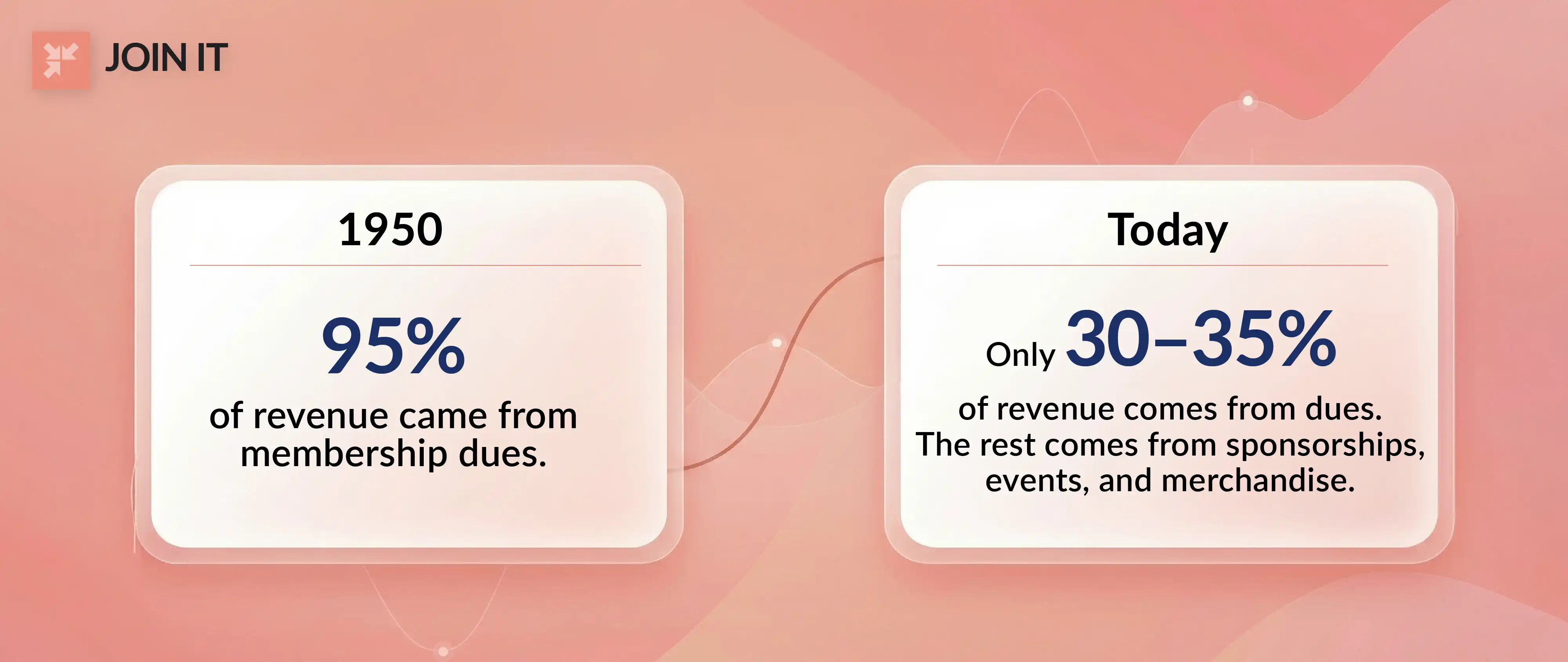
Associations have shifted dramatically in how dues fit their revenue picture. Membership dues now represent only 30-45% of average association revenue, down from roughly 95% in the 1950s. That means your pricing strategy can't be built around dues alone. Understanding what you can build alongside dues is just as important. The non-dues revenue guide from Join It walks through the main options clearly.
Gyms tell a different story. Average monthly dues rose 9% in 2023 to $65 per month, according to the Health & Fitness Association, yet U.S. fitness memberships still hit a record 72.9 million that same year. Higher-end gyms charging $100 or more per month grew membership 7.9% year-over-year, outpacing budget facilities. Price sensitivity is real, but value perception is stronger.
Mission-driven organizations often unlock surprising results by removing price barriers entirely. Synagogues that switched to voluntary dues models saw membership grow 3.6% and total dues revenue rise 1.8%, according to JWeekly. More people joined, and most still contributed at or above the old fixed rate.
Monthly vs annual is a genuine strategic question. Annual prepay typically carries a 15-20% discount compared to monthly billing. Monthly plans reduce entry friction and generate more new member signups. Annual plans improve commitment and smooth your cash flow. Most organizations win by offering both and letting members choose.
How to Set Membership Fees: 4 Steps That Actually Work
The goal isn't a number that feels right. It's a number you can defend.
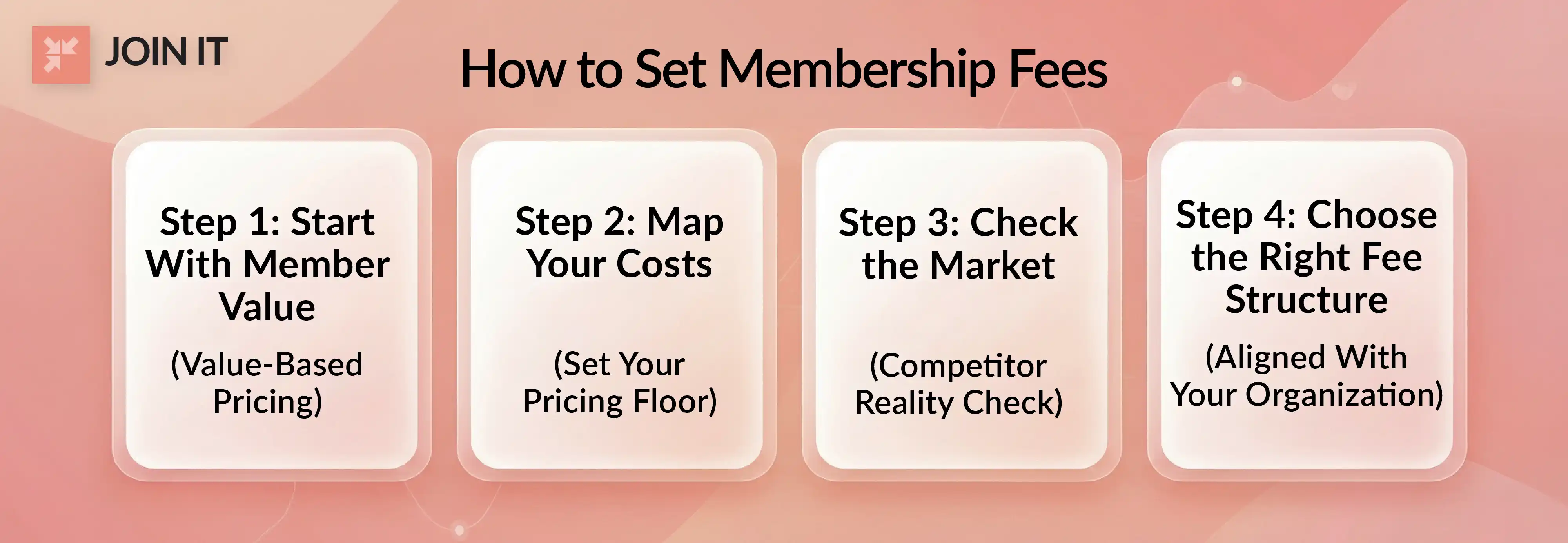
Step 1: Start with member value (value-based pricing) List every benefit your membership includes. Assign an approximate dollar value to each one. Event discounts, training access, networking, exclusive content. When you total it up, you build the case that membership costs less than its parts. That's a story worth repeating at renewal time. If you need ideas you can actually price against, this list of member benefits is a useful reference.
Step 2: Map your costs (cost-plus pricing as a floor) Fixed costs, program delivery, payment processing, staff time. Cost-plus pricing sets your floor. It's not your final number, but it's where you start. If you're not covering costs, no amount of pricing psychology will save you.
Step 3: Do a competitor reality check (competitor-based pricing) Look at organizations with similar members and similar value propositions. Don't copy. But don't ignore what the market expects either. Knowing how to calculate membership pricing means knowing what comparable organizations charge, and why.
Step 4: Choose a membership fee structure that matches your org The structure that works for a professional association looks nothing like the one that works for a gym or a faith community. Choose the model before you choose the number. If you are still working out the model itself, these ideas for a membership program can give you a few clearer starting points before you settle on pricing.
Membership Pricing Models: Pick the Structure First
The model shapes everything that follows.
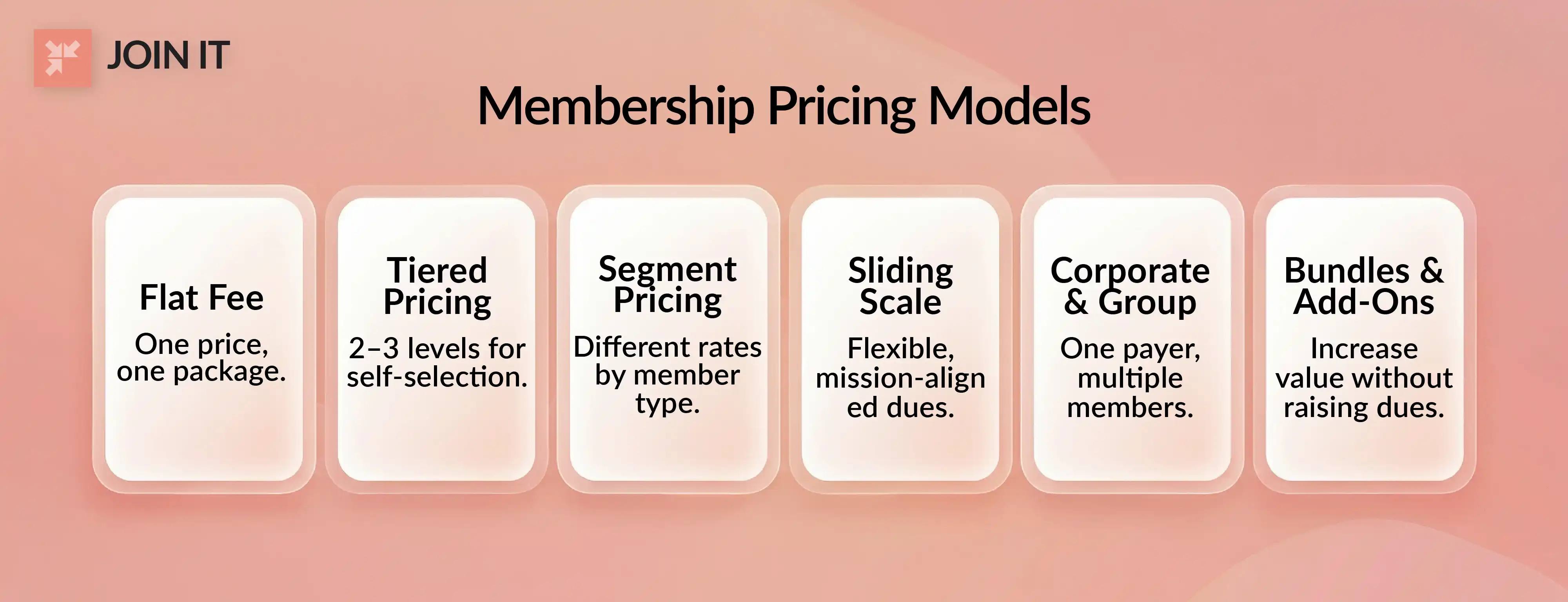
Flat fee works for simple organizations with one clear value package. Low admin overhead, easy to explain. The risk: you undercharge your most engaged members and overcharge your casual ones.
Tiered membership pricing (good-better-best) lets members self-select. Two to three tiers is the sweet spot. More than that and you're back to decision paralysis. If prospects need a spreadsheet to compare your plans, they'll leave. Name tiers around personas, not precious metals. "Supporter, Professional, Leader" works better than "Bronze, Silver, Gold."
Segment pricing covers student membership pricing, senior membership discounts, early career rates, and hardship tiers. It's often cleaner than adding extra tiers for every demographic and signals that your organization is paying attention to who's actually trying to join.
Sliding scale membership dues fit mission-driven organizations best. Voluntary dues models remove cost as a barrier without gutting revenue, especially when paired with a clearly communicated sustaining level.
Corporate membership pricing and group packages solve a different problem. One payer, multiple beneficiaries. Family plans, team access, site-wide benefits. The operational side is genuinely complex (role management, invoicing, mid-term additions), but the revenue opportunity is real and churn tends to be lower since renewal becomes an organizational decision, not an individual one.
Bundles and add-ons raise revenue per member without touching base dues. Membership plus event access, training, or partner perks. Just model the numbers carefully before you bundle. Adding previously paid event access into a membership tier can cannibalize your event revenue if you're not watching.
Before landing on any model, this guide on how many membership tiers to offer can help you make the right structural call.
The 10 Membership Pricing Strategies for 2026
Each strategy here targets a specific problem. Find yours.
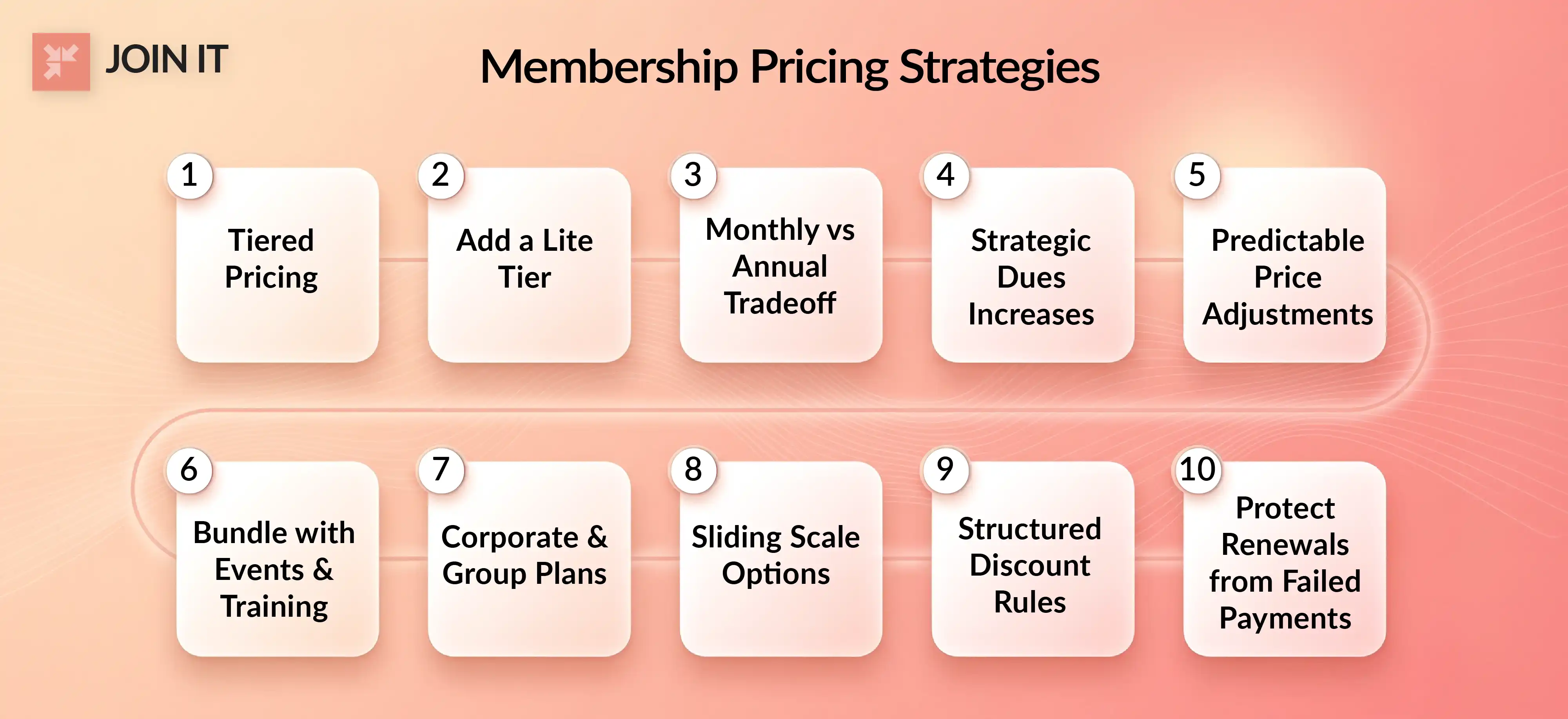
1. Tiered Membership Pricing
Use the good-better-best framework, but make tiers feel like different audiences, not different shopping carts. Anchoring psychology does the work: a premium tier at the top makes the middle tier feel like the rational, obvious choice. Most members will land there naturally.
Keep tier differences meaningful. Minor feature tweaks create confusion. Persona-based names create identity.
Example: A professional community offers three tiers: Member ($49/yr), Professional ($99/yr), and Leader ($199/yr). The Leader tier adds one high-value perk, a monthly live Q&A with the executive director. The standard tiers lose nothing. The new top tier simply gives the most engaged people somewhere to go, and its presence makes the Professional tier look like the obvious, reasonable choice for everyone else.
2. Add a "Lite" Entry Membership Tier
A lower-barrier option gets price-sensitive people through the door. But it only works if the upgrade path to your core tier is obvious and compelling. The goal isn't to park members permanently in the lite tier. It's to start a relationship that grows.
Watch for cannibalization. Before you launch a lite option, be specific about what it doesn't include, not just what it does. If the gap between lite and core isn't obvious, your existing members will notice it first.
Example: A fitness association offers a Digital-Only tier at $25/yr (newsletter, online resources) and a Full Member tier at $85/yr (events, certification discounts, networking). The lite tier is clearly positioned as a stepping stone, with a visible upgrade prompt after 60 days. Members who engage with even one digital resource are far more likely to upgrade at renewal.
3. Monthly vs Annual Membership Pricing with a Clear Tradeoff
Put both options on your pricing page and show the math plainly. A member who sees that paying annually saves them two months' worth of dues is far more likely to choose annual. Don't make them calculate it themselves.
The benefits of the subscription model apply directly here. Recurring value, predictable access, and the set-and-forget effect that keeps monthly autopay members renewing without a conscious renewal decision.
Example: A nonprofit association lists pricing as: $12/month or $120/year (save $24). The annual option is highlighted as "Most Popular." New members, especially younger ones hesitant about a lump-sum payment, choose monthly. After one year of consistent engagement, a significant portion convert to annual at renewal because the organization actively shows the math and sends a single well-timed prompt.
4. Dues Increases Done the Association Way
Before raising dues, do three things. Inventory every benefit and assign a dollar value. Build a communication campaign around the "why" and the ROI for members. Then give adequate runway, at least 60 to 90 days notice.
The MGI benchmarking data is reassuring. Only 9% of associations saw renewal rates fall after a dues increase. The ones that did had one thing in common: they failed to connect the new price to a clear value story.
Example: An association raising dues from $150 to $165 sends a member email three months out that reads: "Your membership includes two annual conferences (worth $400 if purchased separately), access to our job board, weekly industry updates, and advocacy representation in three states. Starting January 1, dues increase by $15 to fund expanded digital resources and a new mentoring program. Renew before December 1 to lock in this year's rate." That's the formula. Benefits first, number second, deadline third.
5. Small, Predictable Dues Adjustments
A 3-5% annual adjustment is far easier to accept than a 25% jump every five years. Set a review cadence, annual or every two years, and stick to it. Explain your cost drivers. Give members time to react.
This reframes price increases from a crisis into a routine. Members who know adjustments are coming rarely cancel over them. Members who feel ambushed often do.
The fitness industry shows what this looks like at scale. Average U.S. gym dues rose 9% in 2023 to $65 per month while total memberships hit a record high. Gyms that communicated the increase as a reflection of improved facilities and rising operating costs kept their members. The price went up. The membership numbers still went up too.
6. Bundle Membership with Events and Training 🎯
Many organizations can't survive on dues alone. Non-dues revenue now covers the majority of association income. Bundling events, training, and partner perks with membership raises perceived value without raising the base price.
If your platform supports it, built-in event registration makes this operationally clean, connecting membership tiers directly to event access without extra manual work on your team's side.
Example: A chamber of commerce offers a Standard membership at $200/yr and a Plus membership at $350/yr that includes two free event registrations (normally $75 each). The Plus tier effectively costs members $200 after they use both event credits, but the chamber earns $150 more per member and sees higher event attendance from their most engaged segment. Just model this carefully before launching: if you bundle events that currently sell out on their own, you may be leaving per-ticket revenue on the table.
7. Corporate and Group Memberships
One sale, multiple members. Corporate membership pricing solves the problem of convincing individual employees to join separately. Package it as team access, site-wide benefits, or family plans depending on your audience.
Renewal becomes an organizational decision rather than an individual one, which means churn is typically lower and the relationship deepens over time.
Example: A trade association offers individual membership at $250/yr and a Corporate Package at $900/yr covering up to five employees. The company saves $350 compared to buying five individual memberships, and the association gains five engaged members in one transaction. When the employee who originally signed up leaves the company, the membership stays because it belongs to the organization, not the individual.
8. Sliding Scale and Pay-What-You-Can Membership
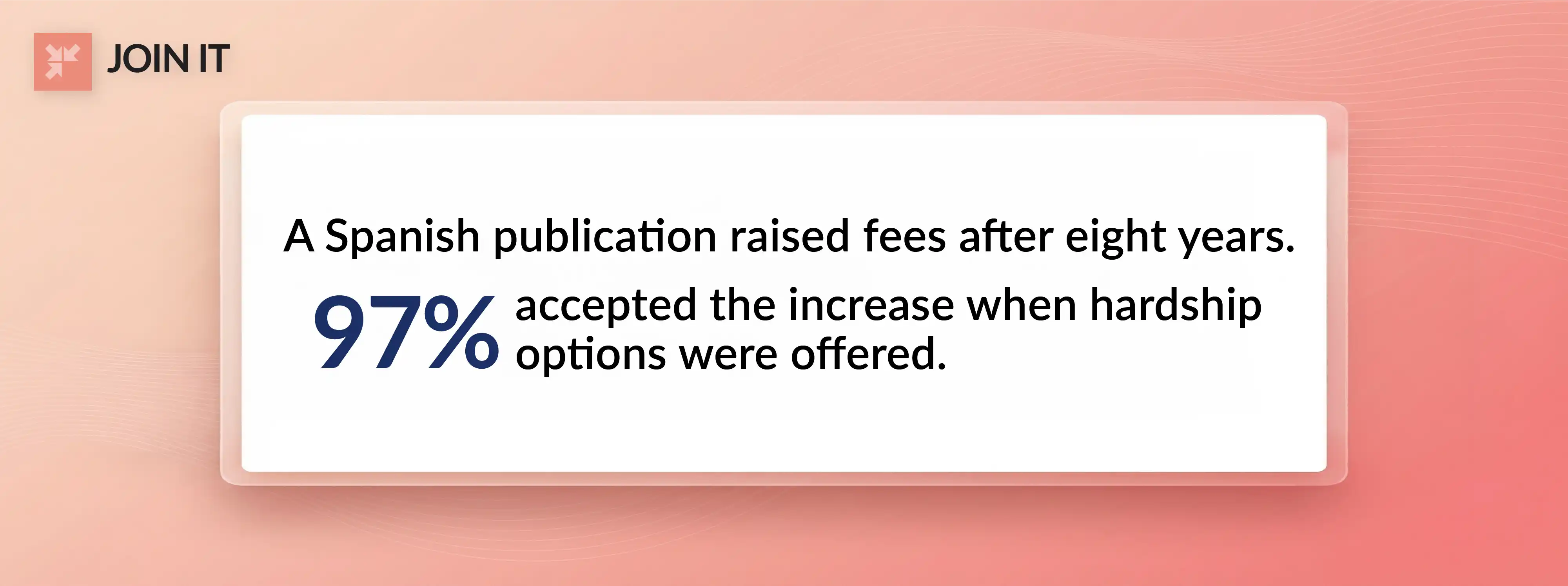
This works best when access is core to your mission. A Spanish publication raised membership fees for the first time in eight years during 2020, but explicitly told members facing hardship they could keep their old rate. 97% of members accepted the increase, and the organization gained thousands of new members in the months that followed.
Another example worth noting: Zetland, a Danish news membership site, added a simple note on their cancellation page during financially difficult times. It said something to the effect of, tell us your situation and we'll reduce your price. Many members who would have cancelled stayed, at a lower rate they could afford. A small change in framing kept real members in the community.
The key in both cases is removing stigma. Make the lower option a dignified, documented choice, not a favor that members feel they need to justify.
9. Discount Strategy with Rules (Not Random Promos)
Random promotions train members to wait. The Audubon Zoo's Black Friday membership sale is a cautionary case study: members came to expect the annual sale, renewal delays became the norm, and when the terms changed (the base price was quietly doubled before the discount was applied), the backlash was public, sharp, and led to paused sales.
Contrast that with an approach from the r/nonprofit community: one nonprofit manager described offering reduced dues or a volunteer-for-dues exchange to members who raised financial hardship. The discount had a clear purpose. It was tied to a specific situation. It didn't train the broader membership to expect a lower price.
Use discounts only when they're tied to a specific goal: early renewal, student pricing, hardship support, win-back campaigns, or referral rewards. Document the rules and apply them consistently. For long-term commitment, the advantages of multi-year membership structures are worth building into your discount framework. Members who commit upfront to two or three years bypass the vulnerable first-year renewal window entirely.
10. Protect Renewals from Failed Payments 🔒
This one is quietly responsible for more churn than most organizations realize. Around 30% of membership cancellations in media are caused by payment failures, not member decisions. And 70% of those members won't come back on their own.
The Daily Maverick in South Africa recovered 10,000 lapsed members by systematically chasing expired card details through automated billing tools. That's a real, measurable outcome from treating billing as part of pricing strategy.
Use renewal reminders, offer multiple payment methods, and implement account updater tools so expired cards don't silently cancel members. Understand how recurring membership payments interact with your platform's retry logic, and set grace periods before access lapses. The tricky auto-renewal practices may cross legal lines, so making cancellation and billing transparent isn't just good ethics, it's good risk management.
Pricing Psychology That Actually Moves the Needle
Price shapes how members feel about their membership, not just what they pay for it.
Members who pay more tend to engage more. They justify the expense by using what they bought. That's why a $250 association member is often more active than a $50 one, up to the point where price starts to feel like a poor trade.
The renewal moment is where psychology matters most. Right before renewal, members (and their finance teams) ask the same question: "What are we actually getting from this?" A good membership experience answers that question all year, not just in the renewal email. Mid-year benefit reminders, usage nudges, and milestone recognition reinforce value before it becomes a problem.
Loss aversion is real. Removing a benefit that members currently enjoy will cause more backlash than adding a new benefit of similar value earns goodwill. If you need to restructure benefits, add first. Adjust second.
The membership experience you build around your pricing is often what determines whether renewal feels like an obvious yes or a reluctant maybe. Tangible perks like a digital membership card make membership feel real and worth keeping, a small thing that consistently outperforms its effort cost.
As one Reddit user noted in r/nonprofit: "Getting donors on autopayments and then never checking in is bad practice." Pricing strategy doesn't end at payment. It continues through every touchpoint that reminds a member why they joined.
The Pricing Mistakes That Cost Organizations the Most
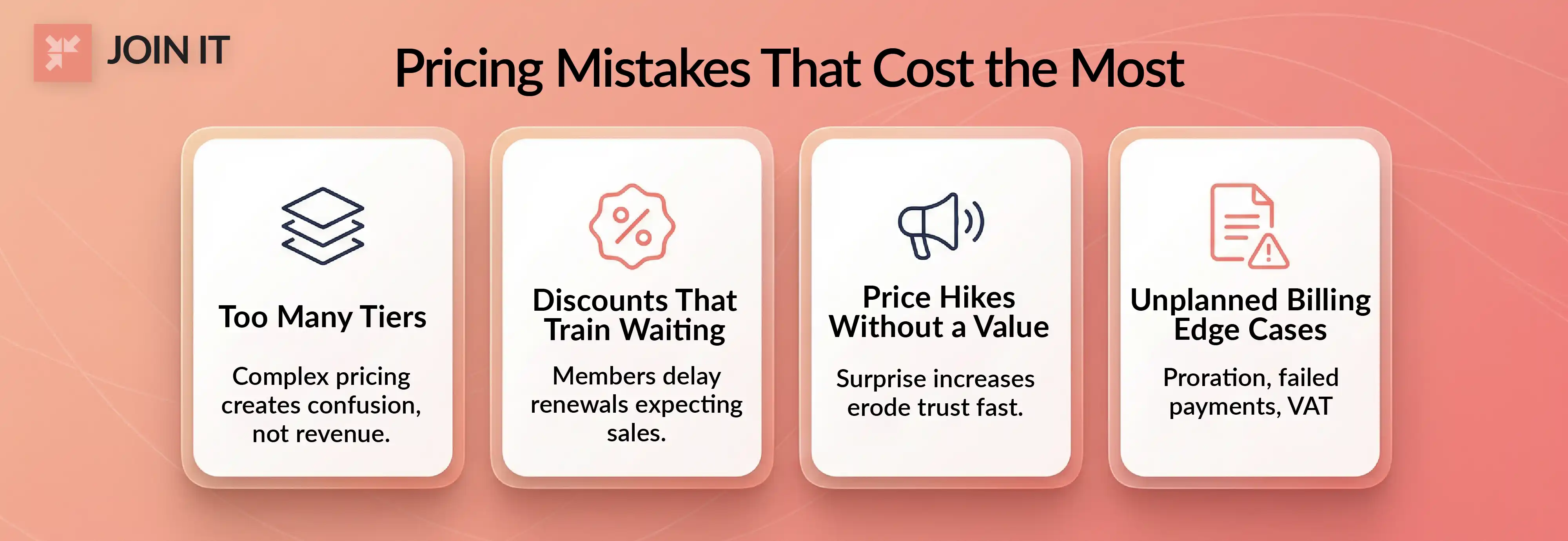
Too many tiers. Five tiers with subtle differences don't serve your members. They serve anxiety about leaving money on the table. Keep it simple. If prospects need a spreadsheet to compare options, you've already lost them.
Discounts that train members to wait. Once you run a seasonal sale, members start expecting it. They delay renewals. They wait for the discount window. Then you're competing against your own promotional history.
Price increases without a value story. The Audubon Institute paused membership sales after a backlash over a rate change revealed at checkout with no advance warning. Long-time members felt blindsided. Any price change needs a clear narrative, announced well in advance.
Billing and renewal edge cases you didn't plan for. Proration in membership pricing, refund policies, grace windows for failed payments, VAT display on invoices. These aren't abstract edge cases. They're the moments where pricing strategy either builds or breaks member trust.
Real platform complaints make this concrete. G2 reviewers on nonprofit CRMs have flagged the inability to apply coupon codes to memberships as a direct revenue limitation. Users on WildApricot reviews have reported confusion between active paying members and general contacts. On CiviCRM Stack Exchange, a bug caused VAT to appear twice on auto-renewal invoices. These are not hypothetical. They're what happens when pricing strategy outpaces operational readiness.
For the operational side, knowing how to track membership dues accurately is what keeps your pricing strategy from quietly leaking revenue.
How to Test Membership Pricing (Without Setting Your Community on Fire)
You don't need to bet everything on a single price change.
Test smaller decisions first: pricing page framing (does leading with monthly or annual change which one members choose?), tier naming, entry tier vs no entry tier, and whether a bonus perk outperforms a straight discount for early renewals.
Keep a control group. Set a clear test window. Define your success metrics before you start, not after. The metrics worth tracking:
- Conversion rate to join
- Renewal rate
- Member churn rate
- Average revenue per member (ARPM)
- Upgrade and downgrade rate
Upgrade and downgrade patterns are especially telling. If too many members are downgrading, your tiers may be priced too close together. Founding member pricing is also a low-risk way to test willingness to pay before you commit to a full pricing structure.
Membership Pricing Playbook by Organization Type
Associations need to balance dues with non-dues revenue. Corporate membership pricing, event bundling, and job board access often matter as much as base dues. Your association membership dues structure should reflect member type and organizational size, especially when enterprise-level members are in the picture.
Nonprofits often blur the line between membership and donation. Nonprofit membership levels work best when the benefits are specific and the price-to-impact story is crystal clear.
Clubs thrive on simplicity and loyalty. Multi-year membership discounts and family plans reward commitment without complicating the offer. Fairness matters more in close-knit club communities than in most other org types.
Gyms price for retention as much as acquisition. Monthly billing is the norm. Small annual increases tied to facility improvements are accepted when communicated clearly. The gym membership pricing strategy that works in 2026 isn't the lowest price, it's the clearest value for the money.
Faith-based organizations need pricing that reflects their values. Sliding scale dues and sustaining levels, communicated with dignity, keep communities inclusive without turning membership into a financial barrier.
Your Membership Pricing Checklist
Before finalizing any pricing decision, work through this:
- Defined your goals? (growth, sustainability, access, or all three?)
- Chosen a model that fits your org type and audience?
- Built tiers around member personas, not just feature bundles?
- Offered both monthly and annual billing options?
- Set discount rules tied to specific behavioral goals?
- Automated your renewal and billing process?
- Tested your dunning sequence and grace period for failed payments?
- Tracking ARPM, churn rate, and upgrade/downgrade rate?
- Set a dues review cadence so increases are never a surprise?
Tools That Make Pricing Actually Work
A pricing strategy only delivers results if your platform can execute it. Before designing a complex tier or discount structure, verify that your system supports proration for mid-cycle upgrades, coupon codes for renewals (not just new members), family and corporate plan management, automated renewal reminders, and reporting by membership level.
Join It is built for exactly this layer. It handles tiers, renewals, member self-service, and the operational detail that most pricing strategies quietly depend on. You can explore the full feature set at Join It features, or start a free trial to see how it fits your org's specific setup. If you'd prefer a walkthrough first, the free demo is a good place to start.
FAQ
How do you price a membership?
Start with member value, set cost-plus as your floor, check what comparable organizations charge, and choose a structure that fits your audience. Price the story, not just the number.
Should membership be monthly or annual?
Offer both. Monthly reduces friction and increases signups. Annual increases commitment and improves cash flow. Most organizations win by letting members choose, with a clear price advantage for choosing annual.
When should you raise membership prices?
When your costs have risen, when you've added meaningful value, or when you've held flat for more than two years. Give at least 60 to 90 days notice, explain the why, and connect the increase to a specific benefit members will see.
What is the biggest membership pricing mistake?
Setting a price and forgetting it. Pricing needs regular review, clear communication, and adjustment based on what your churn rate and renewal data are telling you.
How do you handle members who can't afford dues?
Build a formal hardship or sliding scale option into your pricing structure. Make it easy to request, remove the stigma, and consider setting aside subsidized memberships funded by members who pay at sustaining levels. It's better to have them in the community at a lower rate than not in it at all.

Guides from the Experts
Through our work with 4,000+ organizations - we’ve put together helpful guides to assist; regardless of where you are on your journey.
.webp)

A Complete Guide to Membership Organizations
Everything you need to know to manage and grow your membership business
.webp)
Maximize Membership Retention: 10 Proven Strategies
Tried and true strategies that not only win membership, but keep them

Build a Membership Website: A Step-by-Step Guide
Your one-stop resource for knowing all the features your modern membership website needs
Ready to start your free trial?
Our membership software is intuitive to use and even easier to test for yourself.