
Events for Membership Organizations: Complete Guide
You spent weeks planning the event. You sent the invites. You booked the room.
Then half the seats stayed empty.
That's not just a bad day. About half of association CEOs have reported decreased meeting attendance. Half.
But here's what that stat misses: the organizations that know why events matter, who they're for, and what job they're supposed to do in the member journey? They're still filling rooms, building real communities, and turning first-time attendees into long-term members.
This guide is for them. And for anyone who wants to get there.
Key Takeaways
- Half of association leaders report declining attendance. The organizations still filling rooms plan each event with a clear purpose behind it.
- Registration is not attendance. Your no-show rate tells you more than your sign-up count ever will.
- Every event should have a job in the member journey: attract prospects, welcome new members, deepen engagement, generate revenue, or signal retention.
- Free events carry higher no-show rates. For limited-capacity events, even a small commitment step separates casual RSVPs from people likely to show up.
- Generic invitations sent to everyone land for no one. Segment by member type, tenure, and behavior.
- Selling a sponsorship without a fulfillment plan is how you lose a sponsor before the next event starts.
- Attendees and no-shows need different follow-up emails. One generic thank-you serves neither group.
- Event ROI is more than ticket revenue. Attendance rate, sponsor delivery, and membership renewal signals matter just as much.
- Join It is rated Excellent on Trustpilot and connects event registration, attendance records, and member data in one place, so your events are easier to run, track, and measure.
What Are Events for Membership Organizations?
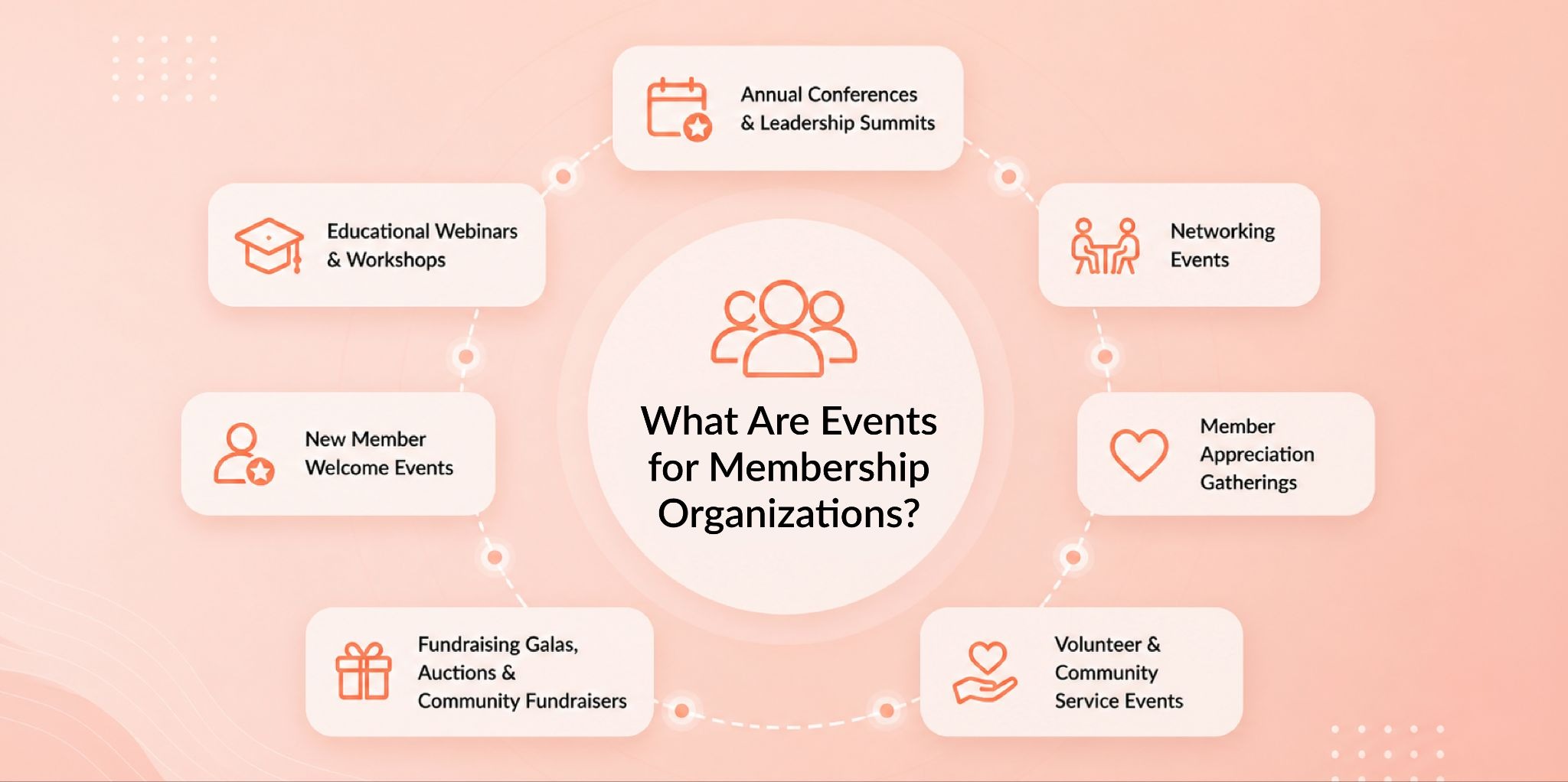
Events for membership organizations are planned gatherings, both in-person and virtual, that bring members, prospects, volunteers, sponsors, and community partners together around education, networking, fundraising, governance, service, or belonging.
That covers a wide range:
- New member welcome events and orientations
- Annual conferences and leadership summits
- Educational webinars and professional development workshops
- Networking breakfasts, happy hours, and peer roundtables
- Fundraising galas, auctions, and community fundraisers
- Volunteer and community service events
- Member appreciation gatherings
What separates membership events from regular events is the purpose behind them. A public concert wants ticket sales. A membership event wants something deeper: engagement, community, renewal, and proof that the membership is worth keeping.
For membership organizations of every type, from associations and nonprofits to chambers, clubs, and alumni groups, events are often the most visible way members experience the value of belonging.
Why Events Matter More Than You Think
There's a version of events that drains budgets, exhausts staff, and leaves everyone asking "was that worth it?"
Then there's a version that makes members feel like they made the right call joining.
The difference is usually intention.
Events create moments that no email newsletter or member portal can replicate. A chamber member meets a referral partner at a breakfast networking event. A nonprofit member sees the mission in action at a volunteer day. An association member hears something from a peer that changes how they lead their team.
Those moments drive renewal. They drive word of mouth. They drive the kind of quiet loyalty that makes a dues increase feel acceptable.
The meetings remain the most affected revenue stream, driven by declining attendance. Associations are adapting through hybrid models, pricing adjustments, partnerships, and technology investments.
The pressure is real. But so is the opportunity for organizations that plan with purpose.
Types of Member Events (And What Each One Is Actually For)
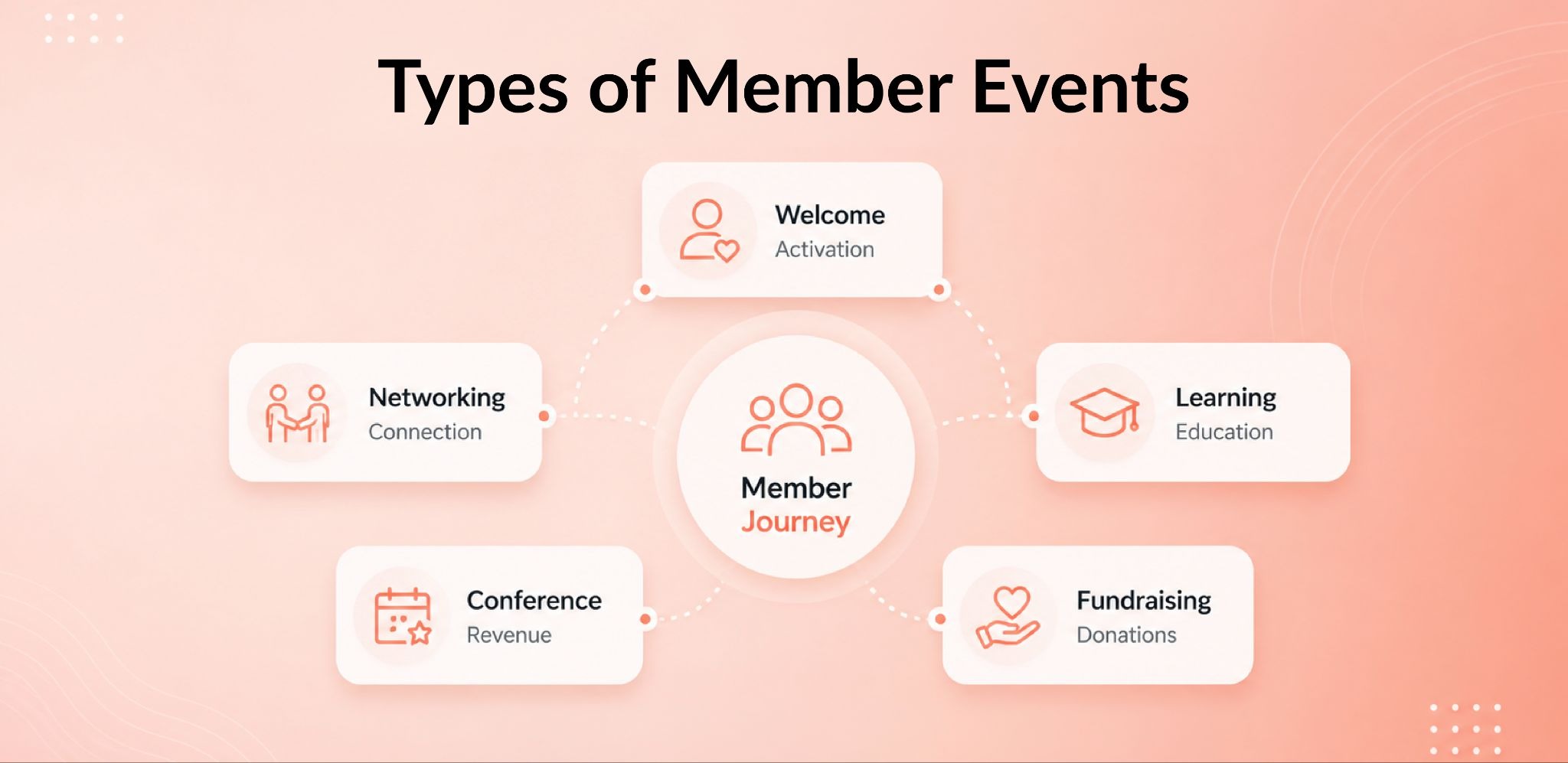
Not every event has the same job. From community-building events to revenue-generating conferences, each one plays a different role in the member journey.
Here's a practical breakdown:
The key insight here: each event type has a different job to do in the member journey. Running a fundraising gala when your new members need a welcome event is like skipping chapters in a book. It rarely lands the way you hope.
The Membership Event Ladder: Plan Events That Go Somewhere
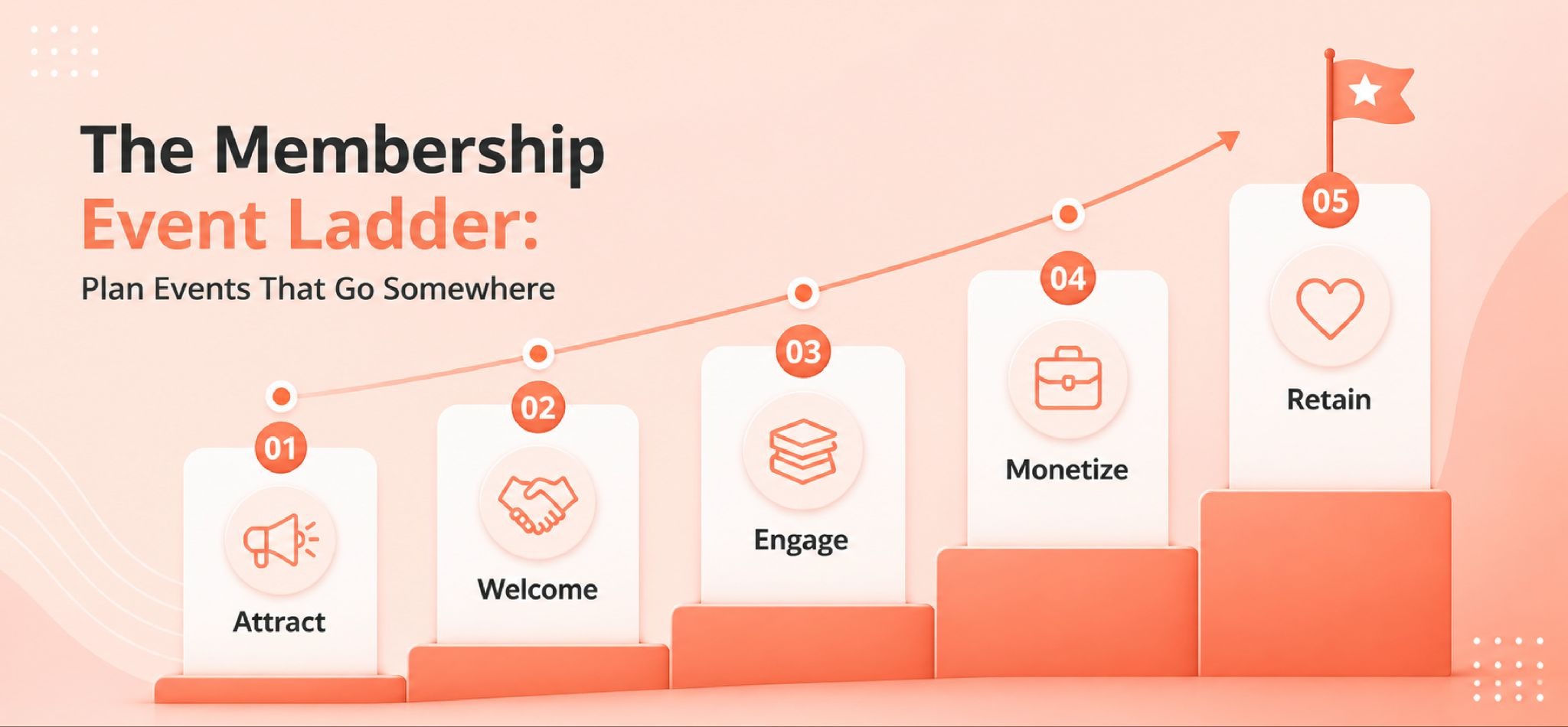
The best membership organizations don't think about events one at a time. They think about events as a connected system, a ladder each member can climb.
Here's how that ladder looks:
🪜 Attract: Public webinars, open houses, and community meetups that give prospects a first taste of the community.
🤝 Welcome: New member orientation sessions and small-group welcome events that turn sign-ups into participants.
📚 Engage: Workshops, peer roundtables, local chapter meetups, and recurring networking events that build the participation habit.
💼 Monetize: Paid conferences, ticketed events, sponsorship-supported breakfasts, and certification sessions that generate non-dues revenue.
❤️ Retain: Member appreciation nights, annual meetings, and impact recaps that remind members why they stayed.
Done well, this kind of connected event strategy works as a flywheel for attendance, engagement, retention, and membership growth, specifically when each event ties back to the organization's core value proposition.
The annual conference may create the big moment, but recurring events create the member habit. A monthly roundtable. A quarterly breakfast. A new member welcome call. These smaller touchpoints keep member engagement strong between large events and build the participation patterns that make renewal feel natural.
Planning Member Events That Actually Work
Before you book a venue or open a design tool for the event graphic, define your event goals and objectives first.
What is this event supposed to do?
Not "networking." Not "community building." Be specific.
"We want early-career members who attended last year's webinar to meet each other in person" is a goal you can plan around. "Let's do a networking night" is not.
Once you have a clear goal, audit your data before deciding anything else. Look at:
- Which member segments attend which event types
- Where the registration-to-attendance drop-off happens
- Which topics produced the highest registrations
- Which formats your remote members actually show up for
- Which segments never attend anything
Run an event marketing audit before shaping your next strategy. Attendee demographics, member preferences, past feedback, surveys, and what the attendance data actually showed all belong in that review. That's not overthinking. That's just not starting blind.
On budget: According to CWT and GBTA's annual Global Business Travel Forecasts, meetings and events average cost per attendee per day rose 4.5% in 2024, with projected increases of 3.7% in 2025 and 2.4% in 2026. Smaller, curated events can actually raise per-attendee costs further because fixed costs spread across fewer people.
As part of your event budget planning, know your break-even number before registration opens. If total event costs are $2,000 and tickets are $40, you need 50 paid attendees before sponsorship to break even. That calculation takes two minutes. Skipping it costs a lot more.
Event Registration: Make It Easy or Lose Them
A great event idea can lose registrants on a confusing sign-up page.
Your event registration page should answer five questions immediately:
- What is this event?
- Who is it for?
- What will I get from attending?
- When and where?
- How much does it cost?
Keep the event registration form short. Name, email, member status, ticket type, and an accessibility request field. That's it. Every extra field is a drop-off risk.
When it comes to payments, being able to process membership payments and event tickets through the same system reduces friction and keeps member pricing accurate without manual workarounds.
Member vs. non-member pricing is one of the most underused tools in membership event planning. Free for members. Paid for non-members. Or a member discount. Or an event ticket plus membership bundle at checkout. These pricing signals reinforce membership value without requiring a sales pitch.
After registration, send a timed sequence of event confirmation emails:
- Immediately: confirmation with calendar invite
- 7 days before: value reminder ("here's what you'll take away")
- 48 hours before: logistics and access details
- Day of: final reminder
For virtual events, add a 2-hour reminder and a 10-minute nudge. Members are busy. Reminders are not annoying. Missing a great event because it slipped off the radar is.
The No-Show Problem (And What Actually Helps)
Here is an uncomfortable truth about free membership events.
A significant portion of the people who register will not show up.
In an HOA community forum discussion, one organizer reported up to 50% of sign-ups failing to attend, leaving dues-funded seats empty and other members frustrated. "Stop using HOA money to fund events that can't be attended by all members," one commenter wrote. That frustration is real, and familiar.
Track your own no-show rate using a simple formula:
No-show rate = registered attendees who did not attend ÷ total registrations
Then change your approach based on it. Free, low-stakes events will always carry higher no-show rates. That's expected. For limited-capacity events with catering, venue costs, and waiting lists, even a small commitment step can help separate casual RSVPs from people who are more likely to show.
One event organizer in an r/EventProduction thread raised attendance from around 50% to 90% by asking registrants to complete a short survey confirming their likelihood to attend. A simple qualifier made people accountable.
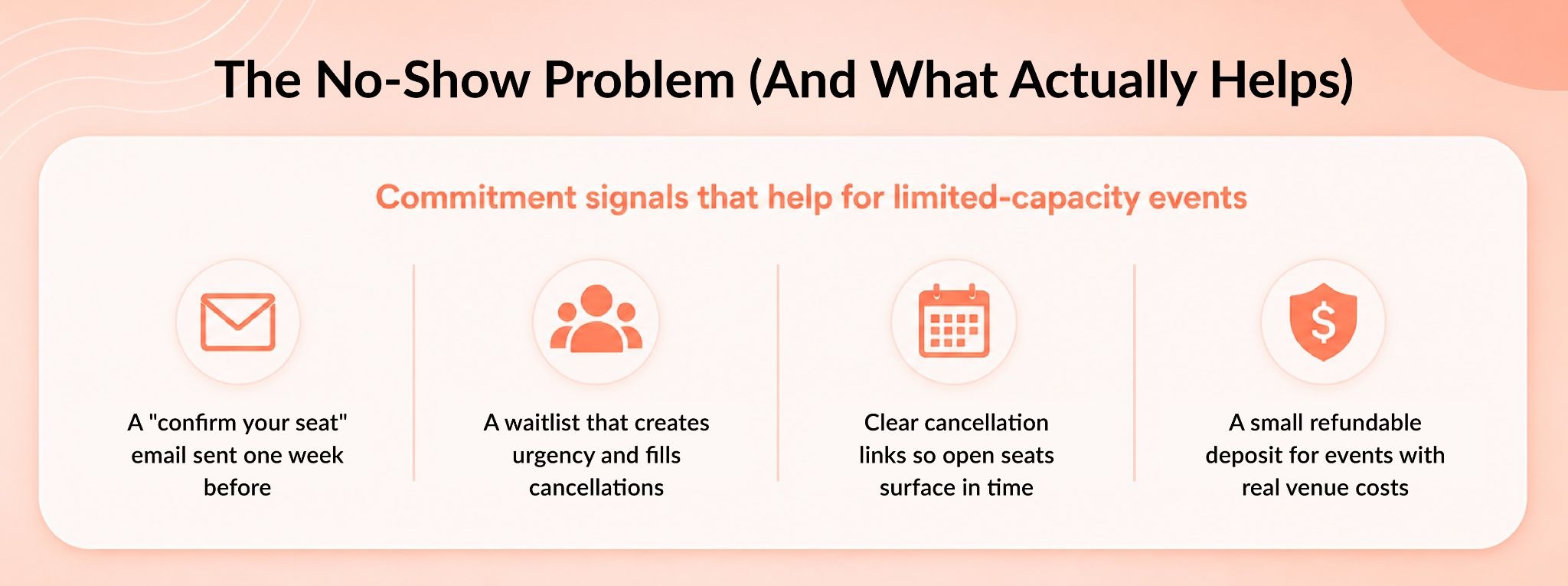
Commitment signals that help for limited-capacity events:
- A "confirm your seat" email sent one week before
- A waitlist that creates urgency and fills cancellations
- Clear cancellation links so open seats surface in time
- A small refundable deposit for events with real venue costs
This doesn't mean paid tickets always fix no-shows. They often help with commitment, but the event still needs to feel worth attending in the first place.
Promoting Member Events Without Being Boring About It
Weak event promotion says: "Join us for our annual networking event."
Strong event promotion says: "Meet 20 local nonprofit leaders, hear how two organizations doubled their renewal rates, and leave with a ready-to-use planning checklist."
The difference is specificity. Answer the member's real question before they ask it: what is actually in this for me?
Segment your event email invitations. The same message sent to everyone is a message that lands for no one.
- For new members: "Meet other members who joined this year."
- For long-term members: "Reconnect with peers and help shape what comes next."
- For non-members: "Attend once and see what membership includes."
- For sponsors: "Meet decision-makers in your target market."
The goal is to segment by genuine interest and behavior, not just insert a first name into a generic email.
Use social proof before the event. Photos from past gatherings. Attendee quotes. Speaker clips. A quick recap snippet from last year. That kind of pre-event storytelling builds anticipation and handles objections before they form.
A simple event promotion strategy that works:
- 6 weeks out: announce with a strong "what's in it for me" message
- 3 weeks out: social proof push with past event highlights
- 1 week out: urgency, logistics, and member-specific reminders
- After the event: recap content that creates genuine FOMO for non-attendees
Event Sponsorship: Sell Value, Not Logo Placement
Most sponsorship packages lead with logos. Most sponsors are quietly underwhelmed.
Sponsors want audience fit, visibility, and real relationship-building. Ask them what they actually need before building a package. Create tiers that are easy to explain. And send a recap after the event that shows exactly what was promised and what was delivered.
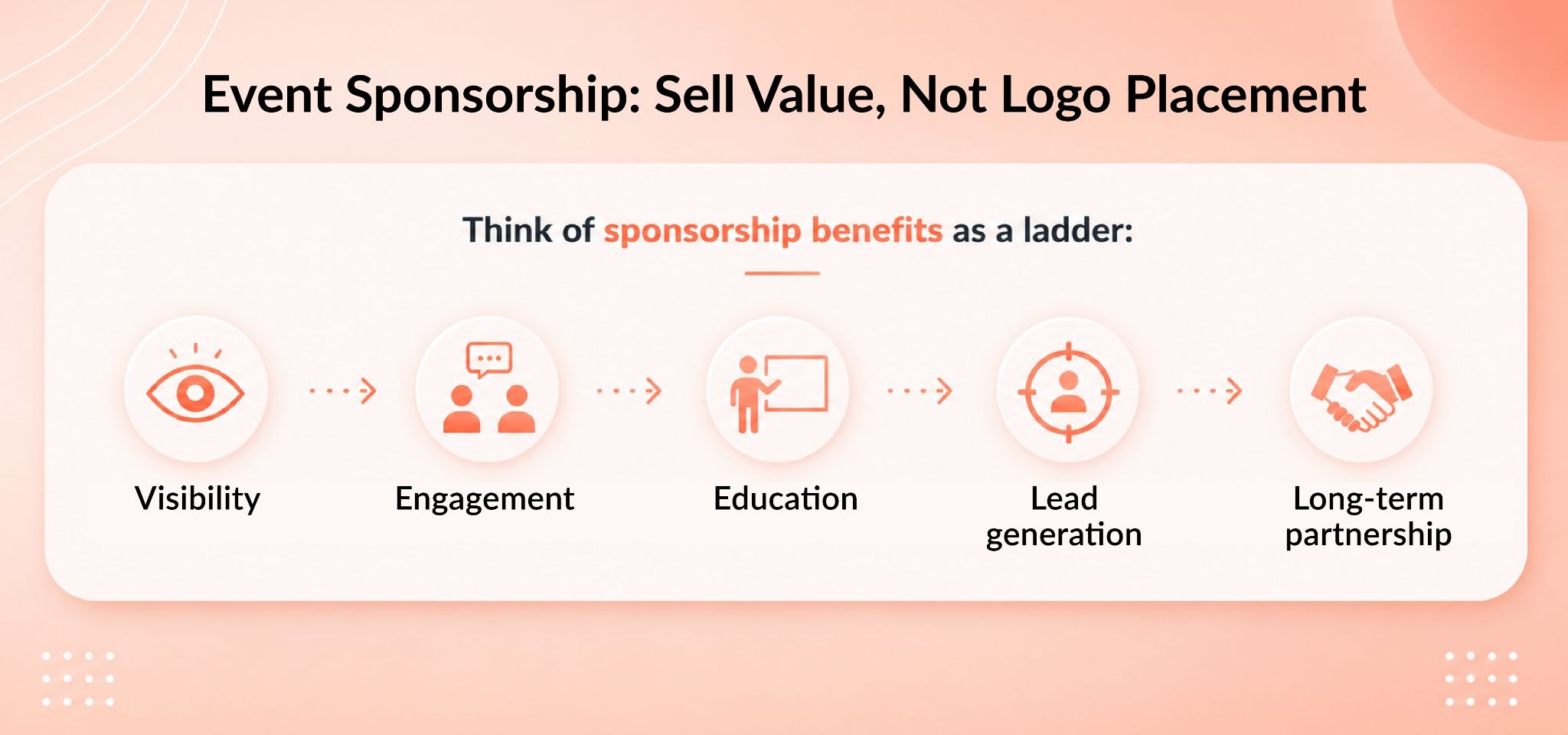
Think of sponsorship benefits as a ladder:
Visibility (logo placement and brand mentions) → Engagement (sponsored networking break or table) → Education (thought leadership session or workshop) → Lead generation (where privacy rules allow) → Long-term partnership (multi-event or annual relationship)
A sponsor at the bottom gets a logo on a landing page. A sponsor at the top gets a sponsored roundtable, a speaking opportunity, post-event engagement metrics, and a renewal conversation before the event recap is even sent.
For practical frameworks on structuring event sponsorship packages across different organization types and event formats, that resource covers what works at both the small and large scale.
One thing that gets overlooked: assign a dedicated sponsor contact for every event. One person who manages sponsor fulfillment: confirming assets, tracking promised placements, monitoring mentions, and sending a sponsor recap report. Many organizations sell the sponsorship and then quietly drop the fulfillment. That's how you lose a sponsor you worked hard to get.
Event Revenue and Pricing Strategy
Events are not free to run. And "we broke even" is not the ceiling.
Revenue levers beyond standard event ticket revenue include:
- Member vs. non-member pricing that reinforces the value of belonging
- Early-bird pricing that drives registrations before promotion fatigue sets in
- VIP ticket tiers with added access or networking opportunities
- Donation add-ons during registration where members can accept donations at checkout
- Sponsored sessions, networking breaks, and post-event content placement
For a broader view of what's possible alongside event revenue, non-dues revenue ideas covers event-based and membership-based income streams together.
One framing shift that changes how organizations think about pricing: pricing is not just about revenue. It shapes perceived value and commitment. In the free vs. paid events debate, a $0 event with no stakes signals no stakes. A $20 event with a clear deliverable signals that this is worth showing up for.
Your membership pricing strategy and your event pricing should be designed in relationship with each other, not in separate spreadsheets on different desks.
For organizations managing member payments at scale, recurring membership payments and recurring billing become especially important when events are bundled into annual membership tiers.
Virtual and Hybrid Events: When They Work (And When They Don't)
Hybrid events are not automatically better. They're more complex to run, and if the virtual experience is an afterthought, remote attendees will notice.
OneCause's 2025 Fundraising Outlook, based on 977 nonprofit professionals, found that 75% of organizations hosting in-person events met or exceeded their fundraising goals, and 76% of those using hybrid models met or exceeded theirs. Both formats work. The question is which one fits your members and your actual capacity.
Virtual works best for: educational webinars, new member orientation, members in different time zones, recorded on-demand content, and expert sessions where location is irrelevant.
Hybrid works best for: conferences where some members cannot travel, fundraising events with a digital giving component, annual meetings that need wider participation, and communities spread across multiple regions.
According to Zoom's Future of Hybrid Events report, organizations now allocate roughly 37% of event budgets to hybrid formats on average.
Across the sector, organizations are responding to attendance and cost pressure by exploring hybrid event planning options, shortening event durations, and renegotiating venue contracts. Smaller, more frequent events are becoming a real alternative to betting everything on one big annual gathering.
For virtual events: shorter sessions win. Add live polls, moderated chat, and clear Q&A windows to keep virtual event engagement strong. Make the recording available afterward. And plan your engagement intentionally, not as a backup plan.
Keeping Attendees Engaged During the Event
Getting people in the room, whether it's a peer networking event or a large educational session, is step one.
Eventbrite's 2026 Social Study found that 79% of 18-to-35-year-olds plan to attend more events in 2026, with a clear shift toward real, less choreographed gatherings that prioritize active participation and organic connection.
People don't want to sit and listen anymore. They want to participate.
Build participation into the event design itself:
- Topic tables where attendees self-select by interest
- A "bring one challenge" format for roundtables
- Quick intro prompts that give everyone 60 seconds
- Live polls at the start of a session to surface real opinions
- Small-group breakouts during larger events
- A post-event discussion thread that keeps the conversation alive
Structured networking beats "just mingle" every single time. When people know what they're supposed to do, they actually do it. When they don't, they check their phones and leave early.
Event Software and Why Spreadsheets Break Down
At some point, managing membership and event management in a spreadsheet stops being manageable.
Duplicate entries. Missed payments. No attendance history. Manual follow-up for every no-show. No record of which members attended what. No way to connect event participation to membership engagement over time.
Good membership management software handles event pages, online registration, member vs. non-member pricing, ticket payments, automated confirmations, event check-in via QR code, attendance records, waitlists, post-event emails, and event reporting, all in one connected system.
For teams evaluating options, Join It pricing covers the plans available and what's included at each level.
The point is not "buy software." The real point is this:
If event registration lives in a spreadsheet, you lose the ability to connect event participation to membership engagement. And that connection is where the long-term value lives.
Two things that often get skipped in event tech setup: failed payment notifications that catch declined cards before they quietly drain event income, and automatic renewal reminders that keep the membership side moving without manual follow-up between events.
Post-Event Follow-Up: Don't Let the Moment Go Cold
The event is over. Most organizations send one generic thank-you email and move on.
The organizations that get the most from their events do something different. They treat attendees and no-shows as two completely different audiences.
To attendees:
- An event recap email with key takeaways and next steps
- Photos from the event
- Slides or recording if available
- A short survey asking what worked and what to improve
- Invitation to the next relevant event
To no-shows:
- "We missed you" message with a recording or recap link
- A short survey asking what prevented them from coming
- Clear cancellation reminder for future limited-capacity events
- Next event invitation with a reason to try again
One generic email serves neither group well and misses a real post-event engagement opportunity. Segmenting this follow-up takes an extra 30 minutes and makes every future event easier to fill.
Your post-event survey questions don't need to be long or complicated. Ask: Was this worth your time? What was the best part? What should we change? Would you attend again? That's enough to spot patterns before they become problems.
If you want to track membership dues alongside event attendance in one place, having both in the same system reveals which members attend, what they contribute, and whether event participation actually correlates with renewal behavior.
Measuring Event ROI: Beyond the Ticket Revenue Line
Event ROI measurement for membership organizations goes beyond what the event made on ticket sales.
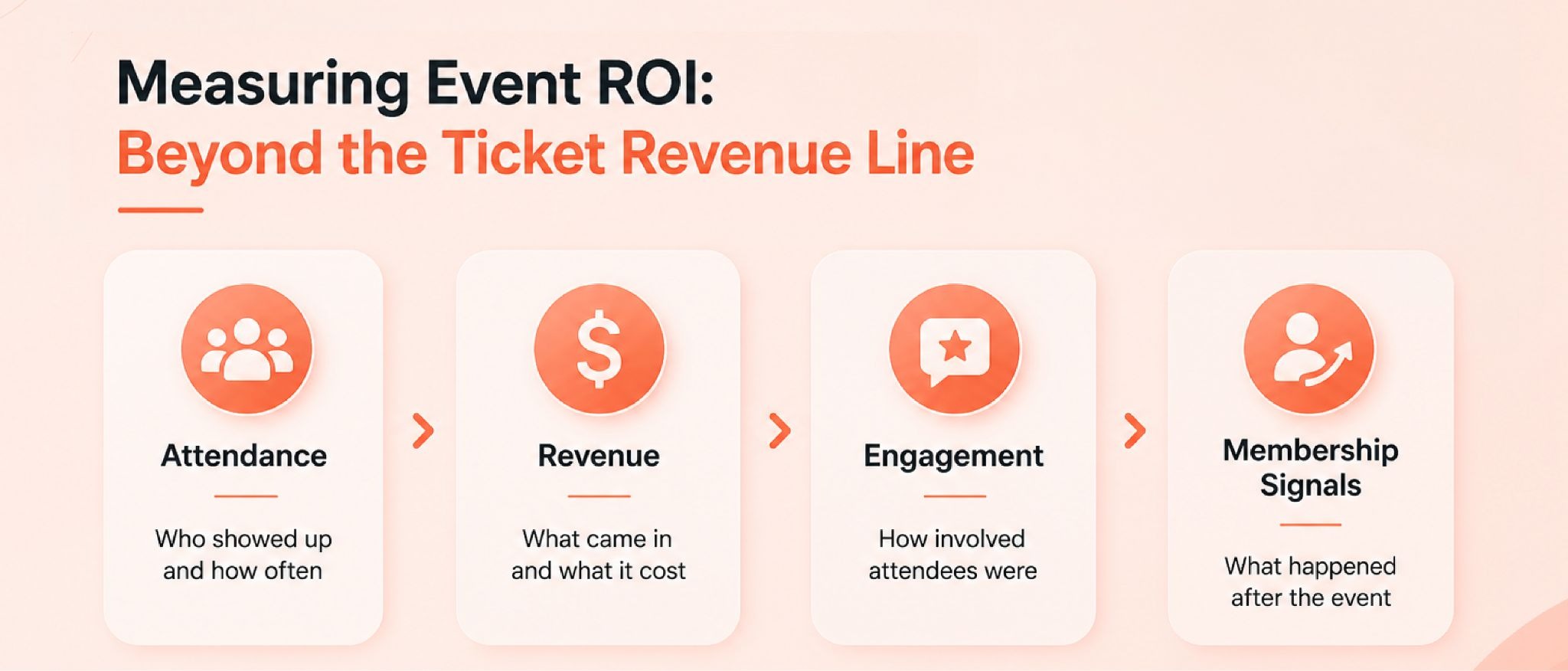
Track four buckets:
Attendance metrics (your core event attendance tracking data): Registrations, actual attendance, no-show rate, first-time vs. repeat attendees, and attendance broken down by member segment.
Revenue metrics: Ticket revenue, sponsorship revenue, donation revenue, net profit or loss, and cost per attendee.
Engagement metrics: Survey rating, repeat attendance, session participation, volunteer signups, and post-event content clicks.
Membership signals: New members influenced by the event, attendees who renewed afterward, lapsed members who re-engaged, and members who escalated to a higher tier.
That last bucket is the one most organizations skip. Track whether attendees renew at a higher rate than members who never attend. You don't need a formal research study to see the pattern. A basic report by membership status and event attendance history tells the story clearly.
Use your CRM and analytics tools to track what actually happened, not just what felt like it worked. That's what turns a one-off event into a better next one.
Frequently Asked Questions
What are events for membership organizations?
Events for membership organizations are planned gatherings, in-person or virtual, that bring members, prospects, volunteers, sponsors, or community partners together around education, networking, fundraising, governance, or community building. They range from small new member welcome sessions to large annual conferences, and each type serves a different stage of the member journey.
How do you plan a membership event?
Start with a specific goal tied to a member outcome. Choose the right format, build a realistic budget with a clear break-even number, create a clean registration page, promote with segmented messaging, design participation into the event itself, and send separate follow-ups to attendees and no-shows.
How do you increase event attendance?
Segment your invitations by member type and behavior. Write clear "what's in it for me" messaging. Use social proof from past events. Send a timed reminder sequence. Make registration fast and mobile-friendly. And test different timing formats to find what your specific members actually show up for.
How do you reduce event no-shows?
For limited-capacity events, add a commitment signal: a seat confirmation email, a waitlist, or a small refundable deposit. Make cancellation easy so open seats surface in time. After the event, send a separate follow-up to no-shows that keeps them connected to the next opportunity.
Should member events be free or paid?
It depends on the goal, the cost, and the member. Free events reduce friction and build access but often see higher no-show rates. Paid events signal value and commitment but can limit reach. Member discounts, sponsor-supported free events, and event-plus-membership bundles offer practical middle-ground options.
How do you measure event success?
Track four things: attendance versus registration, revenue versus cost, sponsor deliverables versus commitments, and membership signals like renewals and new joins that follow the event. Ticket revenue alone is not enough. Engagement and retention metrics tell the fuller story.
Final Thoughts: Events Are Participation Systems, Not Calendar Items
Events for membership organizations work best when they are connected to member value rather than treated as isolated activities to check off a list.
The best events answer a question members carry into every renewal season:
"Is this membership worth staying part of?"
When the answer is "I met someone I wouldn't have met otherwise," or "I learned something I used the next week," or "I finally feel like I belong here," you have done more than host an event. You have built a reason to stay.
If your team is managing member data, payments, event registration, and follow-up across separate tools, there's a cleaner way to connect those workflows. You can book a call to see how Join It supports membership and event management together, or start a free trial to see how it fits your organization.
The goal was never more attendees.
It was always better participation. 🎯
Sources
- ASAE. State of Associations Report 2026
- CWT & GBTA. Global Business Travel Forecast
- Reddit. No-shows at HOA Events
- Reddit. Avoiding No-shows at Free Events
- Zoom. Future of Hybrid Events Report


