
How to Host a 50/50 Raffle: Rules, Pricing & Tips for Nonprofits


How to Host a 50/50 Raffle: Rules, Pricing & Tips for Nonprofits
TL;DR
A 50/50 raffle is a drawing where the winner takes half of all ticket sales and your organization keeps the other half. To host one legally, check your state's raffle rules, sell tickets in advance or at your event, price them low enough for impulse buys, and announce the growing pot often to drive last-minute sales.
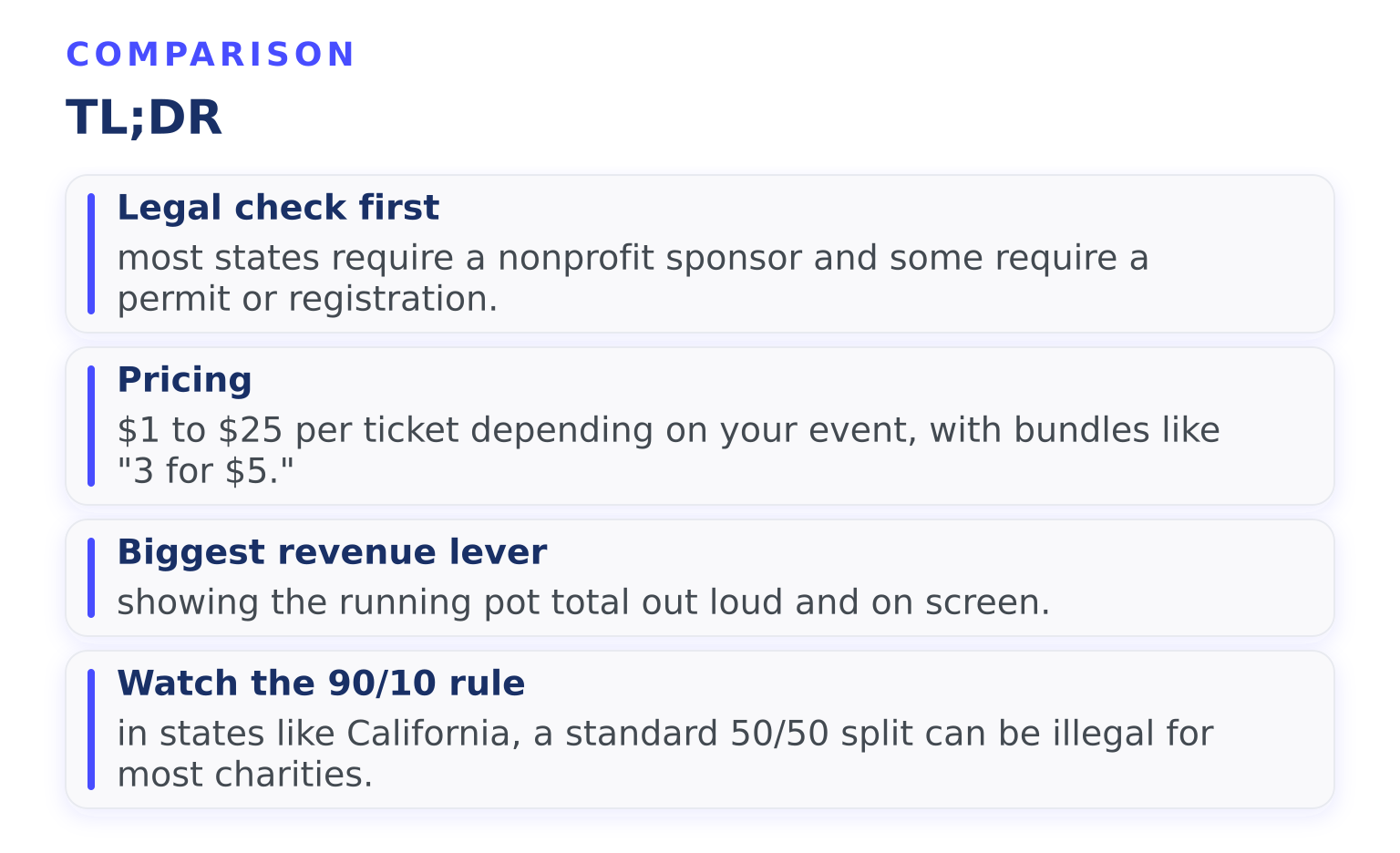
- Legal check first: most states require a nonprofit sponsor and some require a permit or registration.
- Pricing: $1 to $25 per ticket depending on your event, with bundles like "3 for $5."
- Biggest revenue lever: showing the running pot total out loud and on screen.
- Watch the 90/10 rule: in states like California, a standard 50/50 split can be illegal for most charities.
What a 50/50 raffle is
A 50/50 raffle is a cash drawing where the prize is a percentage of ticket sales rather than a donated item. Every ticket sold goes into one pot. The person holding the winning ticket takes half. Your organization keeps the other half.
The math is simple. Sell 500 tickets at $5 each and the pot is $2,500. The winner gets $1,250 and you keep $1,250. The Rafflebase calculator walks through a full example: at that same $2,500 pot, if printing, license fees, and card processing cost you $180, you clear $1,070. The winner still takes the full $1,250 they were promised.
That last part matters. Once you advertise a 50/50 split, the winner's half is the winner's. Your costs come out of your half only. Never dip into the prize side to cover expenses.
Because the prize grows with every ticket sold, you never buy the prize up front. That makes a 50/50 one of the cheapest fundraisers to run, and one of the easiest to explain to a crowd: "Someone here is walking away with half this pot tonight."
Check your state's rules before you sell a ticket
Raffles are a form of lottery, so state law controls how they run. Rules vary a lot, and a few states change the 50/50 format itself.
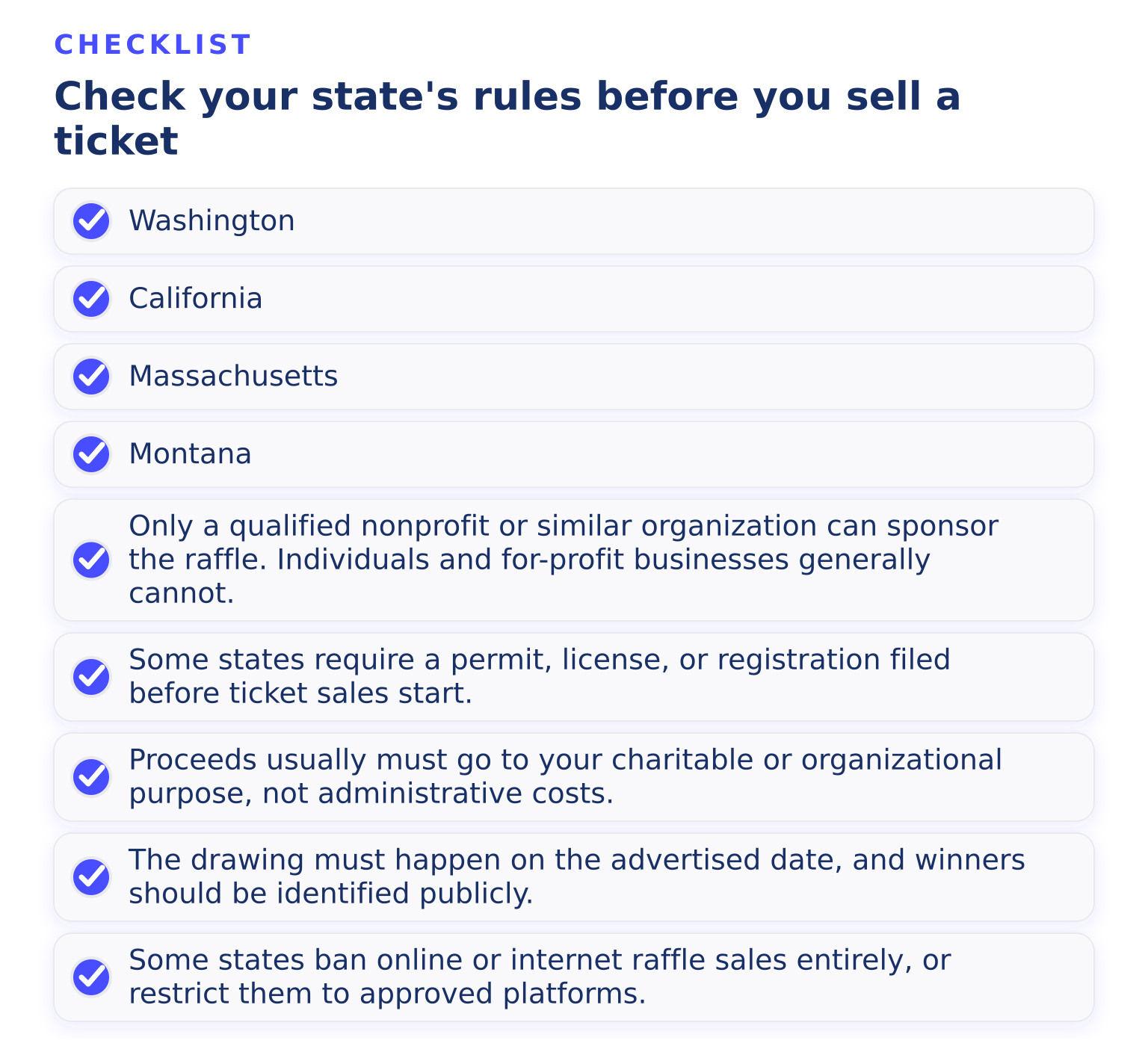
A few examples of how different the rules are:
- Washington requires proceeds to go to your stated purpose, rules printed on each ticket or handout (cost per chance, drawing date, sponsoring organization, and a minimum prize if the payout is a percentage), and stubs drawn randomly so every entry has an equal chance. See the Washington State Gambling Commission's raffle handout.
- California requires that at least 90 percent of gross ticket receipts go to charitable purposes. Under the state's 90/10 rule, a standard 50/50 raffle is illegal for most charities unless you qualify under a specific major league sports program. Registration must be filed at least 60 days before the raffle. The California Attorney General's nonprofit raffles page explains the 90/10 rule and who qualifies.
- Massachusetts warns that a cash prize drawn from ticket proceeds can violate the state's pooling rules, so the cash-pot format may not be available to charities there at all.
- Montana allows 50/50 raffles only for nonprofits, colleges, universities, and school districts, and requires sponsors to use approved electronic processing systems for digital sales. Montana's Department of Justice publishes 50/50 raffle guidelines with the details.
Common requirements across states:
- Only a qualified nonprofit or similar organization can sponsor the raffle. Individuals and for-profit businesses generally cannot.
- Some states require a permit, license, or registration filed before ticket sales start.
- Proceeds usually must go to your charitable or organizational purpose, not administrative costs.
- The drawing must happen on the advertised date, and winners should be identified publicly.
- Some states ban online or internet raffle sales entirely, or restrict them to approved platforms.
If your organization operates in multiple states or chapters, each location needs its own check. A quick search for "raffle license" plus your state's name, or a call to your state's attorney general or gaming commission, settles it fast.
How to host a 50/50 raffle, step by step
If you're new to running fundraisers, our library of how-to guides covers more of the basics, from planning a membership drive to welcoming new members. Here's the 50/50 version, start to finish:

- Confirm you're allowed to run one. Verify your organization qualifies, find out whether you need a permit or registration, and note any filing deadlines. In California, for example, that deadline is 60 days before the raffle.
- Set your fundraising goal and budget. Know what you want to net and what you'll spend on printing, permits, payment processing, and promotion. Remember you only keep half the gross.
- Choose in-person, online, or both. A live draw at an event builds energy. Online sales widen your reach but may be restricted in your state.
- Write the rules and print them. Include ticket price, drawing date, time, and location, your organization's name, whether the winner must be present, and how the prize is calculated. Many states require this disclosure.
- Sell tickets. Use bundles and visible pot totals (more on pricing below). Open sales early so the pot has momentum before the event.
- Draw the winner fairly. Every stub or entry goes into the drawing pool. Pull one at random, in public if possible.
- Pay and record. Announce the winner, pay the promised half promptly, and account for your half against expenses and your stated purpose. Keep records; many states require financial reporting after the raffle.
How to price 50/50 raffle tickets
Pricing is the biggest revenue lever you control. The goal is a price low enough that almost nobody walks past, but high enough that the pot gets exciting.
- $1 to $5 per ticket works at casual community events, school nights, and games where impulse buys drive volume.
- $10 to $25 per ticket fits galas, dinners, and formal events where guests expect to spend more.
DoJiggy's raffle ticket pricing guide shows why single prices should rise slowly as prizes grow: bigger pots attract more buyers, so you make it up on volume, not per-ticket price.
Three pricing tactics that consistently raise more:
- Bundles. "1 for $5, 3 for $10" or "5 for $20" nudges buyers past their planned spend. Givebutter's 50/50 raffle guide includes a pricing formula you can use: (expenses + fundraising goal) ÷ number of tickets × 2 = ticket price, since you only keep half.
- A cap or no cap. A capped raffle ("only 300 tickets") sells odds and scarcity. An uncapped raffle sells a growing pot. Both work; pick the story that suits your crowd.
- Early-bird sales. Open online sales a week or two before the event so the first live announcement already has a number worth shouting.
Seven ways to raise more with your draw
- Announce the pot constantly. At a live event, have the emcee call the running total every 15 to 20 minutes and at least three times before the drawing. Each announcement triggers another wave of sales.
- Display the total on screen or on the sales page. For an online raffle, a visible updating pot is your best salesperson.
- Sell at high-traffic spots. Entrances, bars, and food lines convert better than tables at the back of the room.
- Lead promotions with the money. "Someone's winning $1,000+" outperforms "buy a ticket to support us." Put a dollar figure in every post and email.
- Close sales with a firm deadline. Announce ticket sales end 30 to 45 minutes before the draw to create urgency.
- Pair it with other formats. A 50/50 runs cleanly alongside a silent auction, prize raffle, or fund-a-need appeal, and catches people who won't bid on items but will spend $20 on cash. Our lists of fundraising ideas for clubs and sports fundraising ideas are full of formats that pair well with a split-the-pot draw.
- Time the draw well. Drawing after dinner or during a high-energy moment keeps last-minute buyers in the room.
Where the money goes: an honest tradeoff
The 50/50 split is the format's appeal and its cost. Half of every dollar raised leaves your organization. If your crowd is small or ticket sales are slow, consider asking sponsors to top up the pot, running the raffle as one part of a larger event, or proposing a different split if your state allows it. Some organizations flip the ratio, giving the winner 25 percent and keeping 75 percent, when their audience cares more about the cause than the cash.
Whichever split you choose, keep records of gross sales, expenses, the prize paid, and where your share went. Clean numbers protect you in any audit and make next year's raffle easier to plan.
Making the event itself easy to run
A 50/50 raffle is simple to run; the surrounding logistics are what eat your volunteer hours. Selling event tickets, checking attendees in, tracking who bought raffle entries, and messaging your member list all add up. Good event registration software handles the ticketing and check-in side, and a membership management system can put event registration, payments, and member communications in one place, so your volunteers spend the night selling tickets instead of managing spreadsheets. Wine club Humble Grape, for example, uses Join It to run payments and member data for its events; read how Humble Grape thrives with Join It.
Common questions
Can anyone run a 50/50 raffle?
No. In nearly every state, only a qualified nonprofit, charity, club, school, or similar organization can sponsor a raffle. Individuals and businesses running a "50/50" would be operating an illegal lottery in most jurisdictions.
Is a 50/50 raffle legal in every state?
No. Some states, like California and Massachusetts, restrict or effectively prohibit the cash-pot format for most charities. Always check your state's specific raffle laws before advertising the split.
Do I have to pay tax on raffle winnings?
Cash raffle prizes are treated as ordinary income by the IRS, and a raffle ticket purchase is not a charitable deduction. Some states require you to disclose both on your tickets or in written notice; Massachusetts' raffle guidance, for example, lists both disclosures as required when ticket prices or prizes pass certain thresholds.
Can I sell 50/50 raffle tickets online?
It depends on your state. Some allow it through approved platforms, others prohibit internet raffle sales entirely. Confirm before you set up online selling.
How much should my organization expect to raise?
Your net is roughly half of gross ticket sales minus your expenses. At $5 tickets with 500 sold, that's about $1,070 to $1,250 depending on costs. Setting a target first and working back to a ticket count keeps the goal realistic.
Your next step
Pick a date, confirm your state's rules, and set your goal and ticket price this week. Then recruit two or three volunteers to sell early, because momentum in the pot is what turns a modest raffle into a headline moment. If your organization runs events, dues, and communications throughout the year, start a free trial of Join It and put membership, payments, and event registration in one place so every future fundraiser runs itself.
.avif)
Guides from the Experts
Through our work with 4,000+ organizations - we’ve put together helpful guides to assist; regardless of where you are on your journey.
.webp)

A Complete Guide to Membership Organizations
Everything you need to know to manage and grow your membership business
.webp)
Maximize Membership Retention: 10 Proven Strategies
Tried and true strategies that not only win membership, but keep them

Build a Membership Website: A Step-by-Step Guide
Your one-stop resource for knowing all the features your modern membership website needs
Ready to start your free trial?
Our membership software is intuitive to use and even easier to test for yourself.