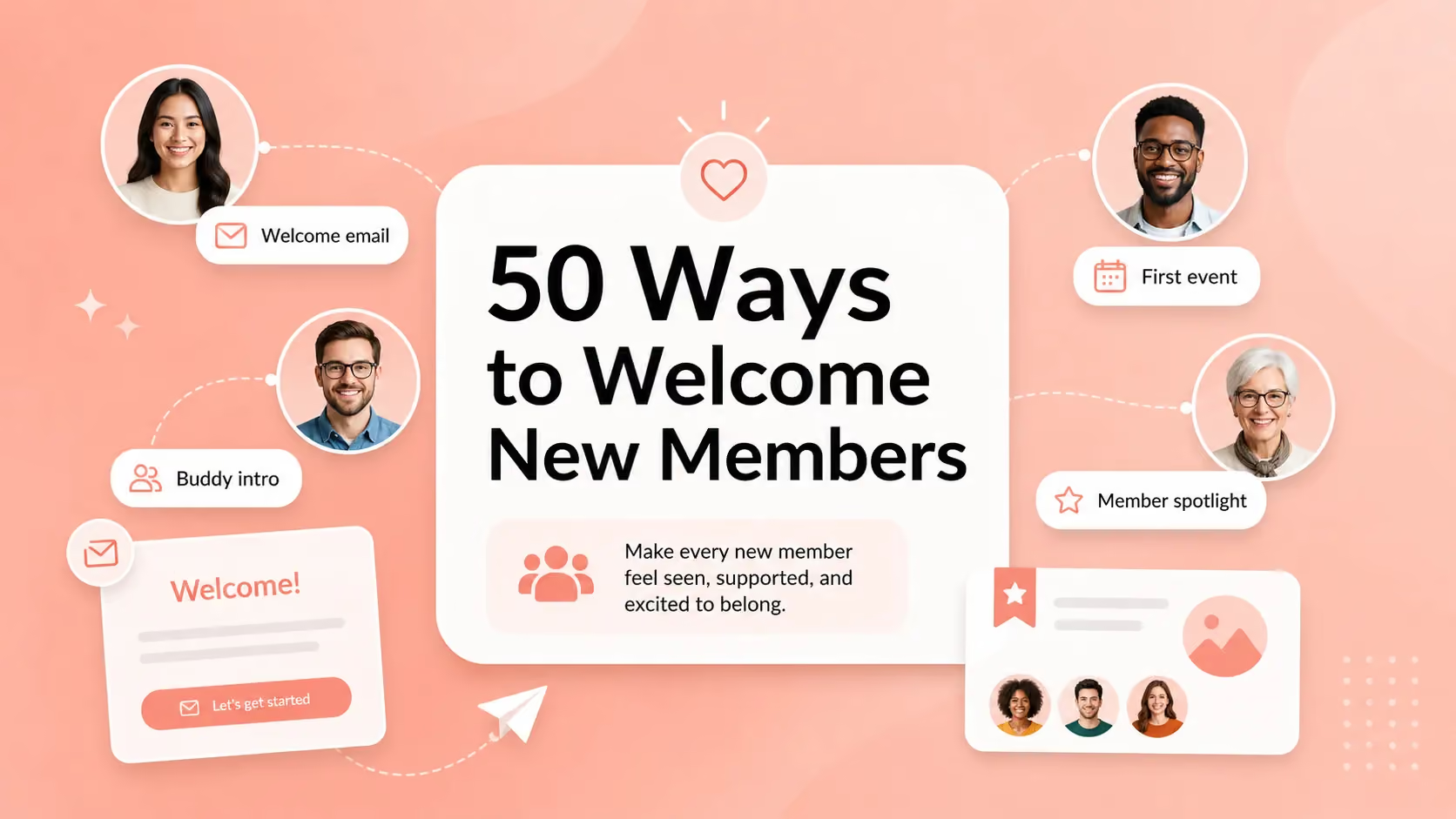
50 Warm Ways to Welcome New Members to Your Group


Most organizations send one welcome email and call it done.
New members join, receive that single message, and then... nothing. They log in, look around, and quietly wonder if they made the right call. Some disengage within days. Most never reach out. And by renewal season, the question is always the same: what happened?
The answer, more often than not, is that the welcome ended too soon.
Welcoming new members is not a hospitality gesture. It is a retention system. The 2024 Membership Marketing Benchmarking Report puts the stakes plainly: the median first-year renewal rate is just 75%, while overall renewal sits at 85%. That 10-point gap represents new members who joined, found no clear path forward, and quietly disappeared.
A smarter welcome process is how your organization closes that gap. These new member onboarding tips are where that process starts.
Key Takeaways
- One welcome email is not a welcome system. New members need a sequence, not a single send.
- The gap between first-year renewal (75%) and overall renewal (85%) is where most organizations lose members without ever knowing why.
- 81% of associations use a welcome email. Fewer than 30% make a welcome phone call. That gap is the opportunity.
- New members who complete a profile, attend one event, or join a smaller group inside the organization are significantly more likely to renew.
- Personalization starts with one question at signup. "What do you want most from membership?" is enough to make every message that follows feel relevant.
- Human contact, whether a phone call, a buddy, or a greeter at the first event, consistently outperforms any automated tactic in membership research.
- Join It is rated Excellent on Trustpilot and helps membership organizations welcome new members with automated sequences, digital membership cards, member profiles, and event invitations, all managed in one place.
Quick Answer: How Do You Welcome New Members?
Before the full list, here is the five-step framework underneath every tactic that actually works:
- Confirm the join and remove uncertainty on day one
- Deliver one quick win within the first 24 hours
- Ask for one easy first action, whether a profile, a post, or an event signup
- Introduce one named human contact
- Keep the welcome going through day 30 to day 90
One email is a message. A sequence is a system. The organizations that retain new members build the second one.
Why Welcoming New Members Is Really a Retention Strategy
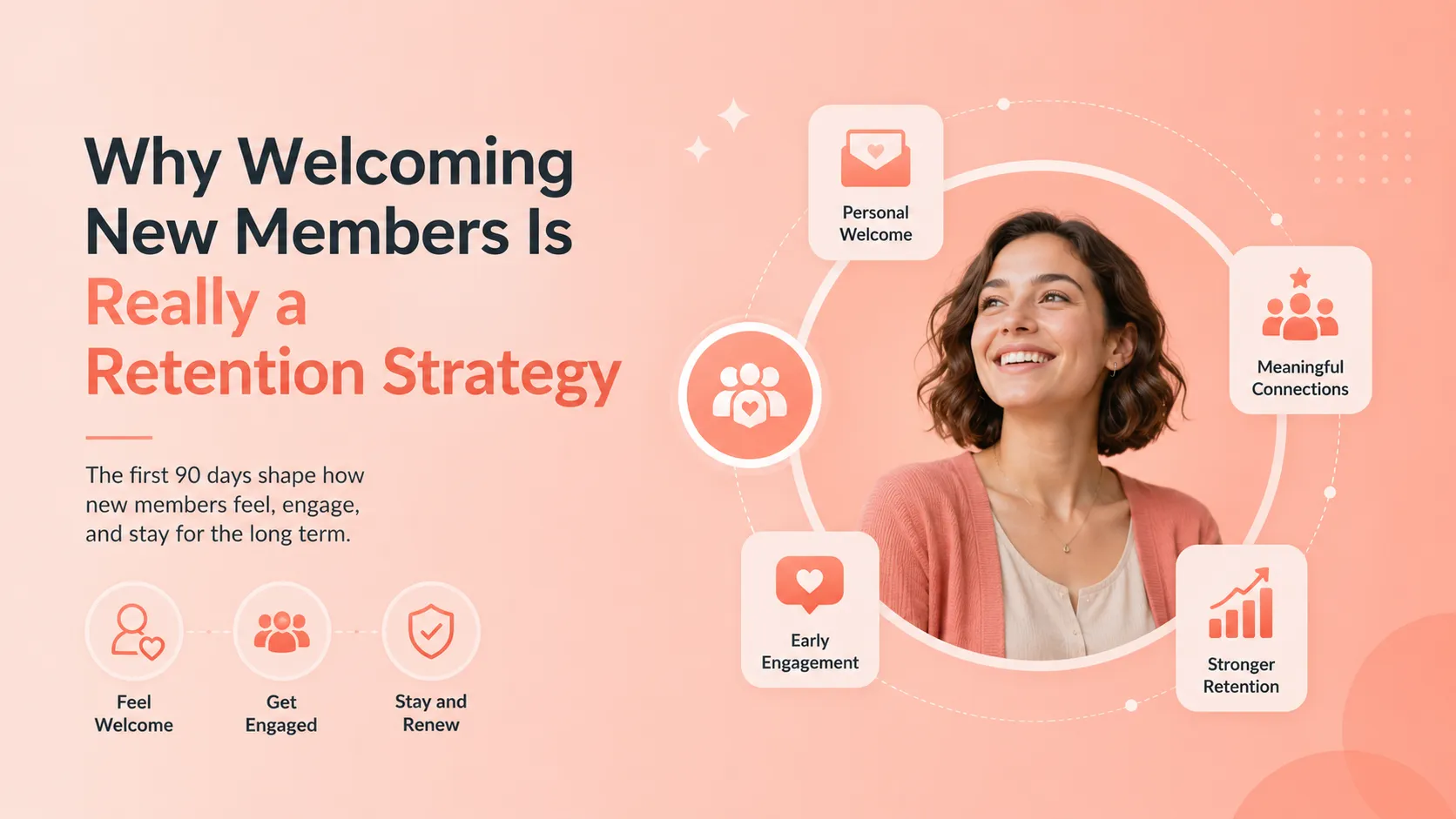
Here is a number worth sitting with: 24% of associations reported first-year renewal below 60%, according to MGI's 2024 benchmarking data. One in four organizations loses nearly half its new members before year two to early drop-off.
And yet, only 29% of associations make a welcome phone call. Just 23% invite new members to an online community. Most stop at email, leaving first-year retention entirely to chance.
71% of members say a personalized experience matters, while 50% already feel they receive too many emails, per Higher Logic's 2024 Member Experience Report. The problem is never doing more. It is doing the right things at the right moments.
That shift in thinking is where a better membership experience actually begins.
50 Ways to Welcome New Members Across the Member Journey
These ideas follow the natural arc of the member journey, from the moment someone joins through their first 90 days. Pick the ones that fit your team size, your budget, and your organization type.
Day 0 to Day 2: The First Impression
1. Send a personalized welcome email from a real sender with one clear next step. Not a noreply address. A human one. Use this new member welcome email template to get started fast.
2. Add a leadership welcome message. A note from the board president, executive director, or chapter chair signals that this person's decision to join genuinely matters. A senior voice does what automated copy cannot.
3. Make a welcome phone call. Associations with renewal rates above 80% are significantly more likely to call new members, per MGI's 2024 benchmarking data. This tactic is widely underused and consistently high-impact.
4. Mail a hand-signed welcome letter. For premium members, donors, chambers, and associations, a physical letter still stands out because everything else arrives digitally.
5. Share a short welcome video. Sixty to ninety seconds, warm tone, captions, one next step. Best fit for nonprofits, churches, and alumni groups who lead with mission and community.
6. Ask one goal question at signup. Something like: "What do you want most from membership?" One honest question is all it takes to make every communication that follows feel like it was written for that specific person.
7. Send a welcome kit with a digital membership card. Keep the kit to one page with key links, upcoming events, and contact info. A digital membership card gives new members something tangible, shareable, and worth keeping on day one.
8. Create a Start Here guide. Three to five first actions. Not forty pages. Just three to five things. New members will actually do them.
9. Name one point of contact. When new members know exactly who to reach, they feel welcome and supported from day one. Confusion about this is one of the quietest early engagement killers there is.
First Week: Activation and Visible Value
10. Share a login and portal guide so members can access the things they actually paid for, not just the homepage.
11. Segment first-week messages by member type. Send different content to students versus seasoned professionals, local members versus remote ones. Most organizations send everyone the same thing, and that gap is the opportunity.
12. Use a communications quarantine. Exclude new members from generic blasts for the first 30 days while the onboarding sequence runs. Getting the right communication cadence for new members is one of the most underrated decisions in membership management.
13. Send a Start Here email with one call to action. Early engagement depends on clarity, not volume. One email, one job. Not five links and a newsletter announcement sharing space in the same message.
14. Show the top three member benefits for their role. Members care far more about certifications, career information, and training than most organizations assume. Surface the right member benefits for each member type early, before they go looking and come up empty.
15. Recommend one resource, not a library. One useful thing they can use today beats a link dump they will bookmark and never open.
16. Ask members to complete their profile. Profile completion is directly linked to higher renewal likelihood. One nudge, real impact on retention.
17. Let members choose their interests, subgroups, and communication preferences. Every future touchpoint improves when members self-select into what actually matters to them.
18. Give one easy community action. Reply to a poll, react to a post, or introduce themselves in a thread. Small, specific actions create a sense of belonging faster than broad invitations ever do.
19. Invite them to one relevant event. "Relevant" is the key word here. One well-matched invitation beats five generic ones. Browse these event ideas to engage members for options that actually fit.
20. Explain dues, renewal, and roles in plain English. Clarity early prevents confusion later, and quiet confusion is one of the most common reasons people leave without ever saying why.
Belonging: Connection and Inclusion
21. Start a buddy system. One veteran member, one new member, one introduction. Awkwardness drops. Questions get answered. Retention improves.
22. Create a mentor program. Communities that add mentoring and volunteering programs see 124% more unique monthly logins than those that do not, per Higher Logic's 2024 Community Benchmark Report. That is not a small difference.
23. Assign a member ambassador or build a simple ambassador program. A trained, reliable guide who shows up at the first event and answers questions by name does more for early belonging than any automated sequence.
24. Introduce new members to a small cohort. Peer-level onboarding helps new members feel included faster than walking into an established group where everyone else seems to know each other already.
25. Recommend one person they should meet first. Curated introductions land. "Go network" does not.
26. Feature new members publicly. A newsletter mention, a community post, a brief intro at the next meeting. Use your member spotlight approach to welcome newcomers in a way that makes them feel seen, not put on the spot. Always ask permission before using names or photos.
27. Connect them to a committee, chapter, or affinity group. Belonging deepens when members find a smaller home inside the larger organization.
28. Ask veteran members to personally greet newcomers. Assign names. Give prompts. Do not leave it to chance. Church communities understand this better than most: newcomers often decide whether to return based entirely on whether one person noticed them.
Orientation: Guided First Entry
29. Host a recurring new member orientation or welcome reception. Monthly or quarterly, recorded for latecomers, focused on Q&A. A conversation, not a lecture.
30. Run a new member meet and greet, welcome event, or coffee chat. Lower pressure than a formal event, higher connection than a webinar.
31. Make "meet the leadership" a defined onboarding step for all new members, including new board members, not an improvised interaction. One r/nonprofit discussion captured the problem directly: when board members and staff both reach out independently, new members end up confused about who owns their experience. Controlled introductions solve this.
32. Set up a first-event welcome table. Arrival friction is real. A dedicated welcome point removes it before it becomes a reason to leave early.
33. Pre-introduce new members to the event host before they arrive. A warm connection before walking into a room full of strangers makes a measurable difference in how people feel at the end of the evening.
34. Send a "what to expect" email before the first event. Where to go, what to wear, who to find, whether it's fine to come alone. These details feel small. To a new member walking into their first event, they are everything.
35. Use greeters or a welcome committee. Human hospitality is often the real onboarding moment. Every digital touchpoint before it is just setup.
36. Hold a leadership Q&A for new members. Clarifies mission, participation paths, and how to make the most of membership for people who are still figuring out if this was the right decision.
Digital and Automated: Scale Without Losing Warmth
37. Build a welcome sequence for new members using a 30 to 90 day drip, keeping one purpose per message. Good email marketing for membership programs means each email earns its open by having exactly one job.
38. Trigger reminders for incomplete setup. No login, no profile, no event registration. Behavior-based nudges are always more relevant than blanket reminders sent to everyone.
39. Auto-tag members by role, join path, or interest. Tagging is the infrastructure that makes personalization possible at scale without adding manual work.
40. Auto-invite members to the right online community or group. The best channel is the one where they will actually show up and stay.
41. Issue a digital membership card or welcome certificate. Recognition plus utility, delivered automatically on day one.
42. Add light gamification. A profile-complete badge or first-post recognition does something simple and powerful. Gamification consistently drives stronger community engagement, and the lift shows up in both logins and discussion activity.
43. Trigger reach-back messages when new members go quiet. Silence is a signal, not a verdict. Catching it early is far easier when you manage memberships in one place and can actually see who has stopped engaging before they have fully left.
Day 30 to Day 90: Retention Follow-Up
44. Send a post-event follow-up with one clear next step. Attendance should lead somewhere. Not just end with a "thanks for coming."
45. Send a 30-day check-in. Two or three honest questions: Did you find what you needed? What is still unclear? What would help most right now? Keep it that short.
46. Run a short onboarding feedback survey. 52% of members wish their association asked for their input more often, per Higher Logic's 2024 Member Experience Report. A two-minute survey is one of the simplest ways to collect member feedback that actually shapes what happens next.
47. Send a "benefits you have not used yet" nudge. Behavior-based follow-up surfaces overlooked value before members quietly disappear at renewal.
48. Offer a one-on-one call to inactive new members. A short conversation after joining can save a relationship that an email never could. Worth the effort for high-value members.
49. Ask new members to volunteer or contribute. Mission connection drives retention, especially in nonprofits, churches, and community organizations. When people give something, they care more about what they get.
50. Survey first-year members before renewal notices begin. The American Chiropractic Association built a multi-touch welcome system with mailed letters, delegate emails, a hand-signed executive letter, phone check-ins, and a first-year survey, and lifted its retention rate from 90% to 93% in a single year. Learning before renewal season always beats learning after churn.
Welcome Email, Check-In, and Buddy Templates
Three welcome message templates worth keeping close:
New member welcome email or welcome letter Subject: "Welcome, [Name]. Here is your first step." Open with a genuine thank-you, name one quick win, include one CTA, sign from a real person. That is the whole formula.
30-day check-in email "Hi [Name], it has been a month since you joined. Three quick questions: Did you find what you were looking for? Is anything unclear? What would be most helpful right now?" Keep it exactly that short.
Buddy introduction script "Hi [Buddy Name], meet [New Member Name]. They just joined and share your interest in [X]. Would you be open to a quick hello this week?" That is the entire message. Simple works.
30-Day New Member Onboarding Checklist
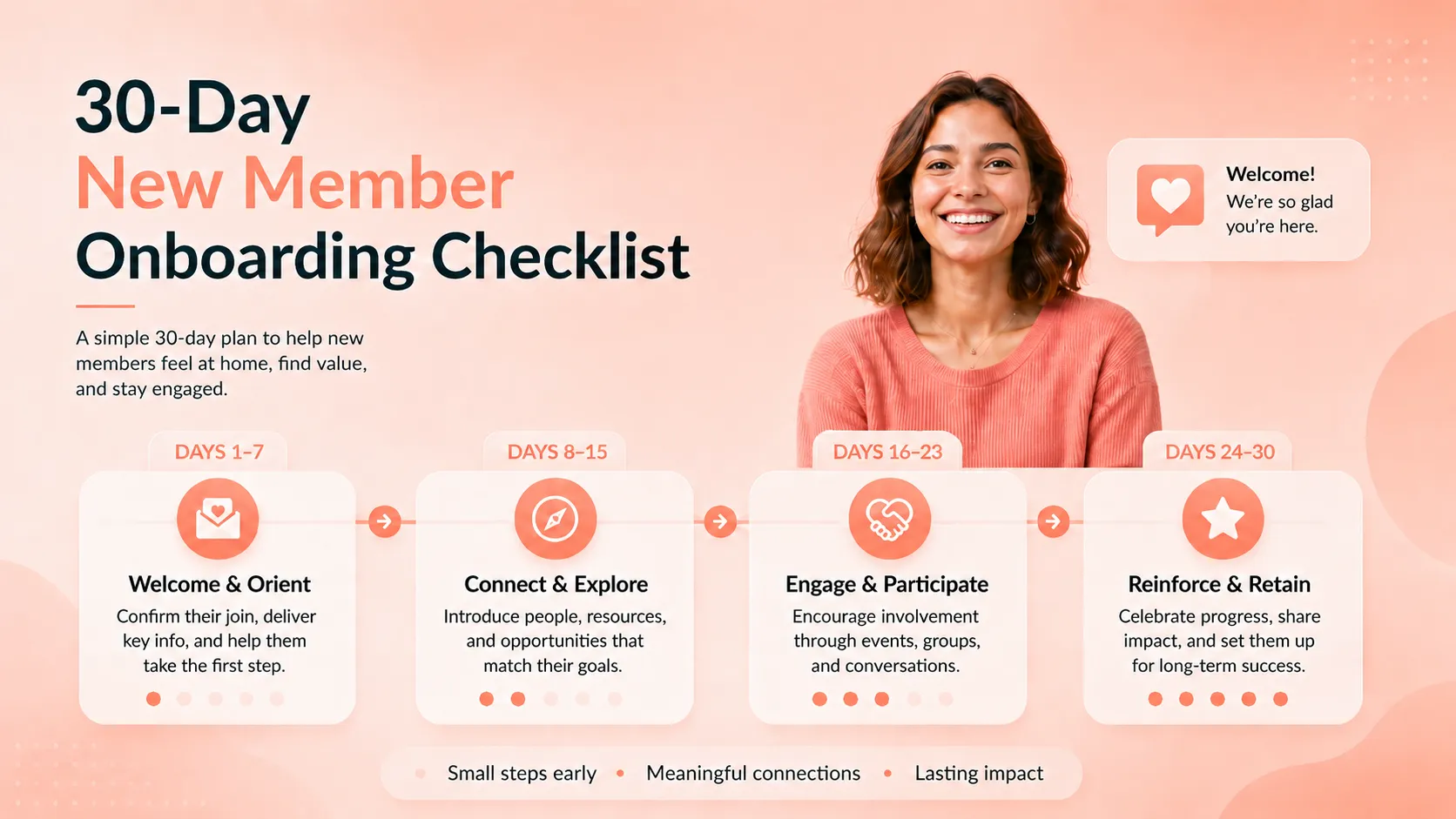
Use this checklist to guide each stage of the onboarding journey, from day one through day 90.
Welcome New Members by Organization Type
Different organizations prioritize different welcome tactics. Here is where to focus first depending on your group type.
Associations: Certifications, training, and industry information. Mentors and chapters come next. Lead with career value, not institutional history.
Nonprofits and volunteer groups: Mission clarity and role definition before anything else. A named point of contact is not optional.
Clubs and community groups: Warmth first. Greeters, buddies, meet-and-greets, and a brief club orientation for newcomers do more than any email sequence for groups where showing up in person is the whole point.
Chambers: One strong curated introduction and a public welcome moment carry more weight than a packet. Connect new members to people, fast.
Alumni associations: Class year tags, affinity groups, and mentor connections create instant relevance. Generic outreach rarely lands.
Churches and faith communities: Newcomers often decide to return based entirely on whether one person made eye contact and said something genuine. Train your welcome committee. Assign names. Make it personal.
Frequently Asked Questions
How do you welcome new members?
Confirm the join, deliver one quick win, ask for one easy first action, introduce a human contact, and keep the welcome going through day 90. That five-step framework outperforms any single email.
What should be in a new-member welcome email?
A subject line with their name, a thank-you that sounds human, one clear next step, one piece of immediate value, and a real signature. Everything else is optional.
How long should new member onboarding last?
At minimum, 30 days. Ideally, 90 days. Member satisfaction and the first-year renewal risk both begin on day one, not renewal season.
How do you make new members feel included?
Buddy systems, small cohort introductions, trained greeters, and simple icebreaker questions at your first orientation do more than any digital tactic. Belonging is a social experience, not a communications strategy.
What is a new-member orientation?
A structured, low-pressure session where new members can ask questions, meet peers, and understand what the organization offers and how to get involved. Monthly or quarterly cadence works best.
How do you welcome new church members?
Human hospitality is the entire strategy. Train greeters, assign names, invite newcomers to something small and low-pressure after the service. One genuine conversation matters more than the best welcome packet ever will.
How do nonprofits onboard new volunteers?
Clarity on roles, a named point of contact, a simple first task, and a check-in at the 30-day mark. Keep the materials short and focused on what success looks like for them, not for the organization.
How do you personalize onboarding without adding staff time?
Segment by one or two member types, automate behavior-based triggers, and use tags in your AMS or CRM to send the right message to the right person automatically.
For everything that happens after the welcome window closes, the membership retention guide covers the long game. And when new members are ready to move from welcomed to genuinely engaged, these member engagement ideas are the natural next chapter.
The Welcome Is Just the Beginning
A great welcome is not one email. It is the opening chapter of the member journey, built from small, intentional moments that a new member can actually feel.
Associations that refresh their onboarding programs are more likely to report membership growth and higher new-member acquisition. The welcome experience and long-term membership health are not separate conversations. They are the same one.
Start with five things: a welcome email, a quick win, a first action, a human touch, and a 30-day follow-up. That is the minimum viable welcome system for any organization, any size, any budget.
Then build from there, one intentional touchpoint at a time.
Ready to put the whole system in motion? Start a free trial and see how much easier a structured member welcome becomes when your tools actually work together.
Sources
- Marketing General Incorporated. 2024 Membership Marketing Benchmarking Report
- Higher Logic. 2024 Association Member Experience Report
- Higher Logic. 2024 Association Community Benchmark Report
- Reddit. r/nonprofit: Board Members Want to Personally Welcome New Volunteers
- ASAE. Member Retention: Hard Work, but Somebody's Gotta Do It

Guides from the Experts
Through our work with 4,000+ organizations - we’ve put together helpful guides to assist; regardless of where you are on your journey.
.webp)

A Complete Guide to Membership Organizations
Everything you need to know to manage and grow your membership business
.webp)
Maximize Membership Retention: 10 Proven Strategies
Tried and true strategies that not only win membership, but keep them

Build a Membership Website: A Step-by-Step Guide
Your one-stop resource for knowing all the features your modern membership website needs
Ready to start your free trial?
Our membership software is intuitive to use and even easier to test for yourself.