
How to Start a Nonprofit Organization: The Complete Startup Guide



How to Start a Nonprofit Organization: The Complete Startup Guide
TL;DR
Starting a nonprofit organization takes eight practical steps: validate the need, write a mission statement, build a founding board, incorporate in your state, get an EIN, file for 501(c)(3) tax exemption, set up your compliance calendar, and choose tools to manage members and donations.
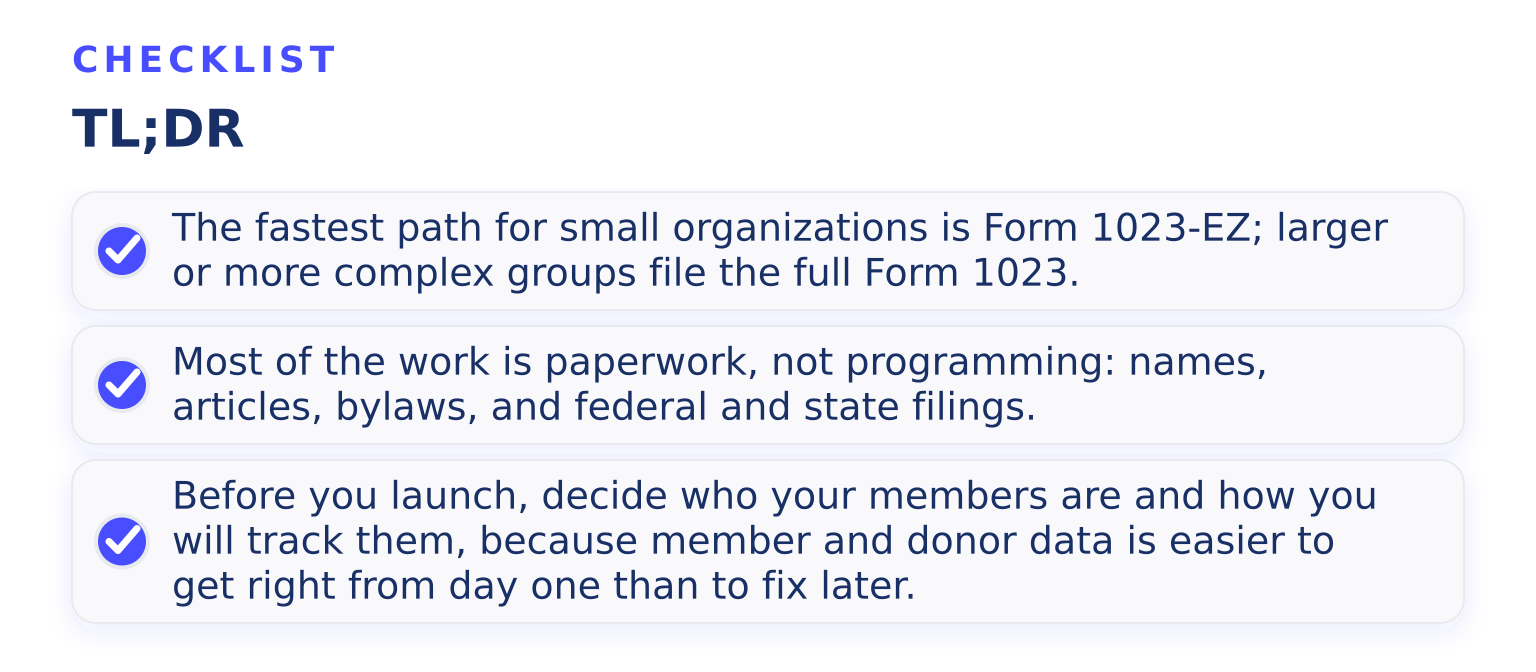
- The fastest path for small organizations is Form 1023-EZ; larger or more complex groups file the full Form 1023.
- Most of the work is paperwork, not programming: names, articles, bylaws, and federal and state filings.
- Before you launch, decide who your members are and how you will track them, because member and donor data is easier to get right from day one than to fix later.
What a nonprofit actually is
A nonprofit is a corporation organized for a purpose other than making a profit, such as charity, education, religion, or science. "Nonprofit" describes how the organization is formed under state law. "Tax-exempt" is a separate federal status from the IRS that most charities apply for under Section 501(c)(3).
You need both to operate the way most founders expect: a state-approved legal entity, and IRS recognition so donors can deduct gifts and the organization avoids federal income tax. The IRS explains both steps in its guide to applying for 501(c)(3) status.
Step 1: Validate the need before you file anything
Filing fees are the cheapest part of this process. Your time is the expensive part, so answer these questions first:
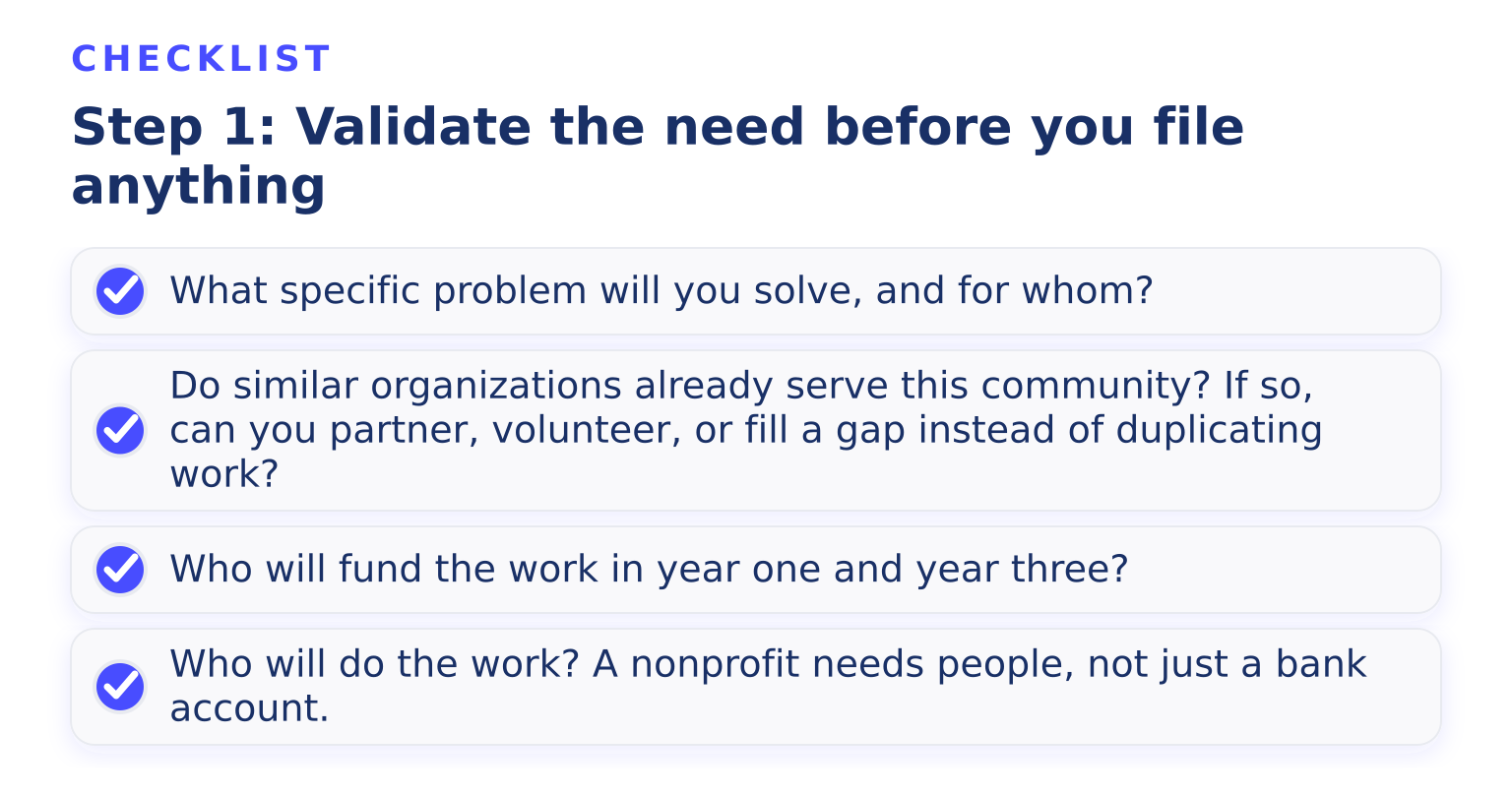
- What specific problem will you solve, and for whom?
- Do similar organizations already serve this community? If so, can you partner, volunteer, or fill a gap instead of duplicating work?
- Who will fund the work in year one and year three?
- Who will do the work? A nonprofit needs people, not just a bank account.
If another group is doing the work well, consider fiscal sponsorship first. A fiscal sponsor lets a project accept tax-deductible donations under an existing nonprofit's umbrella while you test the idea. Our fiscal sponsorship guide covers how that works and when it makes sense.
Step 2: Write a mission statement
Your mission statement does three jobs: it guides decisions, it anchors your IRS application, and it becomes the sentence you repeat to every donor and volunteer.
A workable formula is: who you serve, what you do for them, and the change you create. "We provide free after-school tutoring to elementary students in Riverside County so every child reads at grade level" beats a paragraph of noble-sounding abstractions.
Keep it narrow. The IRS will hold you to whatever purpose you declare, and activities outside that purpose can jeopardize your exemption.
Step 3: Recruit a founding board
Most states require at least three directors for a nonprofit corporation, though the exact minimum varies. Recruit people who bring something specific: financial judgment, community connections, legal or fundraising experience, or deep knowledge of the population you serve.
Write down their core duties early so expectations are clear. Our overview of nonprofit board member responsibilities breaks down the roles of duty of care, duty of loyalty, and obedience, plus practical job descriptions you can adapt.
Your board also makes several early decisions together: adopting bylaws, appointing officers, and approving the Articles of Incorporation before you file them.
Step 4: Incorporate in your state
This is where the nonprofit becomes a legal entity. The process is similar across states:

- Choose a name that is available in your state's business registry and not trademarked.
- Appoint a registered agent, a person or business in your state with a physical street address that receives legal documents on the organization's behalf.
- File Articles of Incorporation with your Secretary of State, usually with a fee between roughly $25 and $125 depending on the state.
- Draft bylaws that cover meetings, voting, officers, and conflict-of-interest rules.
For a concrete example, the Illinois Secretary of State's guide to organizing a not-for-profit corporation shows exactly what Articles of Incorporation and bylaws look like in practice. Your own state's Secretary of State website will have its own forms and fees.
One important choice on the articles: whether the corporation will have members. Membership nonprofits let members vote and elect the board, while directorship nonprofits are governed by the board alone. If you plan to build a member base, decide deliberately, because changing governance later is painful.
Step 5: Get an EIN
An Employer Identification Number is your organization's federal tax ID, issued free by the IRS. You need one even if you never hire an employee, because it opens the bank account and is required on the tax-exemption application. Apply online at IRS.gov/EIN and you will receive the number immediately.
Step 6: Apply for 501(c)(3) status
This is the step most founders dread, and it is manageable if you prepare. File electronically through Pay.gov using either:
- Form 1023-EZ, the streamlined version. Small organizations with expected gross receipts under $50,000 and assets under $250,000 often qualify. Complete the eligibility worksheet in the Form 1023-EZ instructions first; if any answer is yes, you must file the full form.
- Form 1023, the full application. Larger organizations, schools, hospitals, and groups with complex activities or funding usually file this one.
Two timing rules matter:
- File within 27 months of incorporation to have your exemption apply retroactively to your formation date. Miss the window and your exemption generally starts at the filing date.
- The filing fee depends on which form you use; check the current IRS user fee schedule before you budget.
Approval can take weeks with 1023-EZ or several months with Form 1023. You can still fundraise and operate as a state nonprofit in the meantime, but you cannot promise donors deductibility until the IRS recognizes you.
Step 7: Set up compliance and state registrations
Federal exemption is not the finish line. Build a compliance calendar with these recurring obligations:
- Annual IRS return. Even small organizations file something: Form 990, 990-EZ, or the 990-N e-Postcard for groups with gross receipts normally $50,000 or less. Missing three consecutive years automatically revokes your exemption.
- State charitable solicitation registration. Many states require registration before you solicit donations from residents, including online.
- State annual reports for your corporation, plus franchise or business license renewals where applicable.
- Sales and employment tax accounts if you sell goods or hire staff.
Some 501(c)(3)s can have voting members, and the rules depend on your governance structure. Our guide to members in 501(c)(3) organizations explains when members make sense and what the IRS expects.
Step 8: Choose tools for members, donations, and records
A new nonprofit usually has one staff person or a rotation of volunteers running everything. The systems you pick in month one determine how much admin work you do every month after.
Think about three jobs:
- Member records. Who is a member, what tier they hold, when they renew, and how to reach them. A shared spreadsheet works for your first twenty members and falls apart at a hundred. Dedicated membership software keeps records, renewals, and member self-service in one searchable place, and Join It offers digital membership cards, automated renewal reminders, a member portal, and donations alongside memberships.
- Donations. You need a way to accept one-time and recurring gifts once exemption is recognized. Our roundup of donation software for nonprofits compares the main options.
- Email and communications. Most member and donor communication is email. Choose a tool that syncs with your member database so you are not importing lists by hand.
If you are weighing whether software is worth it this early, our guide to nonprofit membership management software reviews what different types of organizations actually need and what it costs.
A nonprofit startup checklist
Use this as your working checklist from idea to launch:
- Validate the need and check for existing organizations serving it.
- Write a specific mission statement.
- Recruit at least three directors and hold an organizational meeting.
- Adopt bylaws and appoint officers.
- Choose a name and appoint a registered agent.
- File Articles of Incorporation with your state.
- Apply for an EIN online.
- File Form 1023-EZ or Form 1023 within 27 months of formation.
- Register for charitable solicitations in states where you will fundraise.
- Open a bank account under the organization's EIN.
- Set up bookkeeping and a compliance calendar for annual filings.
- Set up systems for members, donations, and email.
Common questions from first-time founders
How much does it cost to start a nonprofit? Expect a few hundred dollars in state filing fees, the IRS application fee, and optional legal help. Costs vary by state and by whether you file Form 1023 or 1023-EZ, so get current fees from your Secretary of State and the IRS fee schedule.
How long does the whole process take? Incorporation is often days. IRS approval can take weeks for 1023-EZ or several months for Form 1023. Realistic planning is two to six months from decision to full operation.
Can founders be paid? Yes, as reasonable compensation for actual work, set by an independent board. Excess benefit transactions carry penalties, so document how compensation was approved.
Can a nonprofit make money? Yes. Nonprofits can earn revenue and even sell products related to their mission; profits are reinvested rather than distributed. Our article on whether nonprofits can sell products covers the rules.
Your next step
If your mission involves members, whether that is a charity, an association, a club, or a community organization, set up your member records the right way from the start. You can start a free trial of Join It with no credit card and see how memberships, renewals, digital cards, and donations work together before your first member joins.

Guides from the Experts
Through our work with 4,000+ organizations - we’ve put together helpful guides to assist; regardless of where you are on your journey.


A Complete Guide to Membership Organizations
Everything you need to know to manage and grow your membership business

Maximize Membership Retention: 10 Proven Strategies
Tried and true strategies that not only win membership, but keep them

Build a Membership Website: A Step-by-Step Guide
Your one-stop resource for knowing all the features your modern membership website needs
Ready to start your free trial?
Our membership software is intuitive to use and even easier to test for yourself.