Best Cycling Club Management Software in 2026 for Rides, Dues, and Rosters


Summary of the Article
Most cycling clubs need two things software rarely delivers in one package: a trustworthy record of who has paid their dues, and an easy way to publish rides and collect RSVPs. Pick one tool for membership money and records, and usually a second tool for rides and routes.
- Join It: best when your main gap is dues, renewals, member records, and member cards; rides are handled elsewhere.
- Ride with GPS Club Account: the specialist for route libraries and ride calendars; not a dues system.
- Cyql: cycling-specific ride planning, waivers, and ticketing; admin features sit behind paid tiers.
- Who's In: free ride RSVPs, with a paid Clubs plan that adds dues and membership tiers.
- Spond: a free team-sport app that works well for bunch rides and availability, but is thinner on club-level membership substance.
- Wild Apricot: deep membership features, more cost and complexity to match.
- ClubExpress: broad club administration, with cycling extras like the Ride Log as paid add-ons.
- British Cycling Club Management Tool: worth using if your club is already affiliated, but it is not available to every club.
Start With What a Cycling Club Actually Needs
Before comparing tools, it helps to be honest about the job. A cycling club's software usually has to do five things:

- Keep a current roster of paid-up members. You need to know, on any given morning, who has renewed and whose membership lapsed.
- Publish rides. A ride needs a date, a start time and meeting point, a distance and pace grade, a named ride leader, and a way for riders to say they are coming.
- Collect money. Annual dues, family memberships, and per-event levies, ideally by card and ideally without the treasurer chasing bank transfers.
- Handle waivers. Signed waivers that can be found again months later if insurance or an incident requires it.
- Survive volunteer turnover. Every 12 to 24 months, a new committee member takes over the admin. If the tool takes weeks to learn, that handover fails.
Almost no single product does all five well. That is why so many clubs settle into a two-tool reality: one system that owns the money and the member records, and one system that owns rides and routes. The shortlist below is organized around that split.
The Shortlist at a Glance
Our original cycling club management software buying guide compares four of these options in buying-guide depth: Join It, Ride with GPS, ClubExpress, and the British Cycling tool. If your shortlist is already down to those four, start there before reading the full sections below.
1. Join It: Membership Administration First
If you had to name the one problem that causes the most pain in a volunteer-run club, it is money and records: who paid, who lapsed, who is on the family plan, and who still owes for the weekend event. That is the problem Join It is built for.
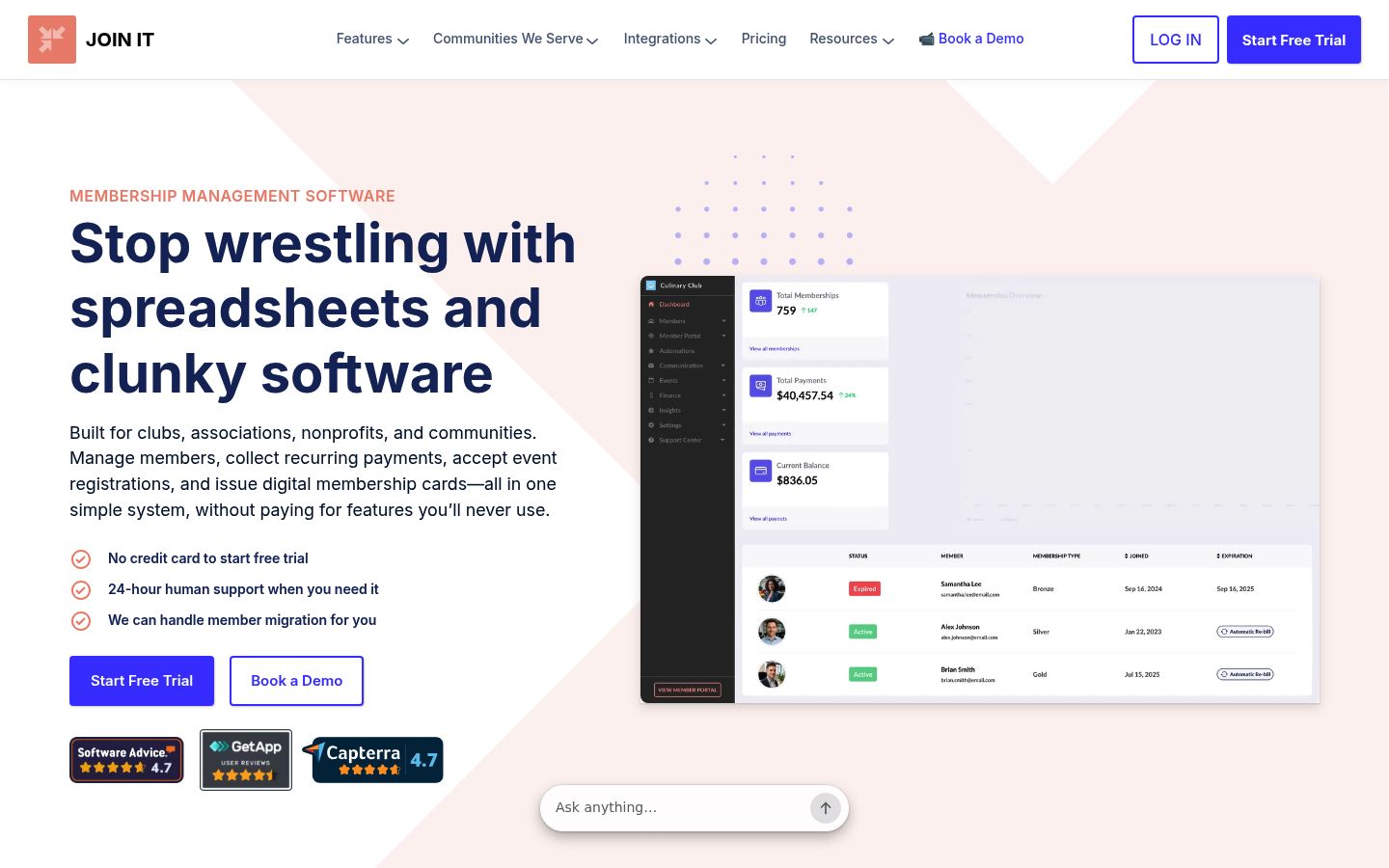
Join It is cloud-based membership management software for membership-based organizations, including clubs. In practice, that means your club gets a searchable database of member records with payments, notes, and activity in one place. Dues can be one-time or recurring, and renewals are automated, so the membership secretary stops rebuilding a spreadsheet every January. Groups and families can be handled through group memberships, which matters for clubs where a household joins once and brings two or three riders.
A few details are especially useful for cycling clubs:

- Digital membership cards work through Apple Wallet and Google Wallet, so a ride leader can check membership status without printed cards. Join It has a member check-in feature for exactly that moment at the ride start.
- Events with registration, pricing controls, payments, and attendance tracking are built in, which covers club sportives, socials, and annual dinners.
- Members get a self-service portal, so people renew and update their own details instead of emailing the treasurer.
- Communications run through email and notifications, with integrations for email marketing tools.
The honest tradeoff: Join It does not plan rides or manage routes. If ride publication is your biggest headache, pair it with a ride tool from the next few sections. But if your club's real pain is a roster nobody trusts and dues nobody chases, starting with cycling club membership software built around the member record is the cleaner fix. You can start a free trial and test the renewal flow on real club data before committing.
2. Ride with GPS Club Account: The Route Specialist
Ride with GPS is the tool many established clubs already run for routes, and its Club Account is built around that. The club gets one shared route library that multiple admins can build and maintain. Members who join the club account get premium navigation features, such as turn-by-turn navigation and offline routes, free on the club's routes, without needing their own paid subscription. That per-member benefit is a genuinely strong retention perk: route access alone sells memberships for some clubs.
The Club Account also covers ride scheduling and calendars, and admins can assign roles, so a ride captain can manage routes without touching billing. Members can be marked active or inactive, which is how some clubs flag lapsed memberships inside the tool.
The boundary is money. Ride with GPS is not a dues collection system, and it does not replace your treasurer's record of who has paid. Organization accounts are priced separately from consumer plans, so check the cycling clubs page for current pricing. The common pattern is Ride with GPS for rides and routes, paired with a membership system for dues, which is exactly the two-tool reality most clubs live with.
3. Cyql: Built Specifically for Cycling Groups
Cyql is the most cycling-specific option on this list. Its feature set reads like a club ride calendar wish list: advanced ride planning with a scheduling calendar, ride leaders assigned to groups, a GPX route library, ride labels and group segmentation, event ticketing with QR codes, and digital liability waivers that members sign on their phone with the acceptance timestamp stored for later retrieval.
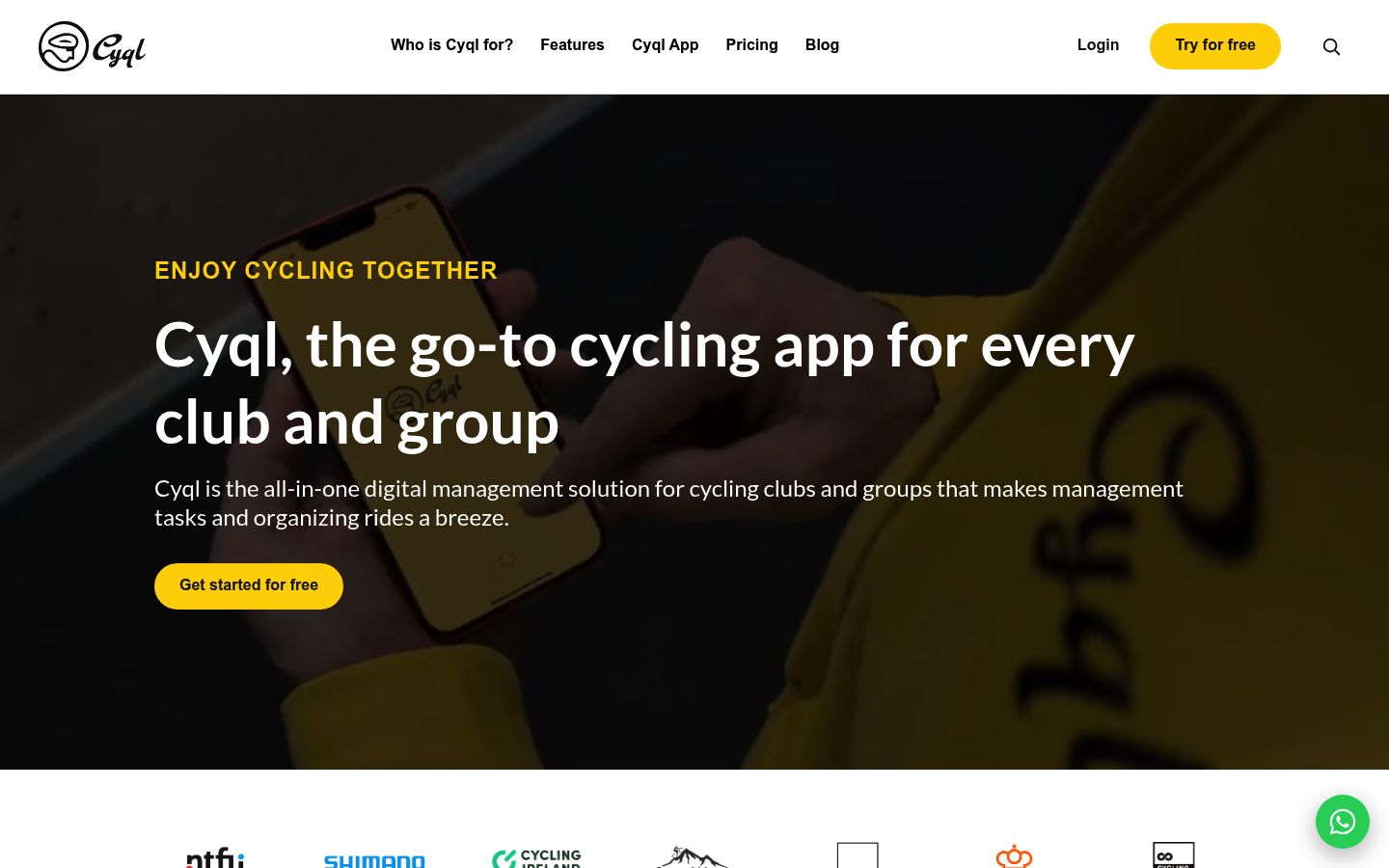
Cyql's pricing page shows a free tier for up to 15 members with one admin, then paid tiers in euros (Starter, Pro, and Elite) that unlock ride labels, repeated rides, membership management, and membership cards as you move up. Members always use the app for free; only club admins pay for management features. Note that payments collected through Cyql carry a 4% transaction fee with a minimum per transaction, on top of the subscription.
Cyql fits clubs whose week revolves around organized group rides with graded pace groups, especially European clubs or clubs comfortable with euro billing. The tradeoff: because the platform is ride-first, the membership side (renewal automation, recurring dues, member self-service at club-administration depth) depends on which tier you buy, and it will not match a dedicated membership system's billing depth. See the features page to judge which tier your club actually needs.
4. Who's In: Free RSVPs With a Low-Cost Dues Plan
Who's In takes the opposite approach to entry: ride RSVPs are free, with no limit on rides or riders, and riders RSVP with just their name, no app and no account. That zero-friction RSVP is its superpower. You share one link in the club WhatsApp group, riders tap in, and capped rides fill from a waitlist with automatic reminders. Its cycling page covers the details that matter on a ride sheet: start time, distance, pace, a link to the route on Strava, Komoot or Ride with GPS, and meeting point directions.

When you outgrow free RSVPs, Who's In Clubs adds the membership layer. Per Who's In's own pricing page, Clubs Starter is $10 per month or $99 per year for up to 99 active members, moving automatically to a Growth plan at $19 per month once you pass 99. Clubs plans include membership tiers, dues collected by card into your own Stripe account, announcements, attendance tracking and QR check-in, and waiver enforcement at signup with a recorded acceptance timestamp. Who's In charges nothing on member payments; Stripe's processing fee applies separately.
Who's In fits smaller clubs and informal ride groups that want RSVPs working today and cheap, structured dues when they need them. The tradeoff: there is no built-in route mapping, and the membership feature set is deliberately simple rather than deep.
5. Spond: Free and Familiar, but Team-Shaped
Spond is a team management app from grassroots sport, and a free one. Clubs use it for events and availability: recurring sessions, RSVPs with waiting lists, automatic reminders, and messaging, all in iOS and Android apps that most members already know how to use. Spond Club, the club-level version, adds a membership database, registration forms, club-wide communication, a website builder, and digital membership cards, and Spond states plainly on its club overview page that the software itself is free with no monthly fee; costs come from transaction fees when you collect payments, with rates varying by country.
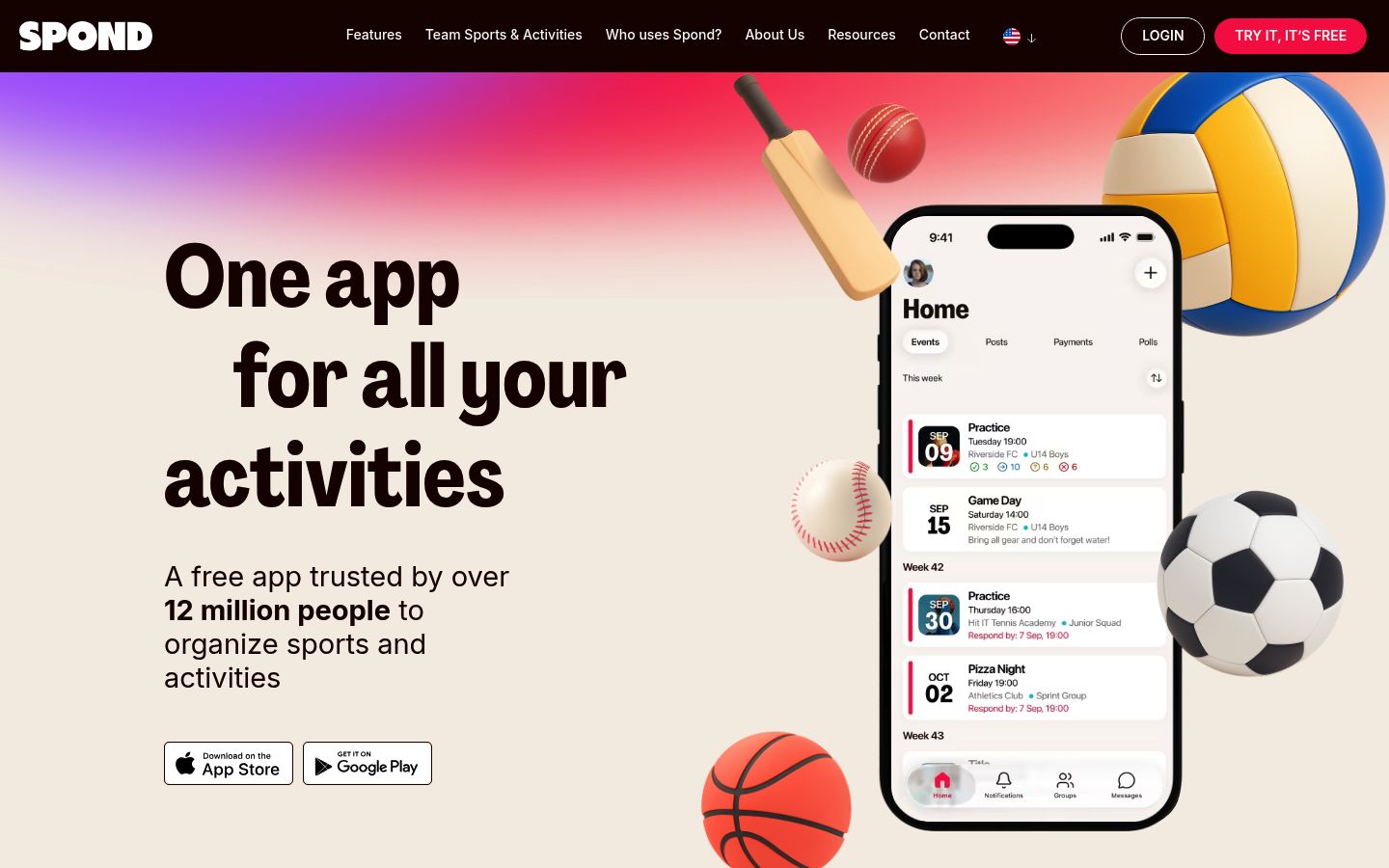
For cycling, Spond maps well onto bunch rides and weekly training: create the recurring ride, invite the group, watch the RSVPs land. Payments for trips and event costs work through payment requests.
The tradeoff is shape. Spond is built around teams, coaches, and (heavily) youth sport with guardian oversight. Its club-level membership substance, tiers, renewal automation, and member self-service depth, is thinner than a membership-first platform, and the help center notes that full club administration (dues invoices, club-wide messaging) is designed to work alongside the team app rather than as a standalone membership system. Clubs that mainly need availability tracking and light payments get a lot for nothing; clubs with serious dues and renewal needs will hit its limits.
6. Wild Apricot: The Established Membership Platform
Wild Apricot is one of the most established names in membership management, used by more than 15,000 organizations. Its feature set is broad: a cloud member database with automated renewals and reminders, a members-only website and portal, event registration, custom forms, and email communications. For a cycling club that also runs a racing series, coaching programs, or a merchandise operation, that breadth is real value.

The cost side is the honest tradeoff. Wild Apricot prices by the number of contacts in your database, and its pricing page shows the smallest plan, 100 contacts, at $66 per month (less if you prepay a year or two). Contacts include not just current members but event registrants, donors, and newsletter subscribers, so a club's real contact count is usually larger than its member count. There is a 60-day free trial with no credit card required.
Wild Apricot suits clubs that have outgrown simple tools and want one platform for everything membership-related, with admin time to match. Volunteer-run clubs that want something a new committee member can run in an afternoon should weigh that seriously. If you are comparing it directly, our page on Wild Apricot covers the differences for smaller organizations.
7. ClubExpress: Broad Club Administration With Cycling Add-Ons
ClubExpress is a full club and association platform: a hosted website, member database, events, communications, and more than 20 built-in modules, with unlimited admins and unlimited email support included. Its pricing page shows per-member monthly pricing with a $24 minimum monthly hosting fee, charged only for active members, and a one-time setup fee that varies by how much help you want.

What makes it relevant to this list is the cycling-specific extra-cost modules. The Ride Log, $15 per month per the pricing page, tracks per-rider statistics such as miles or rides logged in a year, which feeds the mileage competitions many clubs run. The Ride Cue Sheets module, also $15 per month, documents regional rides with downloadable PDFs and includes Ride with GPS support.
ClubExpress fits larger, more structured clubs, especially ones that want an all-in-one website and member system and value phone support. The tradeoffs: the setup is a bigger project than a modern SaaS signup, and the cycling features you care most about are add-ons priced on top.
8. British Cycling Club Management Tool: For Affiliated Clubs
If your club is in the UK and already affiliated to British Cycling, the British Cycling Club Management Tool comes with affiliation. British Cycling describes the tool on its Club Management Tool page: a club dashboard, a membership manager with custom data fields and reporting, email communication from the membership list, and free online subscription collection through British Cycling's payment system. Per British Cycling's subscription FAQs, there is a £1.00 application fee per subscription purchased by riders.

Affiliation itself carries a fee (£110 for clubs and teams at the time of writing, with a discount for early renewals) and brings benefits beyond software, including public liability insurance and entry into national rankings.
For eligible clubs, the tool handles member records and dues collection competently and keeps your club visible in British Cycling's club finder. The boundary is availability and scope: it is exclusive to affiliated clubs, Scottish clubs affiliate through Scottish Cycling rather than British Cycling, and it is not a ride-planning or route tool. Affiliated UK clubs often use it alongside a ride platform anyway.
What to Test in a Trial Before You Commit
Whichever shortlist you narrow to, run the trial against your club's real year, not a demo. Work through this checklist:

- The renewal flow. Join as a test member, let the renewal date pass, and see exactly what the lapsed member sees and what the admin sees. Confusing renewal emails are where member records start to rot.
- Family and group memberships. Add a household with two riders. Check that one payment covers both and that each person still appears on the roster.
- Volunteer handover. Hand the admin login to someone else on the committee for a week. If they cannot run routine tasks without training, the tool fails the real test.
- A full ride listing. Create a ride with a grade, distance, meeting point, and leader. RSVP as a member, then check what a ride leader sees at the start.
- Waiver retrieval. Sign a waiver as a test member, then try to find the signed record three weeks later. If retrieval takes more than a couple of clicks, it will not happen when it matters.
- Event levies. Charge a small fee for a test event and confirm where the money lands and who eats the processing cost.
For a deeper walkthrough of the dues side specifically, our membership billing guide compares tools for recurring payments, and the membership dues guide covers how to set, collect, and raise dues once the tool is chosen. If your committee is entirely volunteers, our guide to membership software for volunteer-run groups looks at ease of handover in more detail.
The Practical Answer
If your biggest problem is rides and routes, look first at Ride with GPS, Cyql, or Who's In, depending on how much structure and how much budget you want. If your biggest problem is dues, renewals, and a roster nobody trusts, start with a membership-first platform, and Join It is built exactly for that gap: dues and renewals automated, group and family memberships, Wallet cards for ride-start checks, events, and a member portal that keeps admin work off the committee's backs. Many clubs end up with one of each, and that is a perfectly sensible outcome rather than a compromise. You can start a free trial of Join It and have the renewal flow tested with real club data this week.
Frequently Asked Questions
Do cycling clubs need separate membership and ride software? Usually, yes. Membership systems collect dues and keep the paid-up roster accurate; ride tools plan rides, share routes, and collect RSVPs. A few products cover pieces of both, but most clubs get better results pairing one of each than forcing one tool to do everything.
How much should a small cycling club expect to spend? It varies widely by tool and country. Some options, like Spond, charge nothing for the software and take a fee only on payments; others charge a monthly subscription that scales with members or contacts. Always check current pricing on each vendor's own site before deciding.
What features matter most for volunteer-run clubs? Automated renewals, simple ride publication, easy waiver retrieval, and admin tools a new committee member can learn quickly. Anything that depends on one long-serving volunteer's personal spreadsheet is a risk.

Guides from the Experts
Through our work with 4,000+ organizations - we’ve put together helpful guides to assist; regardless of where you are on your journey.


A Complete Guide to Membership Organizations
Everything you need to know to manage and grow your membership business

Maximize Membership Retention: 10 Proven Strategies
Tried and true strategies that not only win membership, but keep them

Build a Membership Website: A Step-by-Step Guide
Your one-stop resource for knowing all the features your modern membership website needs
Ready to start your free trial?
Our membership software is intuitive to use and even easier to test for yourself.