Nonprofit vs. For-Profit Business Plans: What Actually Changes


Summary of the Article
A nonprofit business plan and a for-profit business plan share the same skeleton. Executive summary, market analysis, operations, and risk planning carry over almost unchanged. What changes is the why behind the plan: who reads it, where money comes from, and how you measure success.
Here's the short version:
- Audience: Investors who expect returns become a board, grantmakers, and donors who expect mission results.
- Revenue: One dominant model (usually sales) becomes a mix of donations, grants, earned income, dues, and sponsorships.
- Financials: A profit and loss statement becomes a statement of activities, often paired with a functional expense breakdown and a reserves policy.
- Success metrics: Profit targets become a double bottom line: financial sustainability plus measurable mission outcomes.
- Governance: Ownership and equity sections get replaced by board structure and volunteer capacity.
If you're adapting a for-profit template, keep the structure, rename the sections, and rewrite the assumptions. The rest of this article shows exactly which parts move over, which get a new name, and which need a full rebuild.
First, the Honest Answer: More Stays the Same Than You'd Think
Planners often assume nonprofit and for-profit plans are different species. They're not. A University of Colorado business planning guide makes the point plainly: the fundamentals of planning apply to both. You still need to know who you serve, what you'll do, what it costs, and how you'll know it worked.
So before we get to the differences, here's what you keep from any solid for-profit plan:
- Executive summary: A one-page version of the whole plan. Every organization needs this.
- Market or needs analysis: For-profits study customer demand. Nonprofits study community need. Same section, same discipline.
- Operations plan: Staffing, facilities, partnerships, and day-to-day workflow. Nonprofits add volunteers to the staffing picture.
- Risk and contingencies: What could go wrong and what you'll do about it. If anything, this section matters more in nonprofits, where a funding loss can arrive with little warning.
The Community Tool Box at the University of Kansas treats business planning as a shared discipline for all organizations, and the National Council of Nonprofits frames nonprofit business planning the same way: mission first, but the planning mechanics are the same. Don't rewrite what already works. Your energy belongs in the sections below.
The Side-by-Side: What Changes and Why
| Plan Section | For-Profit Version | Nonprofit Version | What Actually Changes |
|---|---|---|---|
| Purpose | Generate profit for owners | Advance the mission sustainably | The goal, not the process |
| Audience | Investors, lenders, founders | Board, funders, grantmakers, community | Accountability flows differently |
| Value proposition | Customer benefit at a price | Community need met, social return on investment | Framing, not structure |
| Revenue model | Sales, subscriptions, licensing | Donations, grants, earned income, dues, sponsorships | One engine becomes several |
| Governance | Owners, shareholders, equity | Board of directors, volunteers | Ownership disappears |
| Financials | P&L, owner distributions | Statement of activities, functional expenses, reserves policy | Different reports, different rules |
| Success metrics | Revenue, margin, growth | Financial health plus mission outcomes | Two bottom lines |
| Legal structure | C-corp, LLC, pass-through | 501(c)(3) or equivalent, no profit distribution | Restrictions and obligations |
Now let's look at each difference in detail.
Purpose and Audience: Who Reads It and What They Expect
A for-profit plan usually exists to convince investors or lenders that the business will return their money with a profit. That shapes the tone: growth curves, market size, exit potential.
A nonprofit plan answers to different readers. The National Council of Nonprofits notes that nonprofit plans center on mission, the board's role, revenue mix, and assumptions about reserves. Your readers are:

- The board, which approves the plan and holds leadership to it
- Grantmakers and major donors, who want to see strategy, not just need
- Staff and volunteers, who use the plan as an operating guide
- The community you serve, whose accountability matters in a way customer accountability doesn't
The practical change: your plan can't promise profit to anyone. It has to promise responsible stewardship and mission progress. That's a different sell, and funders can tell the difference.
Revenue Model: One Engine vs. a Portfolio
Most for-profit plans describe one dominant revenue model. A SaaS company sells subscriptions. A restaurant sells food. The plan optimizes around a single engine.
A nonprofit plan describes a portfolio. Typical income streams include:
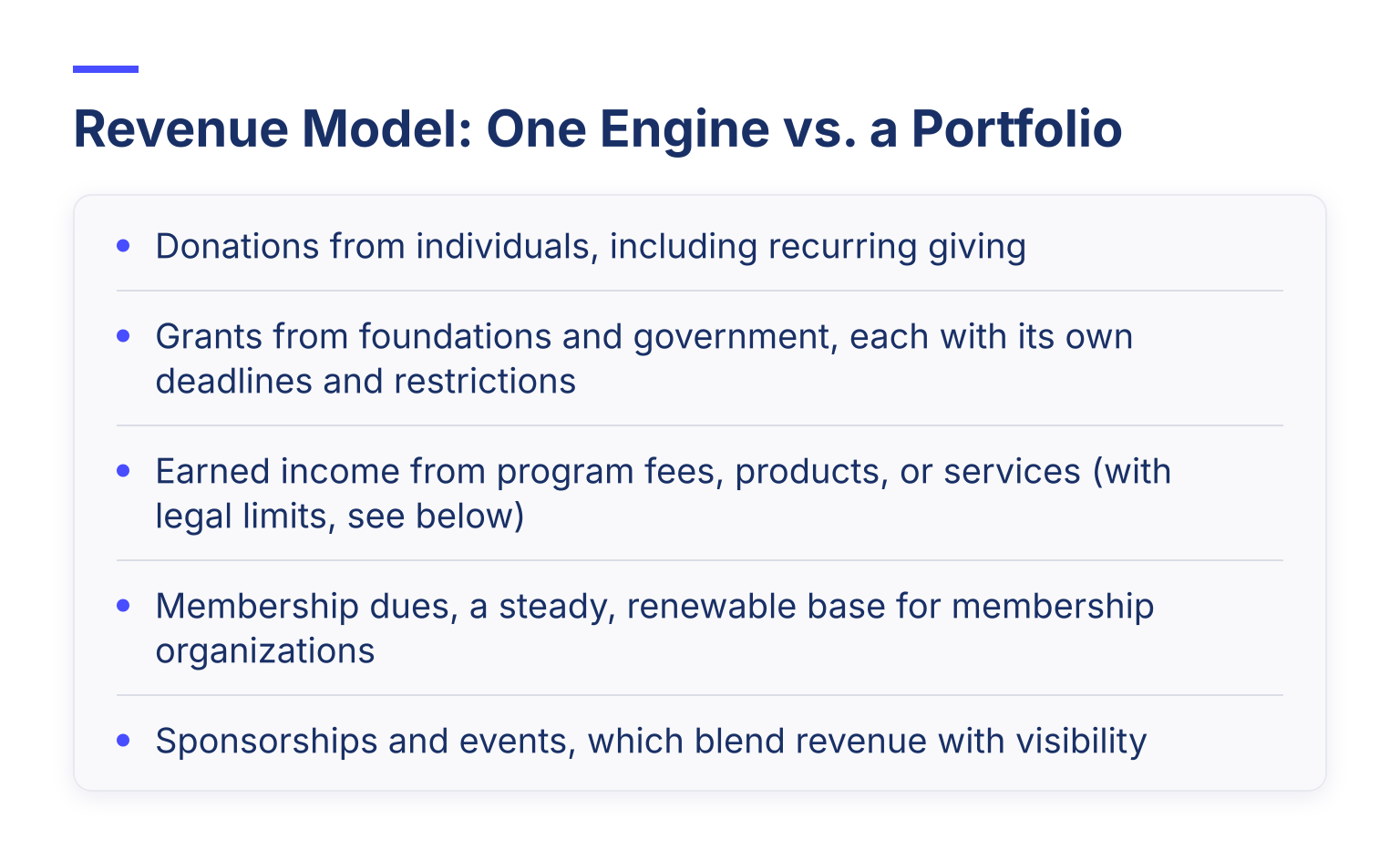
- Donations from individuals, including recurring giving
- Grants from foundations and government, each with its own deadlines and restrictions
- Earned income from program fees, products, or services (with legal limits, see below)
- Membership dues, a steady, renewable base for membership organizations
- Sponsorships and events, which blend revenue with visibility
The Foraker Group's business planning guide calls this sustainable income: the plan must show how each stream behaves, how reliable it is, and what happens if one dips. That's the key shift. For-profit planning asks "how big can this get?" Nonprofit planning asks "how stable is the mix, and what's our backup when one source shrinks?"
If part of your model involves selling things, read Can Nonprofits Sell Products? Legal Things You Shouldn't Forget before you commit the section to paper. And if you're not yet incorporated, Fiscal Sponsorship 101: Your Path to Nonprofit Funding explains a common alternative that changes how the revenue section works entirely.
Mission and Impact Framing: Your Value Proposition Gets Rewritten
In a for-profit plan, the value proposition reads something like: "We save small businesses 10 hours a week for $29 a month." The customer pays; the customer benefits. Simple.
A nonprofit value proposition states a community need and the social return on addressing it. The Propel Nonprofits template shows how mission-driven plans articulate impact as an outcome, not just an activity. "We run a food pantry" is an activity. "We reduce food insecurity for 4,000 households a year" is an outcome.
Here's a useful trick from for-profit practice that translates well: state your beneficiary's problem in their words, then describe your solution and the measurable result. You're still solving a market problem. It's just that the "customer" is the community, and the people paying may not be the people served.
Governance: The Board Replaces Ownership
This is the section where for-profit templates break down completely. There is no ownership section in a nonprofit plan because there are no owners. Nobody holds equity. Nobody receives distributions.
What replaces it:
- Board of directors: Who serves, their terms, committees, and decision rights
- Volunteer structure: Roles, recruitment, training, and how volunteer time supports operations
- Advisory relationships: Community members, beneficiaries, or partner organizations with a voice
The board section deserves real depth. Funders read it to judge credibility, and your own staff will use it to know who decides what. If you're still building that governance layer, the board responsibilities covered in How to Start a Nonprofit Organization: The Complete Startup Guide map directly onto this plan section.
Financials: Different Statements, Same Discipline
For-profit plans lean on the profit and loss statement, cash flow projections, and balance sheet, with owner distributions as the payoff. Nonprofit plans swap in different documents:
- Statement of activities: The nonprofit cousin of a P&L, showing revenue and expenses without profit as the goal
- Functional expenses: Costs split into program, administrative, and fundraising categories, a standard donors and grantmakers expect
- Reserves policy: A stated target for operating reserves, which the National Council of Nonprofits highlights as a core planning assumption
The Foraker Group guide emphasizes that the financial section must connect program costs to income sources. Translation: every program in the plan should show how it gets funded. Keep the for-profit habit of projecting cash flow carefully. Nonprofits run out of cash too, and the consequences land on the mission, not just the bottom line.
Success Metrics: The Double Bottom Line
A for-profit plan's scoreboard is simple: revenue, margin, growth. A nonprofit plan keeps a financial scoreboard (are we sustainable?) and adds a mission scoreboard (is the mission actually advancing?).
Practical mission metrics look like:

- People served or programs delivered per period
- Outcome measures tied to the problem (graduation rates, animals rehomed, trees planted)
- Member or donor retention rates
- Cost per unit of outcome
The honest tradeoff: for-profit frameworks are better at forcing a single number. Nonprofits should keep that discipline by picking a small set of mission metrics the board reviews regularly, rather than tracking everything and reviewing nothing.
Legal Structure: What 501(c)(3) Status Adds to the Plan
Your legal structure shapes what the plan can promise:
- No profit distribution: Surplus must be reinvested in the mission, not paid to owners
- Unrelated business income limits: Regular income from activities unrelated to the mission can be taxable, so your earned-income section should flag which streams are mission-related
- Compliance obligations: Filings, disclosure, and restrictions that a for-profit plan never mentions
If you're at the pre-launch stage, How to Start a Nonprofit walks through the structural steps your plan should assume, and fiscal sponsorship (linked above) can cover the early period before you're ready to incorporate.
Common Mistakes When Transplanting a For-Profit Template
Founders coming from business backgrounds tend to make the same five mistakes:
- Label-swapping without rewriting. Renaming "customers" to "beneficiaries" while keeping an investor-pitch tone confuses funders.
- Assuming one revenue engine. A plan built around a single grant or single event is a risk plan, not a business plan.
- Ignoring the board's role. A for-profit plan's "management team" section is not the same as nonprofit governance, and funders notice.
- Skipping reserves. For-profit plans project growth; nonprofit plans must project survival during funding gaps.
- Measuring activity instead of outcomes. "We held 12 events" impresses nobody. "12 events retained 80% of members" does.
Your Translation Checklist
Use this mapping to convert a standard for-profit template section by section:
| For-Profit Section | Nonprofit Rewrite |
|---|---|
| Executive summary | Keep it; lead with mission and community need |
| Company description | Organization overview: mission, legal status, history |
| Market analysis | Community needs analysis with evidence |
| Products and services | Programs and services, each with an outcome |
| Marketing and sales | Funder development plus member and donor outreach |
| Management team | Board of directors, staff, and volunteer structure |
| Financial projections | Statement of activities, functional expenses, cash flow, reserves policy |
| Funding ask / exit | Funding strategy: diversified income plan, no exit |
| Success metrics | Financial sustainability metrics plus mission outcomes |
Work through your draft against the left column, and you'll end up with a legitimate nonprofit plan instead of a for-profit plan in costume.
After the Plan Is Written: Turning It Into Operations
A plan earns nothing until its revenue commitments become routine. For a membership-based nonprofit, that usually means three recurring jobs: collecting dues on time, processing donations, and running events. When those jobs run on spreadsheets and manual follow-up, they tend to drift, and the revenue plan quietly falls apart.
That execution layer is exactly what the Nonprofit Membership Management: Complete Guide covers for membership-based nonprofits: how to turn dues, renewals, and member engagement commitments into repeatable routines instead of monthly scrambles.
This is where tooling earns its place in your operations section. For example, Join It is cloud-based membership management software that handles member records, recurring dues and renewals, event registration, and donations in one place, so the income streams in your plan run on automation instead of willpower. You can start a free trial and see how much of the revenue plan your software can carry for you.
The next step is simple: take your existing for-profit draft (or template), work through the checklist above, and give the rewritten plan to your board with a date attached. A plan with a review date is a plan that gets used.

Guides from the Experts
Through our work with 4,000+ organizations - we’ve put together helpful guides to assist; regardless of where you are on your journey.


A Complete Guide to Membership Organizations
Everything you need to know to manage and grow your membership business

Maximize Membership Retention: 10 Proven Strategies
Tried and true strategies that not only win membership, but keep them

Build a Membership Website: A Step-by-Step Guide
Your one-stop resource for knowing all the features your modern membership website needs
Ready to start your free trial?
Our membership software is intuitive to use and even easier to test for yourself.