Best Software for Collecting Membership Dues in 2026 (Fees Compared)


Summary of the Article
Collecting membership dues takes more than a payment button. You need recurring billing on a schedule, automatic renewal reminders, a way to recover failed card payments, and fees that don't quietly eat your revenue. The right membership dues software depends on your size, your billing model, and who covers the fees.
What Membership Dues Software Actually Has to Do
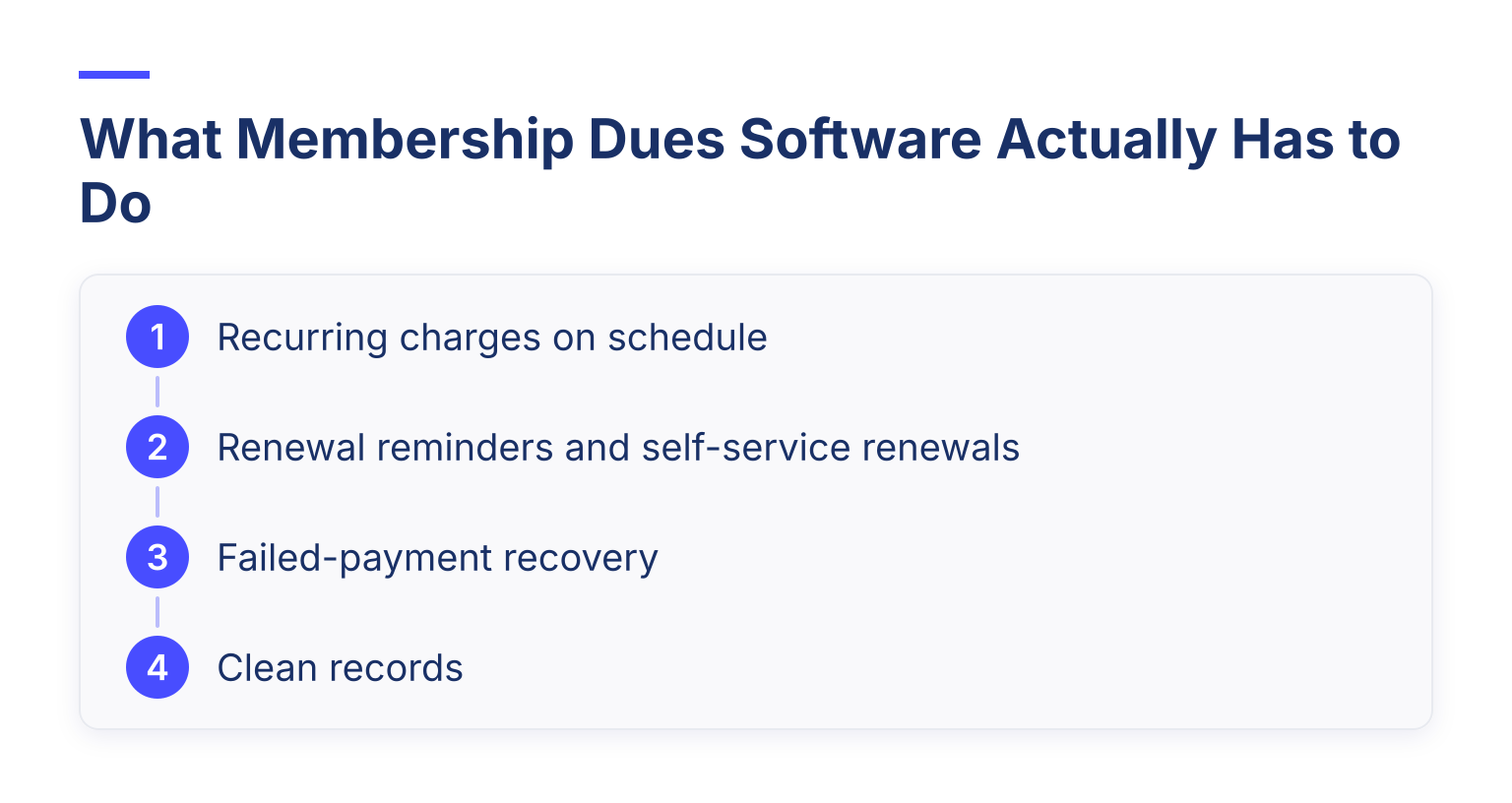
Collecting dues once is easy. Collecting them every month or every year, on time, from hundreds of people, is the hard part. Any tool on this list should handle four things:
If you want a deeper dive on setting and tracking dues themselves, see the guide on how to set, collect, and track membership dues.
Fee Transparency: What a $50 Dues Payment Actually Costs
The monthly subscription is rarely the whole cost. Most platforms take a cut of each transaction, on top of what the payment processor charges. On a $50 dues payment:
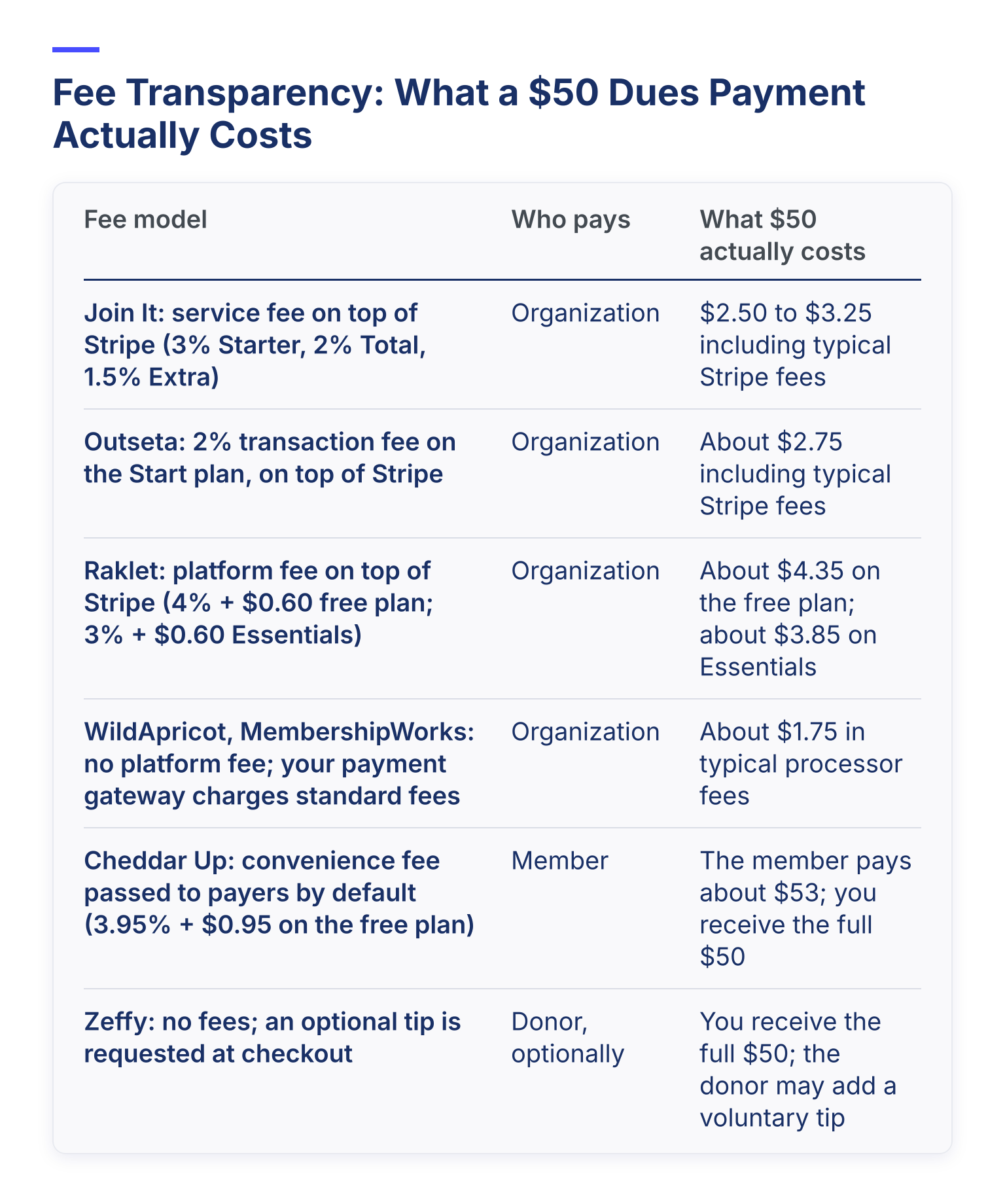
Two things worth noticing. First, transaction fees scale with revenue, so a 3% fee on a group collecting $60,000 in dues is about $1,800 a year. A higher monthly plan with a lower fee can be cheaper as you grow. Second, tools that look free shift costs somewhere: to payers as convenience fees or to donors as requested tips. That's not dishonest, but you should know where the money comes from before you commit.
Processor fees are separate from platform fees. Stripe's standard US rate is about 2.9% plus 30 cents, and processors' fees vary by country and card type. Always check the processor's current rates for your region.
What to Look For: A Quick Checklist

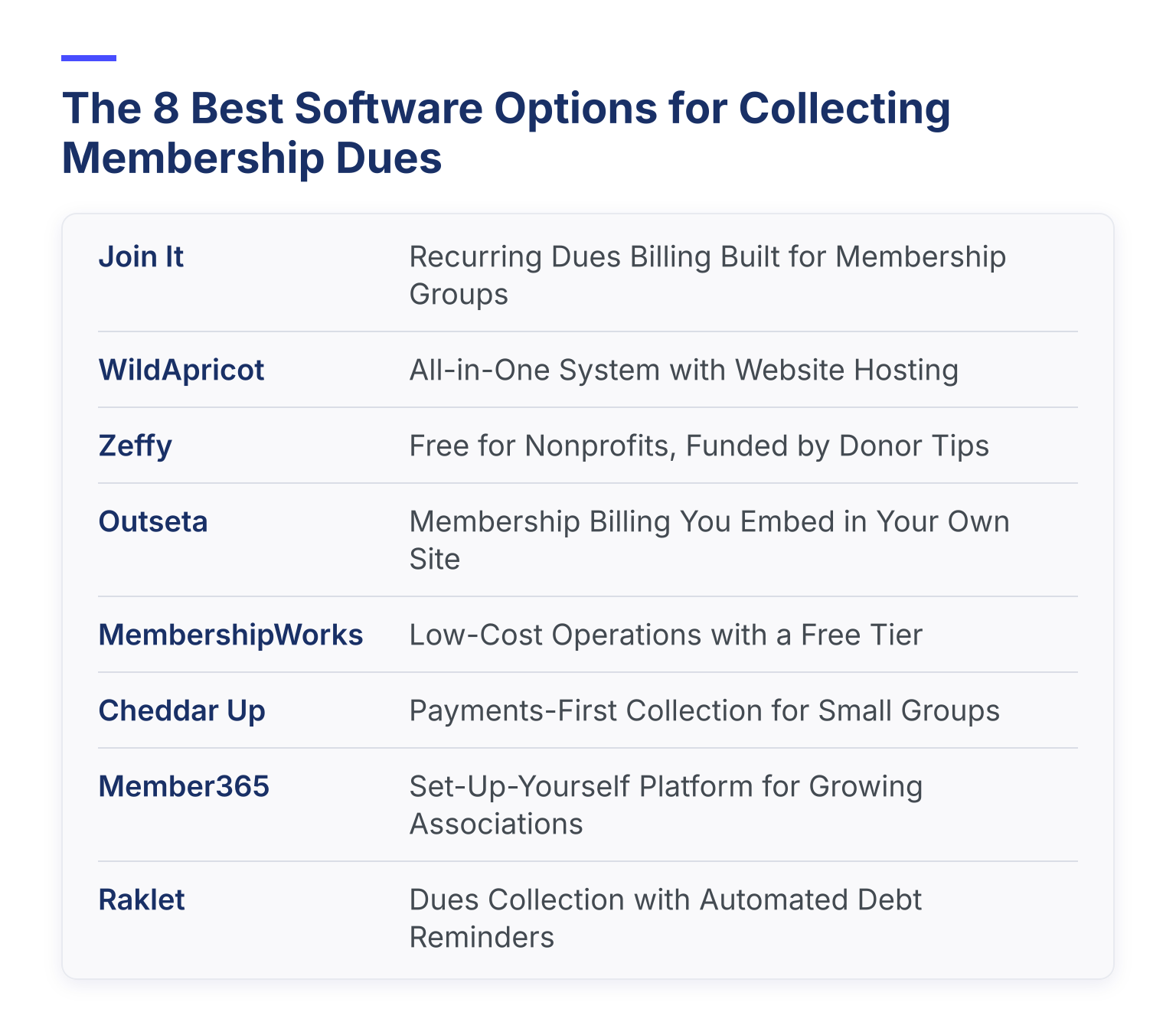
The 8 Best Software Options for Collecting Membership Dues
These tools cover different sizes and budgets, from free payment collection to full association systems. Fees and prices below come from each vendor's own pricing page; confirm current rates there before deciding.
Join It: Recurring Dues Billing Built for Membership Groups
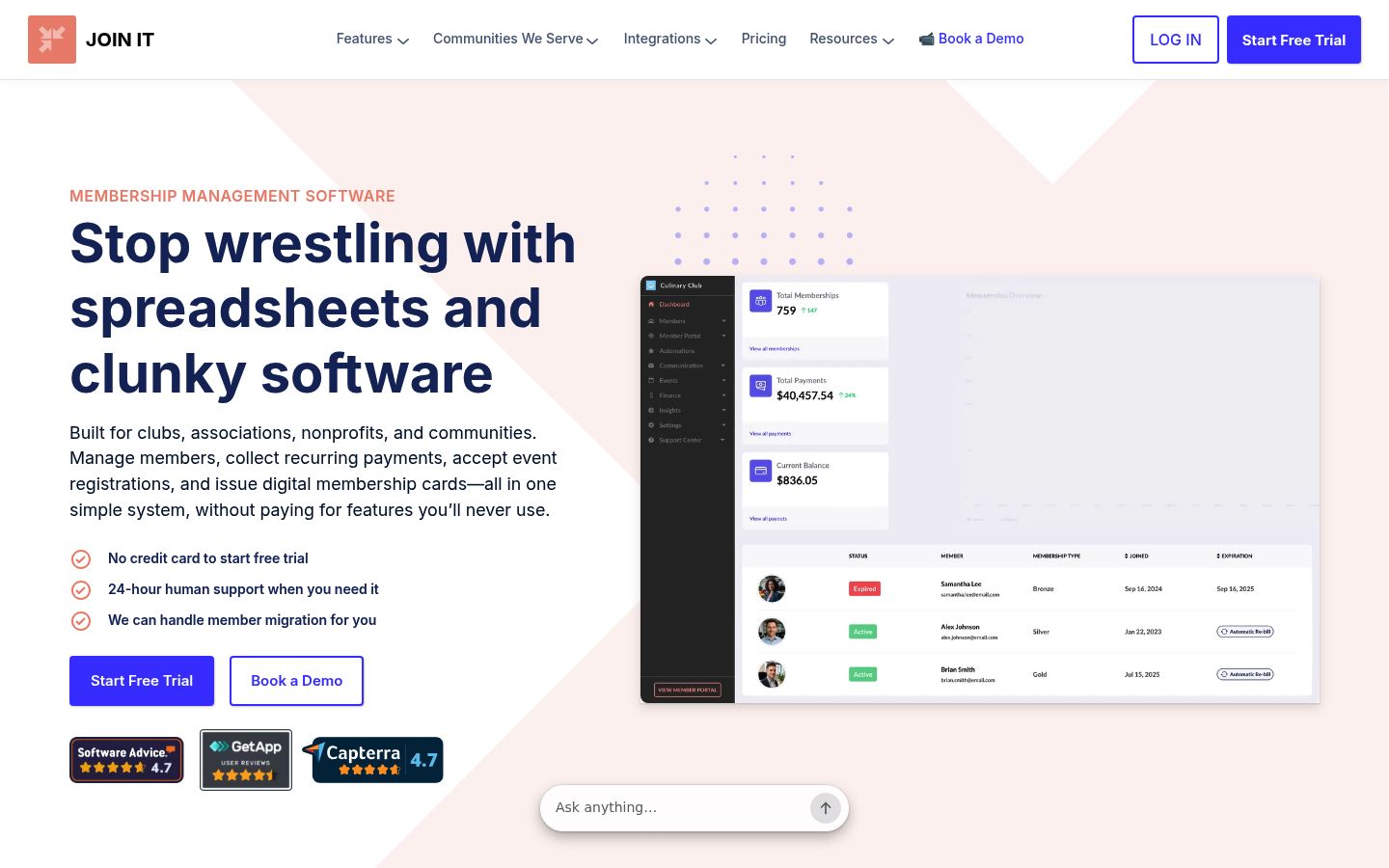
Join It is membership management software built around the dues cycle: recurring billing and subscriptions with automated renewal reminders and emails, so members renew without manual chasing. Members manage their own payments and records through a self-service portal, and the platform issues digital membership cards through Apple Wallet and Google Wallet. It also handles events, donations, and a searchable member database.
On fees, Join It uses a hybrid model: plans start at $29/mo (Starter), $99/mo (Total), and $199/mo (Extra), with a service fee of 3.0%, 2.0%, or 1.5% respectively on paid memberships and event registrations, on top of Stripe's separate processing fee. Annual billing takes 10% off, and eligible nonprofits get another 10%. A group with a smaller budget can start on Starter and save on transaction fees by moving up a plan as dues revenue grows.
The honest tradeoff: the service fee means it isn't the cheapest option at low volume for groups that only want a payment form. It fits best when you want dues billing, renewals, member records, and cards in one place without an implementation project. See how membership payment processing works in Join It and check current pricing.
WildApricot: All-in-One System with Website Hosting

WildApricot bundles membership management, events, email, and a hosted website, which appeals to clubs and associations that don't want separate tools. Pricing is based on the number of contacts in your database, starting at $66/mo for 100 contacts (about $59/mo with a one-year prepay); WildApricot itself charges no per-transaction fee, with payment provider fees handled separately.
Watch two things: contacts include lapsed members, event guests, and newsletter subscribers, not just paying members, so database bloat can push you into a pricier tier. And connecting your own Stripe, PayPal, or Authorize.net account instead of WildApricot's built-in payments adds a servicing fee to your subscription. Check WildApricot's pricing page for current rates.
Zeffy: Free for Nonprofits, Funded by Donor Tips
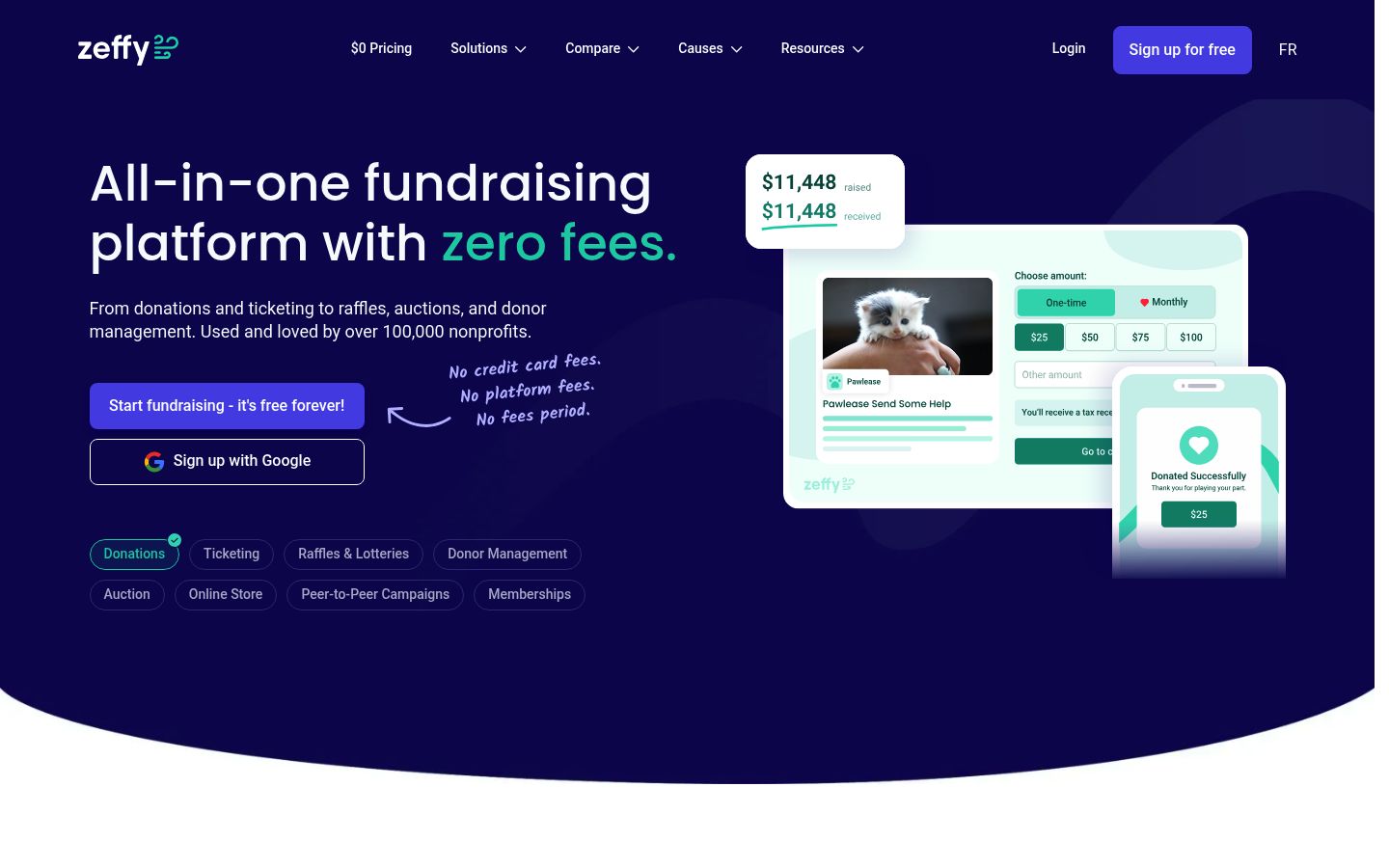
Zeffy charges nonprofits nothing: no platform fee, no transaction fee, and it covers card processing fees. Its only revenue is a voluntary contribution requested from donors at checkout. On a $50 dues payment, your organization receives the full $50 whether or not the donor tips. Its membership tools also cover tiered dues, automatic renewals on fixed or anniversary dates, and digital cards.
The tradeoff is donor experience. The contribution is pre-selected (Zeffy says suggested amounts generally range from about 5% to 20%, falling as amounts rise), and donors who want to tip nothing must choose 'Other' and enter zero. Zeffy reports about 60% of donors do contribute. If your members are used to paying a clean $50 and your group is comfortable with that checkout flow, it's a genuinely free option for nonprofits.
Outseta: Membership Billing You Embed in Your Own Site
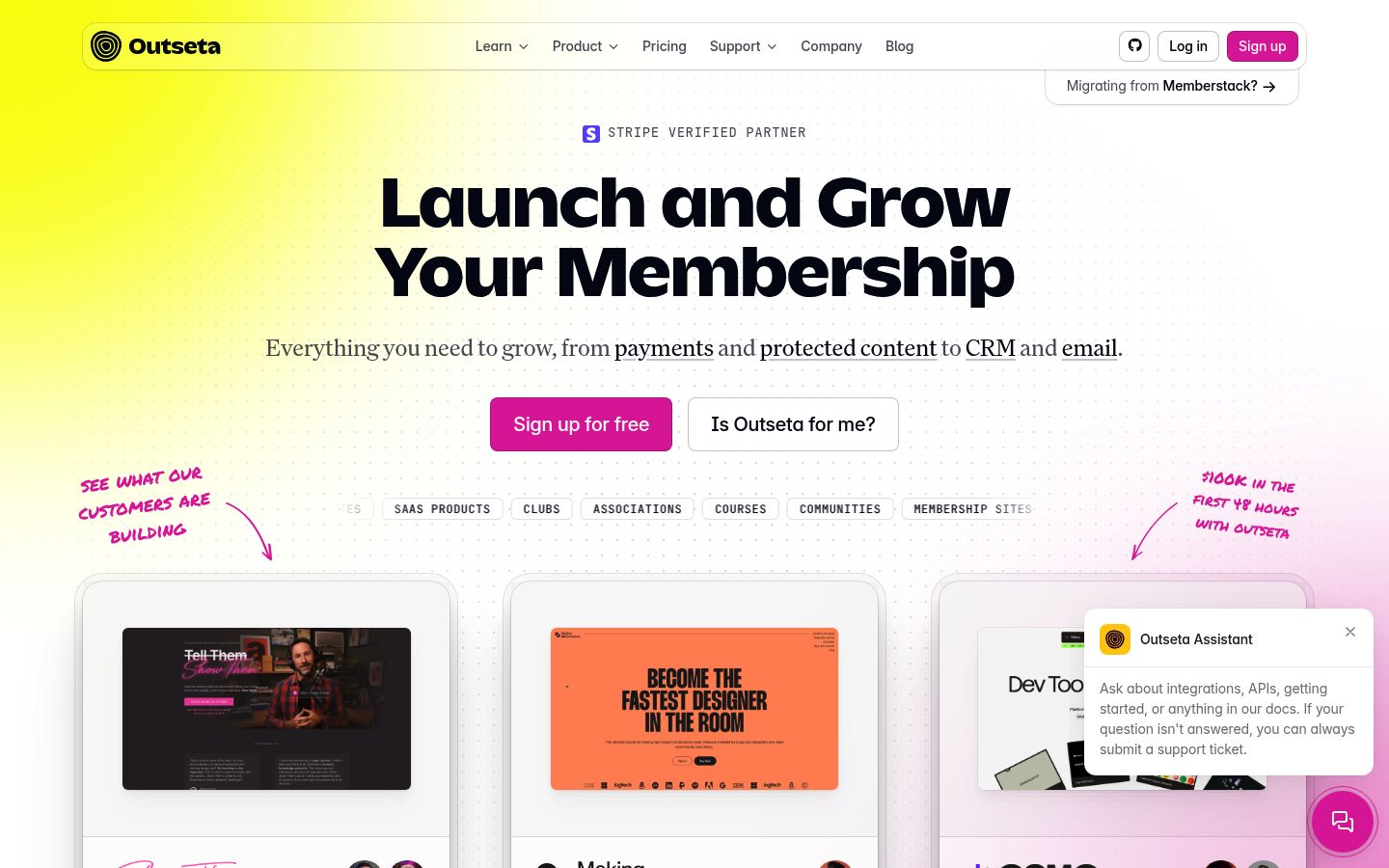
Outseta combines subscription billing, a CRM, email, and content gating, and it's designed to be embedded in an existing website rather than replacing it. Plans start at $37/mo billed yearly ($47 monthly) on the Start plan, which carries a 2% transaction fee on top of Stripe's standard fee; higher plans drop it to 1%, and the top plan has none.
That per-transaction fee is the main cost consideration: on a $50 payment, Start-level fees total roughly $2.75 including typical Stripe charges. It suits organizations with some technical comfort that want membership payments and a member database woven into their own site. Verify details on Outseta's pricing page.
MembershipWorks: Low-Cost Operations with a Free Tier
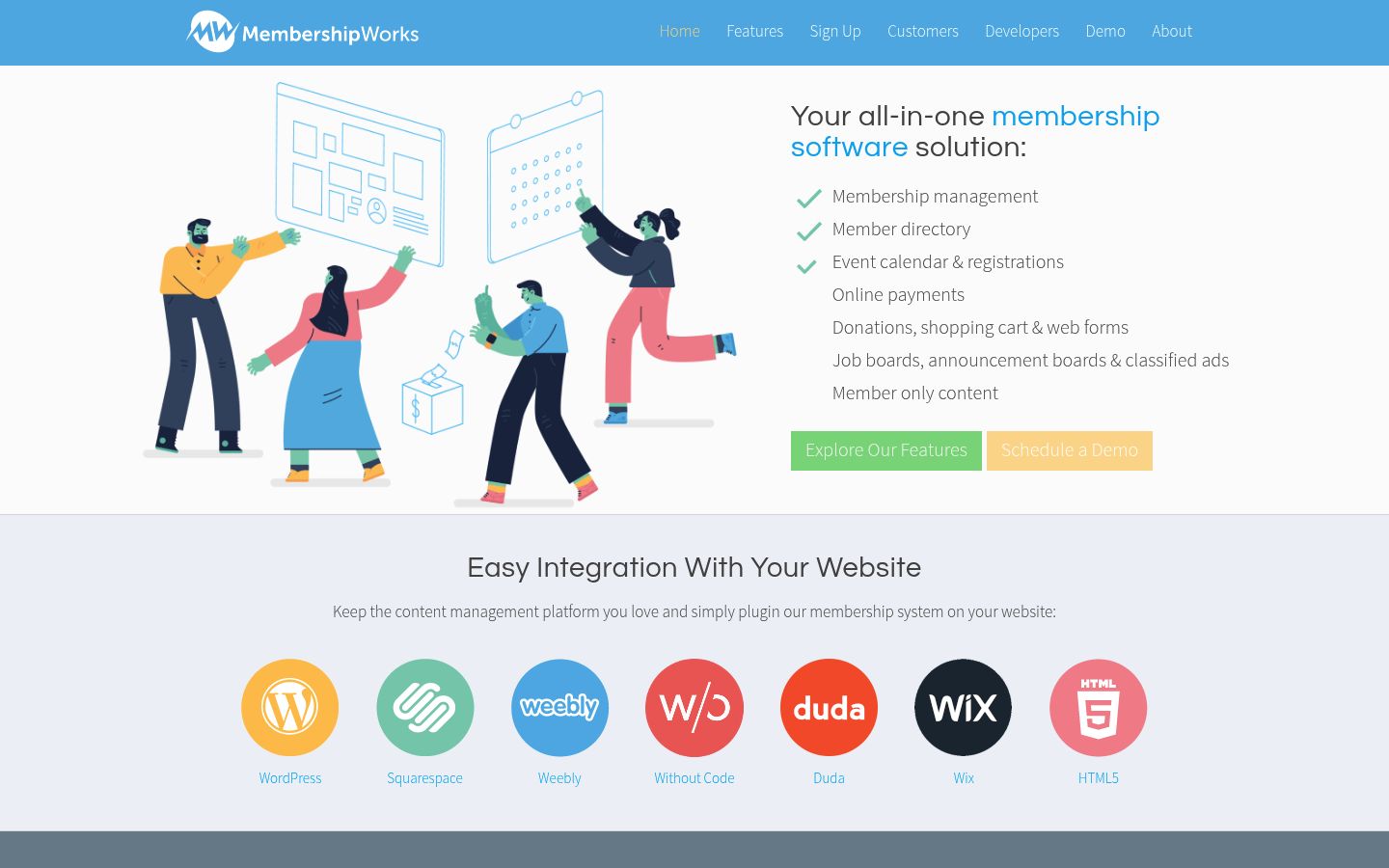
MembershipWorks covers membership payments, events, donations, directories, and member-only content at some of the lowest paid prices in the category: free up to 50 accounts, then $35/mo up to 300 accounts, rising by size. It takes no fee or portion of your payments; your payment gateway (Stripe, PayPal, or Authorize.net) charges its standard transaction fees.
The free tier can't process membership payments, so it works mainly as a trial. Paid plans have no contract and a 30-day money-back guarantee. It fits associations and nonprofits with existing websites that want broad membership operations at a low fixed price. Check MembershipWorks pricing.
Cheddar Up: Payments-First Collection for Small Groups
Cheddar Up is built around collecting money, forms, and sign-ups, which suits small groups that take dues alongside event fees, merchandise, and fundraising in the same place. Collecting is free with no monthly fee; the free plan supports recurring payments and unlimited pages with a five-item cap per page. Pro is $15/mo billed annually and Team is $35/mo billed annually.
The fee model matters: by default, payers cover the transactional convenience fee (3.95% plus $0.95 on the free plan), so a $50 dues payment costs the member about $53 and costs you nothing. You can absorb or share fees instead. If your members might bristle at paying processing fees, that's the tradeoff to weigh. See Cheddar Up's pricing and its fee explainer.
Member365: Set-Up-Yourself Platform for Growing Associations
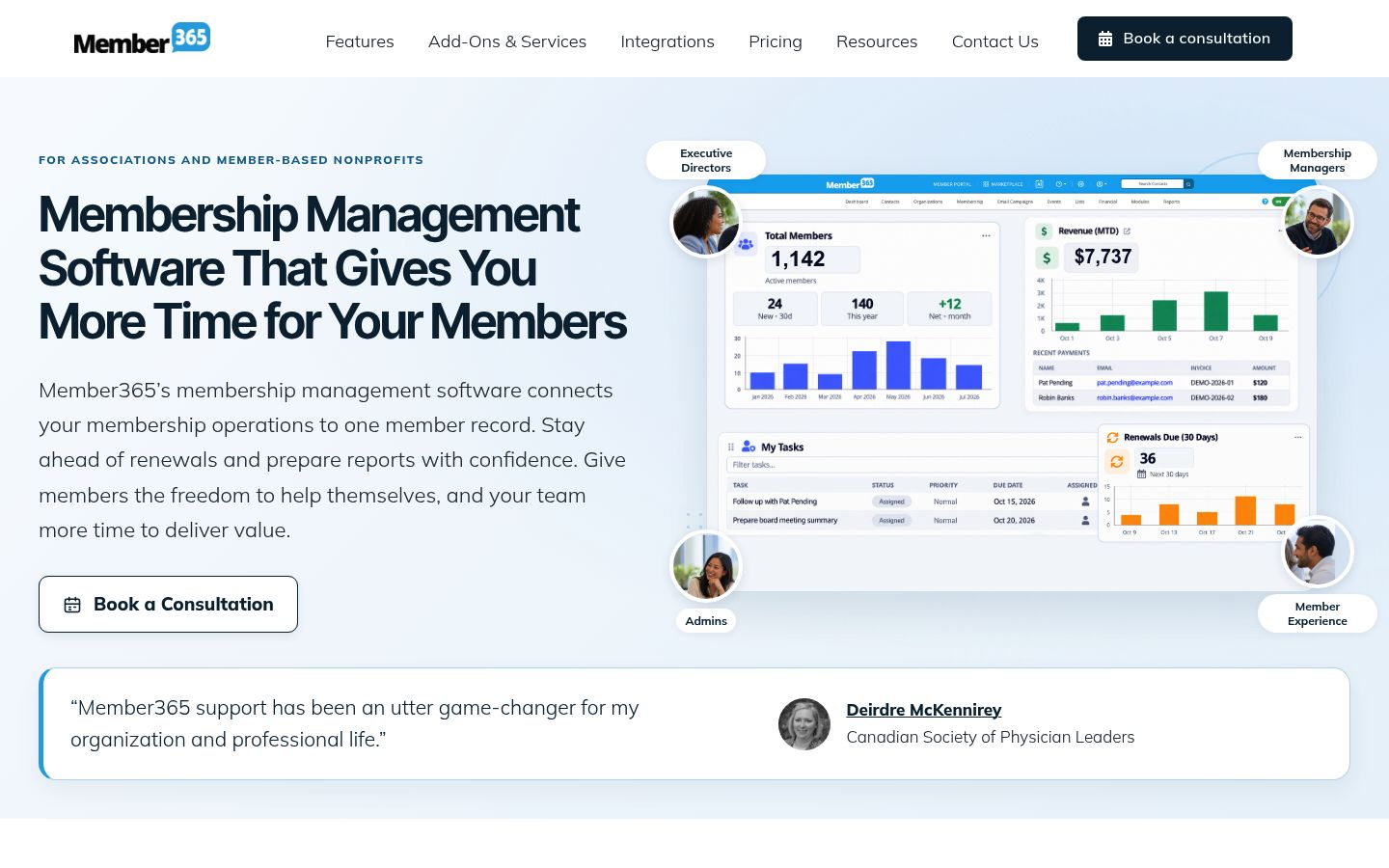
Member365 is an association management system covering membership, events, email, and payments (via Stripe, Authorize.net, or Worldline) in one platform, aimed at associations that are outgrowing lightweight tools. It supports Stripe-based recurring payments and a member portal.
Pricing is quote-based: Member365's own materials say plans start at $299 per month plus a one-time setup fee scoped to your implementation. That places it well above the other options here, so it makes sense for staffed associations with complex needs, not volunteer-run clubs. Discuss current pricing directly on Member365's pricing page.
Raklet: Dues Collection with Automated Debt Reminders
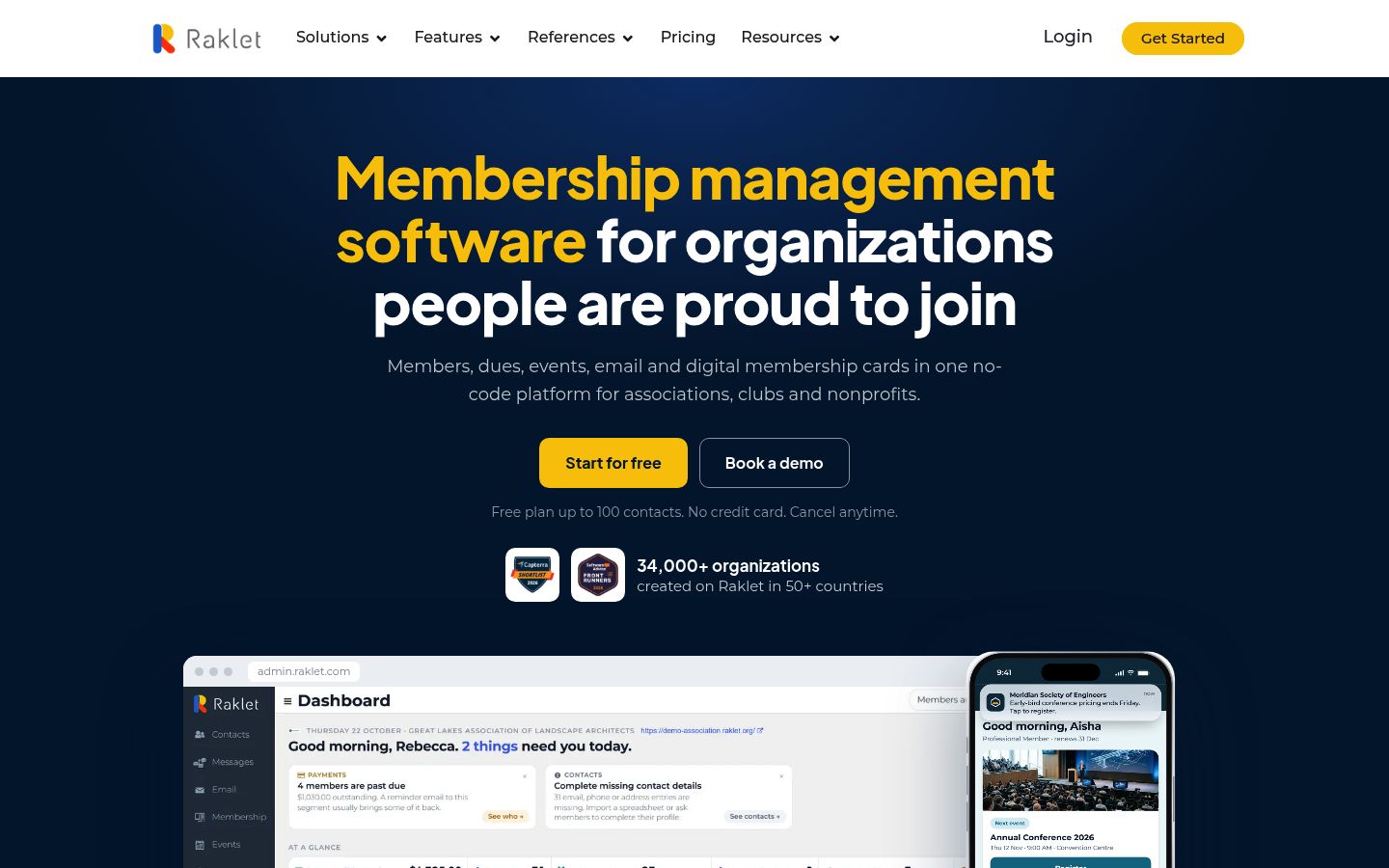
Raklet offers membership management with dues on a schedule, Stripe-based recurring payments, digital membership cards, events, and automated reminders, including reminders for members with outstanding dues. It has a free plan up to 100 contacts, then Essentials at $59/mo month-to-month ($49/mo billed annually) for 500 contacts.
Raklet charges a platform transaction fee on top of Stripe: 4% plus $0.60 per charge on the free plan, 3% plus $0.60 on Essentials, dropping to 1% plus $0.60 on higher tiers. On a $50 payment, the free plan's platform fee alone is $2.60 before Stripe's cut, so upgrading often pays for itself quickly once payment volume grows. Nonprofit discounts are available. Check Raklet's plan comparison.
Quick Comparison
How to Choose
Match the tool to three things:
- Organization size and admin capacity. Volunteer-run groups should favor low fixed prices and easy setup (MembershipWorks, Cheddar Up, Raklet's free tier). Staffed associations with complex structures can justify Member365 or WildApricot's higher tiers.
- Billing model. If everyone renews on a fixed date, make sure the tool supports fixed renewal dates, not just anniversary billing. If dues vary by tier or you bill monthly, confirm recurring cycles and prorating. Join It's recurring billing handles scheduled renewals and reminders, and our broader billing software comparison covers more options on the recurring-payments angle.
- Who absorbs fees. Decide deliberately whether the organization, the member, or the donor covers transaction costs. A 3% platform fee can cost more annually than a higher subscription with a 1.5% fee.
Common Questions
Can I just use Stripe alone or a spreadsheet?
Yes, for a while. Stripe can charge recurring payments, and a spreadsheet can track who paid. It stops working when cards fail and no one notices, members ask for receipts and payment history, renewal dates drift, and the volunteer keeping the spreadsheet leaves. At that point, dues software pays for itself in recovered renewals.
What about Substack or a generic subscription tool?
These charge recurring payments, but they're built for content subscriptions, not membership records. You won't get a member database, tier-based permissions, member portals, check-ins, or dues reporting tied to each person. They work for very small, content-only groups.
How do I compare total cost fairly?
Multiply your expected annual dues volume by the platform's transaction fee, add the monthly subscription, and add processor fees. A tool that looks free but takes 4% per payment is often more expensive than one with a $99 subscription and a 2% fee.
If you want to see how this works for your group, you can start a free trial of Join It and set up recurring dues, renewal reminders, and a member portal without a credit card.

Guides from the Experts
Through our work with 4,000+ organizations - we’ve put together helpful guides to assist; regardless of where you are on your journey.


A Complete Guide to Membership Organizations
Everything you need to know to manage and grow your membership business

Maximize Membership Retention: 10 Proven Strategies
Tried and true strategies that not only win membership, but keep them

Build a Membership Website: A Step-by-Step Guide
Your one-stop resource for knowing all the features your modern membership website needs
Ready to start your free trial?
Our membership software is intuitive to use and even easier to test for yourself.