Event Sponsorship for Associations and Clubs: How to Build Packages and Win Sponsors



Event sponsorship works when you treat it as a trade, not a favor. A business gives you cash, goods, or services, and in return you deliver access to your members that the sponsor cannot easily buy anywhere else.
- Sponsorship types: cash, in-kind (goods or services), digital placements, media partners, venue hosts, and promotional partners.
- What sponsors buy: leads, face time with members, niche brand awareness, and thought leadership. Logos alone rarely close a deal.
- Packages: three or four named tiers with limited spots at the top, plus an a-la-carte menu for sponsors who want to build their own deal.
- Finding sponsors: start with your members' own vendors, employers, and the local businesses that already serve them.
- Winning renewals: track every promised benefit, send a short post-event report with real numbers, and ask to renew while the event is still fresh.
For professional associations, your member base is the asset. Sponsors do not fund your event out of kindness; they pay to reach the specific group of people your organization gathers. This guide walks through the full cycle, from building an audience profile to sending the report that earns next year's check.
The Sponsorship Cycle at a Glance
Every strong sponsorship program follows the same loop. This guide covers each step in order, so you can see where you are and what comes next:

The Sponsorship Cycle at a Glance, in 6 steps: Profile your audience; Build and price your packages; Prospect and pitch; Fulfill every benefit; Report results; Ask for the renewal
- Profile your audience. Pull the numbers, demographics, and spending habits that describe who your event reaches.
- Build and price your packages. Structure three or four tiers priced against what sponsors gain, not what delivery costs you.
- Prospect and pitch. Find companies whose customers look like your members, then send a short, tailored proposal.
- Fulfill every benefit. Deliver everything you promised, on time, with an owner and deadline for each item.
- Report results. Send a post-event summary with real attendance and lead numbers while the event is still fresh.
- Ask for the renewal. Make the ask in the same conversation as the report, not six months later.
What Event Sponsorship Means for Member Organizations
Event sponsorship is a business agreement. The sponsor provides support, and your event provides a defined set of benefits in return. Most agreements fall into one of six types, and many sponsors mix more than one. Industry guides such as Glue Up's overview of event sponsorship types group them broadly the same way.
Cash sponsorship
The sponsor pays money toward your event budget. This is the most common type and the one that funds venues, speakers, catering, and marketing. In return, the sponsor receives agreed benefits such as a booth, a speaking slot, or prominent recognition.
In-kind sponsorship
The sponsor supplies goods or services instead of money: catering, printing, AV equipment, prizes, or hotel rooms. Value each in-kind gift at what you would otherwise have paid a vendor, and write that figure into the agreement so both sides know what was delivered.
Digital sponsorship
A digital sponsor buys placement in your online channels: your event website, registration pages, email campaigns, an event app, or the stream of a virtual or hybrid event. These packages are easy to fulfill and easy to report on, because clicks and impressions are measurable. The distinction that matters is quality: a featured spot in a conference email with a trackable link drives real engagement, while a logo buried in a footer full of other logos drives almost none.
Media sponsorship
A local newspaper, radio station, podcast, or industry newsletter promotes your event to its audience in exchange for visibility at the event. The value is reach rather than cash.
Venue sponsorship
A coworking space, university, or business hosts your event for free or at a reduced rate. You save one of your largest expenses, and the venue gets to show its space to potential clients in the room.
Promotional and community partnerships
A partner promotes your event to its own members or customers, often in exchange for credibility and a presence at the event. These deals bring little money, but they can introduce your organization to a whole new audience.
What Sponsors Actually Want (and What They Ignore)
Sponsorship research from association-industry sources consistently separates the benefits that drive decisions from the ones that just fill a prospectus.
What sponsors pay for:
- Qualified lead access. Contact with attendees who match the sponsor's target customer, handled with appropriate permission and privacy safeguards.
- Face time. Booth conversations, pre-booked meetings, meals, and receptions where sponsors talk with real prospects.
- Brand awareness in a niche audience. Being known by the exact professionals or community members the sponsor wants to reach.
- Thought leadership. A speaking slot, a sponsored session, or a workshop where the sponsor teaches instead of sells.
What sponsors mostly ignore:
- Passive logo placement on a website or banner.
- Printed program ads and bag inserts.
- Generic thank-you social posts.
These low-value items are fine as baseline recognition in every tier, but they rarely justify a buying decision on their own. Build your packages around access and outcomes, and treat logos as table stakes.
Start With a Sponsor-Ready Audience Profile
Before you design a single package, pull together what you know about the people sponsors would be reaching. Government club-development guidance is blunt about why this matters: sponsors decide whether your audience matches their target market, so vague answers lose deals.
Gather what you can from your own records:
- Headline numbers. How many members you have, how many attended your last event, and how many people your emails and social posts reach. The way you promote member events directly shapes those reach numbers, which is exactly what a sponsor is buying.
- Demographics. Age ranges, professions or roles, and whether attendees are business owners, employees, or volunteers.
- Geography. Where members live and work, especially for a local business deciding whether your event is worth its marketing budget.
- Spending signals. What members buy for their work or hobbies, and which vendors they already use. You do not need precise data; even honest ranges beat a blank page.
If you already plan events around what members say they want, you have a head start. The same member conversations that shape a good event also produce the audience details sponsors care about, and our association event planning guide walks through how to collect them.
Build a Tier Structure You Can Sell
Most successful sponsorship programs use three to four levels. More tiers create confusion, and fewer can cap your revenue. Here is a worked example at a small-organization scale, where each level follows a clean climb:
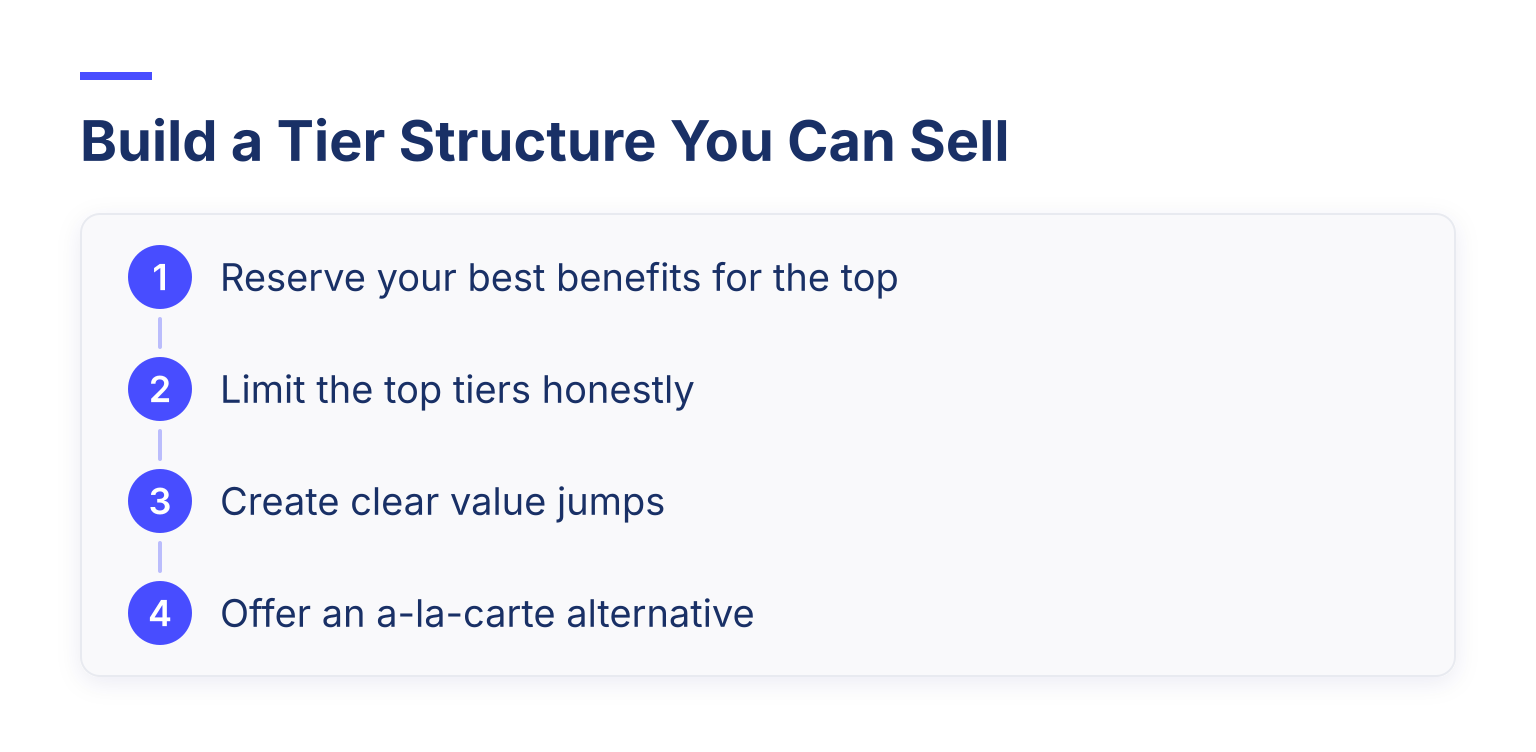
Build a Tier Structure You Can Sell, in 4 steps: Reserve your best benefits for the top; Limit the top tiers honestly; Create clear value jumps; Offer an a-la-carte alternative
These dollar figures suit a club or small association. Published prospectuses from larger associations run far higher: examples collected by i4a show Platinum tiers at $15,000 to $50,000 and up for big conferences. The absolute numbers depend on your audience; the shape of the ladder is what stays constant.
Four rules make a structure like this work:
- Reserve your best benefits for the top. Speaking slots, hosted sessions, private meeting space, and reception hosting belong at the high tiers. If a $1,000 sponsor gets the same treatment as a $4,000 sponsor, nobody upgrades.
- Limit the top tiers honestly. Scarcity works when it is real, such as one presenting sponsor or a fixed number of session slots. Fake limits erode trust.
- Create clear value jumps. Each tier should visibly add something the tier below does not have, not just a bigger logo.
- Offer an a-la-carte alternative. Some sponsors prefer to buy a single item, like sponsoring the lunch or a specific session. A menu of add-ons alongside your tiers captures sponsors whose needs do not fit a preset box.
Name your tiers in a way that fits your organization. Metal names (Bronze, Silver, Gold, Platinum) are instantly understood; role names (Supporting, Partner, Champion, Presenting) can feel warmer. Either works as long as the levels are obvious.
Price With Principles, Not Gut Feel
Two mistakes sink small sponsorship programs: underpricing out of insecurity, and guessing at numbers with no logic behind them. Use these checks instead:

Price With Principles, Not Gut Feel: Keep the ratio sane; Price against value, not cost; Check the market; Factor in fulfillment; Mind approval thresholds; Reward early commitment
- Keep the ratio sane. Aim for a top tier roughly three to four times the price of your entry tier, not ten times. A huge gap makes the top level look unreachable and pushes everyone to the bottom. The worked table above follows this ratio; scale every number up or down together as your audience grows.
- Price against value, not cost. Start from what the sponsor stands to gain: multiply expected decision-makers by a realistic value per lead, or compare your price to what it would cost the sponsor to reach the same audience another way.
- Check the market. Look at what comparable associations and clubs in your area or industry charge for similar access. Public prospectuses from real associations make this easy to research.
- Factor in fulfillment. If a $3,000 package costs you $2,000 in free tickets, printing, and staff time to deliver, your margin is thinner than it looks.
- Mind approval thresholds. Many companies require sign-off above certain amounts. Pricing a tier at $4,500 instead of $5,500 can keep a deal inside a manager's approval limit.
- Reward early commitment. A modest discount for sponsors who sign several months out rewards your best partners and tells you early how much inventory remains.
One caution: prices you find in other organizations' prospectuses are examples, not standards. Your audience size and local market set your numbers.
How to Find and Qualify Sponsors
Figuring out how to get event sponsors starts with one realization: the best prospects are companies whose customers look like your members. Work through this list in order:

How to Find and Qualify Sponsors, in 5 steps: Your members' own vendors; Members' employers; Local businesses; Past sponsors; Media partners
- Your members' own vendors. The software, insurance, suppliers, and service providers your members already pay. They want to keep those customers.
- Members' employers. Companies that hire your members often want recruiting visibility, from career tables to named scholarships.
- Local businesses. Restaurants, real estate agents, banks, and shops that want goodwill and reach in your community.
- Past sponsors. The cheapest sale you will ever make is to a company that already said yes, if you delivered what you promised.
- Media partners. Outlets that reach your audience and want content and presence at community events.
Qualify before you pitch. Ask three questions about each prospect: Do their customers look like our members? What did they sponsor last year? Who actually owns the sponsorship budget there?
Watch for conflicts. Club-development guidance from Western Australia warns plainly about sponsor clashes: potential sponsors chasing the same market should be avoided where possible, and a cash sponsor should never watch you promote their rival for free (see the state government's club sponsorship guide). Decide which benefits are exclusive, protect them in writing, and never promise exclusivity you cannot enforce.
Write a Short, Tailored Proposal
A sponsorship proposal is a business offer, and its length should match the size of the deal. Sponsorship guidance from the NSW Office of Sport recommends keeping it under about 10 pages, tailored to each sponsor, and structured roughly like this:
- Overview. One or two sentences describing the sponsorship opportunity.
- Who you are. A brief profile of your organization and its history.
- Event details. Dates, location, format, and expected attendance.
- Audience. The demographics from your profile: who attends, how old they are, where they come from.
- Benefits, valued in dollars. List exactly what the sponsor receives and what each item is worth at market rates, then show how the total matches the amount you are asking for. Valuing benefits this way makes clear that this is a purchase, not a donation.
- The investment. The price and any early-commitment deadline.
- Evaluation. How you will measure and report results.
Two details separate strong proposals from ignored ones. First, tailor every one: reference the specific sponsor's products, customers, or goals instead of mail-merging a generic deck. Second, define your terms. If your package says signage, state whether the sponsor supplies the sign or you produce it. Ambiguity here starts relationships badly.
Outreach and Follow-Up
Before anything is sent, get on the phone. Call the company, ask who handles sponsorship decisions, and introduce yourself briefly. A short, friendly call that suggests (rather than asks) that you will send a proposal sets you apart from the stack of unsolicited PDFs every marketing manager receives.
Then follow up. Do not send the proposal and wait silently. Government guidance for first-time sponsorship seekers recommends a follow-up call at least five days after delivery; most practitioners aim for about a week. Your follow-up should do three things: confirm they received it, offer any extra information, and ask what a decision timeline looks like.
If a prospect hesitates, offer a short meeting rather than another email. And if the answer is no, thank them anyway and note whether next year's event might fit better. Doors close and reopen.
Fulfill Every Benefit, Then Report Results
Many sponsorships fail here, not at the pitch. Sponsors walk when promised benefits quietly never happen. Protect the relationship with two habits.
Track every deliverable. Before the event, list each promised benefit with an owner and a deadline: logo placements, tickets issued, emails sent, the booth set up, the speaking slot confirmed. Deliver everything, on time, and add small extras when they cost you little. Sponsors remember surprises in their favor.
Capture the numbers. Sponsor reporting lives or dies on clean data: how many people registered, how many actually attended, who they were, and what the sponsor's booth or session produced. This is where event registration and attendance tracking tied to your member records matter. For example, Join It's event registration tools let member organizations run free and paid events with member registration, pricing controls, payments, and attendance tracking, so the counts and attendance records you need for a sponsor report come straight out of the same system you already use to manage memberships.
Send a post-event report within a couple of weeks while the event is still fresh. A solid short report includes:
- Registration and attendance totals, with a member versus guest breakdown.
- Leads, introductions, or signups the sponsor received.
- Evidence for each promised benefit, such as photos or links.
- What worked and what you would improve.
- The sponsor's own goal, restated and answered honestly.
Measurement does not need to be elaborate. Pick a few measures that match what you promised, keep the definitions consistent, and report them the same way every event. If you want a fuller framework, our guide to measuring member event success covers the metrics worth tracking and their honest limits.
Renewals, and How to Avoid the Common Failures
A renewal is the easiest sponsorship sale you will ever make, but only if you set it up. Ask for the renewal while the event's results are still recent, ideally in the same conversation where you deliver the report. Waiting six months until the next prospectus round means selling to a sponsor who has forgotten the value you delivered.
Four obstacles trip up small organizations most often:
- Underpricing. If you set entry-tier prices too low out of caution, you cap your revenue and teach sponsors that your audience is cheap. Price on value, and raise incrementally year over year rather than in big jumps.
- Overpromising exclusivity. Promising a sponsor that no competitor will ever appear anywhere is a commitment you may regret. Grant exclusivity narrowly, by category and benefit, and write it down.
- Overpromising generally. Never commit to a benefit you cannot deliver. A delivered modest package beats an unfulfilled impressive one, every time.
- Volunteer capacity. A sponsorship program takes real work: prospecting, proposals, fulfillment tracking, and reporting. Plan for the hours honestly, start with two or three sponsors rather than twelve, and grow the program only as fast as your team can service it well.
Sponsorships are one revenue stream among many beyond dues. If you are mapping out all of them, our fundraising guide for membership organizations shows where sponsorship fits alongside donations, events, and other non-dues income.
Frequently Asked Questions
How far in advance should we approach sponsors?
Months, not weeks. Assessment, negotiation, and planning a sponsorship take substantial time on the sponsor's side, especially where budgets need internal approval. Start conversations well before your prospectus deadline, and offer an early-commitment discount to reward fast decisions.
How many sponsors should one event have?
As many as you can serve well. A tiered structure with open entry-level slots and limited top-tier spots typically supports anywhere from a handful to dozens of sponsors. The constraint is your capacity to deliver benefits and report on them, not the number itself.
What if a business says no?
Thank them, ask whether timing or fit was the issue, and note the answer for next year. A polite no with a reason is useful market research, and many sponsors pass one year and sign the next after seeing your report or another company's results.
If you want the registration lists, attendance counts, and member data behind those sponsor reports in one place, start a free trial of Join It and see how your event records connect to your member database.

Guides from the Experts
Through our work with 4,000+ organizations - we’ve put together helpful guides to assist; regardless of where you are on your journey.


A Complete Guide to Membership Organizations
Everything you need to know to manage and grow your membership business

Maximize Membership Retention: 10 Proven Strategies
Tried and true strategies that not only win membership, but keep them

Build a Membership Website: A Step-by-Step Guide
Your one-stop resource for knowing all the features your modern membership website needs
Ready to start your free trial?
Our membership software is intuitive to use and even easier to test for yourself.