Recurring Donations: How to Automate Monthly Giving That Last


Here is a fundraising reality that most organizations feel but rarely say out loud.
Overall giving grew 5.0% in 2025. But according to the Fundraising Effectiveness Project, donor counts fell 3.6% that same year. More money. Fewer people giving it.
That gap is exactly where recurring donations stop being a nice-to-have and start being the foundation of predictable fundraising revenue.
Recurring donations are preauthorized gifts that process automatically on a set schedule, most often monthly. One donor, one commitment, many transactions over time. And when the system behind them is built right, those donors stay far longer and give far more than any one-time contributor ever will.
Neon One's 2026 Recurring Donor Report found that recurring donor retention sits at 79.11%, compared to just 32.41% for non-recurring donors. That is not a marginal advantage. That is a fundamentally different kind of donor relationship.
Quick answer: Recurring donations are preauthorized, automatic gifts on a fixed schedule. They improve donor retention, increase lifetime value, and create predictable fundraising revenue for nonprofits, churches, and membership organizations.
Understanding why automatic recurring donations matter is the first step. Building the system behind them is what makes the difference.
Key Takeaways
- Recurring donors retain at more than twice the rate of one-time donors. That gap compounds into years of additional giving.
- Most failed recurring payments are not cancellations. They are expired cards and bank declines that a well-built recovery workflow can resolve.
- The donation form is where recurring giving starts. Impact updates, payment recovery, and donor control are what make it last.
- 90% of nonprofits offer monthly giving. Only 35% make it the visible default. That gap is where conversion disappears.
- Giving donors a simple way to pause, reduce, or update their gift does not increase cancellations. It reduces them.
- Recurring donations and membership dues coexist cleanly when they share one constituent record, not two disconnected lists.
- Join It is rated Excellent on Trustpilot and connects recurring giving, automated donor communications, and membership management in one place.
What Are Recurring Donations, Really?
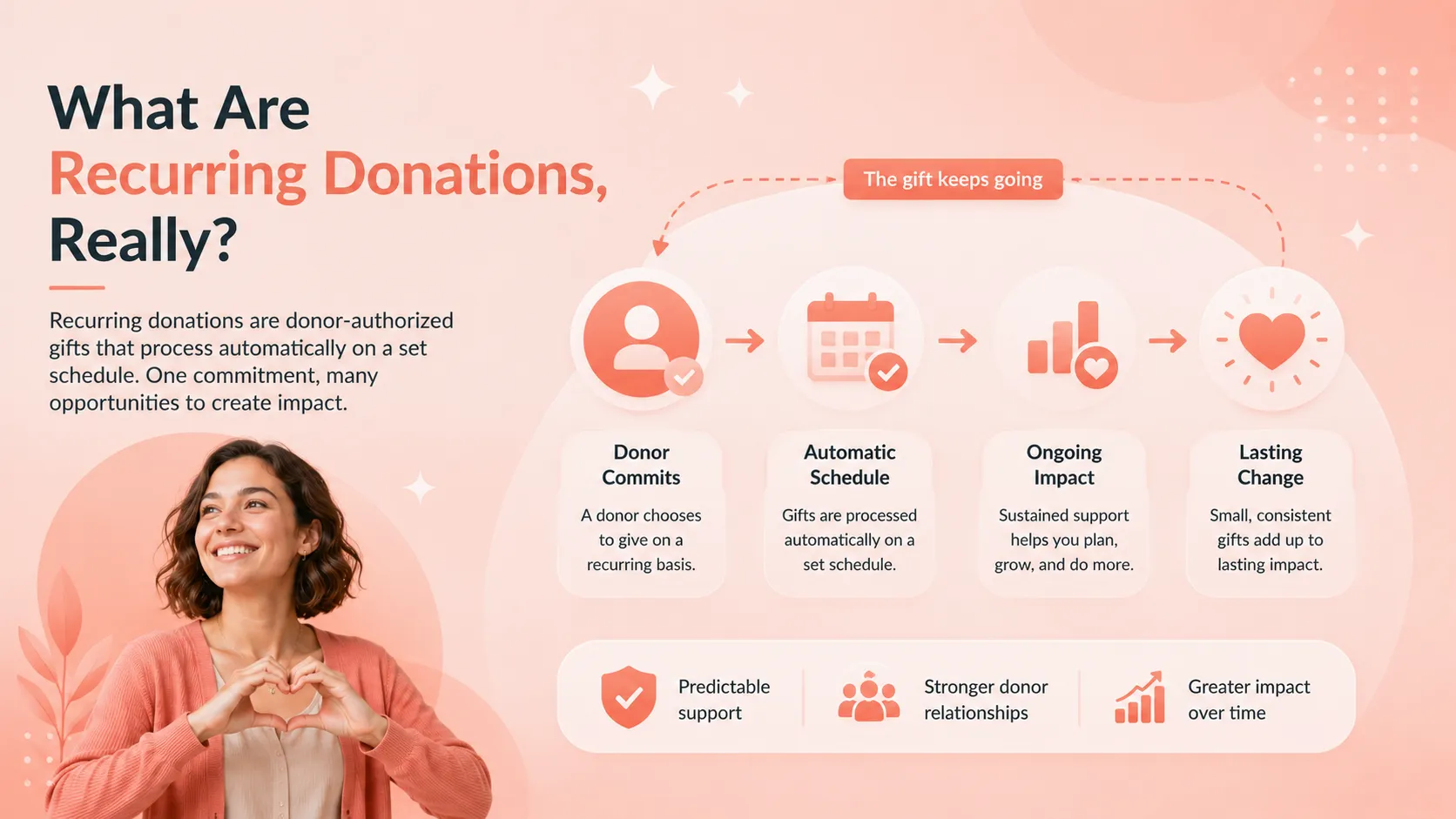
Recurring donations, also called recurring giving, monthly giving, sustainer giving, automatic donations, scheduled donations, or recurring contributions, are donor-authorized gifts that process automatically at a set frequency.
Monthly is the most common cadence. But recurring giving can also run weekly, quarterly, or annually depending on what your donors prefer and what your platform supports.
The operational model is clean. One donor record. One recurring plan managed through your recurring billing system. Many individual transactions over time. The platform handles the processing. Your job is to handle the relationship.
The real difference with one-time donations vs recurring donations is not the payment schedule. It is the relationship structure. One-time donors must make a fresh decision to give every single time. Recurring donors have already said yes. That removes friction for them and removes the constant reacquisition burden for you.
For organizations managing both giving and dues, understanding how recurring membership payments differ from recurring donations helps keep your data model clean and your donor communications coherent.
The Numbers That Make This Hard to Ignore
Some statistics deserve a moment of silence. These are a few of them.
M+R Benchmarks reports that 71% of sustainers are still active after one full year. For comparison, overall online one-time donor retention sits at 48%, with new donor retention dropping to just 24%.
The lifetime value gap is even wider. According to Neon One, recurring donors stay engaged for 7.5 to 8 years on average, compared to 1.5 to 2 years for one-time donors. Their average recurring donor lifetime value reaches $7,288.26.
Monthly recurring donors generate 2.75 times more annual value than non-recurring donors. And yet, half of nonprofits still do not acquire a single new recurring donor in a given year.
Recurring giving revenue grew 144% from 2018 to 2022, according to Neon One's 2024 Recurring Giving Report. That growth reflects a shift in how the strongest fundraising programs think about donor acquisition. Not just who gives once, but who stays.
One more thing worth noting. According to Classy's 2021 Recurring Donor Sentiment Report, 84% of recurring donors took an additional action beyond their regular gift. That includes 45% who volunteered, 42% who made an extra donation, and 35% who attended an event.
Recurring donors are not just automatic payers. They are your most engaged community members.
The 4-Part System Behind Monthly Giving That Lasts
Most organizations flip on a recurring option in their donation form and call it a program. The ones with strong, durable results build their recurring giving strategy around four connected parts.
Acquisition means designing the donation experience so that recurring giving is the clearest and most natural path, not a secondary option buried below a one-time default.
Payment continuity means building retry logic, card updaters, and recovery workflows so that a failed charge does not silently end a donor relationship before anyone notices.
Proof of impact means showing donors exactly what their monthly gift accomplishes, every month, not just confirming the payment was received.
Donor control means giving people a clean, transparent, self-managed way to update, pause, or cancel their gift at any time. That kind of control does not increase cancellations. It increases trust.
If your organization wants to accept donations through your member portal alongside your membership experience, those four layers have to connect. The form is just the entry point.
How to Ask for Monthly Donations
The most common mistake in recurring giving messaging is leading with what the organization needs.
"Help us stabilize revenue" is an internal benefit. Donors do not enroll for that reason.
According to Classy's Recurring Donor Sentiment Report, 56% of recurring donors gave because it let them continuously support the mission. 47% said recurring gifts make more impact than a one-time donation. And 61% were motivated simply by the ability to break a larger commitment into smaller, affordable amounts.
That last point changes everything about how you frame suggested monthly donation amounts. A $10 or $25 monthly ask does not feel small when it is tied to a real, specific outcome. Meals provided. Families served. Ministry sustained. Emergency care funded.
Tunnel to Towers built its entire recurring acquisition model around a consistent $11 per month ask, connected to a clear mission promise. That program now drives the majority of its online donations.
When you ask also matters. The donation form is the first conversion point. A follow-up ask after a donor has experienced real impact is the second. Not every donor is ready to commit during the first gift. That is not a failure. It is an opportunity.
Donation Form Practices That Actually Convert
M+R Benchmarks 2025 found that 90% of nonprofits offered a way to accept recurring donations online through their main donation page. But only 35% pre-selected monthly giving. The rest still defaulted to one-time.
That gap between availability and visibility is where monthly giving conversion gets lost.
A few donation form best practices that consistently improve recurring giving conversion:
- Place the recurring option where the donor's eye naturally lands first
- Offer more than one frequency, since Classy found more than half of recurring donors preferred options beyond monthly only
- Tie each suggested amount to a specific, concrete outcome
- State the amount, frequency, and ongoing nature of the gift clearly before the donor confirms
Ambiguity is the silent conversion killer. When donors feel misled into a monthly commitment they did not fully understand, you get charge disputes, cancellations, and lost trust. Clarity costs nothing and protects everything.
On the payment side, offering Stripe recurring payments for memberships and multiple payment methods matters more than it used to. According to Worldpay's Global Payments Report, digital wallets represented 53% of e-commerce spend in 2024. Donor payment expectations have shifted, and forms that lag behind create friction at the worst possible moment.
What Happens When a Recurring Payment Fails
This is the section most organizations skip. And it quietly costs them thousands in lost recurring revenue every year.
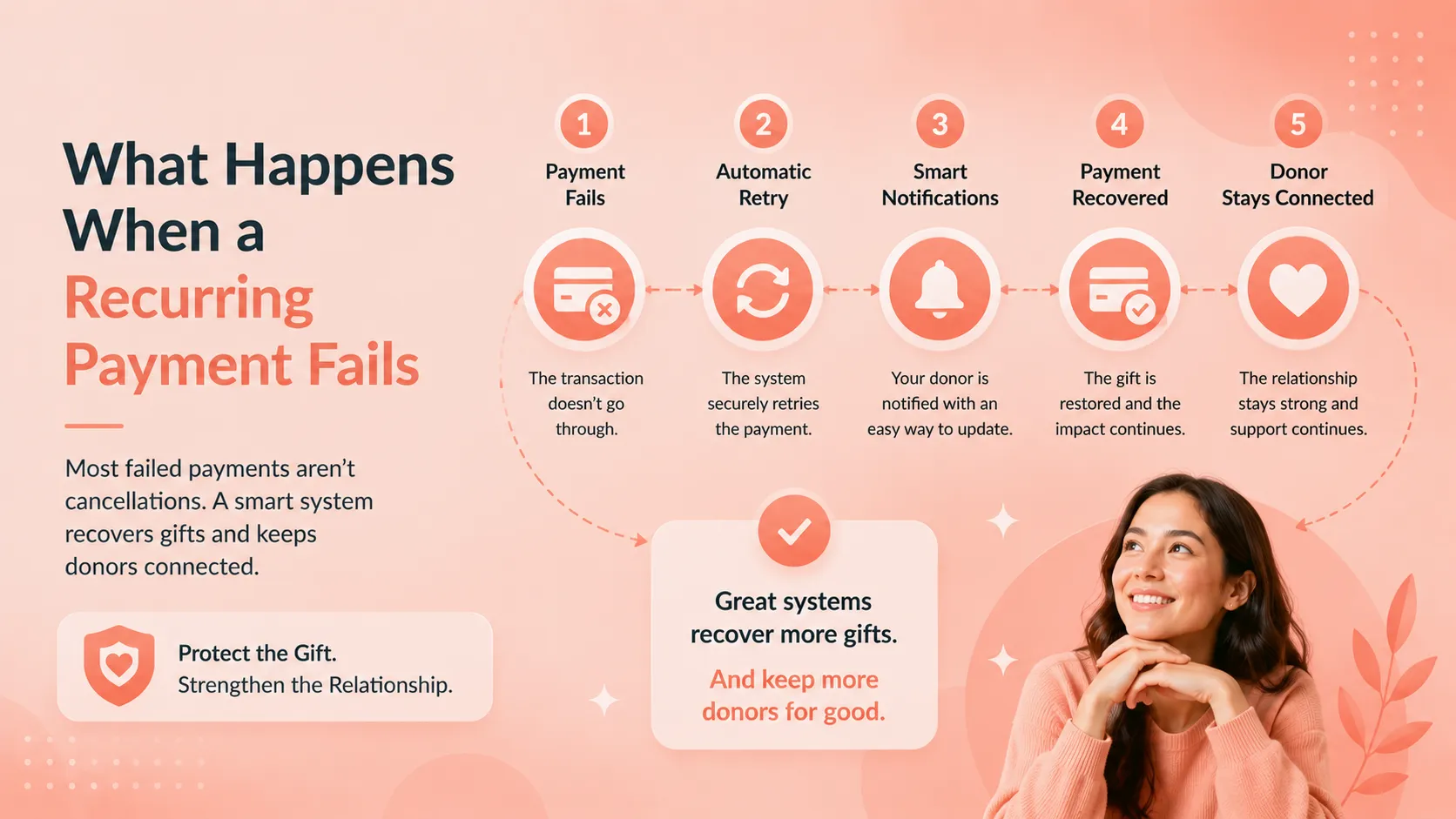
According to GoCardless, recurring payments fail at an average rate of 14.6%, compared to 11.35% for one-time transactions. Most of those failures are not donors choosing to leave. They are expired cards, replaced cards, and routine bank declines.
The fix is a recovery workflow that starts automatically and escalates only when it has to.
That means smart retries after the initial failure, failed payment notifications that give donors a direct link to update their payment details, and proactive expiring card reminders before a charge even attempts.
For organizations open to bank-based options, bank-to-bank recurring payments can achieve failure rates as low as 0.5%. Offering ACH is not just a convenience feature. It is a churn prevention tool.
When automated recovery does not resolve the issue, human follow-up should kick in. Define when a plan moves from "failing" to "suspended" to "ended." That process clarity keeps your team responsive and your reporting accurate.
Automating the Donor Relationship ❤️
Donation automation handles the transaction. Donor stewardship keeps them giving.
Effective donor onboarding for recurring programs starts with a confirmation email covering the amount, cadence, next charge date, and a link to manage the gift. A mission-centered welcome email that explains what the gift supports. A first impact update within the first few weeks. And automated member emails that keep donors connected without requiring individual staff attention on every message.
From there, a lightweight but consistent communication cadence does the long-term work. A short impact touchpoint every month or two. A deeper story quarterly. An anniversary message that reinforces the donor's identity as a supporter. A recurring donation upgrade ask only after genuine relationship value has been established.
Here is something worth printing out and putting on the wall about recurring donor engagement. Classy found that 38% of recurring donors want more communication, not less. Only 7% wanted fewer touchpoints.
Most organizations are under-communicating with the donors most likely to stay.
On the compliance side, the IRS requires written acknowledgments for contributions of $250 or more, with disclosure rules applying to quid pro quo contributions over $75. Automated receipts and year-end summaries are not administrative extras. They are legally relevant and donor-trust essentials.
Calvary Family of Churches reduced their tax receipt workflow from three to four days of manual work down to a single click after fully automating their recurring giving infrastructure. That is what the operational payoff looks like in practice.
How to Retain Recurring Donors Long-Term
Retention and recurring donor churn are two sides of the same lever, and they respond to very different approaches.
Voluntary churn happens when donors actively choose to stop giving. Involuntary churn happens when a payment fails and no one catches it in time. Treating both the same way means solving the wrong problem half the time.
For voluntary churn, the most preventable cause is a lack of perceived value. Classy found that 73% of recurring donors want to understand the exact impact their donations make. 53% want a chance to connect with the people who benefit. Going quiet after the welcome sequence is one of the clearest churn signals a program can send.
When a donor does want to exit, offer options before the door closes: a payment pause, a reduced amount, a frequency change, or a temporary break that keeps reactivation possible later. Some donors cancel because the current plan is too much right now, not because they want the relationship to end. Giving them a self-service member portal to manage those choices without needing to call anyone keeps the relationship open.
For organizations that want to apply retention principles across both giving and membership programs, membership retention strategies that work at the relationship level are worth studying alongside your recurring giving approach.
Recurring Giving for Nonprofits, Churches, and Associations
The mechanics are universal. The context shapes everything.
For nonprofits, a strong monthly giving program prioritizes source tracking, conversion testing, and retention reporting that shows plan health, not just total revenue. The program is only as strong as the data behind it.
For churches, recurring giving supports regular offerings, recurring tithes, designated ministry funds, and digital giving at events and kiosks. AISDC is a compelling example: after adding a kiosk with recurring options, 62% of donations became recurring and total donations increased approximately 10x. Among the thousands of charities and nonprofits that collect recurring donations, faith-based organizations have found some of the strongest results from low-friction recurring setups.
For associations and membership organizations, recurring donations and membership dues can coexist cleanly, but only when they share one constituent record. If your member data lives in Join It, recurring donations should map to the same contact, tags, and communication history. Separate lists for the same person create duplicated outreach and fragmented giving history. When you set up membership payments, building that connection from the start saves significant cleanup later.
For small nonprofits building their first recurring giving program, the right move is to launch simple. A few clear ask amounts, two or three frequency options, strong thank-you automation, and clean exportable reporting. Project Street Vet grew from zero to 700 monthly donors over three years with exactly that kind of focused, unglamorous approach.
Choosing the Right Recurring Donation Software
The right recurring donation platform is not the one with the most features. It is the one where the right features work reliably together.
When evaluating best donation software for nonprofits, these capabilities matter most:
- Donor self-service to update payment method, pause, cancel, and download receipts
- Smart retry logic and automatic card updater
- ACH and digital wallet support
- Clear recurring plan status history and decline reason reporting
- CRM integration that keeps one clean constituent record
- Automated acknowledgment and year-end summary generation
Reporting depth and CRM integration are the two areas where platforms most consistently disappoint in practice. Those are the details worth pressure-testing before you commit.
Key Metrics That Show Whether Your Program Is Healthy
A total revenue number alone does not tell you whether your recurring program is strong or quietly eroding.
The metrics that reveal actual program health include active recurring donors, monthly recurring donation revenue, failed payment rate, payment recovery rate, recurring donor retention rate, and one-time to recurring conversion rate.
A well-built recurring donation dashboard serves most teams in two layers. A staff view with full operational detail across plan statuses, payment outcomes, and cohort retention. A leadership view with clean trend lines showing program growth and donor count movement.
The benchmark to hold yourself to when working to increase recurring donations: M+R Benchmarks reports 71% of sustainers still active after one year. If your retention is meaningfully below that, the gap almost always lives in the welcome sequence, the impact communication cadence, or the failed payment recovery workflow.
FAQ
What are recurring donations? Recurring donations are preauthorized gifts that process automatically on a fixed schedule, most often monthly. The donor authorizes the amount and frequency once, and the system handles every subsequent transaction.
How do recurring donations work for nonprofits? A donor selects an amount and cadence on a donation form, authorizes a payment method, and the platform processes each scheduled gift automatically. The nonprofit receives a steady revenue stream and communicates impact over time to retain the donor relationship.
What is the difference between recurring donations and one-time donations? One-time donations require a new giving decision each time. Recurring donations remove that friction for the donor and eliminate the ongoing reacquisition cost for the organization.
Can donors pause or cancel recurring donations? Yes, and making that easy is good strategy, not a risk. Donors who can manage their gift without friction are more likely to pause temporarily rather than cancel permanently.
What happens when a recurring donation payment fails? The platform should attempt smart retries, send the donor a direct notification with a payment update link, and escalate unresolved failures to manual outreach. Most failed charges are involuntary, not a donor decision to stop giving.
Are recurring donations tax-deductible? Yes, recurring donations to qualifying charitable organizations are tax-deductible. The IRS requires written acknowledgment for contributions of $250 or more, and year-end summaries help donors file accurately.
How can nonprofits increase recurring donations? Make recurring giving the clearest option on the main donation form, tie each ask amount to a specific mission outcome, and follow up with recent one-time donors after they have experienced real impact.
Can churches accept recurring giving online? Yes. Most modern giving platforms support recurring tithes, designated fund giving, and digital or kiosk-based recurring enrollment. The AISDC and Calvary Family of Churches cases both show strong results from church-based recurring programs.
How are recurring donations different from membership dues? Membership dues are payments tied to access, benefits, or organizational standing. Recurring donations are charitable gifts. For organizations managing both, keeping them on one constituent record prevents data fragmentation and communication confusion.
The Form Is Where It Starts. The Relationship Is What Makes It Last.
Recurring donations do not last because the technology is clever. They last because the organization behind them treats each monthly gift as the beginning of an ongoing conversation, not a completed transaction.
A clear ask. Resilient payment infrastructure. Consistent impact communication. Genuine donor control. Those four things, working together, are what separate programs donors stay in from programs they quietly leave.
If you are ready to see how this looks inside a platform built for both giving and membership management, book a demo to explore what the right setup makes possible. Or start a free trial and build your first recurring program today.
Sources
- Fundraising Effectiveness Project. FEP Q4 2025 Report
- Neon One. 2026 Recurring Donor Report
- M+R Benchmarks. Fundraising Benchmarks
- GivingTuesday Data Commons. Recurring Giving Research
- Neon One. 2024 Recurring Giving Report
- Classy. 2021 Recurring Donor Sentiment Report
- M+R Benchmarks. 2025 Key Findings
- Worldpay. Global Payments Report 2025
- GoCardless. Consequences of Failed Payments
- GoCardless. Reducing Involuntary Churn
- IRS. Charitable Contributions: Written Acknowledgments

Guides from the Experts
Through our work with 4,000+ organizations - we’ve put together helpful guides to assist; regardless of where you are on your journey.
.webp)

A Complete Guide to Membership Organizations
Everything you need to know to manage and grow your membership business
.webp)
Maximize Membership Retention: 10 Proven Strategies
Tried and true strategies that not only win membership, but keep them

Build a Membership Website: A Step-by-Step Guide
Your one-stop resource for knowing all the features your modern membership website needs
Ready to start your free trial?
Our membership software is intuitive to use and even easier to test for yourself.