How to Increase Your Membership Retention Rate
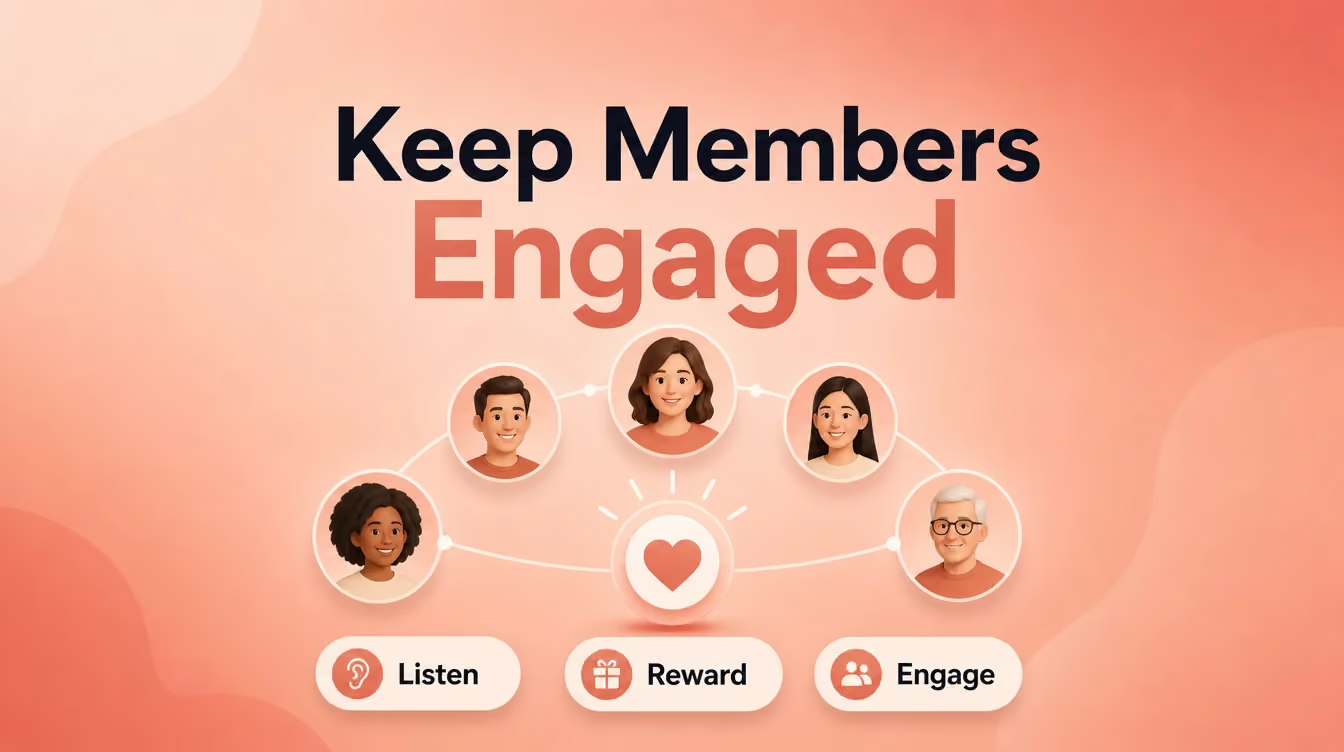


Most membership organizations treat retention like a fire drill. Ignore it for eleven months, then scramble when renewal invoices go out.
The result is predictable. Members leave quietly, revenue shrinks, and the recruitment hamster wheel spins faster every year.
Here is the good news: retention is not a mystery. It is a measurable, fixable system. And the organizations doing it well are not smarter. They are simply more deliberate about it.
This article covers what your membership retention rate actually means, how to calculate it correctly, what the benchmarks say, why members leave, and which tactics genuinely move the needle based on real research, not guesswork.
Key Takeaways
- Membership retention rate and renewal rate are not the same calculation. Using the wrong formula makes your number look better than it actually is.
- First-year members lapse at a significantly higher rate than long-term members. They need separate tracking and a dedicated onboarding path.
- Lack of engagement drives more nonrenewals than dissatisfaction. Members who are about to leave rarely say so first.
- A 50% renewal rate means the average member stays roughly 2 years. At 80%, that stretches to roughly 5 years, and that difference compounds across dues, referrals, and participation over time.
- Most churn is decided long before the renewal invoice arrives. Year-round engagement is what moves the number, not a last-minute email sequence.
- Expired cards and failed payments create involuntary churn that has nothing to do with how much a member values their membership.
- Join It is rated Excellent on Trustpilot and gives membership organizations the tools to track retention metrics, automate renewal reminders, recover failed payments, and manage the full member lifecycle in one place.
Quick Answer: How to Increase Your Membership Retention Rate
Organizations that consistently improve member retention share six habits:
- Onboard new members through a structured first-30-day path, not just a single welcome email
- Drive members toward a first meaningful action before passive habits form
- Keep membership value visible year-round, not only at renewal time
- Identify at-risk members before the renewal invoice arrives
- Reduce friction in payments, portals, and renewal flows
- Reactivate lapsed members with campaigns built around the actual churn reason
The most important thing to understand: retention starts on day one, not when the invoice is due. To improve it, you first need to measure it correctly.
What Membership Retention Rate Means and Why It Matters
Membership retention rate measures the share of your prior member base that remains active after a defined period. In plain terms, it answers one question: of the members who could have stayed, how many actually did?
Think of it as a lifecycle health metric, not a renewal-season number. Organizations that track it only once a year tend to miss the warning signals that appear months earlier in member behavior.
The economic logic is straightforward. A 50% renewal rate implies roughly 2 years of average member tenure. Push that to 80% and average member tenure stretches to roughly 5 years, which means far more dues income, event participation, referrals, and non-dues revenue from the same person, all without adding to your recruitment budget.
Retention Rate vs. Renewal Rate vs. Churn Rate
These three terms appear interchangeably in most organizations. They are not the same thing.
How to Calculate Membership Retention Rate
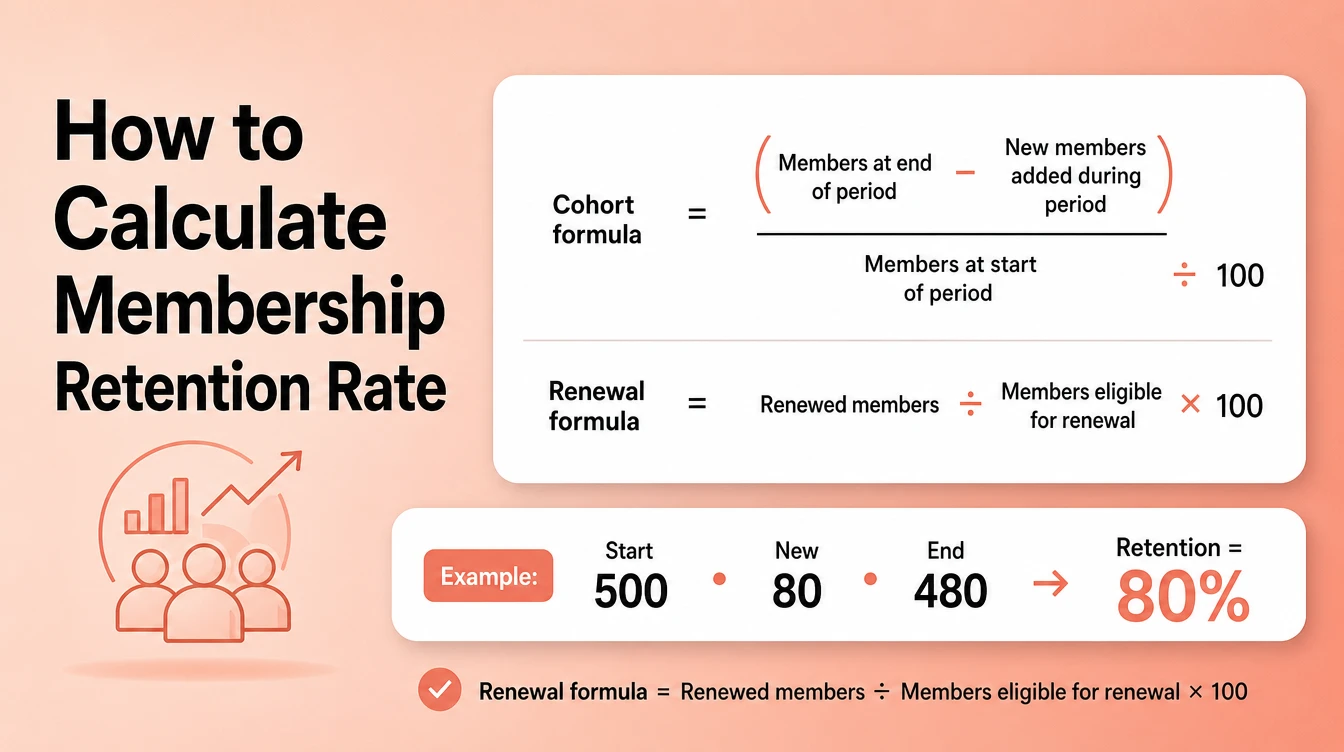
Two formulas are used most commonly, and both work when applied consistently.
Cohort-style membership retention rate formula:
(Members at end of period - New members added during period)
divided by Members at start of period, multiplied by 100
Renewal-style formula:
Renewed members divided by Members eligible for renewal, multiplied by 100
The critical difference: the cohort formula strips out new joins so you measure only retained members. The renewal formula measures what share of eligible renewals actually converted. Both are valid. Consistency in defining your time window and cohort is what matters.
Worked example:
Your organization started the year with 500 members. You added 80 new members during the year. You ended with 480 members total.
Retained members: 480 - 80 = 400
Annual membership retention rate: 400 / 500 x 100 = 80%
The most common calculation mistake is including new members in the retained count. This inflates your rate and hides real churn underneath the headline number.
What Is a Good Membership Retention Rate?
According to MGI's 2025 Membership Marketing Benchmarking Report, the median association renewal rate is 84%. An earlier MGI benchmarking summary reported an average individual-association renewal rate of 79%.
That gives you a practical reference range for average member retention rates: high-70s to mid-80s is common territory for associations.
One important caution worth repeating: avoid importing gym membership retention rates, SaaS churn benchmarks, or subscription service numbers into your association planning. Those models are structurally different and the numbers will mislead more than they inform.
What counts as "good" also depends entirely on your organization's model. Employer-paid memberships renew differently than self-paid ones. High-dues organizations face more cost scrutiny at renewal than low-cost community clubs. Local groups behave differently from national societies. Your most useful membership retention benchmark is your own trend line over three to five years, segmented by member type and cohort.
Why Members Do Not Renew
The research and the real-world complaints line up uncannily well here.
Members leave for two main reasons: lack of engagement and inability to justify the cost. This pattern has shown up year after year in association benchmarking. In 2022, 52% of association executives cited lack of engagement as the primary nonrenewal reason, up from 50% the previous year.
Real members put sharper language on the same problem. In a public discussion about chamber memberships, one small-business owner said the only time they heard from their chamber was when dues were due. Events felt irrelevant. There was no tangible value between renewal moments.
A Toastmasters member described being bombarded by renewal emails after already deciding not to renew. That complaint reveals something important: the problem is rarely too few emails. It is not enough relevant, value-bearing contact during the year, followed by too much blunt renewal pressure at the end.
Academic research adds another layer. In a study of 13,229 members across 18 professional associations, Ki and Wang found that members' perceptions of personal and professional benefits were directly tied to renewal intent and likelihood to recommend. When benefits feel vague or easily replaced by outside alternatives, members leave.
Then there is the operational side. Across the membership sector, the same digital pain points keep appearing: inability to measure engagement, multiple disconnected databases, and limited self-service. These are not edge cases. They are common infrastructure failures that quietly drive member churn without ever showing up in a renewal survey.
How to Increase Your Membership Retention Rate
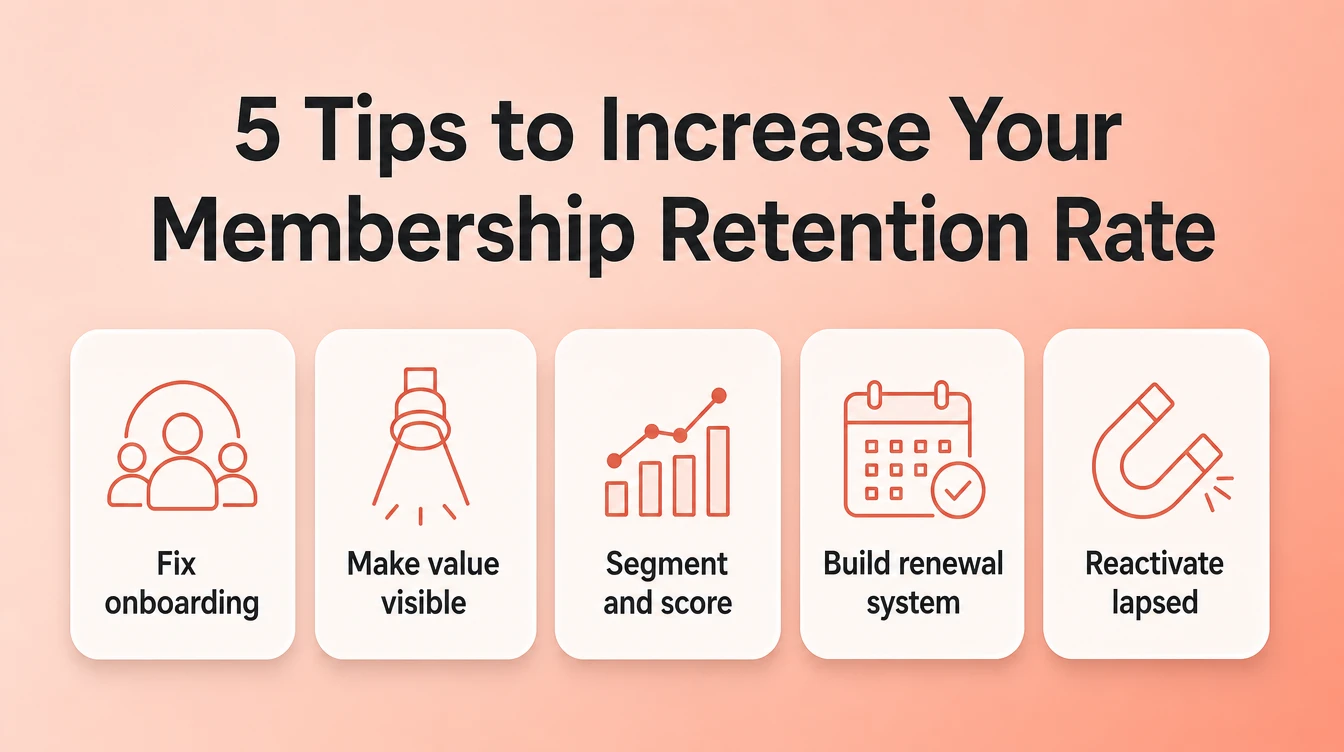
Effective member retention strategies share one common trait: they address the full member lifecycle, not just the final renewal window. Here is how to build that system stage by stage.
1. Fix Onboarding First
Most organizations send a welcome email and consider onboarding complete. Most associations still lack a structured first-year engagement plan, and that gap is one of the most preventable causes of early churn.
A practical new member onboarding sequence includes:
- A new member welcome email on the day of joining
- A benefits page or members-only content linked immediately after signup
- One clear next action prompted within the first week
- Follow-up touches over the first 30 to 90 days
Members who complete at least one non-dues transaction in their first year are significantly more likely to renew. The metric to prioritize is not open rate. It is time to first meaningful action: first event attended, first resource downloaded, first community post, first volunteer shift.
Track your new member retention rate separately from your mature-member rate. Overall engagement can look healthy while new members quietly fail to activate, and blending the numbers together hides that problem completely.
2. Make Value Visible, Not Just Available
This is where most membership organizations underperform. Benefits exist somewhere on a page. Members cannot find them, do not understand them, or cannot connect them to their actual goals.
The fix is translating benefits into outcomes. Instead of listing features, show members what they gain: career growth, business visibility, advocacy support, referrals, community belonging, mission impact. Chambers that do this well, like the Boston Chamber of Commerce, foreground concrete outcomes on their benefits pages rather than vague membership promises.
A better membership experience does not happen by accident. It requires quarterly benefit reminders, member success stories, a member impact report, and anniversary messages that keep value front of mind throughout the year. Digital membership cards are one practical way to make membership tangible and visible in everyday life, not just at renewal time.
Only 11% of associations in MGI's 2025 benchmarking said their value proposition was "very compelling." That is a significant gap, and it is entirely fixable with more deliberate value reinforcement year-round.
3. Segment Members and Score Engagement Risk
Waiting until non-renewal to notice disengagement is too late. The key is using behavioral signals to identify at-risk members well before renewal season arrives.
A simple engagement score might look like this:
- +3 for event attendance
- +2 for community participation
- +2 for a renewal page click
- -3 for a failed payment
- -2 for no portal login in 90 days
- -2 for several consecutive unopened emails
The goal is a live at-risk member view that captures early warning signs of disengagement, reviewed monthly rather than only before invoices go out. A well-organized member database with clean status definitions, active, expired, grace period, lapsed, and reinstated, makes it straightforward to identify inactive members and run targeted segmentation without manual scrambling before every renewal cycle.
Only 43% of organizations say it is easy to access the performance data they need, per iMIS's 2026 benchmarking. That data gap is itself a retention problem hiding in plain sight.
4. Build a Renewal System, Not Just a Reminder
A single renewal email is not a renewal strategy. Renewal is a multi-stage workflow:
- 30 days before expiration
- 7 days before expiration
- Day of expiry
- One or two grace-period follow-ups
Automated renewal reminders reduce manual follow-up burden and ensure every member receives consistent, well-timed outreach across the cycle. Personalized renewal reminders that reference what the member actually used consistently outperform deadline-only notices.
Where it fits the membership model, auto-renewal through recurring billing eliminates "forgot to renew" churn almost entirely. Roughly a third of individual membership organizations offer automatic annual card renewal, and those that do see substantially stronger renewal outcomes, especially for first-year members.
A member portal where members can renew, update payment details, and retrieve receipts without staff intervention removes the friction that quietly kills conversions. Test your own renewal flow from a real member's perspective before the next cycle opens.
For failed payments, retry logic makes a measurable difference. Stripe's Smart Retries uses machine learning to choose optimal retry timing, reducing involuntary churn from temporary card failures or expired payment methods.
5. Reactivate Lapsed Members Before Writing Them Off
Win-back programs are both a revenue opportunity and a diagnostic tool. Associations with the highest renewal rates are significantly more likely to keep contacting lapsed members beyond a single attempt, rather than abandoning them after one "we miss you" email.
Build a targeted lapsed member reactivation campaign for each churn reason:
- "Forgot to renew" members need a simple, frictionless prompt
- "Payment failed" members need a direct card update link
- "Not using enough" members need a value case tied to their interests
- "Price concern" members need a return-on-investment story
Prioritize recently lapsed members first for any re-engagement effort. The longer the gap since lapse, the more your outreach has to rebuild relevance rather than simply restore a payment.
Membership Retention Strategies by Organization Type
The right approach depends on what your members are actually buying, and what makes them leave.
The Metrics That Actually Matter
Strong membership management routines track both lagging and leading indicators, not just the headline retention rate.
Lagging indicators tell you what already happened:
- Overall membership retention rate and annual churn rate
- First-year renewal rate by activation behavior
- Reactivation rate for lapsed members
- Renewal rate by member segment
Leading indicators tell you what is about to happen:
- Time to first meaningful action for new members
- Event attendance trends across member cohorts
- Failed payment rate and resolution time
- Portal login frequency over rolling 30 and 90 day windows
- Email engagement depth by segment
A membership CRM that centralizes member data, communication history, and engagement signals turns these metrics from spreadsheet exercises into a clear membership retention dashboard your team and board can act on weekly. When you track event attendance and check-ins alongside renewal behavior, you start to see which participation types predict loyalty specifically within your organization, not just in someone else's benchmark study.
A 90-Day Membership Retention Action Plan
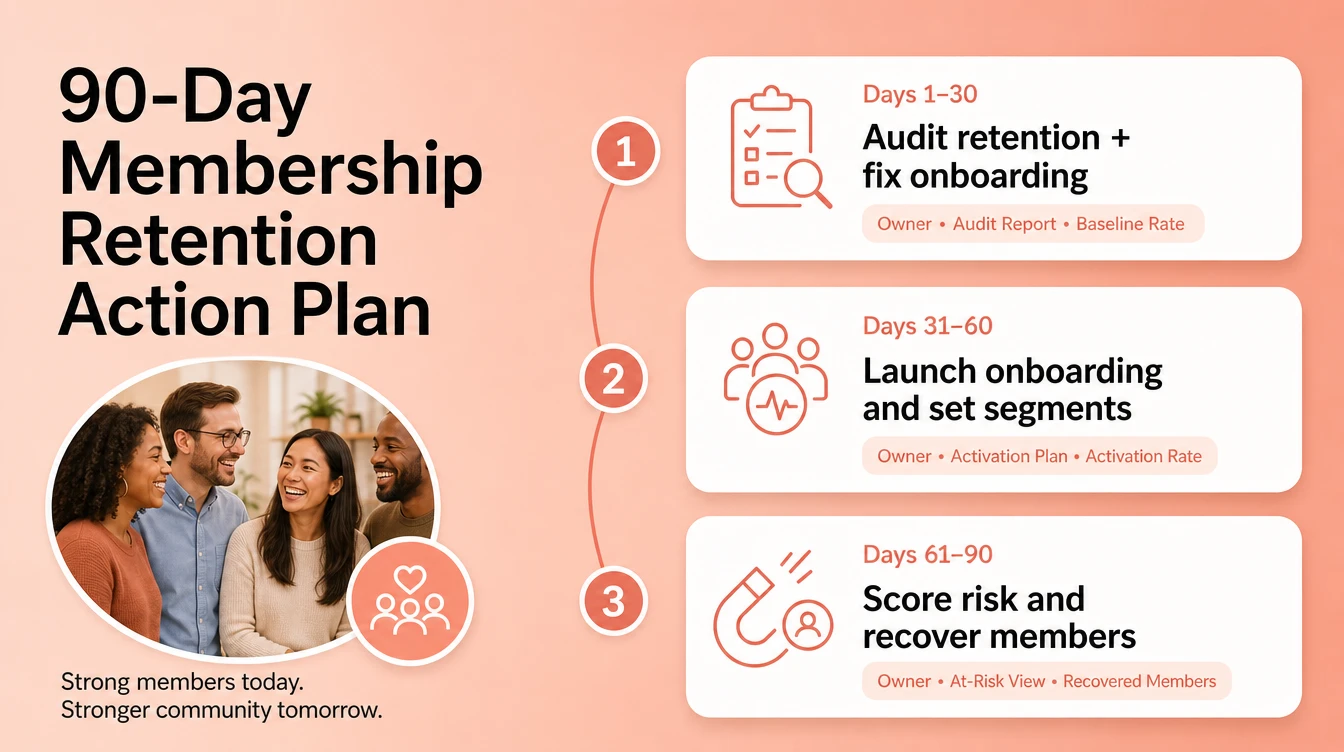
You do not need to overhaul everything at once. Start here.
Days 1 to 30: Calculate your actual retention rate using the cohort formula. Audit your member statuses. Identify where onboarding, renewal, and payment flows break down. Gather real churn reasons from your most recently lapsed members.
Days 31 to 60: Launch a structured onboarding sequence for new members, using a member onboarding checklist to keep each step consistent. Rewrite benefit descriptions as member outcomes, not organizational features. Test your renewal flow from a member's perspective. Set up basic lifecycle segments.
Days 61 to 90: Build a simple engagement score. Create a live at-risk member view. Activate grace-period reminders and failed-payment recovery. Launch a reactivation campaign targeting members who lapsed most recently.
Each phase should have one clear owner, one deliverable, and one metric that tells you whether it is working.
Frequently Asked Questions
What is membership retention rate?
Membership retention rate is the percentage of members from a prior period who remain active in a later period. It measures how many members who could have stayed actually did, excluding new joins from the calculation.
What is the membership retention rate formula?
The cohort-style formula: members at end of period minus new members added, divided by members at start of period, multiplied by 100. The renewal-style formula: renewed members divided by members eligible for renewal, multiplied by 100.
How do you calculate membership retention rate?
Start with your member count at the beginning of the period. Subtract new members added during the period from your end count to get retained members. Divide retained members by starting members and multiply by 100. This is the cohort-based calculation that most associations use.
What is a good membership retention rate?
For associations, MGI's 2025 Membership Marketing Benchmarking Report reports a median renewal rate of 84%. An earlier MGI summary reported an average of 79% for individual associations. High-70s to mid-80s is common public benchmark territory, though the right average member retention rate target depends on your membership model, member type, and dues structure.
What is the difference between retention rate and renewal rate?
Retention rate measures what share of your prior member cohort stayed active, typically excluding new joins. Renewal rate measures what share of members eligible to renew actually did renew. For annual membership programs the numbers are often close, but the cohort definition and framing differ meaningfully.
What is the difference between churn rate and retention rate?
Churn rate is the inverse of retention rate. An 80% annual membership retention rate equals a 20% member churn rate. Churn is useful in board reporting because it shows loss directly rather than framing it inside a positive percentage.
How do you reduce member churn?
Reducing member churn starts with fixing the causes before they reach renewal. Build a structured onboarding path, communicate membership value year-round, identify at-risk members through engagement signals, and reduce friction in the renewal process. Addressing failed payments and offering auto-renewal options also eliminate a significant share of involuntary churn.
Why do members not renew?
The top reasons are lack of engagement and inability to justify the cost, a pattern that runs through years of association benchmarking data. Poor communication timing, invisible benefit value, and renewal friction are the most common operational causes underneath those top-line answers.
How do you increase membership renewals?
Start before renewal season by improving onboarding, keeping value visible year-round, and identifying at-risk members early. Then build a multi-touch renewal workflow, reduce payment friction, and offer recurring billing where it fits. These steps together move the needle far more than any single renewal email ever will.
How do you win back lapsed members?
Segment by churn reason rather than sending one generic win-back message. "Forgot to renew" members need a simple prompt. "Payment failed" members need a direct update link. "Low usage" members need a value case. Prioritize members who lapsed within the last 90 days while the relationship is still warm.
One Last Thing
The organizations with the strongest membership retention rates are not the ones sending the most renewal emails.
They are the ones who designed a membership worth staying for, tracked the behavioral signals that predict churn before it happens, and built operational systems that do not depend on one person, one season, or one frantic month of follow-up.
When manual renewal workflows start limiting what your team can actually do, membership management software gives you the infrastructure to manage reminders, payments, statuses, and reporting in one organized place.
If you want to see what that looks like for your specific organization, see how Join It can simplify membership management.
And when you are ready to put the system in place, start a free trial and build your first retention workflow before your next renewal cycle begins.
Sources
- Marketing General Incorporated. Renewals, the Key to Your Organization
- Marketing General Incorporated. 2025 Membership Marketing Benchmarking Report
- Marketing General Incorporated. How to Measure Member Engagement
- Reddit. Has Anyone Left Their Local Chamber of Commerce?
- Reddit. Bombarded by Emails to Renew
- Ki and Wang. Membership Benefits Matter
- Boston Chamber of Commerce. Membership Benefits
- Marketing General Incorporated. Membership Marketing Benchmarking Report, 12th Edition
- Stripe. Developer Documentation
- Marketing General Incorporated. Reinstatement: Step Five in the MGI Membership Lifecycle

Guides from the Experts
Through our work with 4,000+ organizations - we’ve put together helpful guides to assist; regardless of where you are on your journey.
.webp)

A Complete Guide to Membership Organizations
Everything you need to know to manage and grow your membership business
.webp)
Maximize Membership Retention: 10 Proven Strategies
Tried and true strategies that not only win membership, but keep them

Build a Membership Website: A Step-by-Step Guide
Your one-stop resource for knowing all the features your modern membership website needs
Ready to start your free trial?
Our membership software is intuitive to use and even easier to test for yourself.