Best Association Management Software for Multi-Chapter Organizations (2026)


Summary of the Article
The best association management software for a multi-chapter organization depends on who owns member records, collects dues, and controls local access. Join It is worth evaluating when chapters need independent accounts with headquarters visibility. Organizations that require one shared member record or automatic national and chapter dues allocation should make those workflows explicit requirements in every demo.
No single platform wins for every structure. The question that matters most is how the headquarters-to-chapter relationship works in each system. This article is published by Join It, which appears in the comparison. Every entry reflects vendor documentation reviewed for this piece, not hands-on testing.
Which multi-chapter model fits your association?
Start with three decisions: whether chapters keep separate records or share one database, whether dues are collected locally or centrally, and which actions headquarters and chapter administrators can take. A consolidated dashboard answers a reporting question; it does not by itself establish a shared member record or split-payment workflow.
For Join It, each chapter has its own account and headquarters can review connected chapters. Test a person who belongs to two chapters, a chapter administrator updating a record, and the totals headquarters sees. Ask the team to scope the account structure and required reporting before choosing a package.
What multi-chapter association management software must do
Running one chapter is hard enough. Running 12, 40, or 300 chapters adds a second layer: headquarters needs a clear picture, while each chapter still serves its own members locally. Association management software (AMS) for multi-chapter organizations has to make that split work.
Before comparing vendors, write down who owns member records, who collects dues, who can edit information, and which reports each team needs. If you are still building that picture, the site's broader multi-chapter membership management guide walks through the operating models in more depth, and How to Compare Membership Software covers the general evaluation method. If you are not yet sure chapter-level control is your main requirement at all, the broader comparison in Best Association Management Software for Professionals evaluates general AMS options for associations without a chapter focus.
The shortlist at a glance
Join It: independent chapter accounts with headquarters visibility
Join It is cloud-based membership management software that handles member records, dues and payments, automated renewals, digital membership cards, events, donations, and a member self-service portal.
For multi-chapter organizations, Join It's model is one account per chapter. Each chapter manages its own members, payments, and records, while headquarters gets a consolidated view across all of them. Dues can be collected at the chapter level. The Multi-Chapter Management feature page describes this setup in detail, and the Multi-Chapter Membership Software category page lays out the plan structure: multi-chapter is an Enterprise plan scoped with the team, so you talk through your chapter count and needs with the Join It team rather than picking a tier off a price sheet.
Best fit: Organizations whose chapters run their own operations day to day, but where headquarters still needs to see the whole picture.
What to test in a demo: Show a member who belongs to two chapters and ask how they appear in reports. Check what a chapter administrator can view, edit, and export. Ask how chapter-level dues show up in headquarters reporting.
Tradeoff: Because chapters run separate accounts, groups that need one shared member record and centrally managed dues splitting should confirm exactly how that would work before committing.
Glue Up: connected chapter operations, engagement, and communications
The documented structure includes unlimited chapter creation, two- or three-level hierarchies, chapter-level admin roles, granular permissions, and data visibility controls. Headquarters can aggregate data across chapters while each chapter keeps autonomy over its own workflows. A chapter inclusion feature lets members join selected chapters through one membership application, with fixed, volume, or graduated pricing models, and the umbrella organization controls approvals from one workflow manager. Glue Up also documents split payments and finance integrations with tools like QuickBooks, Sage Intacct, and Xero.
MemberNova: multi-level hierarchies and dues relationships
MemberNova built its association management system around multiple entities and hierarchies. Its multi-chapter management software page documents a centralized chapter database where each chapter can operate like its own space, with custom roles, chapter-level directories, and roll-up reporting for chapter executives.
The dues side is where MemberNova gets specific. The vendor documents combined dues and payment structures with recurring billing, installments, and chapter-specific promo codes. Member account statements consolidate charges from national, regional, and chapter levels into one statement, which answers a real headache for members who interact with several parts of the organization.
Best fit: Organizations with layered structures, such as national, regional, and local levels, where dues relationships between levels are complicated.
What to test in a demo: Map your actual hierarchy onto the system during the demo. Ask how a member who upgrades or moves between levels is handled, and how roll-up reports treat people who appear at more than one level.
Tradeoff: Pricing is quote-based, and a structure-heavy system rewards teams that invest time in setup. Ask what configuration support is included.
GrowthZone: chambers and mid-size associations
GrowthZone sells association management software through a family of products, which matters for multi-chapter buyers because fit depends on which product you land on:
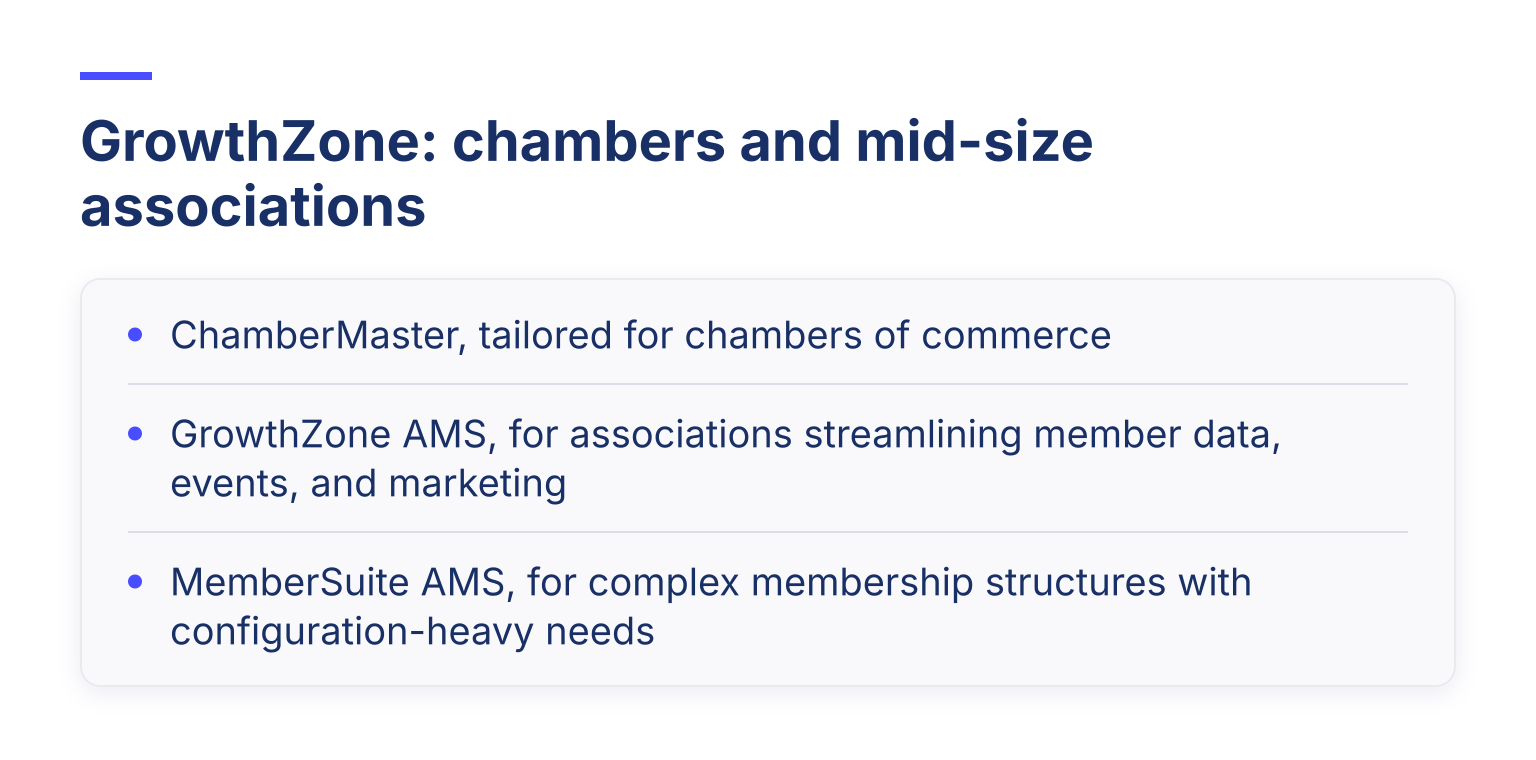
The products overview describes all three as part of one ecosystem with add-ons for learning, community, payments, and websites. GrowthZone publishes package tiers (Starter, Engage & Grow, Enterprise) that differ mainly in user seats and email volume, so check seat limits against your combined HQ-plus-chapter admin team. The company reports serving more than 4,700 organizations.
Best fit: Chambers and mid-size associations that want to grow into a bigger product rather than switch vendors later.
What to test in a demo: Confirm which product in the family your structure actually calls for, and what happens when a chamber member also belongs to a state association. Ask about data migration support between products if you expect to scale.
Tradeoff: Multiple products mean multiple conversations during evaluation. Make sure you compare the right one to the other vendors on this list.
Fonteva: associations already on Salesforce
Fonteva is association management software built natively on Salesforce. Its association management page documents the ability to organize chapters, committees, and business groups inside the platform, alongside member management, events, communities, and eCommerce.
Because Fonteva runs on Salesforce, your member data lives in the same system as your CRM records, and the vendor documents Fonteva Payments, a payments solution built on Stripe. For a multi-chapter organization with in-house Salesforce expertise or an existing Salesforce investment, that foundation can avoid integration work other vendors need.
Best fit: Trade associations and professional societies already running Salesforce who want membership management on the same platform.
What to test in a demo: Ask how chapters and committees are modeled in the data structure and how chapter-level reporting works. Request a realistic implementation timeline with your own Salesforce setup.
Tradeoff: Salesforce-native means Salesforce licensing and administration are part of your total cost and skill requirements. If nobody on your team knows Salesforce, budget for that learning curve.
MemberClicks: small-staff association operations with two editions
MemberClicks is association management software from Momentive Software, connecting more than 6 million members across 3,000-plus associations and chambers by the vendor's count. It comes in two editions, and the distinction matters for chapter-based groups:
MemberClicks publishes pricing starting at $4,500 annually for MC Professional, with final quotes depending on organization size and needs, so confirm current numbers on the vendor's site. For multi-chapter use, ask specifically how chapter administration is handled within the edition you are considering, since the vendor's marketing centers on single-association operations.
Best fit: Small-staff associations that want approachable software with real implementation support.
What to test in a demo: Ask directly how the platform supports chapter-level record keeping and permissions in the edition you are pricing, and whether any chapter functionality requires MC Trade instead.
Tradeoff: The two editions create a fork in the road. Make sure the edition you need today still fits if your chapter structure grows.
Wild Apricot: a budget-friendly option with per-chapter websites
Wild Apricot is membership management software used by more than 15,000 organizations, and it publishes a dedicated chapters solution covering membership, events, communications, and CRM capabilities across chapters.
Two details stand out for multi-chapter buyers. First, each chapter can get its own customizable website built on shared templates, which keeps branding consistent across accounts. Second, the vendor's pricing page documents volume discounts for multi-chapter organizations, with published plans such as $66 per month for 100 contacts on monthly billing and a 60-day free trial.
Best fit: Budget-conscious multi-chapter groups, especially smaller ones, that want transparent published pricing.
What to test in a demo: With a template-and-separate-account approach, ask how consolidated reporting rolls chapters up and whether dues can be split between headquarters and chapter accounts.
Tradeoff: Published per-contact pricing is easy to budget but check which tier your total member count across all chapters lands in, and what the multi-chapter discount actually covers.
Momentive Software: a portfolio that ranges from small to enterprise
Momentive Software is the parent company behind several names on this page and beyond. Its association management portfolio spans WildApricot and YourMembership at the smaller end up to NetForum, Cobalt, Nimble AMS, and Aptify for larger, more complex organizations.
For a multi-chapter association, that breadth cuts both ways. On one hand, you can start with a lighter product and move within the same vendor family as you grow. YourMembership, for example, is documented as an all-in-one AMS for small-staff associations with automated renewals, engagement scoring, and role-based permissions. On the other hand, evaluating a portfolio means evaluating several products at once, and capabilities differ product by product.
Best fit: Organizations that want a single vendor relationship across growth stages, or that already use one Momentive product.
What to test in a demo: Name the specific product in the portfolio you would actually deploy, then run the same multi-chapter tests you would run anywhere else. Ask what migration between portfolio products looks like.
Tradeoff: Portfolio breadth is not the same as feature depth in any one product. Verify chapter support in the specific product, not the family.
How dues, reporting, and member movement differ across platforms
Three questions expose the biggest differences between these platforms:
Who collects the money? Join It and Wild Apricot both support chapter-level dues collection, though the accounting behind it works differently in each. Glue Up documents split payments that tie each payment to the right chapter. MemberNova consolidates charges from all levels into one member statement. Ask every vendor how a refund and a failed payment flow back through the chapter structure.
What does a "member" mean in your reports? A person who belongs to two chapters can show up as two memberships or one unique person. If your board report needs unique people, confirm the platform can produce that number, not just a count of chapter memberships.
What happens when a member moves? When someone joins a second chapter or relocates between regions, does their original membership end, continue, or transfer? Who makes the change, and does payment history stay with the original chapter? Define the rule before the demo so you can test it.
Total cost and implementation differences
Sticker prices hide the real differences here:
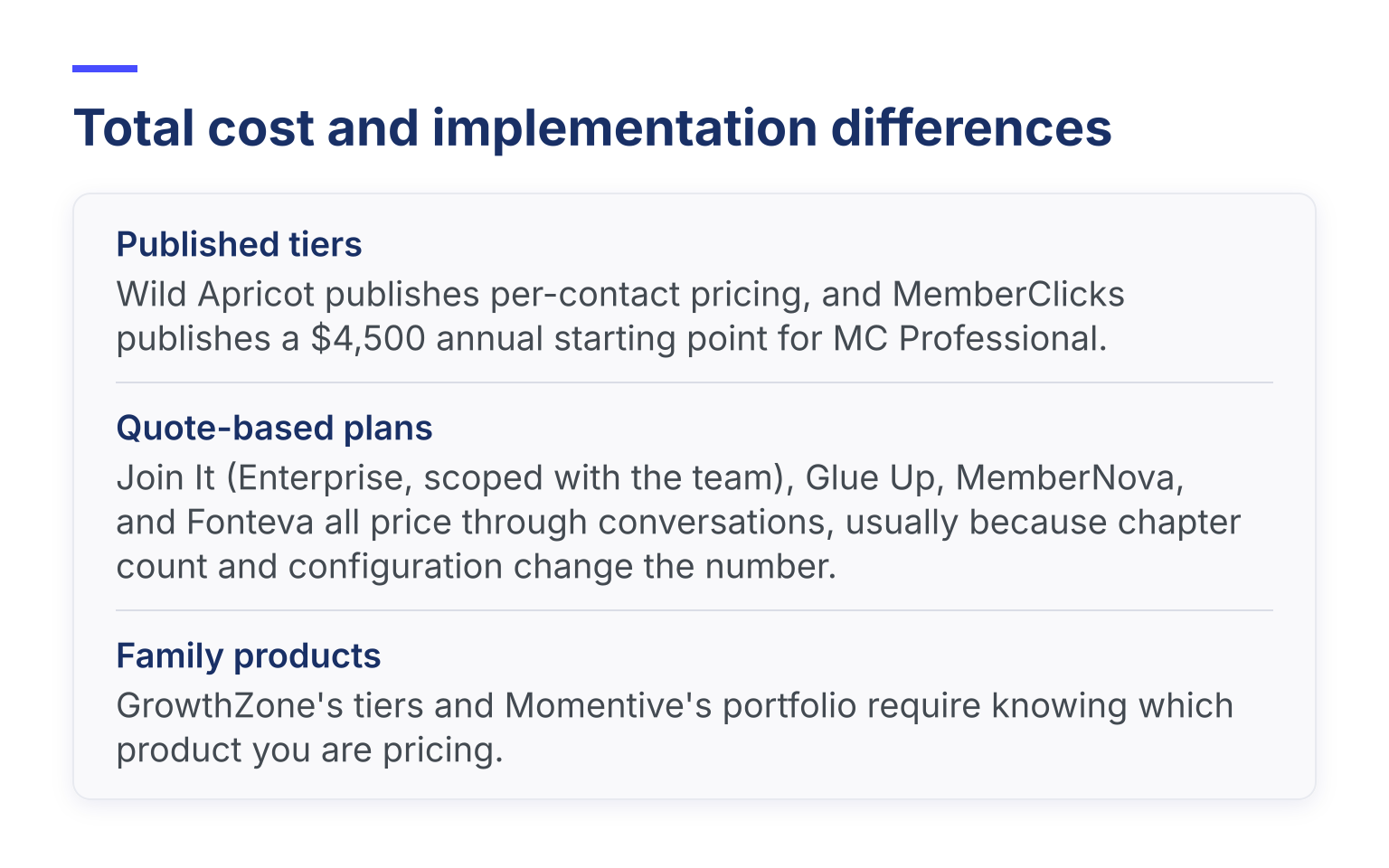
Add implementation to every comparison. A Salesforce-native build such as Fonteva carries Salesforce licensing and administration. Quote-based enterprise plans often include guided configuration, which matters if your headquarters team is small. Ask each vendor what a typical go-live takes for an organization your size and how much of the setup work falls on your staff.
A demo checklist for multi-chapter workflows
Bring this list to every demo. It turns a feature tour into a test of your actual structure:

Frequently asked questions
When is Join It a fit for a multi-chapter organization?
Join It is a candidate when chapters manage their own memberships and payments while headquarters needs visibility across connected accounts. If you need one person record shared across chapters or dues automatically divided among accounts, ask for a demonstration of those exact requirements before deciding.
What is association management software for multi-chapter organizations?
It is an AMS configured to handle a headquarters-to-chapter structure. Beyond standard membership features such as dues, renewals, events, and member records, it defines who controls data at each level, how money flows between headquarters and chapters, and how reports roll up across the organization.
Is separate chapter accounts or one shared database better?
Neither is universally better. Separate accounts suit chapters that manage their own operations and want independence. A shared structure suits associations that need one centrally managed relationship with each person. Ask vendors to demonstrate both models with your own scenarios, including a member who belongs to two chapters.
Does a consolidated dashboard mean dues are collected centrally?
No. A platform can consolidate payment totals for reporting while chapters continue collecting dues separately. If you need one checkout that divides dues between national and local accounts, make that an explicit, tested requirement.
How much does multi-chapter AMS pricing cost?
It varies widely by vendor and structure. Wild Apricot publishes per-contact plans, MemberClicks starts at $4,500 annually for MC Professional, and most enterprise options quote based on chapter count and configuration. Check each vendor's site for current pricing and get chapter count into every quote.
Choose the model that matches how your chapters work
The strongest platform on paper is the one that matches your operating model. If your chapters run their own operations with headquarters oversight, Join It's model of one account per chapter with a headquarters view is built for that shape. If your structure is a tightly connected federation or lives inside Salesforce, Glue Up, MemberNova, or Fonteva will fit better than a lighter tool.
Use the multi-chapter feature guide to discuss your headquarters and chapter structure with the Join It team. You can also start a free trial to explore core membership administration. Confirm the Enterprise multi-chapter setup separately, then use the demo checklist above with every platform you evaluate.

Guides from the Experts
Through our work with 4,000+ organizations - we’ve put together helpful guides to assist; regardless of where you are on your journey.


A Complete Guide to Membership Organizations
Everything you need to know to manage and grow your membership business

Maximize Membership Retention: 10 Proven Strategies
Tried and true strategies that not only win membership, but keep them

Build a Membership Website: A Step-by-Step Guide
Your one-stop resource for knowing all the features your modern membership website needs
Ready to start your free trial?
Our membership software is intuitive to use and even easier to test for yourself.