
Club Membership Management: Complete Guide for Clubs

Somewhere right now, a club treasurer is copying email addresses into BCC by hand. A membership chair is hunting through three different spreadsheets trying to figure out who actually paid. And a volunteer who has run the whole system for five years is about to resign.
Sound familiar?
Club membership management is one of those things that sounds simple until you are the person doing it. It is not just about keeping a list of names. It is about keeping a club alive, organized, and growing, while usually running on volunteer time and goodwill.
This guide covers what club membership management actually is, why it breaks down in real clubs, and how to build a system that works, whether you have 50 members or 5,000.
What this guide covers:
- The club membership lifecycle and where the real gaps appear
- How to build a clean member database before choosing any tool
- Dues collection, renewals, and failed-payment recovery
- Events, communication, and member engagement
- Reducing volunteer admin and making handover survivable
- When to move beyond spreadsheets, and what to look for when you do
Key Takeaways
- Club membership management is an operations and capacity problem first. Software does not fix a process that was never defined.
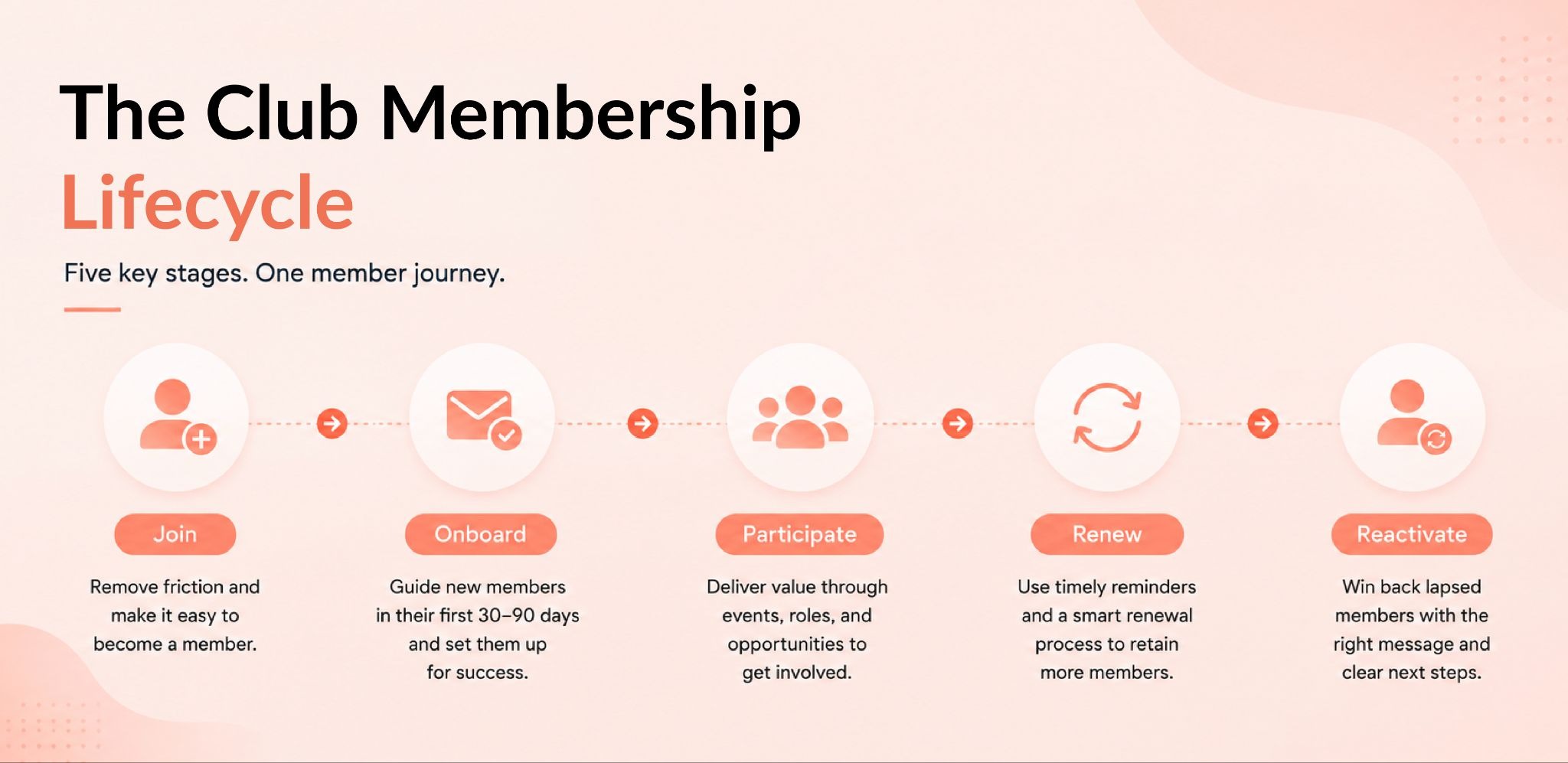
- The membership lifecycle has five stages: Join, Onboard, Participate, Renew, Reactivate. Most clubs quietly lose members at the handoffs between them, not somewhere in the middle.
- One clean member record per person is the foundation. Dues, renewals, events, and communication all become harder when that foundation is fragmented across files.
- Renewal is a sequence, not a single email. Sending one reminder after a membership has already lapsed is the most common and most preventable cause of member drop-off.
- Some "churn" is failed billing, not lost interest. A recovery workflow for failed payments recovers members no reminder sequence ever would.
- A system that lives in one volunteer's head, inbox, or personal laptop is one resignation away from operational collapse. Shared access and documented workflows are not optional extras.
- Spreadsheets become a liability when recurring renewals, online payments, multiple admins, and board reporting are all needed at the same time.
- Join It is rated Excellent on Trustpilot and brings member records, dues collection, renewal automation, event management, and a self-service member portal together in one place built specifically for clubs.
What Is Club Membership Management?
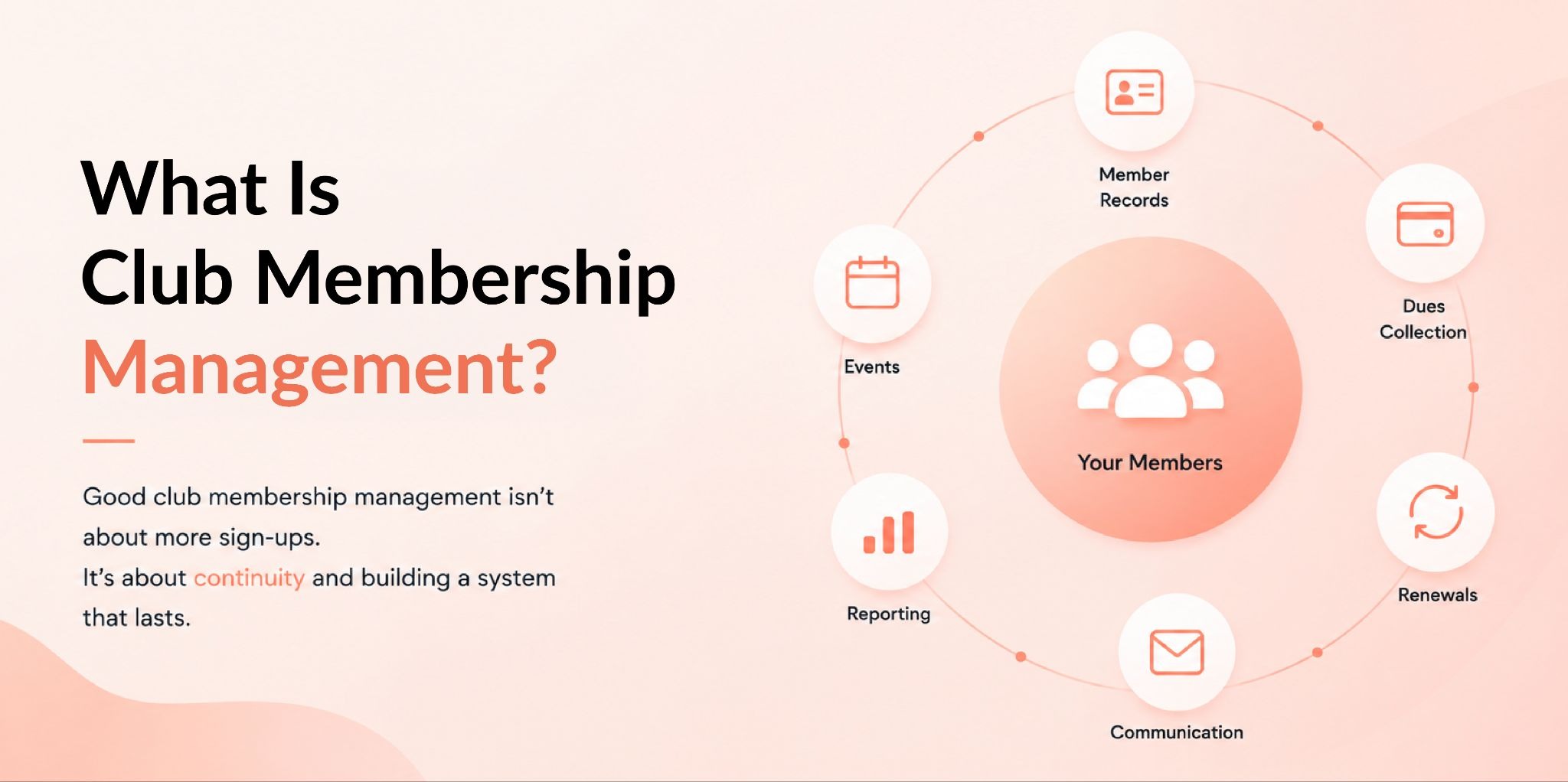
Club membership management is the system a club uses to manage member records, collect dues, track membership status, run renewals, organize events, communicate with members, report results, and hand operations to the next volunteer or board member.
That is a wide definition. And that is entirely the point.
It covers membership organizations of all types: sports clubs, hobby groups, social clubs, community organizations, and private clubs. What they all share is this: they need to know who their members are, whether those members are current, and what to do when they are not.
Good club membership management is not about getting more sign-ups. It is about continuity. It is about building a system that does not collapse when the person who built it decides to move on.
What club membership management is not:
- It is not just a mailing list
- It is not automatically solved by buying software
- It is not the same as club growth
- It is not a spreadsheet of names with no renewal logic attached
The biggest mistake clubs make is treating membership management as an admin task instead of an operational system. That distinction matters more than most clubs realize until something breaks.
The Six Jobs at the Core of It
At its core, club membership management covers six recurring jobs. These are worth knowing by name because they become your framework for evaluating everything else.
Member records. Contact details, join date, expiration date, membership type, payment history, volunteer roles, communication preferences. One clean member database is the foundation everything else sits on.
Dues collection. Annual fees, recurring payments, overdue accounts, and failed-payment recovery. Getting payment friction right saves weeks of chasing.
Renewals. Reminder sequences, grace periods, auto-renew options, lapsed member reactivation. This is where most clubs silently lose members they did not need to lose.
Events. Registration, attendance tracking, and connecting participation data back to the member record. This data is more valuable than most clubs ever use it for.
Communication. Renewal reminders, newsletters, segmented updates by member type or status. One mass email to everyone is not a communication strategy.
Reporting. Monthly dashboards, board visibility, and handover documentation. If the board cannot see the numbers cleanly, the club cannot make good decisions.
How Club Membership Management Changes by Club Type
Sports clubs deal with seasonal renewals, training attendance, team coordination, and often facility or session management. Sports club membership software typically needs to handle session-based participation alongside standard membership records.
Social and hobby clubs tend to be event-heavy. Member directories, newsletters, and volunteer-run administration form the operational core. The challenge is usually that one person does everything, and nobody else knows how.
Community and volunteer-led clubs face the tightest constraints: minimal budget, shared admin needs, and a high risk of institutional memory loss every time leadership changes.
Private clubs often need membership tiers, access control, and member verification. Privacy expectations are higher, and the cost of inaccurate records is greater.
Why Club Membership Management Breaks Down in Real Clubs
Here is what most software comparison pages will not say: bad membership management is almost never a technology problem first.
According to the Charity Digital Skills Report 2025, 69% of charities cited squeezed finances as a significant barrier to moving forward with digital systems, 63% cited lack of headspace and capacity, and 41% cited lack of technical expertise. Just 27% said they did not have a CRM or were relying on spreadsheets.
That last number is deceptively small. The real story is that clubs often know their spreadsheets are fragile and still cannot find the time, confidence, or budget to change them. The Charity Digital Skills Report 2024 reinforced this: 64% of small charities were still at an early stage with digital. That is the landscape most clubs are actually operating in.
What Breaking Down Looks Like in Practice
Club admins on Reddit describe the reality better than any vendor page.
On r/Agility, one user captured it cleanly: "spreadsheets all over the place" and systems that do not talk to each other. Member data in one file, payments in another, event sign-ups in a third.
A community theatre group on r/Theatre described how they desperately needed membership tracking, especially renewal reminders, and how their setup depended entirely on whichever volunteer had the technical skill that year. When that volunteer left, so did the system.
And on r/cubscouts, one admin was still copying email addresses from Google Sheets into BCC by hand. Every single time.
These are not edge cases. This is how a huge number of clubs actually run.
Why the Stakes Are Higher Now
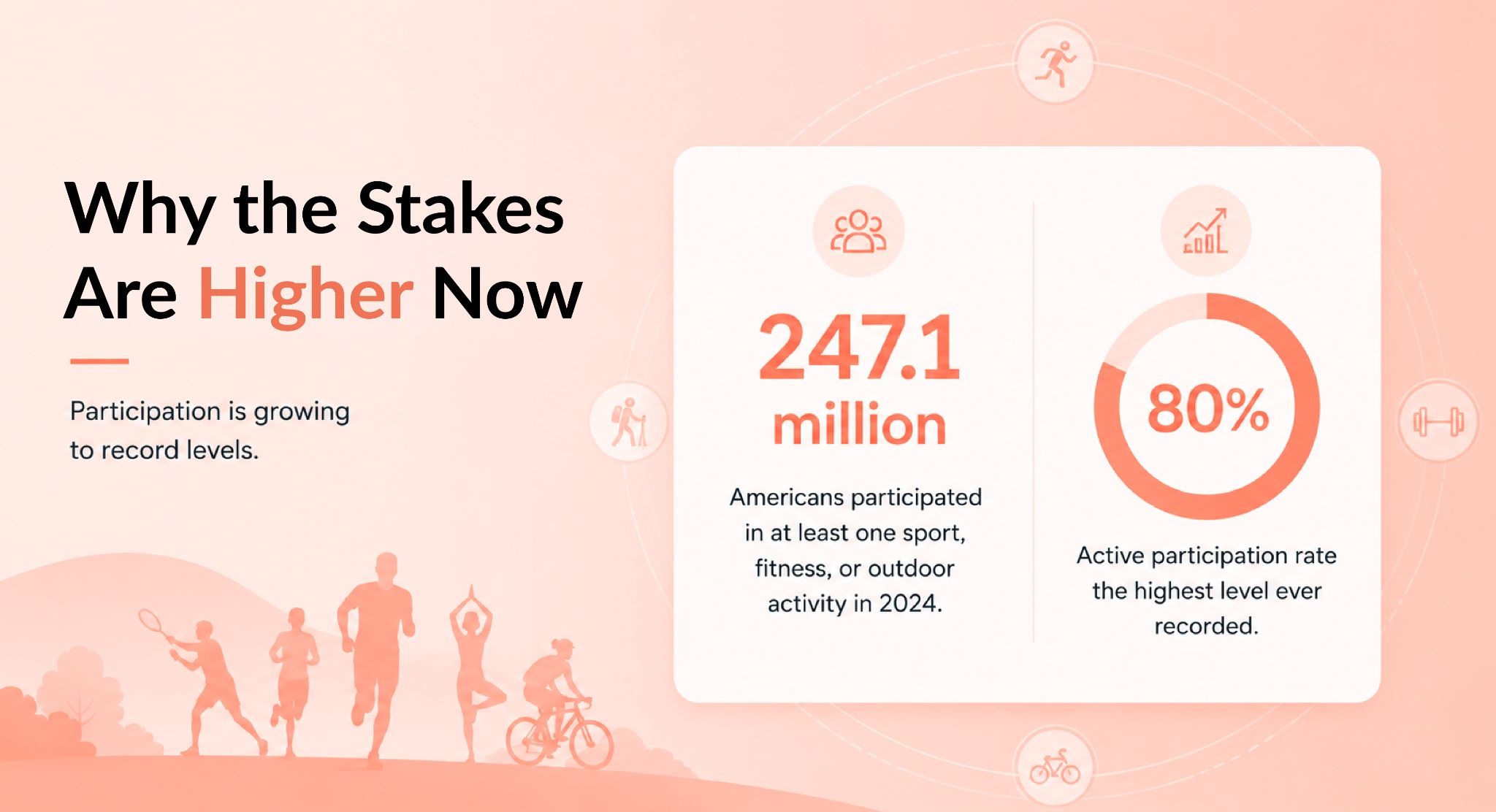
Participation is growing fast. The Sports and Fitness Industry Association's 2025 topline report found that 247.1 million Americans participated in at least one sport, fitness, or outdoor activity in 2024, with active participation reaching 80%, the highest level ever recorded by the association.
More demand with weak systems does not produce growth. It produces chaos.
Volunteer dependence is structural, not accidental. The FA Council Annual Report 2024-25 reported that 1 million volunteers support grassroots football in England alone, with more than 15 million people playing regularly. When an entire sector depends on volunteer labor at that scale, systems that live in one person's inbox become a structural risk, not just an inconvenience.
Members also increasingly expect digital-first payment. The 2024 Diary of Consumer Payment Choice from the Federal Reserve found that more than 60% of payments were made by card, cash fell to just 16% of transactions, and mobile apps handled 50% of person-to-person payments. A club still collecting dues by bank transfer or cash envelope is working against a strong current.
The Club Membership Lifecycle: Join, Onboard, Participate, Renew, Reactivate
Most pages on this topic talk about "managing members" as if it is one undifferentiated job. The real problems happen at the handoffs between lifecycle stages, not in the middle of them.
Join. Someone finds the club and decides to sign up. The friction here matters more than most clubs think. A clunky membership form builder experience, manual approval delays, or a missing confirmation email can lose a member before they ever properly become one.
Onboard. This is not a welcome email. ASAE's membership guidance frames onboarding as a structured first 30 to 90 days: what to do this week, which event to attend first, how to update a profile, who to contact. Clubs that skip real onboarding lose members who simply go quiet and never engage, then do not renew.
Participate. This is where value gets delivered and where retention data lives. Event attendance, committee involvement, volunteer roles, training sessions. A club that tracks none of this has no idea which members are genuinely at risk before renewal season arrives.
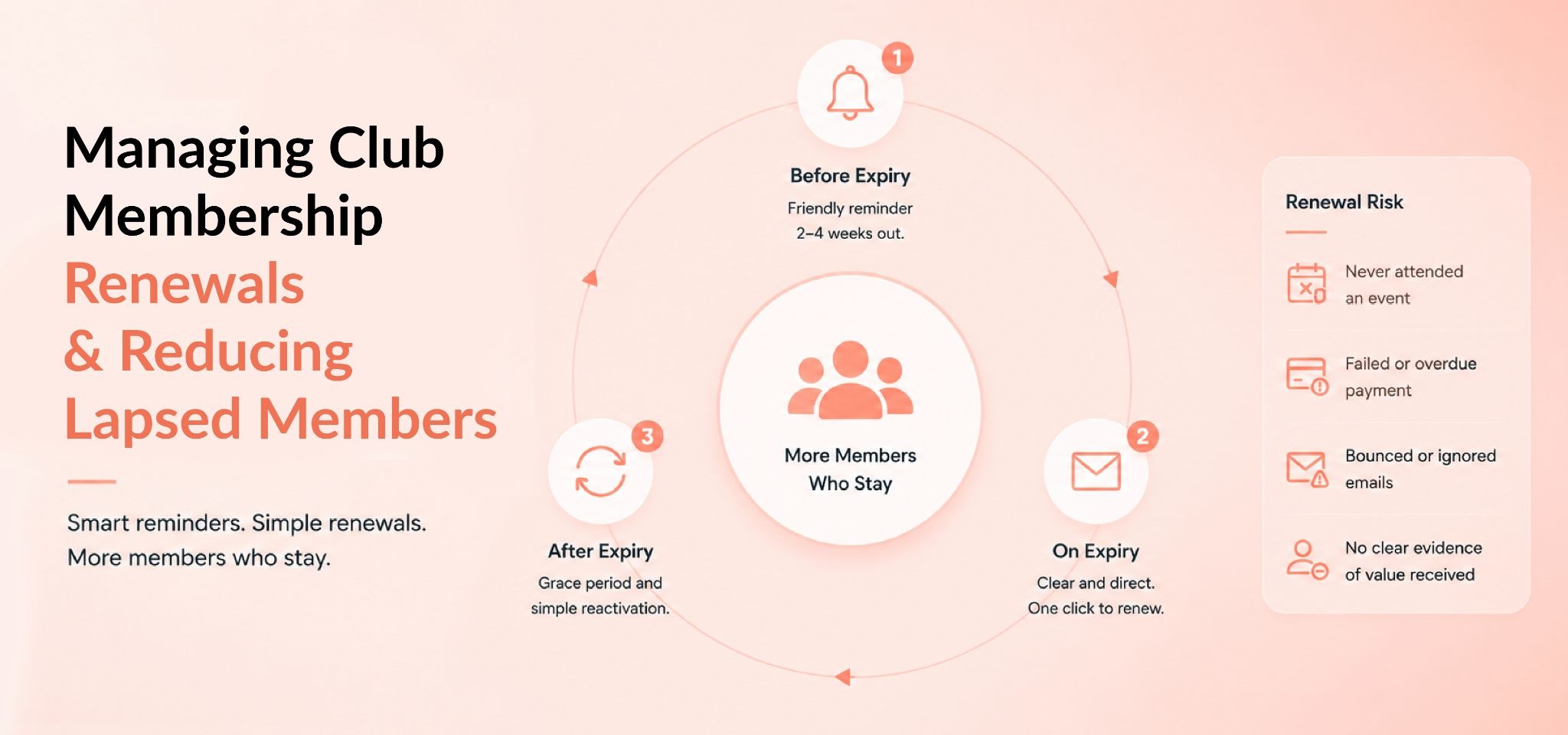
Renew. The moment of truth. Renewal is not one email. It is a sequence with different messages before, on, and after expiry. Automated renewal reminders are not a luxury for most clubs. They are the difference between 70% retention and 90%.
Reactivate. Some members lapse. The question is whether the club has any system for identifying them, reaching them with the right message, and making a clear case for coming back. Most clubs do not. That is a recoverable mistake once you know which members went inactive and why.
How to Build a Clean Club Member Database
Before choosing any tool, define your data.
The most common club data problem is not too little information. It is the same person stored in three different places: once as a member, once as an event registrant, once on a mailing list somewhere with a slightly different spelling of their name.
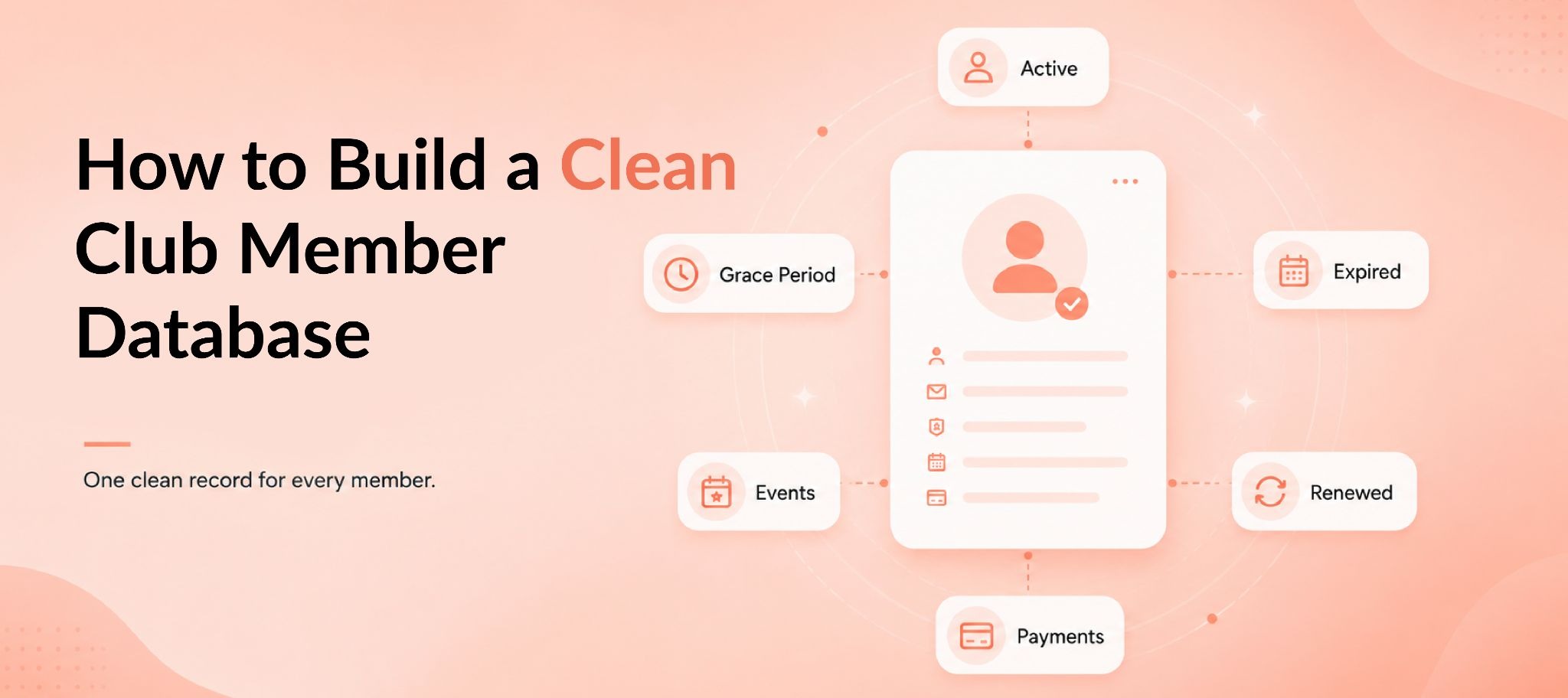
The fix is one clean system of record per member. CiviCRM describes the contact as the center of the data model, with memberships, events, payments, and communication all tied back to that one record. That principle holds whether you are using dedicated software or a carefully structured spreadsheet.
Every member record should include: name, contact details, membership type, status, join date, expiration date, payment history, last event attended, volunteer role if applicable, and communication preferences. Start minimal. Add fields only when you have a clear use for them.
The ICO's guidance on data protection frames this directly: personal data should be adequate, relevant, and limited to what is necessary. Every field you do not collect is one less field to keep accurate.
Defining Membership Status Before Anything Else
Status is the most important field in any club membership management system, and it is the one most clubs define loosely.
Here is a clean model that covers most clubs:
Define these before configuring any software. Renewal messaging, event access, board reports, and email segments all depend on consistent status logic. Clubs that use "inactive," "expired," and "former" interchangeably produce reports that tell them nothing useful.
Keeping Records Clean and Transferable
The British Gliding Association's club management guidance makes an observation worth remembering: "only one person knows where the relevant information and knowledge is kept."
That is exactly the problem clean data habits solve. Run a duplicate check before migrating to any new system. Set required fields that every record must include. Create a quarterly review habit for stale contacts and bounced emails. And as a non-negotiable rule: club records should never live only on one volunteer's personal laptop or inside their personal email account.
Family memberships and junior memberships deserve specific attention here. The right structure is one billing relationship with multiple contacts attached, not separate records for each family member. That distinction keeps mailing lists accurate, payments clean, and reporting usable.
Collecting Club Membership Dues Without Constant Chasing 💸
"Running after members to renew is tiresome." That quote from a nonprofit membership thread on Reddit is not an unusual complaint. It is practically a universal club experience.
The root cause is almost never a payment problem. It is a process problem.
Make online payment the default path. Consumer payment behavior has shifted decisively: the Federal Reserve's data shows cash at 16% of transactions and card payments as the dominant method. When a club's only payment path is a bank transfer with a handwritten reference code, drop-off is not a conversion problem. It is a friction problem that could be fixed in an afternoon.
Recurring billing removes friction for predictable memberships. When payment is handled automatically and members receive clear confirmation, the "I forgot to renew" problem largely disappears on its own.
Building a Failed-Payment Recovery Workflow
Some churn is not member dissatisfaction. It is billing failure.
A card expires. Bank details change. A direct debit fails silently and nobody notices until the membership has been lapsed for three months. A solid recovery workflow handles this before it becomes a churn statistic:
- An immediate automated notice when a payment fails
- A secure link for the member to update their payment details themselves
- Smart retry logic on the payment processor side
- A human follow-up rule after repeated failures, not an automatic cancellation
The Drug Science case study from Join It showed how automated failed-payment notifications removed significant manual burden from a lean volunteer team and kept supporter status clean without adding admin overhead. The operational principle holds regardless of which tool a club uses: failed payments need a workflow, not just a notification.
Managing Club Membership Renewals and Reducing Lapsed Members
Renewal is where most clubs lose members they did not need to lose.
Not because those members stopped caring. Because renewal felt forgettable, the payment required one login too many, or nobody reminded them until after they had already mentally moved on.
The Reminder Sequence That Actually Works
Treat renewal as a sequence, not a single message.
Before expiry. A friendly reminder two to four weeks out, framed around value already received, not just an invoice. What events did this member attend? What did they get from the club this year? WildApricot forum users flagged this exact insight in a thread about event registration reporting: clubs specifically want cross-event data so they can remind members of benefits already used at renewal time.
On expiry. Clear, direct, no ambiguity. "Your membership expired today. Here is your renewal link." One click to payment. No login maze.
After expiry. A grace-period message with a simple reactivation path. Then a final outreach. Then archive, and focus energy on members who are still active.
The International Music Association case study from Join It shows what happens when this sequence runs on automation. The organization reported that roughly 85% to 90% of members were on auto-renew after implementing structured reminder timing and self-service payment updates. One WildApricot forum user described the goal simply: renewal should be "a convenient one-click flow to a payment screen, rather than a login-heavy process." That is the standard worth aiming for.
Renewal Risk: Who Is Actually About to Leave?
A member is far more likely to lapse when multiple weak signals stack up together:
- Never attended an event
- A failed or overdue payment somewhere in their history
- A bounced or consistently ignored email
- No clear evidence of benefit received before renewal season hits
If you can tag members by attendance, payment status, and communication engagement, you can act before renewal season becomes a scramble. That is membership status tracking doing its actual job, not just labeling records.
Events, Engagement, and Member Communication
An event is not just a social occasion. It is a data point. ✅
Who registered? Who showed up? Who registered and did not come? That information, connected to the member record, tells you more about retention risk than almost anything else a club collects.
CiviCRM's event module records participation back to the contact record automatically, using statuses like registered, attended, no-show, or cancelled. A member who has attended six events in the past year is a completely different renewal conversation from one who joined nine months ago and never came to anything.
The member check-in process is where this data gets captured in real time. QR code check-in, attendance lists, access reports: these are not just logistics tools. They are retention inputs that most clubs are leaving unused.
Segmenting Communication Without Overcomplicating It
Most club communication problems are routing problems.
The wrong people get the wrong message at the wrong time. Active members receive lapse warnings. Expired members get event invitations as if they are still current. New joiners receive the same newsletter as ten-year members who already know everything in it.
Start with three or four core segments:
- Active members vs. expired members
- Families and juniors vs. individual adults
- Members who attended recently vs. members who have not engaged in months
- Members due to renew in the next 30 days
That level of segmentation handles most communication problems without needing a marketing stack or a data analyst.
Digital membership cards add a useful layer for clubs that run events or facilities regularly. Apple Wallet and Google Wallet integration means members can show active status from their phone without an admin checking a spreadsheet. It is a small change that removes a recurring friction point at the door.
Reducing Volunteer Admin and Making Handover Survivable
This is the section most software comparison pages skip. It might be the most important one.
A well-managed club should be able to survive a key volunteer leaving with no warning. Most cannot. Not because the people involved are not committed, but because the system lives in their head, their inbox, or their personal laptop.
Build Shared Admin from the Start
Role-based access is not a premium feature. It is basic operational hygiene.
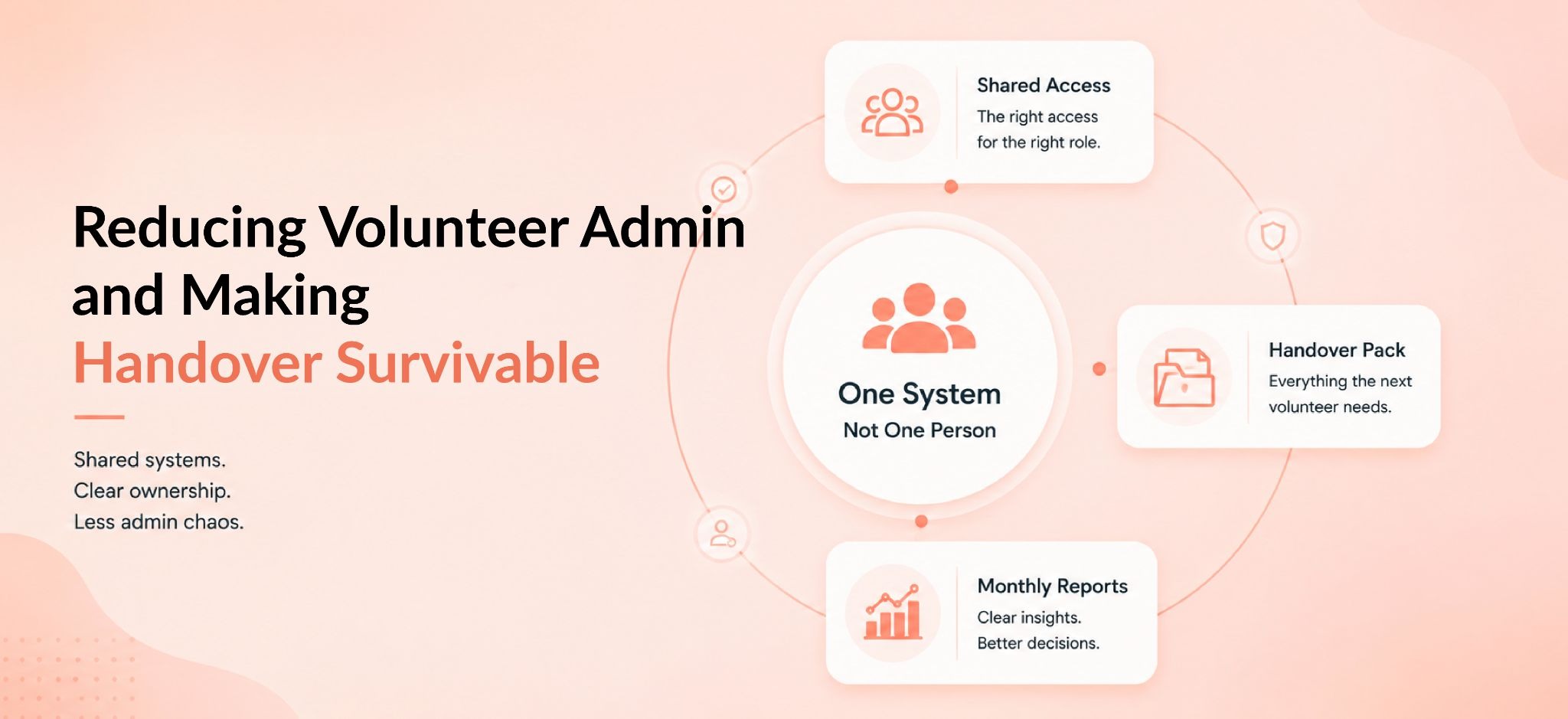
A treasurer needs payment data. A membership chair needs the full member record. A committee volunteer needs enough to run an event and nothing more. One shared login for everything is a security problem and a handover problem at the same time.
The member portal reduces admin load from the member side. When members can update their own contact details, change their payment method, check their membership status, and access their card without emailing a volunteer, the admin team gets meaningful time back every month.
From the governance side, Sport England's club governance guidance explicitly lists committee succession as a risk category alongside data protection and membership numbers. Membership operations belong in the risk register, not just the weekly to-do list.
What a Handover Pack Should Actually Include
When a new volunteer takes over a membership role, they should receive more than a password and a "good luck":
- A role description with the recurring annual calendar
- Document and file locations, not just login credentials
- Key contacts: payment processor, software support, accountant
- Current priorities and any unresolved issues
- The monthly reporting routine and where past reports are stored
The British Gliding Association's club management guide is one of the clearest documents on this in the sector. It recommends handover notes, recent meeting minutes, file navigation aids, handover meetings, named deputies, and shared drives instead of personal devices. Not because this is complicated governance, but because "only one person knows where everything is kept" is a failure mode, not a normal operating condition.
What the Board Should See Every Month
Board reports do not need to be long. They need to answer five questions:
- How many active members do we have, and is that number up or down from last month?
- How many members renewed this month versus how many lapsed?
- How much was collected in dues, and are there overdue accounts?
- What was event attendance, and are engagement levels holding?
- Are there any workflow risks or operational bottlenecks to flag?
BoardSource recommends dashboard reporting built around a small number of significant measures, reviewed regularly. Trends and deltas, not raw totals. "We have 240 members" is much less useful than "net membership is flat because 38 renewed, 41 lapsed, and 39 joined."
When a Spreadsheet Stops Being Enough
Spreadsheets are not the enemy.
For a small club with one admin, one membership type, minimal events, and no recurring billing, a well-maintained spreadsheet can work. The tipping point arrives when five things become true at once:
- More than one volunteer needs access to member records
- The club runs recurring or seasonal renewals
- Online payments are expected or already in use
- Regular events need registration and attendance tracking
- Board reporting requires filtered, accurate data on demand
At that point, the real cost of maintaining a spreadsheet system, the errors, the reconciliation time, the handover risk, starts to exceed the cost of a purpose-built tool.
How to Choose Club Membership Management Software
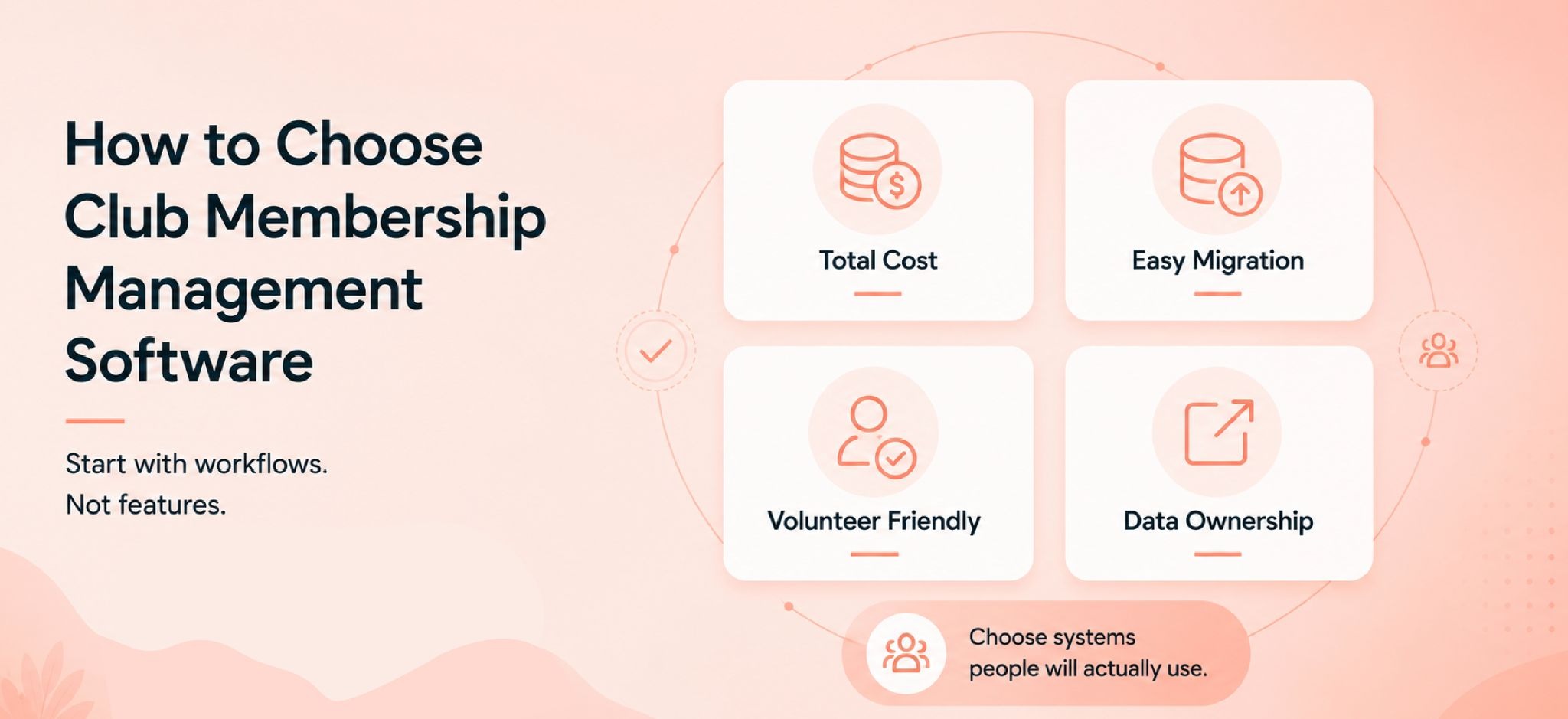
Start with workflows. Not features.
The six recurring jobs covered earlier in this guide, records, dues, renewals, events, communication, and reporting, are your buying framework. Before evaluating any tool, map which jobs are currently manual, which are broken, and which are working well enough to leave alone.
A detailed membership management software guide can walk through evaluation criteria in depth. But the four questions worth answering before anything else are:
What is the total cost? Subscription fees, payment processing percentages, migration time, and volunteer training time all count. A free tool with high transaction fees is not always cheaper than a paid tool with lower fees over a full year.
How hard is migration from spreadsheets? Data import quality matters more during migration than almost any feature on the marketing page.
Can volunteers use it without technical expertise? The best club membership management system is the one actual volunteers will use consistently, not the one with the longest feature list.
Can you export your data cleanly if you leave? If the answer is complicated, that is a risk worth knowing before committing.
Must-Have Features for Most Clubs
Good membership management features for a typical club include:
- A searchable member database with consistent status tracking
- Online membership forms with integrated payment
- Recurring billing and automated renewal reminders
- A member self-service portal
- Event registration and attendance reporting
- Role-based access and clean data export
Family memberships, junior accounts, digital cards, and QR code check-in are genuine additions for clubs that need them. They are not universal requirements.
Free and Open-Source Options
Free club membership management software and open-source platforms can work well, but they come with real tradeoffs: lower software cost means higher setup, maintenance, and integration complexity. They fit best when a club has genuine technical capacity on the team.
WordPress-based membership plugins follow the same logic. Flexible when managed well, risky when nobody is actively maintaining the stack.
If you want to see how a purpose-built tool handles the core jobs before committing to anything, one option is to build a membership website and test it with a small cohort of existing members first.
Real Examples: What Operational Improvement Looks Like
All four examples below are vendor-authored Join It case studies. Treat them as directional illustrations, not industry benchmarks.
Renewal automation: International Music Association. Structured reminder sequences and self-service payment updates shifted the organization from manually chasing renewals to a model where 85% to 90% of members were on auto-renew. The operational change was not the software. It was treating renewal as a workflow instead of a one-off event.
Volunteer-led growth: Washington Clay Arts Association. The association grew from roughly 400 active members to nearly 950 while keeping administration lean. The ingredients were simpler online joining, searchable records, and built-in communication tools, none of which required paid staff to maintain.
Lean-team operations: Drug Science. A small team with minimal overhead used automated failed-payment and expiry notifications to keep supporter tier management clean without manual intervention. Cleaner status visibility across a supporter base that would otherwise have required significant manual tracking time.
Revenue and events: Winchester VA Local AAPC Chapter. After combining paid events with automated member workflows, the chapter reported 650% revenue growth in a single quarter, 300 new members in three months, and more than 20 admin hours saved per quarter. The gains came from combining event revenue with membership automation, not from either strategy in isolation.
Club Membership Management FAQs
Do small clubs really need membership management software?
Not always. A spreadsheet can work for very simple clubs with one admin, one membership type, and minimal renewals. The tipping point is when multiple people need access, renewals are recurring, and events need tracking. Complexity plus volunteer turnover is the real threshold, not member count alone.
How do you track active and expired members?
Define your status model first, then configure your system to update statuses automatically based on payment dates and expiration rules. Consistent definitions matter more than any particular tool.
How do clubs collect membership dues online?
Online payment forms connected to member records are the standard approach. Recurring billing handles predictable renewals automatically and eliminates most of the manual chasing cycle.
How do you reduce renewal chasing?
A three-part reminder sequence before, on, and after expiry, combined with a one-click payment path, removes most of the friction. Auto-renew handles the remainder.
Can club software support family memberships and junior memberships?
Yes, though implementation varies by platform. Look for tools that allow multiple contacts under one billing relationship without creating duplicate records.
How do you hand the system to the next volunteer?
Shared role-based access, documented workflows, and a proper handover pack. A verbal briefing and one shared password is not a handover. It is a risk.
How much does club management software cost?
Costs vary significantly: subscription fees, payment processing percentages, and add-ons all factor in. Evaluate total cost of ownership over a full membership cycle, not just the monthly price.
Is there free club membership management software?
Some platforms offer free tiers or open-source options. They tend to require more technical setup and ongoing maintenance. Evaluate whether the time cost outweighs the subscription savings for your specific situation.
What is the best club management software?
The one that matches your actual workflows, that volunteers will use consistently, and that can be handed off cleanly when leadership changes. There is no universal best answer.
How secure is club member data?
Security depends on the platform and how the club manages access. Key practices: role-based access controls, no shared master passwords, data stored in the platform rather than on personal devices, and compliance with applicable data protection requirements in your region.
Conclusion: Start Simpler Than You Think You Need To
Good club membership management is not about feature overload.
It is about fewer manual steps, cleaner records, predictable renewals, smarter communication, and a system that survives when volunteers change. Most clubs do not need a dozen integrations or an enterprise dashboard. They need one place where member data lives, one reliable renewal workflow, and one process their successor can follow on day one.
Start there. Get those right. Add complexity only when a real operational problem demands it.
If you want to see what a purpose-built system looks like in practice, the membership management software category has matured significantly in recent years. You can book a quick demo to see how one compares to your current setup, or start a free trial and test it against your actual workflows before committing.
Either way: the best time to fix your membership system is before the next volunteer leaves, before the next renewal season hits, and before the next spreadsheet breaks at the worst possible moment.


