A Guide to Building and Sustaining a Thriving Community
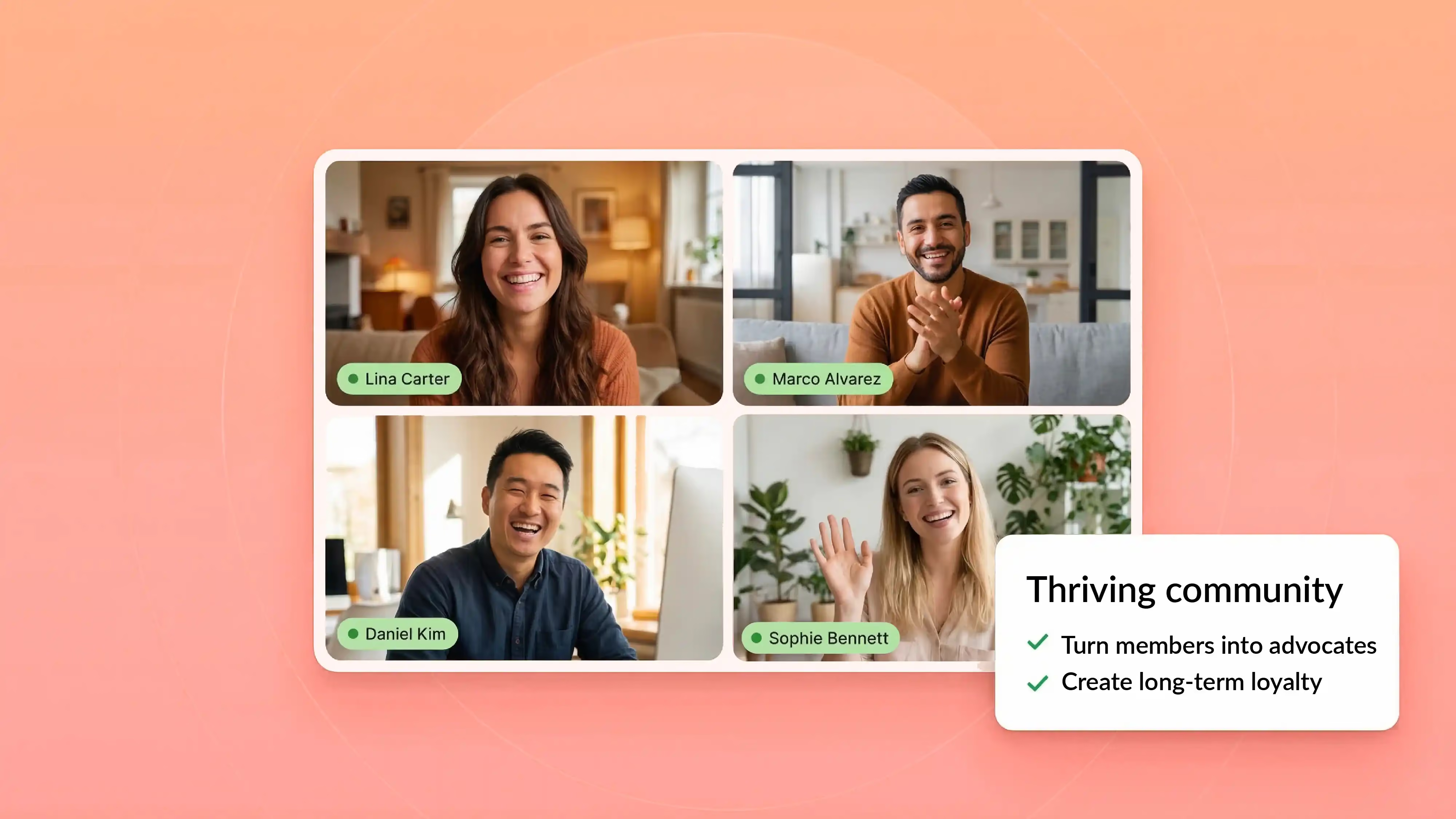


Think about the last community you actually looked forward to showing up in. The one where you recognized names, jumped into conversations without hesitation, and walked away with something useful every time.
Now think about the ones you quietly abandoned. No replies to your posts. No reason to return. No real connection.
That gap between "just existing" and "genuinely thriving" is what separates the communities people forget from the ones they can't imagine leaving.
Whether you lead an association, a nonprofit, a local club, a chamber of commerce, or an online membership organization, the challenge is the same. How do you build a thriving community people want to be part of, and how do you keep it that way?
This guide covers what makes a thriving community, how to build one with intention, how to sustain community engagement over time, and how to measure community success without chasing vanity metrics.
Here's why this matters right now: over half of associations reported flat or declining membership counts in 2023. And only about 11% feel their value proposition is "very compelling". Engagement pressure is real. Retention pressure is real. The organizations that figure out community building now will be the ones members stick with for years.
Let's start with what "thriving" actually means.
What Is a Thriving Community?
A thriving community is a group of people who share a clear purpose, actively participate, trust one another, and continue showing up because the experience delivers real, ongoing value.
It is not just an email list. Not a directory of names. Not a social media group where someone posts once a month and nobody responds.
Here's the distinction most organizations miss.
An active community has traffic. People log in, scroll, maybe click something.
An engaged community has interaction. People reply, attend events, share content.
A thriving community has belonging. People return because they feel connected to the mission, to each other, and to the value the community creates over time.
That difference matters because many organizations confuse a busy dashboard with a healthy community. And it costs them.
Thriving Community Definition vs Community Engagement
Community engagement measures activity. A thriving community measures outcomes.
You can have strong engagement metrics with low community loyalty. Members might attend a single webinar but never return. They might post once during onboarding and disappear.
True community health shows up in patterns. Are members coming back? Are they helping each other? Are they staying involved over months and years, not just during a launch week?
When you think about community culture and member engagement together, the question shifts from "How many people logged in?" to "How many people found a reason to come back?"
As one experienced community manager put it on Reddit: "Building a thriving community takes time, patience, and dedication. It's about creating a space where members feel a sense of belonging."
The Core Signs of a Thriving Community
How do you know when a community is genuinely thriving? Look for these signals:
- Members return consistently, not just once
- Members contribute ideas, answers, and resources to each other
- New members feel welcome and get involved quickly
- Members help each other without being asked
- People stay involved over time, not just during a campaign or event
If your community checks most of those boxes, you're building something real.
Why a Thriving Community Matters for Member Engagement, Retention, and Loyalty
Thriving communities are not a nice-to-have. They're directly tied to whether your members stay, participate, and refer others.
The data is clear. According to a survey by iMIS, 51% of associations cite "pure lack of engagement" as the number-one reason members don't renew. Another 33% point to "lack of value."
That means if your community isn't engaging members and delivering something tangible, you're leaving membership retention on the table.
The impact goes beyond renewals. A thriving community creates stronger peer-to-peer support, higher event participation, more member-generated content, and a membership experience that genuinely feels worth the investment.
Before vs After a Thriving Community
Before: Silent members. Low renewal rates. Staff carrying all the weight. Fragmented tools. Weak sense of belonging.
After: Members connecting with each other. More returning members each month. Contributors stepping up voluntarily. Visible value everywhere. Healthier retention patterns.
Real numbers tell the story. Cosley Zoo grew its membership base by 80% after implementing a structured community engagement program. One association that launched a year-round mobile community app reported a 25% boost in overall retention and a 40% year-over-year increase in renewals.
These are not abstract improvements. They are what happens when a community moves from "existing" to thriving.
Why Thriving Communities Strengthen Member Value
People don't stay in a community for content alone. They stay for belonging, access to people they can learn from, recognition for their contributions, practical help when they need it, and a shared identity with others who understand their world.
When those elements come together, member retention improves because members aren't just paying for a service. They're invested in a community that's invested in them.
That's why improving membership management without investing in community often falls short. The tools matter, but the connection is what keeps people.
What Makes a Thriving Community? 6 Essential Traits
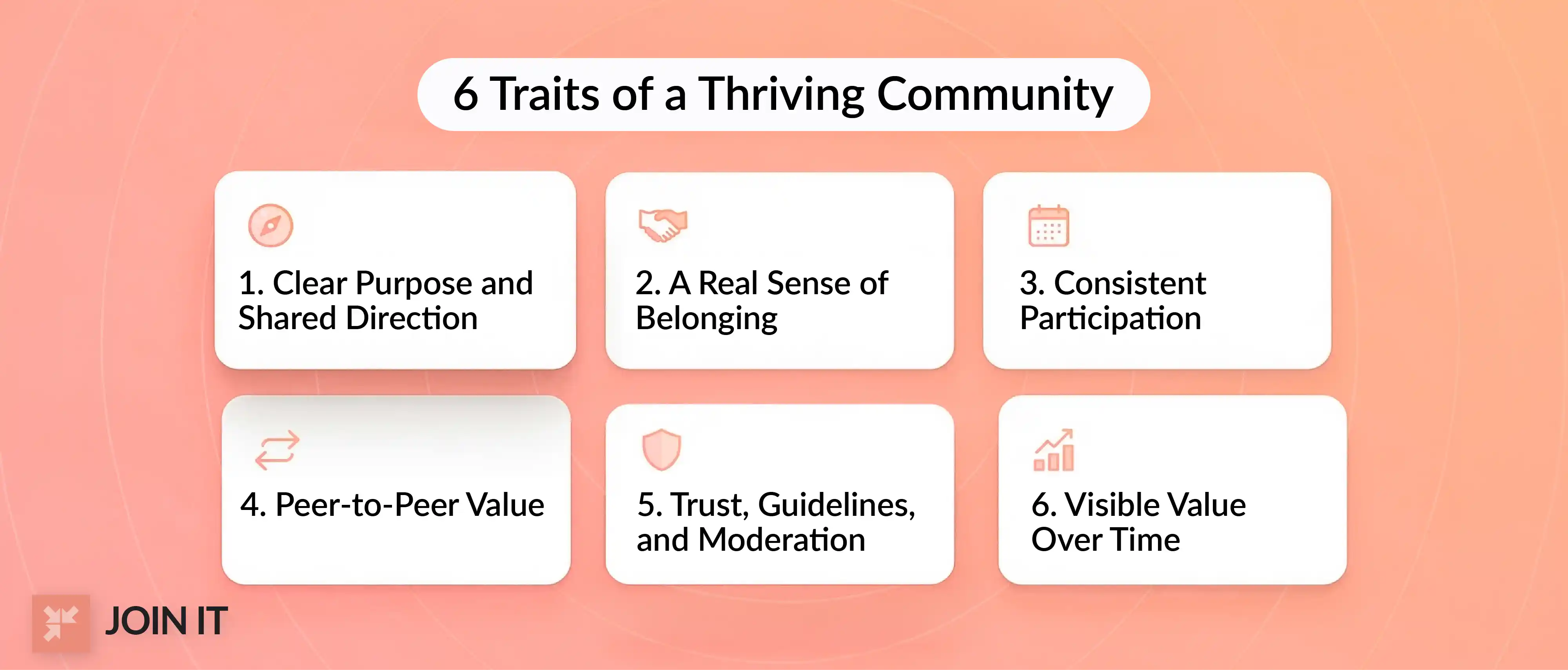
These are the characteristics of a thriving community that separate growing, healthy groups from stagnant ones. Think of them as the foundation everything else gets built on.
1. Clear Purpose and Shared Direction
A thriving community needs a reason to exist that its members actually care about. Without a clear community purpose, conversations drift, participation scatters, and people lose interest.
Define who the community serves, why it exists, and what success looks like. Then align every activity back to that purpose.
2. A Real Sense of Belonging
Belonging is what turns a collection of strangers into a community. It means emotional connection, inclusive language, feeling welcome from day one, and knowing your voice matters.
Communities that prioritize a real sense of belonging retain members longer. It's not a soft metric. It's the foundation.
3. Consistent Participation, Not One-Time Activity
Thriving communities create rhythm. Weekly prompts, monthly events, recurring discussions. When community participation becomes a habit, members don't have to decide whether to show up. They just do.
4. Peer-to-Peer Value
If members only get value from staff, the community can't scale. The real power shows up when members gain value from one another, through meaningful member connections, peer-to-peer support, and professional networking.
5. Trust, Guidelines, and Healthy Moderation
Community trust requires boundaries. Clear community guidelines, fair moderation, and a constructive environment where people can share honestly without fear of being attacked or ignored.
6. Visible Value Over Time
The longer a community exists, the more valuable it should become. Useful discussions get archived. Resources get curated. Events build on previous conversations. This compounding effect is what makes members say, "I can't imagine leaving."
How to Build a Thriving Community Step by Step
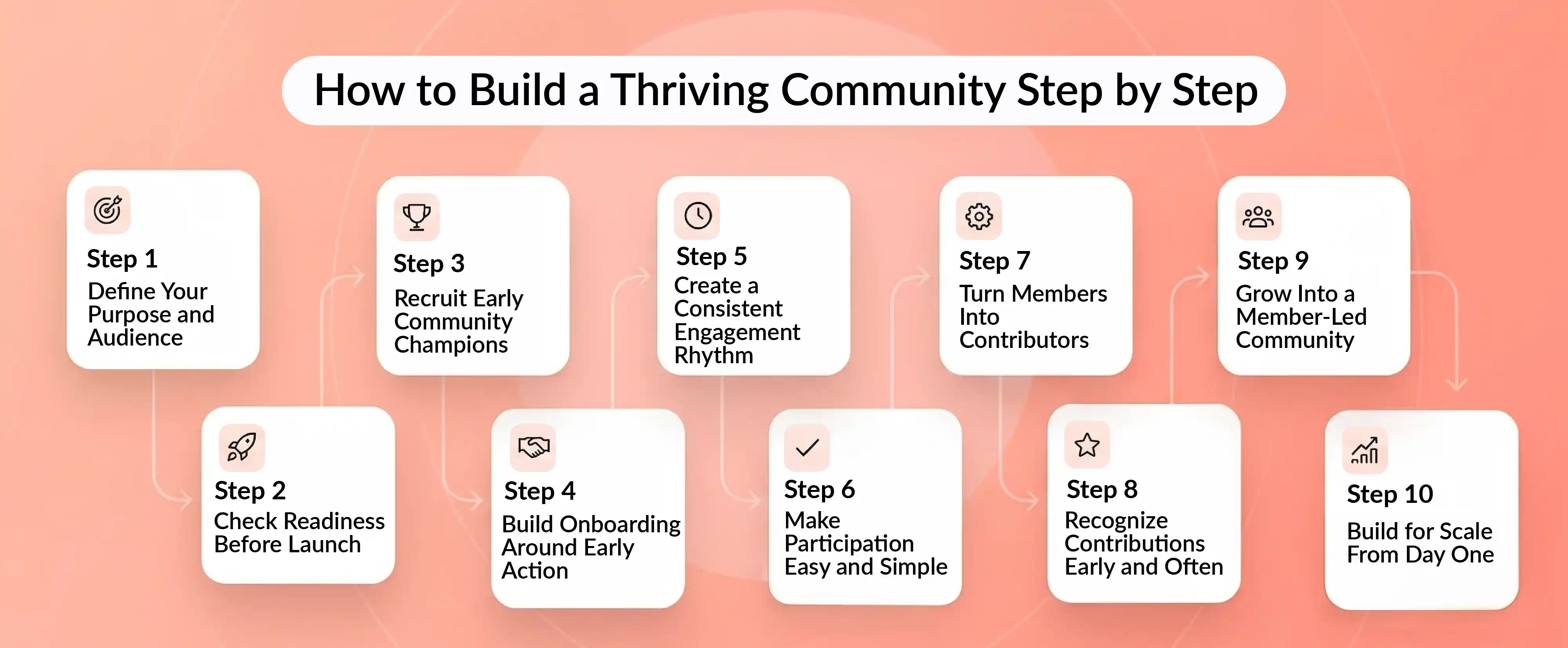
Building a thriving community follows a clear path, from foundation to participation to sustainability. Here's what that looks like in practice.
Step 1. Define the Purpose, Audience, and Outcome
Start with the North Star. Who does this community serve? Why does it exist? What does success look like?
For associations, this might mean professional development or continuing education. For nonprofits, it could be advocacy or peer support. For clubs and chambers, local connection and visibility.
If you're building the organizational foundation alongside your community, an association management guide can help you align the two from the start.
Step 2. Check Community Readiness Before Launch
Before you launch or relaunch, validate that you have leadership support, staff time, platform readiness, early champions, a moderation plan, and a content plan.
Communities struggle when they launch before the foundation is solid. Taking time to build a membership website with the right structure pays off enormously.
Step 3. Bring in Early Community Champions
Communities gain traction faster when a small group of committed members helps seed conversations, welcome newcomers, and model the behavior you want to see.
These community champions make the space feel alive from day one, reducing the "empty room" problem that kills momentum early.
Step 4. Design Community Onboarding Around the First Meaningful Action
A welcome email is not enough. Real new member onboarding guides someone toward one useful action, like introducing themselves, answering a quick prompt, attending a small event, or joining a subgroup.
That first action is what turns a passive signup into an active participant. For practical ideas on this, here's a helpful resource on how to welcome new members effectively.
Step 5. Create a Predictable Rhythm of Engagement
Cadence creates habit. Weekly discussion prompts, monthly spotlights, quarterly events, regular recaps. This always-on engagement approach makes participation easier because members know what to expect.
Need inspiration? These community engagement strategies can help you build that rhythm.
Step 6. Make It Easy for Members to Participate in Small Ways
Not everyone has time for long posts. Low-friction participation, things like replying, reacting, voting, sharing, or answering a quick question, keeps online communities and time-pressed members connected without overwhelming them.
Step 7. Turn Members Into Contributors
The journey from passive reader to active contributor doesn't happen on its own. It takes prompts, recognition, follow-up, and direct invitations to lead.
When you figure out how to turn members into contributors, your community starts running on peer energy instead of staff effort. Explore more member engagement ideas to help with this transition.
Step 8. Recognize Contribution Early and Often
Small acknowledgments matter more than you think. Replies, shout-outs, badges, visible recognition, and ambassador roles all tell contributors their effort is valued. That recognition is what brings them back.
Tools like digital membership cards can also reinforce a member's sense of identity and belonging within the community.
Step 9. Let the Community Become More Member-Led
As the community matures, members should step forward while staff steps back. Subgroups, volunteer leaders, peer moderation, member-led events, and shared ownership all signal that the community has reached a self-sustaining stage.
A truly member-led community is one of the clearest signs you've built something that can last.
Step 10. Build for Scale From the Beginning
Even small communities should plan for growth. Tagging systems, content categories, role structures, subgroup logic, and moderation systems need to work when your membership doubles.
Using membership management software and a well-organized member directory early keeps things structured as you scale.
How to Sustain a Thriving Community Long Term
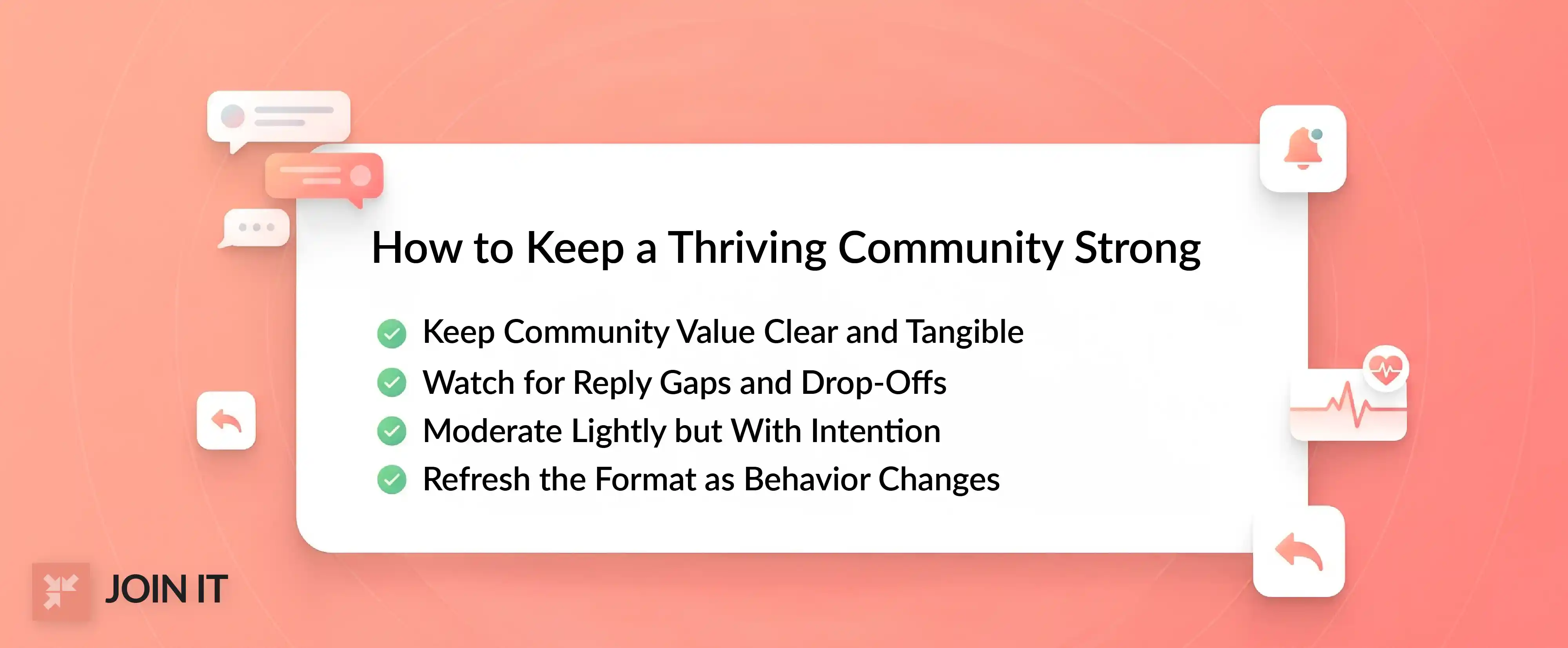
Building and sustaining are different stages. The launch is exciting. The long-term work is where most communities either thrive or slowly fade.
Keep Community Value Tangible
Communities become stronger when the value is visible. Useful discussions, event follow-ups, curated resources, archived knowledge, and member-generated insights all make the community more valuable the longer it exists.
A member portal that surfaces this content makes the value impossible to miss.
Watch for Reply Gaps and Silent Drop-Off Points
Unanswered posts damage trust fast. Higher Logic's research found that 59% of posts in large communities get no reply at all. That silence creates a "dead space" feel that drives people away.
Monitor reply gaps, no-response threads, and member drop-off points. These are the early warning signals that momentum is slipping.
Moderators on r/CommunityManager reinforce this, noting that "consistency in moderation and engagement is key to keeping the community active and thriving."
Moderate Lightly, but Intentionally
Healthy communities need guidelines without feeling over-controlled. Set clear expectations, maintain boundaries, and keep the tone constructive. Members should feel free to lead and debate while the environment stays safe and on-purpose.
Refresh the Format as Member Behavior Changes
Communities evolve. What worked in year one might feel stale in year three. Retire formats that no longer serve the community, test new touchpoints, adjust the content mix, and revisit your structure regularly. Adaptation is what keeps a community relevant.
Thriving Community Strategies by Organization Type
One-size-fits-all community advice rarely works. Here's what thriving looks like across different kinds of organizations.
Associations and Professional Membership Organizations
For associations, a thriving community supports member retention, professional networking, learning, and communities of practice. The key is creating year-round value between major events rather than treating the community as a disconnected side project.
Track whether active community participants renew at higher rates. Signals like replies per thread, contributor growth, and returning members tell you if the community is actually driving results.
Nonprofits and Mission-Led Communities
Mission and shared identity drive community participation in nonprofits. Give members meaningful ways to contribute through advocacy, volunteer pathways, peer support, and visible impact.
Highlight real people and real outcomes. That's what makes a mission-led community feel human instead of organizational.
Clubs, Chambers, and Local Community Groups
Rituals matter here. Monthly meetups, member spotlights, structured introductions, and recurring discussion prompts create the local belonging that keeps people coming back.
Public recognition and celebration of visible participation builds momentum and a stronger sense of community loyalty.
Online Communities
Digital communities depend on low-friction participation, fast replies, and clear moderation. Automated nudges, digest emails, and structured reminders help maintain momentum without overwhelming anyone.
A membership directory helps online members find and connect with the right people quickly.
Learning Communities and Communities of Practice
These communities thrive through shared problems, strong facilitation, and useful outputs. Organize around a common challenge, use expert prompts and structured discussion, and turn conversations into shared assets like playbooks, frameworks, and resources members can reference later.
Churches and Faith-Based Communities
Community deepens when people move beyond attending services into smaller, more relational settings. Small groups that create belonging, integration of worship and community connection, and outward service to real local needs all strengthen a faith-based community.
Common Challenges That Stop a Community From Thriving
Even well-intentioned communities hit walls. Here are the most common ones and why they matter.
No Clear Purpose or Value Proposition. When a community exists without a defined reason, everything from content to conversations becomes scattered.
Low Participation and Too Many Lurkers. Lurking is normal. But if there's no clear path from passive to active, it's a structural issue, not a member issue.
Content Fatigue and Inconsistent Engagement. Random or repetitive posting weakens interest and signals that nobody's steering the ship.
Unanswered Posts and Slow Responses. Silence damages trust faster than almost anything else.
Fragmented Tools and Platform Overload. Disconnected systems create friction and confusion. Consolidating your tools helps members know exactly where to go.
Volunteer Burnout and Staff Dependence. Too much reliance on a few passionate people is unsustainable. Building shared ownership is the fix.
Weak Inclusivity or Cultural Fit. Communities fail when members don't feel represented or welcome. An inclusive, supportive community is a non-negotiable foundation, not a nice-to-have.
No Clear Way to Prove ROI. Without metrics tied to real outcomes, communities risk losing internal support and being treated as optional.
How to Measure Community Success Without Relying on Vanity Metrics
A thriving community should be measured by mission outcomes, not just activity totals. Here's a practical framework.
Community Engagement Metrics
Track returning members, replies per thread, contributor growth, participation rates, event engagement, and unanswered posts. These community engagement metrics reveal whether people are genuinely connecting or just passing through.
Community Health Metrics
Look at the balance of readers versus contributors, subgroup activity, repeat participation, response speed, and conversation depth. Together, these form a community health dashboard that tells the real story behind the numbers.
Member Retention and Loyalty Metrics
Connect community activity to retention, renewal behavior, loyalty indicators, and member satisfaction. Features like automated renewal reminders help you track and act on these signals before members slip away.
How to Tie Community Metrics to Organizational Outcomes
This is the part that secures budget and leadership support.
Connect community activity to concrete results: retention rates, event attendance, volunteer involvement, course completion, and non-dues revenue.
When Higher Logic's research shows that communities integrating volunteering and mentoring see 124% more logins, 50% more discussions, and 53% more contributors, the case for investment becomes hard to argue with.
Organizations that can draw a direct line between community participation and revenue will never have to fight for community budget again.
The Future of a Thriving Community in 2026 and Beyond
The community landscape is shifting fast. Here's what's worth paying attention to.
Private Community Spaces Over Borrowed Platforms
While 76% of community builders still rely on social media for growth, the trend is clear. Organizations want more ownership and control over their community experience. Only about 6% of community professionals plan no platform consolidation in 2025, according to the same Circle report.
AI and Personalization With a Human Touch
AI-powered digests, engagement nudges, and predictive analytics will help communities scale without losing the personal feel. Studies show roughly 80% of people prefer personalized experiences, so personalization is quickly becoming a baseline expectation. But automation should support community care, never replace it.
Hybrid Community Models
Online and offline are not competing strategies. They're complementary. About 74% of live event attendees say in-person experiences deepen their connection to the brand. The strongest communities will combine year-round digital engagement with meaningful face-to-face moments.
Smaller, More Relevant Community Experiences
The rise of subgroups, niche spaces, and micro-communities reflects a simple truth. People want relevant connections, not crowded feeds. Smaller, focused communities foster deeper engagement, higher retention, and stronger community loyalty.
FAQ: Building and Sustaining a Thriving Community
What makes a thriving community? A thriving community is defined by shared purpose, a real sense of belonging, consistent participation, peer-to-peer value, trust, and visible value that compounds over time.
How do you build a thriving community? Start by defining a clear purpose and audience. Check readiness before launching. Recruit early champions. Design onboarding around a first meaningful action. Create engagement rhythms. Then make it easy for members to contribute and eventually lead.
How do you sustain an engaged community? Keep the value tangible and visible. Monitor reply gaps. Moderate intentionally. Recognize contributors regularly. And refresh your formats as member behavior evolves.
What is the difference between community engagement and member engagement? Community engagement measures how actively the group interacts as a whole. Member engagement measures how an individual participates across all touchpoints with the organization, including but not limited to the community.
How do you measure community engagement? Track returning members, replies per thread, contributor growth, participation rates, and unanswered posts. Then tie those metrics to outcomes like retention and event attendance.
How do online communities boost member engagement? Online communities give members low-friction ways to participate, access peer support, find resources, and stay connected between in-person events or major touchpoints.
What does an engaged association community look like? Active discussions, a healthy contributor-to-reader ratio, growing subgroups, high rates of returning members, and clear connections between community participation and renewal behavior.
How do you create a welcoming community? Design onboarding around a first meaningful action, greet new members personally, make introductions structured and easy, and establish guidelines that promote respect and inclusion from the start.
Conclusion: Build a Thriving Community That Members Want to Return To
A thriving community doesn't happen by accident. It's built on purpose, belonging, participation, trust, and measurable value.
The organizations that get this right don't just retain members. They create something people actively want to be part of. Something they would genuinely miss if it disappeared.
Start with a clear purpose. Build the foundation before you launch. Bring in champions. Create rhythm. Recognize contributions. Measure what matters. And keep evolving.
Whether you're building a community for an association, a nonprofit, a chamber, or a learning group, the principles are the same. Thriving communities are built intentionally, then sustained through rhythm, ownership, and adaptation.
Ready to build the infrastructure your community needs? Join It helps membership organizations manage, engage, and retain members with tools designed for exactly this kind of work. See a demo or get started today.
References
- GrowthZone. Groundbreaking 2024 Association Survey Reveals Critical Insights for the Industry
- ASAE Center. The Membership Model Is Breaking Down
- Reddit r/CommunityManager. Struggling to Build a Community on Facebook
- iMIS. How Community Engagement Boosts Association Member Retention
- Higher Logic. 2025 Association Community Benchmarks & Trends
- Higher Logic. 2024 Association Community Benchmark Report
- Circle. The 2025 Community Trends Report
- Bevy. 7 Community Management Trends to Know in 2025

Guides from the Experts
Through our work with 4,000+ organizations - we’ve put together helpful guides to assist; regardless of where you are on your journey.
.webp)

A Complete Guide to Membership Organizations
Everything you need to know to manage and grow your membership business
.webp)
Maximize Membership Retention: 10 Proven Strategies
Tried and true strategies that not only win membership, but keep them

Build a Membership Website: A Step-by-Step Guide
Your one-stop resource for knowing all the features your modern membership website needs
Ready to start your free trial?
Our membership software is intuitive to use and even easier to test for yourself.