
12 Unique Raffle Prize Ideas That Sell Tickets (2026)



Summary
The best raffle prizes match what your crowd already wants and what you can get donated. Prize data from more than 1,700 charity raffles shows gift cards, experiences, and getaways perform well at every budget, while cash drives the strongest simple result and a car the largest totals.
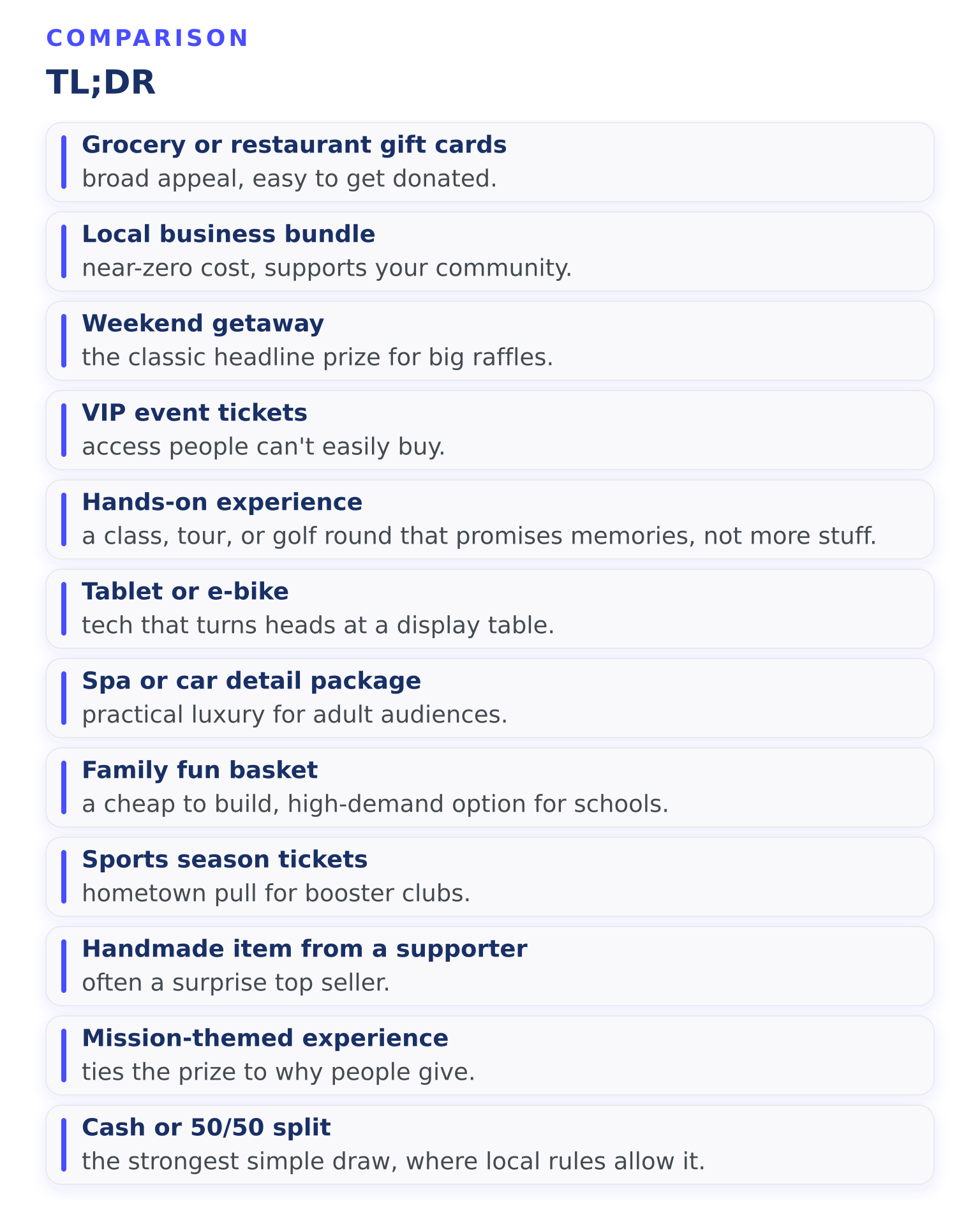
- Grocery or restaurant gift cards: broad appeal, easy to get donated.
- Local business bundle: near-zero cost, supports your community.
- Weekend getaway: the classic headline prize for big raffles.
- VIP event tickets: access people can't easily buy.
- Hands-on experience: a class, tour, or golf round that promises memories, not more stuff.
- Tablet or e-bike: tech that turns heads at a display table.
- Spa or car detail package: practical luxury for adult audiences.
- Family fun basket: a cheap to build, high-demand option for schools.
- Sports season tickets: hometown pull for booster clubs.
- Handmade item from a supporter: often a surprise top seller.
- Mission-themed experience: ties the prize to why people give.
- Cash or 50/50 split: the strongest simple draw, where local rules allow it.
12 Unique Raffle Prize Ideas That Sell Tickets (2026)
A raffle lives or dies on one decision: the prize. Pick something your audience genuinely wants, and tickets sell themselves. Pick something generic, and even a good cause struggles to move them.
This guide gives you 12 prize ideas sorted by budget and audience, plus a quick look at which prize types actually raise the most money, and the legal and tax basics to check before you print tickets.
What the data says about prize types
Before the list, one useful benchmark. RaffleLink analyzed more than 1,700 charity raffles run on its platform since 2016 and tracked what happened by first-prize type. The platform is Australian, so the figures are in Australian dollars, but the patterns travel well. A few findings worth knowing as you plan:
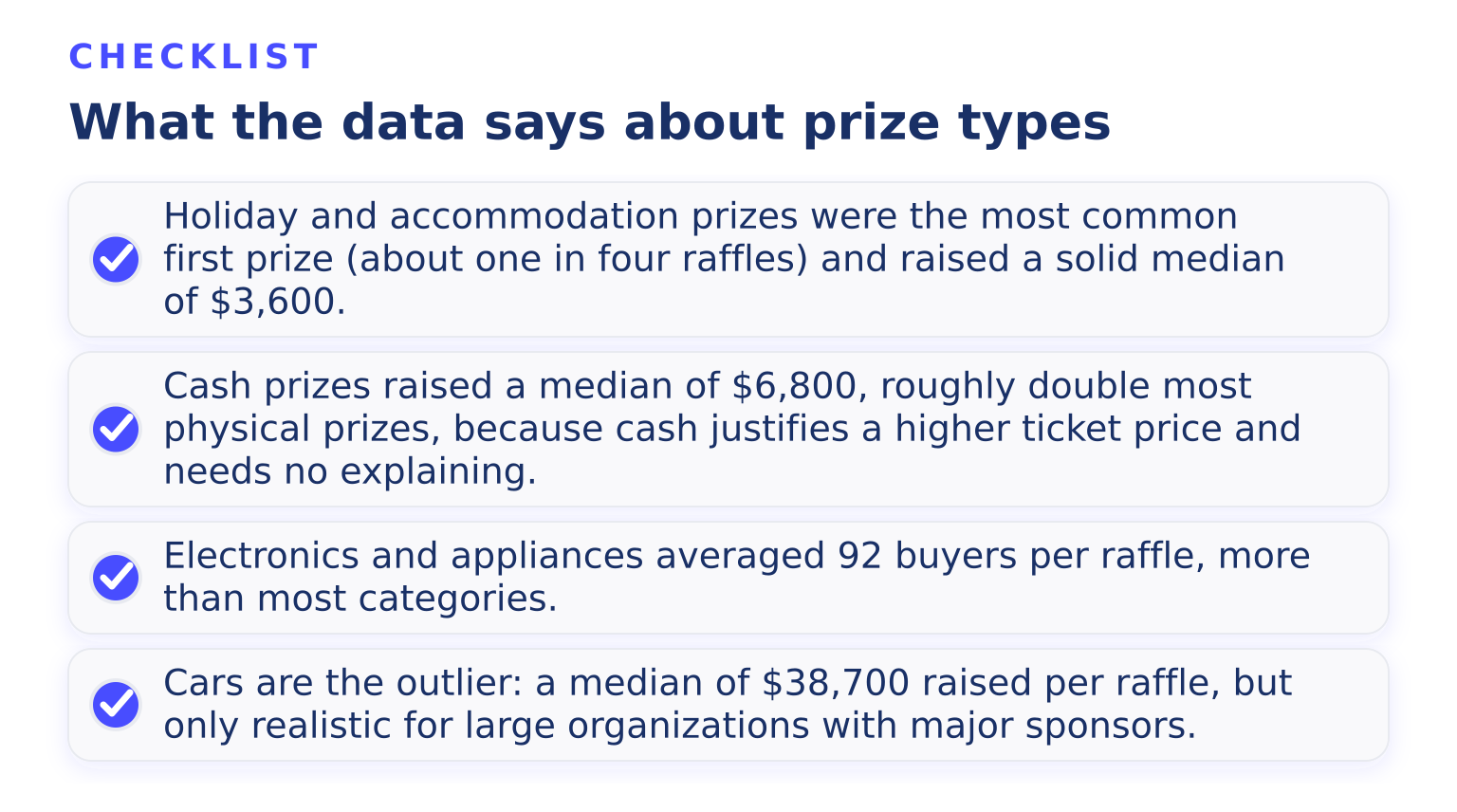
- Holiday and accommodation prizes were the most common first prize (about one in four raffles) and raised a solid median of $3,600.
- Cash prizes raised a median of $6,800, roughly double most physical prizes, because cash justifies a higher ticket price and needs no explaining.
- Electronics and appliances averaged 92 buyers per raffle, more than most categories.
- Cars are the outlier: a median of $38,700 raised per raffle, but only realistic for large organizations with major sponsors.
The pattern: bigger, simpler, more universally desirable prizes raise more. But you don't need a car to run a great raffle. Most clubs and small nonprofits work with donated or low-cost prizes. Here are 12 that work.
Low budget (under $100, mostly donated)
1. Grocery or restaurant gift cards
A $100 grocery card feels like real money, and every household can use it. Restaurant bundles work the same way and are among the easiest prizes to get donated; local restaurants say yes to a raffle mention far more often than to a cash request. Best for schools, churches, and community groups.
2. The local business bundle
Collect five or six small gift cards and items from neighborhood businesses and package them as one prize. Your cost is near zero, every donor gets exposure, and the bundle reads as a bigger prize than any single item. This is the workhorse prize for community fundraisers.
3. Family fun basket
Movie passes, popcorn, snacks, and a game night kit in one basket. It costs little to build, photographs well for social media, and hits both parents and kids. A good fit for class reunion and school raffles where the audience is families.
4. Handmade item from a supporter
A quilt, framed artwork, pottery, or woodwork made by one of your members. These routinely surprise organizers by outselling pricier items, because they carry a story and can't be bought in a store. Ask your own community first; you likely have a maker.
Mid budget ($100 to $500)
5. Spa or self-care package
A massage, facial, or salon day is something many people won't buy for themselves, which is exactly what makes it sell. Pair it with a candle or gift card to lift the perceived value. Great for galas and adult audiences.
6. VIP event tickets
Concert or sports tickets with parking, a lounge, or meet-and-greet access. Access money can't always buy is the selling point, and local teams and venues will sometimes donate for the promotion. Strong pick for booster clubs and sports organizations, and it pairs well with the fundraising ideas in our college fundraising guide.
7. A hands-on experience
A cooking or mixology class, brewery tour, or golf foursome at a nice course. Experiences punch above their cost because they promise memories rather than more stuff, and culinary schools and courses often donate spots for publicity.
8. Car detailing or home cleaning service
Practical luxury. Busy adults see real value in an hour they don't have to spend, and service businesses donate these readily. An easy add-on to any bundle.
High budget ($500+)
9. Weekend getaway
Two nights at a hotel or a donated vacation home, ideally with a dining credit. The holiday prize is the default headline of charity raffles for a reason: it photographs big, appeals to nearly everyone, and off-season weekends are often donated by supporters with vacation property.
10. Headline tech
An iPad, a gaming console bundle, or an e-bike. Tech shows well on a display table and creates buzz in a way a gift card never will. Ask local electronics retailers or carriers for a donation or a steep discount; budget at least a few hundred dollars if buying outright.
11. Season tickets
A season pass to local sports or theater keeps the winner thinking about your organization all year. Higher perceived value than cost, and a natural fit for clubs tied to a team or venue.
The prize that costs you nothing
12. Cash or a 50/50 split
In a 50/50 raffle, the winner takes half the pot and your organization keeps half. There's no prize budget at all, and cash is the strongest simple draw in the benchmark data. The catch: cash prizes are restricted or banned in some states and provinces, so check your local rules first.
If your raffle draws a community-service crowd, you can also theme a prize around your mission, like a behind-the-scenes tour of your work. Those tend to work best as add-on prizes rather than headliners. For more ideas along those lines, see our list of 150 community service ideas.
Matching the prize to your ticket price
One rule ties this together: the prize value should justify the ticket price. The benchmark data shows spend per buyer climbing steadily with price, from about $22 per buyer on $1 to $2 tickets to $143 per buyer on $50+ tickets, while the number of buyers barely changes. So if your grand prize is a $100 gift card, don't try to sell $20 tickets. And use a ticket ladder, like one for $5, three for $10, ten for $25, to lift average spend without pressuring anyone.
A simple formula for most organizations: one headline grand prize, three to five mid-tier supporting prizes, and a handful of small donated items for extra chances to win.
Before you sell a single ticket
Raffles are regulated games of chance in most places, and the rules are real. A few basics:
- Licensing. Many states require nonprofits to register or hold a license before selling tickets. California, for example, requires registration at least 60 days before the raffle and that at least 90% of gross receipts go to the charitable purpose. The National Council of Nonprofits has a good overview of how state rules differ, and California's Attorney General publishes its own raffle requirements in detail.
- Taxes on big prizes. If a prize is $600 or more and at least 300 times the ticket price, the organization generally must report it to the IRS on Form W-2G, and prizes over $5,000 trigger withholding. This applies to noncash prizes too, valued at fair market value. The IRS explains the raffle rules here, so build the paperwork into your prize plan.
- Prize descriptions. Some states require specific prize details printed on tickets. Check what yours requires before printing.
None of this is hard, but it's much easier to handle before ticket sales start than after.
What to do next
Pick your headline prize first, then build the supporting tiers around it. Ask your own members and local businesses for donations before spending money; most successful raffles are built almost entirely on donated prizes.
Once tickets start selling, you'll want a clean way to track buyers, payments, and who's eligible to win. Join It's membership tools let you sell tickets, take payments, and keep your member records tidy in one place, and you can start a free trial to see if it fits your next raffle.
.avif)
Guides from the Experts
Through our work with 4,000+ organizations - we’ve put together helpful guides to assist; regardless of where you are on your journey.
.webp)

A Complete Guide to Membership Organizations
Everything you need to know to manage and grow your membership business
.webp)
Maximize Membership Retention: 10 Proven Strategies
Tried and true strategies that not only win membership, but keep them

Build a Membership Website: A Step-by-Step Guide
Your one-stop resource for knowing all the features your modern membership website needs
Ready to start your free trial?
Our membership software is intuitive to use and even easier to test for yourself.