What Is a Micro Community? Definition, Examples, and How It Works



Here is a number that should change how you think about community size.
In communities of 500 to 1,000 members, 36% of logged-in users actively contribute content, the highest contributor ratio of any community size segment. In the largest communities, only around 10% of members log in each month.
Smaller is not a consolation prize. It is a design strategy.
A micro community is a small, focused group where people connect around one specific interest, role, goal, identity, location, or challenge. Not just a group with fewer people. A group built for deeper participation, more relevant conversations, and stronger trust between members.
That difference matters whether you run a membership association, a nonprofit, a brand, or a creator business. Large online communities get noisy. Micro communities cut through that noise by being built for exactly the right people.
In this article, you will learn what a micro community means, see real examples across different organization types, understand the benefits and honest challenges, and know how to decide whether one belongs in your strategy.
Key Takeaways
- "Micro" means narrow in purpose, not just small in number. A 1,000-member chapter built around one shared focus is still a micro community.
- Smaller groups drive stronger participation. In communities of 500 to 1,000 members, 36% of logged-in users actively contribute, the highest contributor ratio of any size segment.
- The biggest threat is not launching too small. It is launching without clear demand, a defined purpose, and an active facilitator.
- Nearly 60% of posts in online communities receive no reply. In a micro community, silence lands harder than in any large forum.
- Over-segmentation is as dangerous as inactivity. Start with 3 to 5 high-demand groups, prove activity, then expand deliberately.
- Micro communities work best when they connect to the full member journey: onboarding, events, and renewals, not as disconnected side projects.
- Join It is rated Excellent on Trustpilot and gives membership organizations everything they need to build and manage micro communities: local chapters, member groups, events, and renewals all in one place.
What Is a Micro Community?
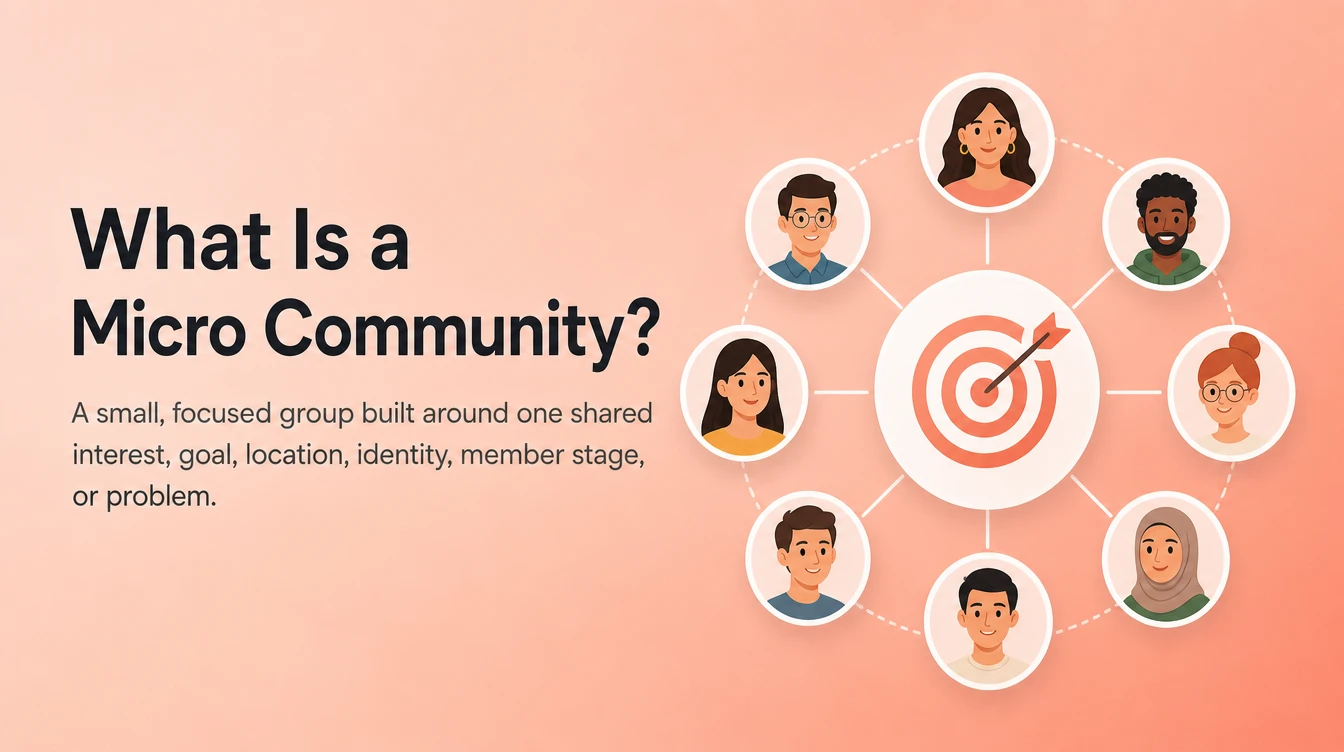
A micro community is a small, focused community built around one shared interest, goal, location, identity, member stage, or problem.
The word "micro" does not only mean small in number. It means narrow in purpose. A micro community can have 10 people in a creator cohort, 50 members in a customer advisory group, 200 people in a local chapter, or 1,000 members in a highly focused association subgroup.
Micro Community Meaning in Simple Terms
Think about the last time you were in a large group where most of the conversation had nothing to do with you.
That feeling of irrelevance is exactly what a micro community solves.
In a micro community:
- Members share something very specific in common
- The group has one clear reason to exist
- Conversations feel directly useful, not background noise
- Members are more likely to recognize and help each other
- Participation matters more than audience size
The value is not in the volume. It is in the relevance.
What Makes a Community "Micro"?
Six attributes define a micro community: a specific audience, a clear shared purpose, a smaller participation environment, higher relevance, more visible member contributions, and easier relationship-building.
One important clarification: a micro community can live inside a larger organization. A national association with thousands of members can still run micro communities for local chapters, new member cohorts, and volunteer teams. That is community building at every level of the member experience.
A 200-person Facebook group may be small, but it is not necessarily a micro community. A 200-person group for first-year nonprofit development directors solving donor retention problems? That is a micro community. The difference is purpose, not headcount.
Micro Community vs Online Community vs Niche Community
These terms overlap constantly. Here is how to tell them apart:
Unlike a broad macro community focused on reach, a micro community is designed around depth, focus, and intentional participation. You can have a niche community that is large and passive. A micro community is intentionally designed to avoid exactly that.
Brand communities and membership communities benefit most from the micro community approach, because both depend on long-term relationships rather than short-term reach.
Why Are Micro Communities Important?
Community engagement only happens when members feel the conversation was built for them.
People join and stay in small online communities because they provide unique informational and interactional spaces that larger communities cannot replicate. Members develop group-based identity, not just casual connections.
Organizations that added chapters and microsites saw 2.6 times more monthly logins, 88% more contributors, and 73% more discussions compared to those without subgroups.
That is not a marginal improvement. That is a different category of membership experience.
Micro communities also create better feedback loops. As one community manager noted in a r/AskMarketing discussion, a 200-member Discord group of power users delivered better product insights than months of broader social listening. The reason is simple: community trust building happens faster in small groups, and trust is what turns passive members into honest, active participants.
Micro Community Examples
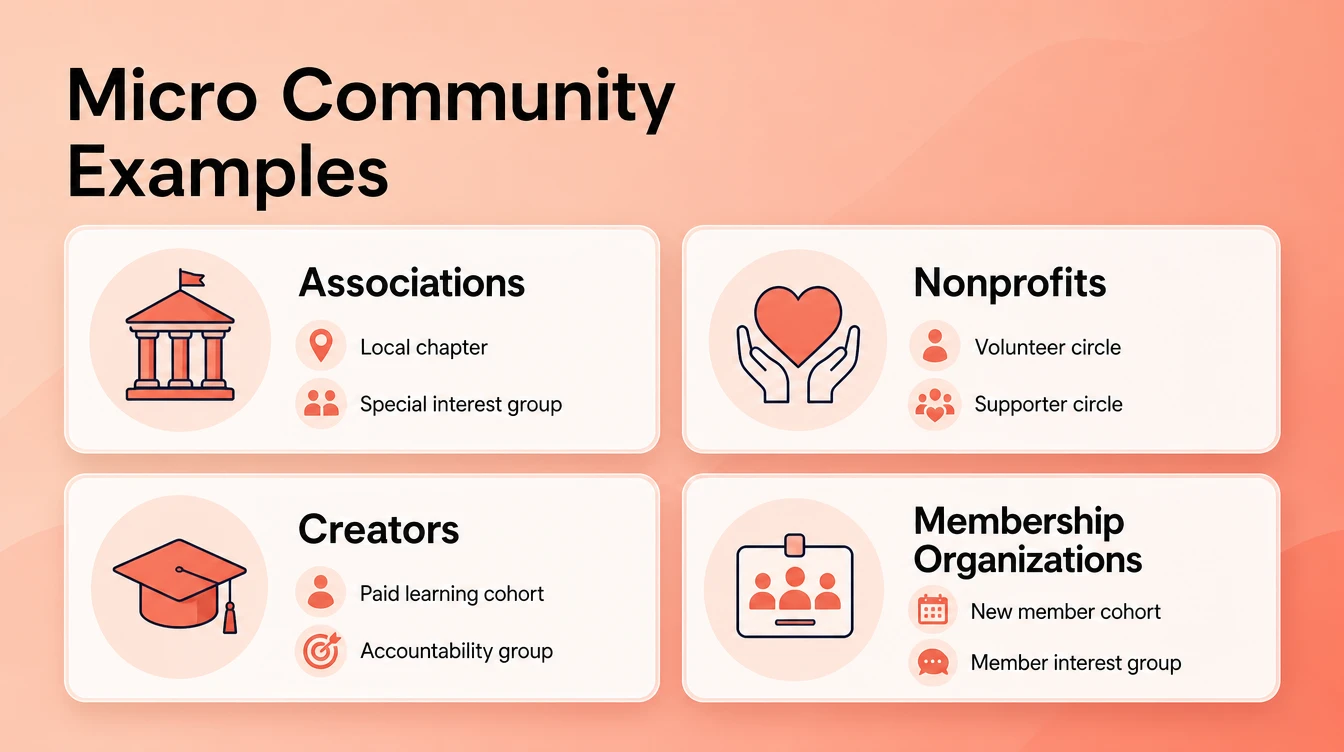
Micro communities look different depending on who is running them. Here are the most effective models by organization type.
For Associations
🏛️ Local chapter community. A geography-based group for regional events, local conversations, and face-to-face relationships. Multi-chapter membership management becomes essential here because chapters need their own focused space while staying connected to the national body.
🎯 Special interest group. A subgroup for members sharing a role, career stage, or professional challenge. A young professionals group inside a large association creates faster, more relevant relationships than the main community ever could.
🤝 Committee or working group. Built around shared responsibility, not just shared interest. Members coordinate action together, which drives even stronger participation than discussion-only groups.
For Nonprofits
💛 Volunteer circle. A focused space for volunteers working on a specific program or campaign. For organizations thinking about membership management for nonprofits, volunteer circles create structured peer support and recognition without adding operational complexity.
Supporter circle. A private community for nonprofit supporter circles: recurring donors and cause advocates connected by shared mission. When supporters feel like insiders, they stay longer and advocate more.
For Creators
🎓 Paid learning cohort. A cohort-based community where members work through a creator-led program together over a defined period. Paid communities achieve 11 to 37% higher engagement than comparable free groups. Skin in the game changes behavior.
Accountability group. A small peer circle for checking in on goals and progress. Simple structure, high participation, strong relationships.
For Membership Organizations
New member cohort. A temporary micro community for members who joined in the same period. It removes the awkwardness of entering a large existing community cold. Pairing the cohort with strong member engagement ideas from day one can meaningfully improve first-year renewal rates.
Member interest group. A focused subgroup based on shared professional interests, life stages, or member needs. These private member groups serve young professionals, event volunteers, regional members, or first-time board members.
How Do Micro Communities Work?
Every micro community starts with a shared reason to gather. A goal, a problem, a location, a career stage, or a project.
Then members need one clear first action. Introduce yourself. Answer a prompt. Join the first events for members. Not a complex onboarding sequence. Just one step that opens the door.
A member portal gives members a central home to access discussions, resources, and group events without jumping between platforms. But the portal is infrastructure. Facilitation is what keeps the group alive.
Someone needs to handle the community management: seed early conversations, reply to unanswered posts, recognize useful contributions, and hold the group focus. Nearly 60% of posts in online communities receive no reply. In a small group, one unanswered question feels like silence. The cure is consistent facilitation, not more members.
Benefits and Honest Challenges of Micro Communities
Why They Work
Higher relevance. Members engage when the conversation speaks directly to their situation. Generic topics get scrolled past. Specific ones get answered within hours.
Stronger trust. Repeated interactions inside a smaller group build familiarity quickly and create deeper member relationships. That familiarity is why small groups produce the kind of candid feedback that large communities rarely surface.
Better membership retention. People stay when they have relationships and receive consistent value. Micro communities build both. Peer-to-peer support scales community value without scaling team workload.
Measurable engagement outcomes. When micro communities connect to strong membership management, engagement signals become real business metrics, not just feel-good participation numbers.
Where They Fail
Community ghost towns are the most common failure mode. Nearly 60% of posts in online communities go unanswered. In a small group, that silence lands harder than in a large forum.
As founders on Indie Hackers found when niche groups launched on the platform: "Most groups here are dead... eventually 100% inactive." The problem was not the format. It was the absence of clear purpose and active facilitation.
Community over-segmentation is equally dangerous. Too many subgroups scatter contribution and confuse discovery. Creating 20 micro communities when you have enough energy to sustain 3 is a recipe for a graveyard of abandoned groups.
Champion dependency. A few active members often drive most of the activity. Build the community around purpose and recurring rituals, not personalities.
The fix for most of these problems is not technical. It is having a proven demand, a clear purpose, and a committed facilitator before the first invitation goes out.
How to Create a Micro Community
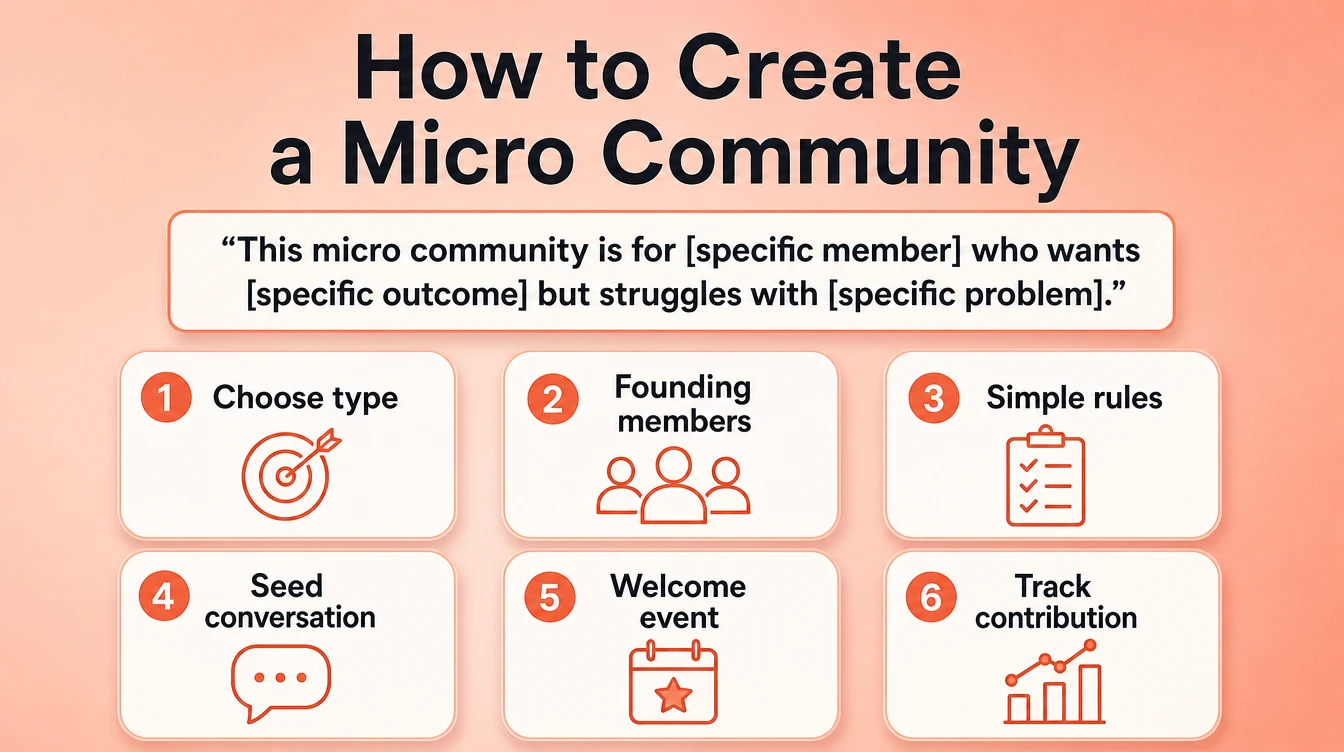
Start with one sentence before you build or launch anything:
"This micro community is for [specific member] who wants [specific outcome] but struggles with [specific problem]."
If you cannot finish that sentence clearly, the group is not ready to launch.
Then follow these steps:
- Choose the right type. Local chapter, special interest group, paid community cohort, new member group, or advisory group.
- Recruit 5 to 15 founding members before launch. These are the people who will introduce themselves, reply early, and attend the first call.
- Set simple rules. Who belongs, what topics fit, how promotion works, who moderates.
- Seed the first conversation. "What brought you here?" beats silence every time.
- Host a welcome event in the first 7 days. A 30-minute call does more for early momentum than any tool or template.
- Track contribution, not just count. Reply rate, unanswered posts, and active contributors tell you more than total member numbers.
Never launch into an empty room. The founding members are the community. Everything else follows from them.
How to Keep a Micro Community Active
Active micro communities run on rituals. Not complex systems. Simple, recurring reasons to show up.
A Monday question. A monthly member spotlight. A new member welcome thread. A post-event recap discussion. A resource of the week.
Community engagement strategies that work in large communities apply here too, with one meaningful difference: every contribution is visible. Recognize one member publicly and every other member notices.
Weekly consolidated digest emails achieve 54% open rates on community platforms, compared to a 36% average association email open rate. Use a weekly digest instead of constant notifications. Members stay informed without feeling bombarded.
Assign roles early. Give members a reason to own a piece of the experience: ambassador, discussion host, resource curator, or welcome volunteer. When members have a role, the most common community engagement problems, like silence and drop-off, tend to solve themselves.
Micro Communities for Membership Organizations
For membership organizations, micro communities are not a nice-to-have feature. They are the mechanism that makes a large organization feel personal.
Join It users, particularly across association communities and nonprofits, have applied micro community structures for new member onboarding cohorts, local and regional chapters, committee working groups, volunteer coordination teams, and career-stage peer groups.
The key is keeping micro communities connected to the broader member journey, not running them as disconnected side projects. Organizations using membership management software can link micro communities directly to member records, renewal workflows, and event data, making the impact visible and measurable.
When a local chapter discussion leads to an event registration, when a new member cohort reduces early drop-off, when a peer group improves renewal confidence, the micro community is doing real membership work.
Start with 3 to 5 high-demand groups. Prove activity. Then expand deliberately.
Micro Community FAQs
What is a micro community? A micro community is a small, focused group of people connected by a specific shared interest, goal, location, identity, or challenge. It is designed for deeper participation, stronger trust, and a more personal experience than a broad online community provides.
What is an example of a micro community? A local chapter inside a professional association, a new member cohort inside a nonprofit, a paid creator-led learning cohort, or a customer advisory group inside a brand community are all clear examples.
How big is a micro community? There is no universal number. In creator settings, 10 to 100 members is typical. In association contexts, a focused subgroup of several hundred can still function as a micro community if the purpose is specific and participation is intentional.
What is the difference between a micro community and an online community? An online community is the broader category, connecting people digitally around almost any topic or interest. A micro community is a focused subset: intentionally small, built around one specific purpose, and designed for deeper participation than a general online community can offer.
What is the difference between a micro community and a niche community? A niche community is defined by topic focus. A micro community emphasizes smaller size, deeper relationships, and higher participation rates. A niche community can be large and passive. A micro community is designed to be small and active.
Why do micro communities fail? Most fail because the purpose is unclear, there is no active facilitator, demand was assumed rather than proven, or too many subgroups were created at once without enough members to sustain activity.
Are micro communities good for nonprofits and associations? Yes. Especially for local chapters, new member cohorts, committees, and volunteer teams. They make large organizations feel personal and create the peer relationships that support long-term member retention.
How do you keep a micro community active? Use specific prompts instead of generic questions, create recurring rituals, recognize member contributions publicly, reply to unanswered posts within 48 hours, and connect the group to shared events and goals.
The Smallest Room Can Hold the Biggest Ideas
The communities creating the strongest relationships right now are not the largest ones.
They are the ones where members know each other's names, where questions get answered, where someone is paying attention.
Start small. Be specific. Show up consistently. That is how real communities are built.
If you are ready to connect micro communities to your membership infrastructure, create a free Join It account and explore how member groups, chapters, and events work together in one place. Review free trial and pricing options to find the right fit for your organization, or book a call with the team to talk through your specific setup.
Sources
- Higher Logic. 2025 Association Community Benchmarks & Trends
- Reddit. How Are Brands Using Micro-Communities to Build Trust
- Mighty Networks. 12 Research-Backed Community Engagement Strategies
- Indie Hackers. "Create Group" Did More Harm Than Good to IH

Guides from the Experts
Through our work with 4,000+ organizations - we’ve put together helpful guides to assist; regardless of where you are on your journey.
.webp)

A Complete Guide to Membership Organizations
Everything you need to know to manage and grow your membership business
.webp)
Maximize Membership Retention: 10 Proven Strategies
Tried and true strategies that not only win membership, but keep them

Build a Membership Website: A Step-by-Step Guide
Your one-stop resource for knowing all the features your modern membership website needs
Ready to start your free trial?
Our membership software is intuitive to use and even easier to test for yourself.