Food Fundraising Ideas: 25 Practical Ideas for 2026



Here's something most fundraising guides won't tell you: the best food fundraiser isn't the one with the highest theoretical profit margin.
It's the one you can actually pull off with the volunteers, time, and resources you have right now.
This guide is for nonprofits, schools, booster clubs, PTAs, community organizations, and volunteer-led groups looking for food fundraising ideas that work in 2026. Not ideas that worked five years ago when everyone paid cash and permits were simpler.
The 2026 reality is different. People expect to pay with their phones. Volunteers have less time than ever. And food safety rules vary wildly by location.
How to use this guide:
- Pick your goal (quick cash vs. community building vs. major event)
- Identify your constraints (volunteers, venue, time, permits)
- Choose from the category that matches both
- Run the simple checklist for your chosen idea
Quick Picks:
- Last minute food fundraiser ideas: Restaurant partnership night, donut sale
- Cheap food fundraising ideas: Lemonade stand, potluck dinner
- High profit: Pancake breakfast, chili cook-off
- School-friendly: Ice cream social, bake sale
Key Takeaways
What Makes Food Fundraisers Work in 2026
Food fundraisers work because people want what you're selling. Nobody gets excited about wrapping paper, but a pancake breakfast or chili cook-off? That's an event people actually want to attend.
The numbers prove it. Charitable giving in the U.S. hit $592.5 billion in 2024, with individuals contributing $392.5 billion. In the UK, donors gave about £15.4 billion.
Three factors determine whether your food fundraiser succeeds or flops in 2026, turning it into one of the most profitable food fundraisers for your organization.
Convenience and Cashless Payments Are Now the Default
Over half of donors prefer giving online, and over 80% of event attendees prefer digital wallets or texting to donate.
If you only accept cash, you're leaving money on the table. Add one QR code per table linking to your donation page for easy QR code donations at events. Use a card reader for in-person sales. Offer online preorders with a cutoff time 24-48 hours before your event.
Volunteer Time Is the Bottleneck
Nearly 28% of U.S. adults volunteered in 2022-2023. In the UK, active volunteers dropped from 7.1 million to 5.6 million in 2024.
The "return per volunteer hour" matters more than theoretical profit margin. A restaurant partnership night where your only job is promotion will often raise more than an elaborate bake sale requiring 15 volunteers for six hours.
Food Rules and Permits Can Kill Good Ideas
Any person or group that prepares and sells food must get a temporary food license in many areas. Requirements vary wildly by location.
As one teacher noted, "We can't sell candy or soda in my district", pointing to nutrition policies and compliance issues.
Before you fall in love with any idea, confirm it's actually allowed where you operate.
How to Choose the Right Food Fundraising Idea
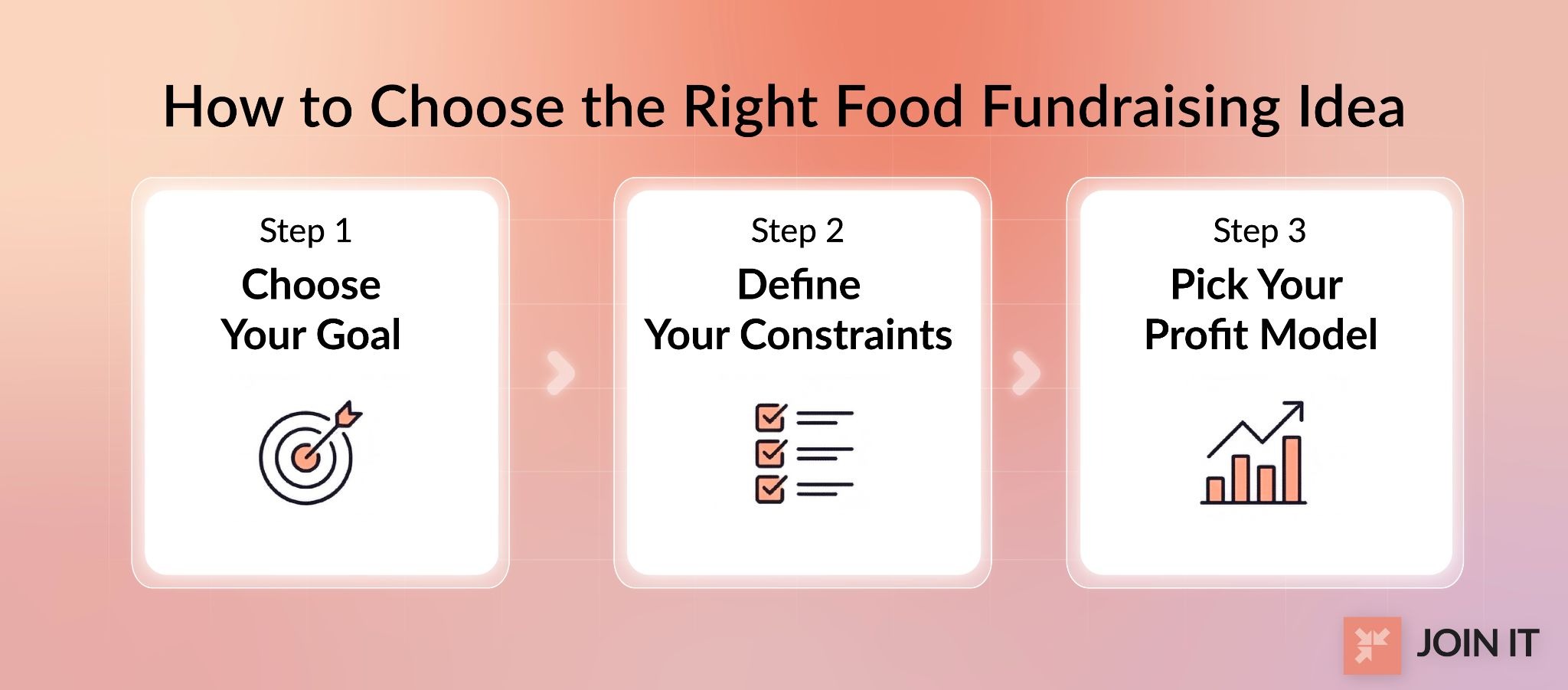
Step 1: Choose Your Goal
Cash fast (urgent one-time need): These quick food fundraising ideas work best: Restaurant partnership, donut sale, candy bars
Community-building (relationships over margin): Potluck dinners, international food fair, coffee morning
Major annual fundraiser (big revenue driver): Pancake breakfast, chili cook-off, farm-to-table dinner
Recurring revenue (sustainable income): Monthly soup sale, Taco Tuesday series
Step 2: Define Your Constraints (5-Minute Checklist)
Be honest about your resources to find the right low cost food fundraising ideas for your situation:
✓ Venue: Indoor/outdoor? Kitchen access? Parking?
✓ Equipment: Warming trays, coolers, serving utensils?
✓ Volunteers: How many can you reliably get?
✓ Time window: Weeks to plan or days?
✓ Food safety: Can you store perishables properly?
✓ Rules: Any banned items (candy, soda, homemade foods)?
Step 3: Pick Your Profit Model
Margin: Gap between food cost and selling price
Volume: More people paying = more money
Upsells: Toppings bars, raffle tickets, "pay it forward" options
Balance all three. A tight-margin bake sale with high volume can beat a premium dinner with low attendance.
Quick Comparison: Representative Ideas from Each Category
This table compares one idea from each category to help you see trade-offs:
How to use this table:
- Low volunteers + need money fast → Restaurant night or Cookie dough
- Have volunteers + want high profit → Pancake breakfast or Food truck festival
- Minimal budget + quick turnaround → Bake sale
- Want recurring income → Choose ideas you can repeat (Pancake breakfast, Restaurant night)
25 Food Fundraising Ideas for 2026
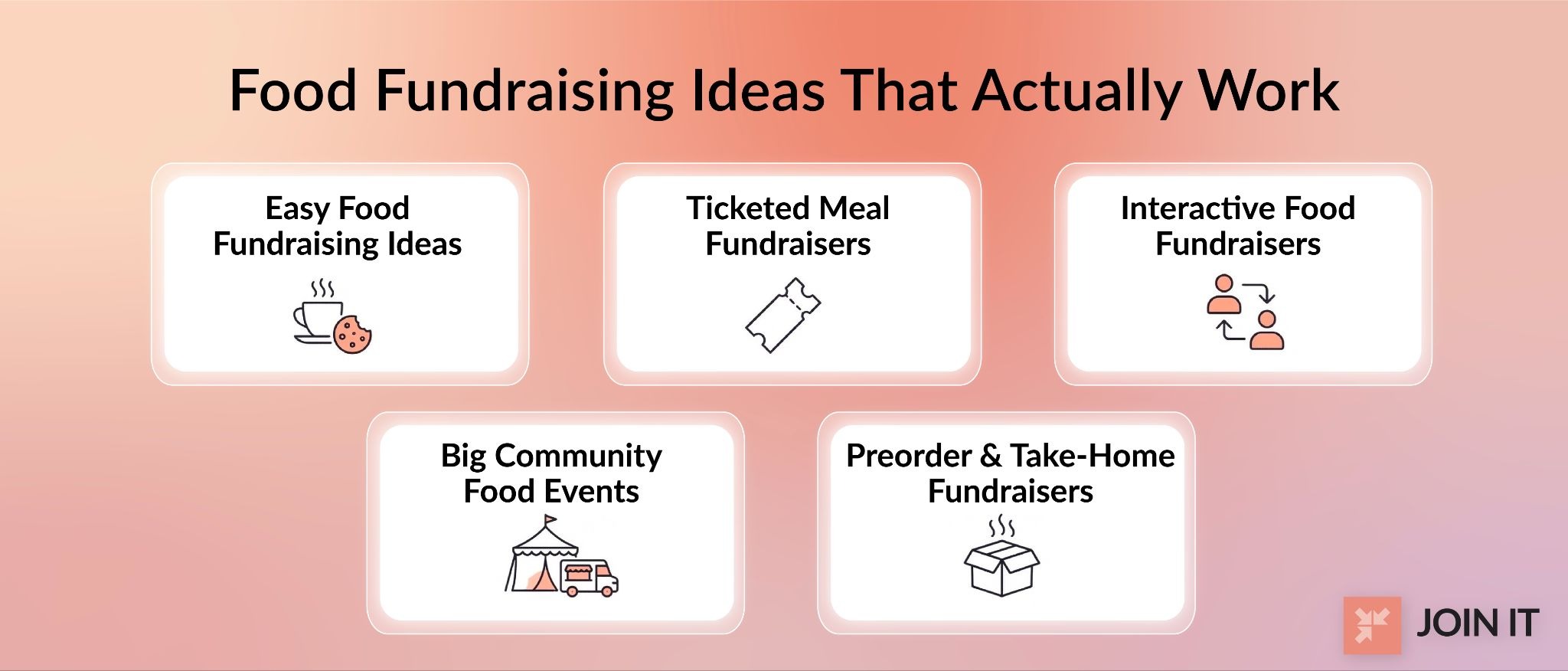
Each idea follows the same structure: what it is, why it works in 2026, quick setup steps, costs and pricing, common problems and fixes, and optional add-ons.
Easy Food Fundraising Ideas (Volunteer-Friendly, Fast Setup)
These easy food fundraising ideas are perfect for groups with limited time and volunteer capacity.
1) Restaurant Partnership Night
Partner with a local restaurant that donates 15-20% of sales during a specific time window. Your only job is promoting the event. This restaurant night fundraiser model is one of the simplest to execute.
Why it works in 2026: Zero food handling, zero permits, zero volunteer burnout. Most restaurants have these programs ready to go.
Setup:
- Contact restaurants with fundraiser programs (Chipotle, Panera, local pizza places)
- Book a date 3-4 weeks out
- Get promotional materials (flyer, social posts, online code)
- Promote via email, social media, and parent networks
Costs + pricing: You pay nothing. The restaurant absorbs costs and donates 15-20% of sales.
Common problems + fixes: Low turnout without promotion. Send 3 reminders (1 week before, 2 days before, day-of).
Optional add-on: Station a volunteer on-site to thank attendees and collect email signups.
If readers want even more options beyond food, point them to fundraising ideas for clubs for additional themes and formats.
2) Coffee Morning / Morning Tea Fundraiser
Host a simple coffee and pastry morning with optional games or themes. Coffee morning fundraising is especially popular in the UK and growing in popularity elsewhere.
Why it works in 2026: Coffee has incredible margins (a $15 bag makes 50+ cups at $2-3 each). Morning timing attracts parents at drop-off.
Setup:
- Secure venue with tables and electricity
- Buy bulk coffee, tea, and pastries
- Set up 1-2 self-serve stations
- Optional: Add a theme (book club, craft activity)
Costs + pricing: Upfront $50-100, charge $3-5 per person. Break-even at 15-20 attendees.
Common problems + fixes: Pastries go stale. Buy fresh the morning of or pre-sell tickets for accurate headcount.
Optional add-on: Silent auction or recipe card exchange.
3) Sausage Sizzle Fundraiser
Classic Australian community BBQ: sausages in bread with onions and sauce, sold from a grill at high-traffic locations.
Why it works in 2026: Extremely simple menu, fast service, huge community nostalgia in AU/NZ.
Setup:
- Get permission for high-traffic location (hardware stores in AU often host these)
- Buy bulk sausages, bread, onions, sauce
- Rent or borrow BBQ grill
- Staff with 2-3 volunteers
Costs + pricing: $1 per sandwich to make, sell for $3-5. 200 sales = $400-800 profit.
Common problems + fixes: Weather cancellations. Have a backup date or tent.
Optional add-on: "Donate extra" jar for additional support.
4) Donut Sale
Buy wholesale donut boxes, resell individually or as boxes during high-traffic times.
Why it works in 2026: Universal appeal, 24-hour shelf life, strong margins. Preorders eliminate waste.
Setup:
- Partner with donut shop for wholesale pricing ($0.80-1.00 per donut)
- Offer preorders online 1 week before
- Pick up donuts early morning of sale
- Set up at school drop-off/pickup or community event
Costs + pricing: One user shared: "I buy $0.99 donut dozen and resell them for $1 each, earning $11 profit per box".
Common problems + fixes: Stale after 24 hours. Only order presold quantity plus small buffer.
Optional add-on: Sell coffee alongside donuts.
For school teams and athletics audiences, explore these sports fundraising ideas as another idea bank.
5) Hot Chocolate Bar
Serve hot chocolate with toppings bar: marshmallows, whipped cream, peppermint, chocolate shavings.
Why it works in 2026: Seasonal appeal, high perceived value from customization, excellent margins.
Setup:
- Make hot chocolate in batches or use commercial mix
- Set up self-serve toppings bar
- Offer small and large sizes
- Use festive cups
Costs + pricing: $0.30-0.50 per cup. Sell basic for $2-3, premium with toppings for $4-5.
Common problems + fixes: Toppings spill. Use small bowls with serving spoons and clear signage.
Optional add-on: Sell hot chocolate kits as take-home gifts.
6) Ice Cream Social
Serve ice cream with classic toppings in a community space.
Why it works in 2026: Universal appeal, easy execution, nostalgia factor.
Setup:
- Buy bulk ice cream and toppings
- Set up serving stations
- Charge per scoop or flat unlimited price
- Add picnic tables and music
Costs + pricing: $0.75-1.25 per serving. Sell for $3-5 per person.
Common problems + fixes: Ice cream melts fast. Use coolers with dry ice and serve in waves.
Optional add-on: Ice cream eating contest.
Ticketed Meal Fundraisers (Higher Revenue Per Person)
7) Pancake Breakfast
Bulk pancake mix plus toppings bar. Time-boxed morning event (7-10am weekends). This pancake breakfast fundraiser is a classic for good reason.
Why it works in 2026: Incredibly low food costs ($0.30-0.50 per serving), familiar comfort food, family-friendly.
Setup:
- Rent or use community kitchen with griddles
- Recruit 6-8 volunteers
- Buy bulk mix, eggs, milk, butter, toppings
- Sell tickets in advance ($8-12 adult, $5-6 child)
Costs + pricing: Food cost $1.50-2 per plate, sell tickets $8-12. Serve 100-200 people for $600-2,000 profit.
Common problems + fixes: Griddles can't keep up. Stagger ticket times or run 4+ griddles.
Optional add-on: Raffle tickets or photo booth.
One community raised $37,000 in a single year with an annual pancake breakfast.
8) Spaghetti Dinner
Large-batch pasta with marinara or meat sauce, garlic bread, and salad.
Why it works in 2026: Pasta is the cheapest protein per serving. Filling, broadly appealing, handles dietary restrictions.
Setup:
- Cook pasta in large pots (prep sauce ahead)
- Buffet-style serving or plated meals
- Recruit 8-10 volunteers
- Sell tickets advance ($10-15 adult, $6-8 child)
Costs + pricing: Food cost $2-3 per plate, sell tickets $10-15. Profit $8-12 per person.
Common problems + fixes: Pasta gets sticky. Cook in batches or toss with oil.
Optional add-on: Dessert auction during meal.
9) Chili Cook-Off
Competitors pay entry fees, attendees buy tasting tickets to sample and vote. The chili cook-off fundraiser format generates revenue from both participants and spectators.
Why it works in 2026: Revenue from both competitors and tasters. Competition creates buzz.
Setup:
- Charge competitors $20-30 entry
- Competitors bring chili in slow cookers
- Sell tasting tickets ($10-15 unlimited samples)
- Provide voting cards and prizes
Costs + pricing: Minimal costs (cups, spoons, prizes). 15 competitors ($300-450) + 100 tasters ($1,000-1,500) = $1,300-1,950.
Common problems + fixes: Chili runs out early. Require minimum quantities in rules.
Optional add-on: Sell voting tickets separately ($1 each).
If you talk about hosting meals or competitions, this resource on planning a successful fundraising event backwards helps build working timelines.
10) Pizza Party / Pizza Night
Sell slices or tickets. Easy to scale with local pizzeria.
Why it works in 2026: Universally loved, easy to serve, minimal equipment needed.
Setup:
- Partner with pizza shop for wholesale ($8-10 per large)
- Sell tickets in advance ($5-8 for 2 slices and drink)
- Set up casual dining area
- Offer variety of toppings
Costs + pricing: Each large pizza = 8 slices. Cost per slice $1-1.25, sell 2-slice tickets $5-8.
Common problems + fixes: Pizza gets cold. Use warming trays or ovens.
Optional add-on: Salad bar or dessert table.
11) Taco Bar
Build-your-own taco bar with proteins, toppings, and tortillas. Can become recurring monthly event.
Why it works in 2026: Customizable, accommodates dietary restrictions, trendy.
Setup:
- Set up taco bar with proteins (beef, chicken, beans) and toppings
- Charge flat rate per person ($8-12 unlimited)
- Cook in large batches, keep warm in chafers
- Promote recurring schedule if monthly
Costs + pricing: Food cost $3-4 per person, sell tickets $8-12. Profit $5-8 per person.
Common problems + fixes: Irregular attendance. Send reminders 2 days before each event.
Optional add-on: Dessert or drink upgrades.
12) Potluck Fundraiser Dinner
Community brings dishes to share, charge entry fee. Add raffle or auction.
Why it works in 2026: Zero food cost. Builds community through shared contribution.
Setup:
- Charge $5-10 per person or $20-30 per family
- Coordinate dishes via signup sheet
- Provide plates, utensils, drinks, dessert
- Add entertainment
Costs + pricing: Just venue, plates, drinks. Entry fees are pure profit.
Common problems + fixes: Too many desserts. Assign categories when people sign up.
Optional add-on: Raffle tickets ($5 each or 5 for $20).
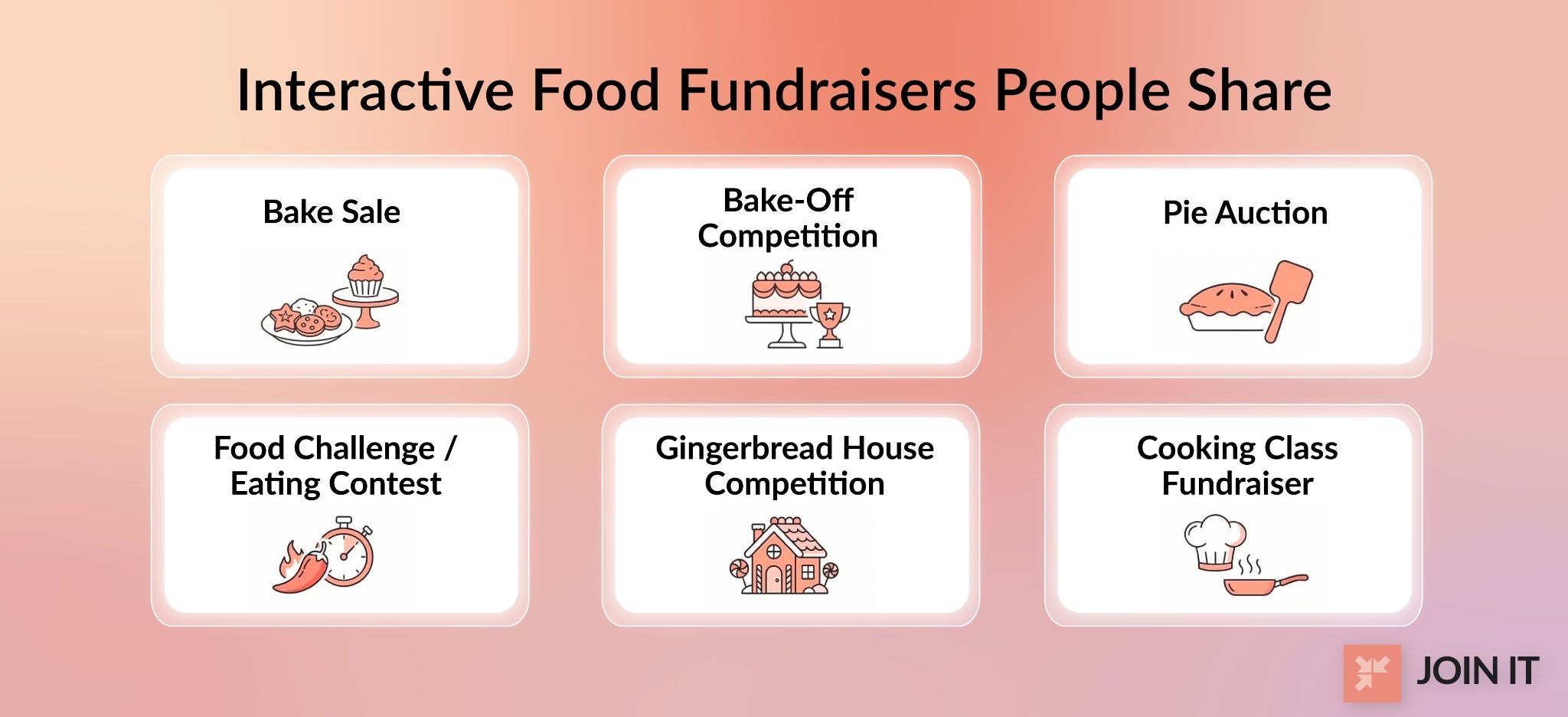
Interactive Food Fundraisers People Share
If you include add-on merchandise, reference t-shirt fundraiser ideas as an easy revenue booster.
13) Bake Sale
Classic bake sale modernized with dietary labels and themed bundles. The bake sale fundraiser remains popular when done with modern expectations in mind.
Why it works in 2026: Transparency about ingredients meets current expectations.
Setup:
- Recruit bakers or buy from licensed sources
- Create labels listing ingredients and allergens
- Offer bundles ("Movie night box" with cookies and brownies)
- Accept digital payments
Costs + pricing: Homemade costs $0.50-1.50 per item, sell for $2-5 each or bundles $15-25.
Common problems + fixes: Districts ban homemade. Buy from licensed bakeries.
Optional add-on: Coffee or hot chocolate sales.
14) Bake-Off Competition
Participants enter their bakes, judges score, entries become sale inventory.
Why it works in 2026: Competition creates engagement. Revenue from entries, tasting tickets, and final sales.
Setup:
- Charge entry fees ($10-20)
- Set categories (cakes, cookies, creative)
- Recruit judges
- Sell tasting tickets ($5-10)
- Sell bakes after judging
Costs + pricing: Minimal costs. Revenue from fees + tasting + sales.
Common problems + fixes: Not enough entries. Promote 3-4 weeks ahead with fun categories.
Optional add-on: Live voting ($1 per vote for "people's choice").
15) Pie Auction
Auction homemade or bakery pies. Consider "pie a teacher" variant.
Why it works in 2026: Auctions create competitive bidding, raising more per item than fixed pricing.
Setup:
- Recruit community or bakeries to donate pies
- Host live or silent auction
- For "pie a teacher," students bid for the privilege
- Use auctioneer to drive energy
Costs + pricing: Donated pies = zero cost. Pies auction for $20-75 each.
Common problems + fixes: Bidding stalls. Set minimum bids and use enthusiastic auctioneer.
Optional add-on: Sell coffee and dessert tickets to auction spectators.
16) Food Challenge / Eating Contest
Ticketed spectacle around speed eating, spicy tolerance, or dessert consumption.
Why it works in 2026: Events attract crowds and social sharing.
Setup:
- Choose challenge (hot wings, pie eating, donuts)
- Charge competitors entry ($20-30)
- Sell spectator tickets ($5-10)
- Award prizes
Costs + pricing: Food costs $50-150. Revenue from entries + spectator tickets.
Common problems + fixes: Mess concerns. Embrace it with plastic tablecloths.
Optional add-on: Live stream with virtual donations.
17) Gingerbread House Competition
Holiday competition with family participation, voting, and display period.
Why it works in 2026: Families enjoy participating together. Extended display creates ongoing visibility.
Setup:
- Charge entry fees ($15-25 per family)
- Provide kits or require scratch building
- Display 3-7 days in public space
- Sell voting tickets ($1 per vote)
- Award prizes
Costs + pricing: Participants provide materials. Revenue from entries + voting.
Common problems + fixes: Houses collapse. Provide structural guidelines and stable surfaces.
Optional add-on: Auction winning houses.
18) Cooking Class Fundraiser
Charge per seat for class hosted by chef or skilled volunteer.
Why it works in 2026: Experiential events are increasingly popular. People value learning while supporting a cause.
Setup:
- Partner with chef or culinary instructor
- Choose theme (pasta, sushi, pastry basics)
- Charge $40-75 per person for 2-3 hours
- Provide ingredients and equipment
- Participants eat what they make
Costs + pricing: Food and instructor $500-800 for 20 people. Sell tickets $40-75 ($800-1,500). Profit $0-700.
Common problems + fixes: Limited class size caps revenue. Host multiple sessions.
Optional add-on: Sell recipe books afterward.
Big Community Food Events (Sponsors + Scale)
For seasonality like BBQs and holiday meals, connect to springtime fundraising events for timely inspiration.
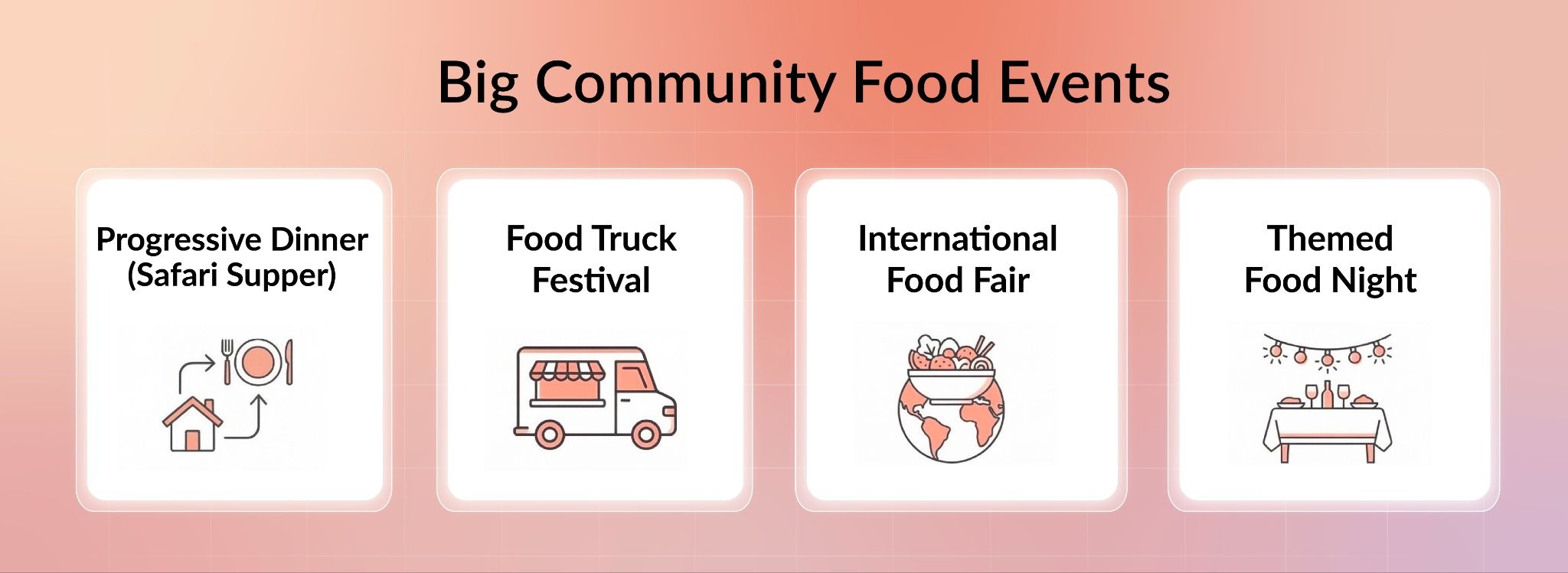
19) Progressive Dinner (Safari Supper)
Participants eat rotating courses at different homes/venues, ending with dessert together.
Why it works in 2026: Adventure-style experience builds connections. Spreads hosting duties.
Setup:
- Recruit 4-6 host homes
- Assign courses (appetizers, salad, main, dessert)
- Sell tickets ($25-40 per person)
- Provide maps and timing
- Hosts prepare their assigned course
Costs + pricing: Hosts cover course costs (often reimbursed). Ticket revenue minus reimbursement is profit.
Common problems + fixes: Timing issues. Build 15-minute buffers between courses.
Optional add-on: Wine pairings at each course.
20) Food Truck Festival
Partner with food trucks for participation fees or revenue share. A food truck festival fundraiser offers huge variety without any cooking on your part.
Why it works in 2026: Huge variety without any cooking. Trucks handle prep, service, cleanup.
Setup:
- Secure venue with space for 5-10 trucks
- Charge trucks $100-200 or take 15-20% of sales
- Optional: charge entry fee ($5) or keep free
- Add entertainment
- Promote food variety
Costs + pricing: Venue and promotion $500-1,000. Revenue from truck fees + entry + beverages.
Common problems + fixes: Last-minute cancellations. Over-recruit by 20%.
Optional add-on: People's choice voting ($1 per vote).
When you mention timing and turnout, link to the best time of year to fundraise to help pick the right window.
21) International Food Fair
Booths representing different cultures serve traditional foods. Sell tickets or tokens.
Why it works in 2026: Celebrates diversity, creates cultural exchange. Global flavors are trending in event catering.
Setup:
- Recruit families/groups to sponsor cultural booths
- Sell entry tickets ($10-15) or token cards
- Booths prepare sample portions
- Add cultural performances
Costs + pricing: Booth participants cover food costs. Revenue from entry or tokens.
Common problems + fixes: Uneven participation. Actively recruit across cultural groups.
Optional add-on: Sell cookbooks or recipe cards.
22) Themed Food Night
Themed dinner where decorations, music, and food match a specific cuisine.
Why it works in 2026: Theming increases perceived value and creates shareable experiences.
Setup:
- Choose theme (Mexican fiesta, Italian trattoria, French bistro)
- Decorate venue accordingly
- Create matching menu
- Sell tickets ($15-30 per person)
- Add themed music/entertainment
Costs + pricing: Food and décor $500-1,000 for 100 guests. Tickets $15-30 ($1,500-3,000). Profit $500-2,000.
Common problems + fixes: Theme feels generic. Consult community members from that culture.
Optional add-on: Cultural education or trivia.
Preorder and Take-Home Food Fundraising Ideas
For readers asking "what else can we sell?" include things to sell for fundraising as a broader list.
23) Community Cookbook
Collect recipes from community members and compile into a printed or digital cookbook. A cookbook fundraiser creates lasting value beyond the initial sale.
Why it works in 2026: Personal connection creates emotional value. Low upfront cost, high perceived value.
Setup:
- Collect recipe submissions (4-6 week deadline)
- Design and format book
- Include photos, stories, dedications
- Print via print-on-demand or local printer
- Sell for $15-25
Costs + pricing: Printing $5-8 per book, sell $15-25. Profit $7-17 per book.
Common problems + fixes: Low submissions. Use online form and send multiple reminders.
Optional add-on: Digital version for $10 instant download.
24) Cookie Dough Fundraiser
Partner with established company. Take preorders, they ship frozen dough, you distribute.
Why it works in 2026: Proven model with 40-60% margins. Company handles production and logistics.
Setup:
- Partner with cookie dough company
- Open preorders 2-3 weeks
- Collect payments upfront
- Company ships in bulk
- Organize pickup day
Costs + pricing: No upfront cost. Keep 40-60% of sales ($8-12 profit per $20 tub).
Common problems + fixes: Dough melts during distribution. Coordinate pickup times with coolers ready.
Optional add-on: Sell additional items from same company.
If you include online ordering or ticketing, this list of free fundraising tools is practical next step.
25) Pizza Kit Fundraiser
Sell preorder kits with dough, sauce, cheese, and toppings for home assembly.
Why it works in 2026: Interactive cooking experience. Appeals to families wanting easy dinners.
Setup:
- Partner with pizzeria or create kits
- Each kit has dough, sauce, cheese, toppings
- Take preorders 1-2 weeks ahead
- Assemble kits and organize pickup
- Provide baking instructions
Costs + pricing: Cost $5-7 per kit, sell $15-20. Profit $8-13 per kit.
Common problems + fixes: Dough quality degrades. Assemble fresh day before pickup, keep refrigerated.
Optional add-on: Family-size kits or specialty toppings.
Food Fundraising Ideas for Schools, PTAs, and High School Groups
Schools face unique constraints when choosing food fundraising ideas for schools: nutrition policies, food allergies, permission requirements, and strict scheduling.
School-specific considerations:
- Nutrition policies (Smart Snacks guidelines limit sugar, fat, portions)
- Allergy risks require careful labeling
- Permission slips often required
- Limited to after-school hours, weekends, or special events
- Best results during drop-off/pickup windows
Best-fit ideas: Restaurant partnership nights, donut sales, ice cream socials, hot chocolate bars, pancake breakfasts, preorder fundraisers. These PTA food fundraising ideas work well for volunteer-led school groups.
School-safe checklist: ✓ Get admin approval 3-4 weeks ahead
✓ Check nutrition policies and restrictions
✓ Label all allergens
✓ Offer nut-free/gluten-free/vegan options
✓ Schedule during approved times
✓ Plan for leftover inventory
When restrictions are tight, one teacher's coin drive collected $700 proving sometimes the best fundraiser isn't food at all.
Food Fundraising Ideas for Nonprofits, Community Orgs, and Booster Clubs
Nonprofits and community organizations have more flexibility when choosing nonprofit food fundraising ideas, but face different challenges: volunteer capacity, mission alignment, and building long-term donor relationships.
Align with your mission: Food fundraisers should reinforce what you stand for. A food bank can host "hunger awareness dinners." Environmental nonprofits can emphasize local, sustainable, zero-waste events.
Best-fit ideas by type:
Booster clubs/sports teams: Game-day concessions, BBQ cook-offs, chili cook-offs, pancake breakfasts before tournaments. These booster club food fundraising ideas work well around sports schedules.
Community organizations: Farmers market booths, international food fairs, food truck festivals, potluck dinners
Nonprofits: Farm-to-table dinners with sponsor tiers, themed food nights, cooking classes, food tasting events
The key is choosing formats that create community moments, not just transactions. When people connect over food, they stay engaged long-term.
If your post recommends setting goals, reference fundraising metrics so readers know what to track.
Real-World Problems People Run Into (and How to Avoid Them)
Low Margins, High Effort
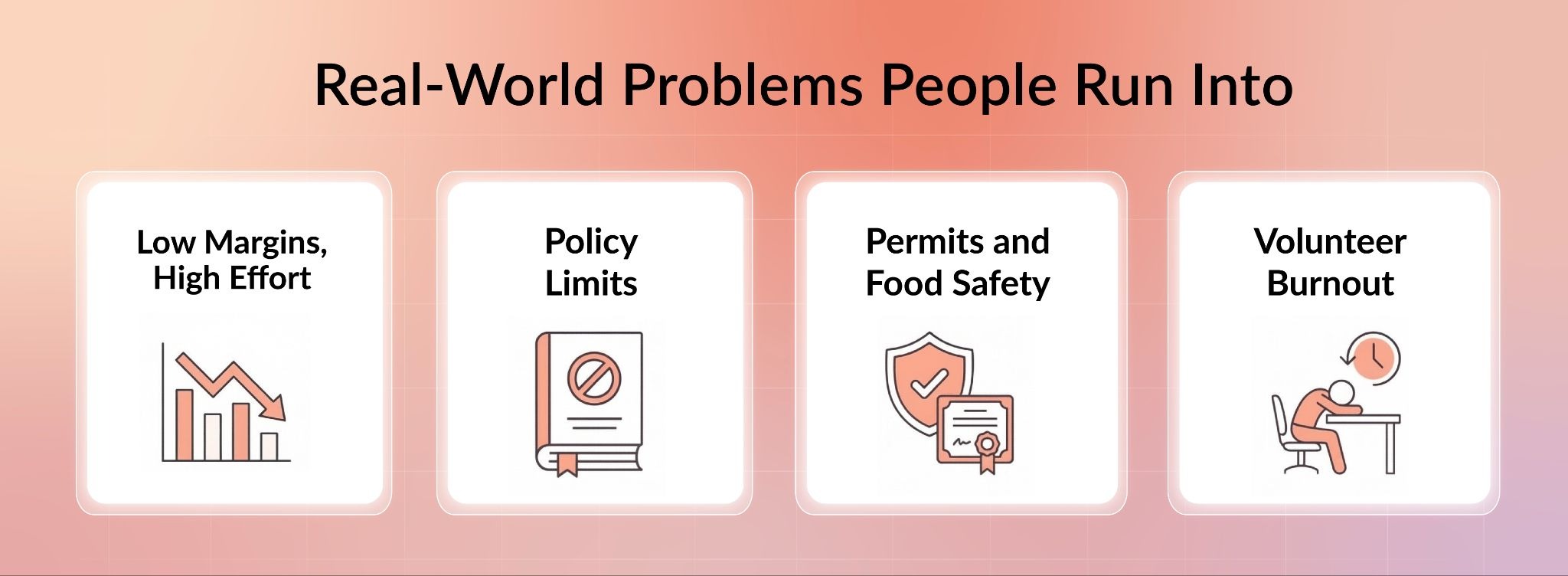
Spending 6 hours baking, recruiting 10 volunteers, selling 150 items, and netting $200 means $33 per volunteer hour.
Fix: Simplify menu, use preorders, create bundles, set pricing floors, buy wholesale
Policy Limits
School rules can kill otherwise great ideas.
Fix: Focus on healthier items, shift to contests, use ticketed meals, embrace restaurant partnerships
Permits and Food Safety
Food sales require licenses in many jurisdictions.
Compliance checklist: ✓ Contact health department 4-6 weeks ahead
✓ Ask about nonprofit exemptions
✓ Label all allergens
✓ Keep hot foods above 140°F, cold below 40°F
For nonprofits, review can nonprofits sell products for compliance guidance.
Volunteer Burnout
Active volunteers dropped 21% in one year.
Fix: Use 2-hour shifts, choose pre-packed sales, run fewer events with higher yield, automate ticketing/payments, celebrate volunteers. Focus on volunteer friendly fundraiser ideas that don't overwhelm your team.
How to Organize a Food Fundraiser
Learning how to organize a food fundraiser effectively comes down to three key areas: timeline, promotion, and payment systems.
Timeline Templates
7-Day (Last-Minute):
Day 1: Pick idea | Days 2-3: Get approvals, recruit volunteers | Days 4-5: Promote | Day 6: Reminders | Day 7: Execute
14-Day (Standard):
Week 1: Choose, get permits, recruit, set date | Week 2: Market heavily, finalize roles, execute
30-Day (Big Event):
Week 1: Form committee, secure permits/venue | Week 2: Recruit volunteers, budget, vendors | Week 3: Heavy promotion, sponsors | Week 4: Confirm details, reminders, prep
Promotion That Works
One message, one CTA, one deadline: Be clear about what, when, where, why, and how.
Show impact: "Help us raise $2,000 for new soccer uniforms" beats "Support our booster club."
Use networks: School emails, Facebook groups, Nextdoor, church bulletins, business boards
Send 3-4 reminders: announcement, 1 week before, 2 days before, day-of.
Payments (Cashless Setup)
Over 80% prefer digital payments.
Solutions: QR codes to donation pages, Venmo/PayPal, Square reader, online ticketing
If you use a membership platform for dues/events, reuse it for ticketing and checkout.
Measuring Success and Proving Impact
Track these metrics every time:
Financial: Total revenue, total costs, net profit, profit margin, average order value
Engagement: Attendance, number of orders, volunteer hours, new supporters, repeat attendance
Operational: Waste percentage, setup/cleanup time, issues/complaints
Before vs. After Comparison
Document Your Wins
Goal: Raise $1,500 for band uniforms
Setup: Pancake breakfast, 150 advance tickets at $10
Result: $1,800 revenue, $400 costs, $1,400 profit
Lesson: Pre-selling guaranteed baseline revenue
To understand broader engagement strategies, explore this membership retention guide and membership experience framework.
FAQ
How do food fundraisers work?
Food fundraisers sell food items, meals, or experiences to supporters, with profits benefiting your organization. You either prepare food yourself, partner with restaurants for give-back nights, or sell through established vendors. The key is offering what people want at a price covering costs plus generating profit.
What is the best food to sell for fundraising?
When considering what food sells best for fundraising, the best foods balance low cost, high perceived value, and easy execution. Top performers: pancakes ($0.50 cost, $8-10 sale), donuts (wholesale $0.80, sell $2-3), popcorn ($0.10 kernels, $1-2 bag). One teacher noted "Sno-cones are great, the syrups are cheap and go really far".
Do you need a permit to sell food for fundraising?
Usually yes. Any group selling food must get a temporary license in most locations. Requirements vary significantly. Some areas have nonprofit exemptions. Contact your local health department 4-6 weeks before your event.
What should you sell at a fundraising bake sale?
When deciding what to have at a fundraising bake sale, sell easy-to-transport items with shelf life: cookies (wrapped or bundled), brownies, cupcakes, muffins, rice crispy treats. Create themed bundles like "breakfast bundle" or "movie night box" to increase average purchase. Label all allergens and offer gluten-free/vegan options.
How do you do a restaurant fundraiser night?
Learning how to do a restaurant fundraiser night is straightforward: Contact restaurants with fundraising programs (Chipotle, Panera, local pizza places). Book 3-4 weeks ahead. They provide promotional materials. You promote via email and social media. On event night, supporters dine and mention your organization or use a code. Restaurant donates 15-20% of participating sales.
How do you run a chili cook-off fundraiser?
Here's how to run a chili cook-off fundraiser: Charge competitors $20-30 entry. Each brings chili in slow cookers. Sell tasting tickets to attendees ($10-15 unlimited samples). Provide voting cards. Award prizes for 1st, 2nd, 3rd, and "people's choice." Revenue from entries plus tasting sales. Add cornbread and drinks as upsells.
What are easy food fundraisers for schools?
Easiest for schools: restaurant partnership nights (just promotion), donut sales at drop-off (wholesale, pre-sell), ice cream socials after school, preorder fundraisers like cookie dough (no cooking), hot chocolate bars at games. These avoid meal prep complexity while generating strong profits.
Summary
Food fundraising works because you're selling something people want. The best fundraiser for your organization depends on your specific constraints: volunteers, timeline, budget, permits, and audience.
Key takeaways:
✓ Match format to volunteer availability (restaurant nights need minimal volunteers, meal events need teams)
✓ Embrace cashless payments (QR codes and digital wallets are expected)
✓ Check permits first (contact health department before planning)
✓ Focus on margin AND volume ($2 profit on 500 items beats $10 profit on 30)
✓ Build community, not just transactions (strong events create ongoing support)
Next step: Pick 3 ideas from this guide that match your constraints, run the decision checklist, and start with the simplest one. You can always scale up once you've proven the model works.
The fundraiser that actually happens beats the perfect one that never launches.

Guides from the Experts
Through our work with 4,000+ organizations - we’ve put together helpful guides to assist; regardless of where you are on your journey.
.webp)

A Complete Guide to Membership Organizations
Everything you need to know to manage and grow your membership business
.webp)
Maximize Membership Retention: 10 Proven Strategies
Tried and true strategies that not only win membership, but keep them

Build a Membership Website: A Step-by-Step Guide
Your one-stop resource for knowing all the features your modern membership website needs
Ready to start your free trial?
Our membership software is intuitive to use and even easier to test for yourself.