The 8 Best Homeowners Association Software Options in 2026


Summary of the Article
Homeowners association software should handle dues and renewals, member records, violations and architectural requests, communications, and a portal for owners and board members. The right pick depends mostly on your community's size and whether volunteers or a management company runs it.
Most small boards overbuy. If your community is under about 100 units and volunteers do the work, you need dues, records, and communication more than enterprise accounting. Match the tool to that reality and you will save money and avoid a system nobody logs into.
What HOA Software Actually Has to Do
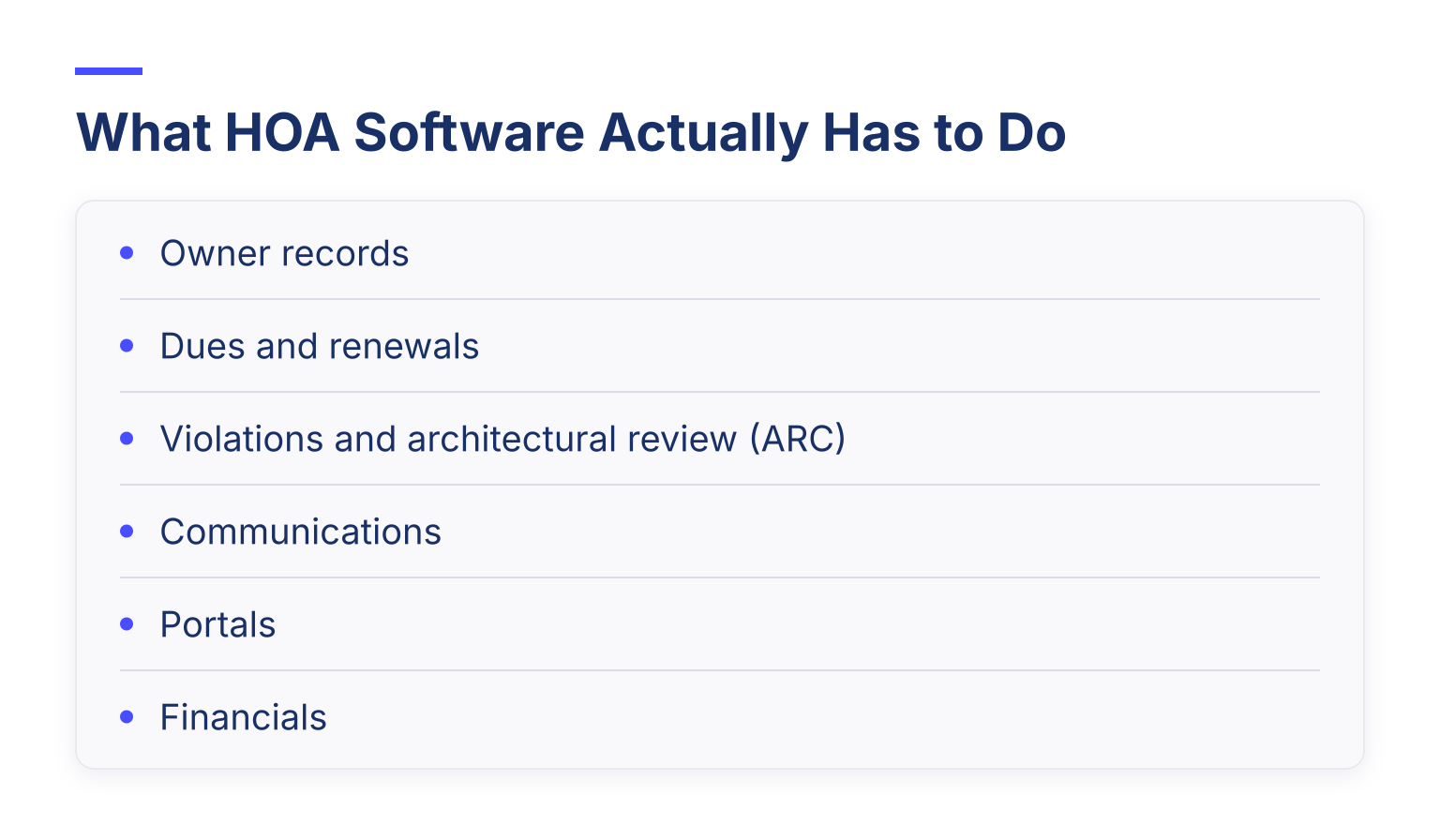
Before comparing tools, get clear on the jobs. A homeowners association, whether it has 20 homes or 2,000, needs the same core functions:
If you want a refresher on what board members themselves are responsible for, the HOA Board Responsibilities 101 guide breaks down the roles. The software should carry the administrative load of those jobs, not add a new one.
One warning up front: the tools below differ sharply in who they are for. Some are built for volunteer boards. Others are built for companies that manage dozens of communities and will feel like overkill, and price like it, for a single neighborhood.
How Pricing Models Differ (and Where Costs Hide)
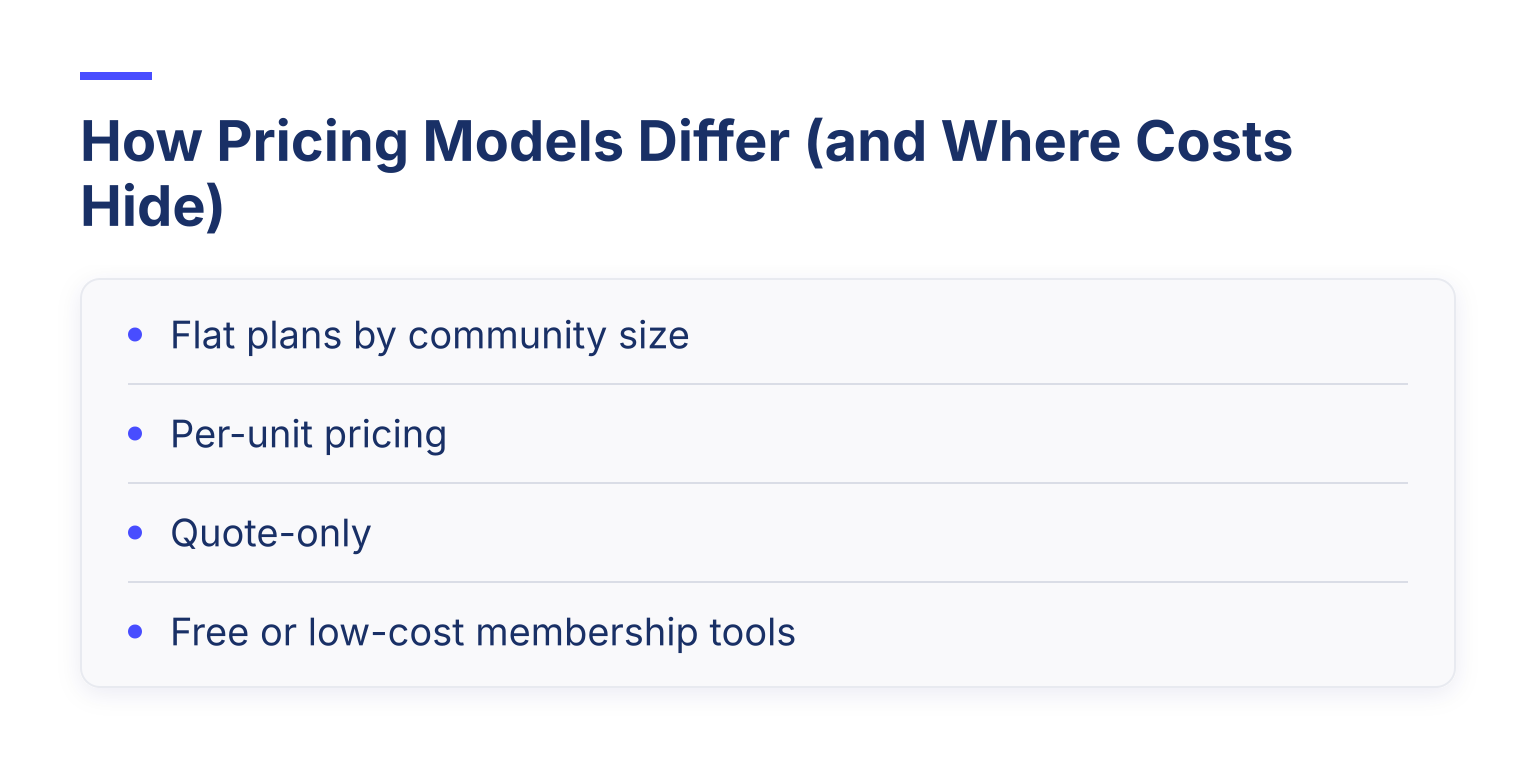
You will meet four pricing models:
Then come the hidden costs. Online payment fees are the big one: PayHOA, for example, publishes $2.45 per bank transfer and 3.5% plus $0.50 per card payment for online payments, which means a 200-home community collecting dues electronically pays real money in processing fees every month. Also ask about add-ons (violations tracking is a paid add-on on some platforms), implementation and data migration, and whether the entry price locks you into an annual bill.
Our general guide on how to compare membership software on features, cost, and fit walks through an evaluation checklist that works for HOA tools too. Use it as you read the options below.
The 8 Best Homeowners Association Software Options
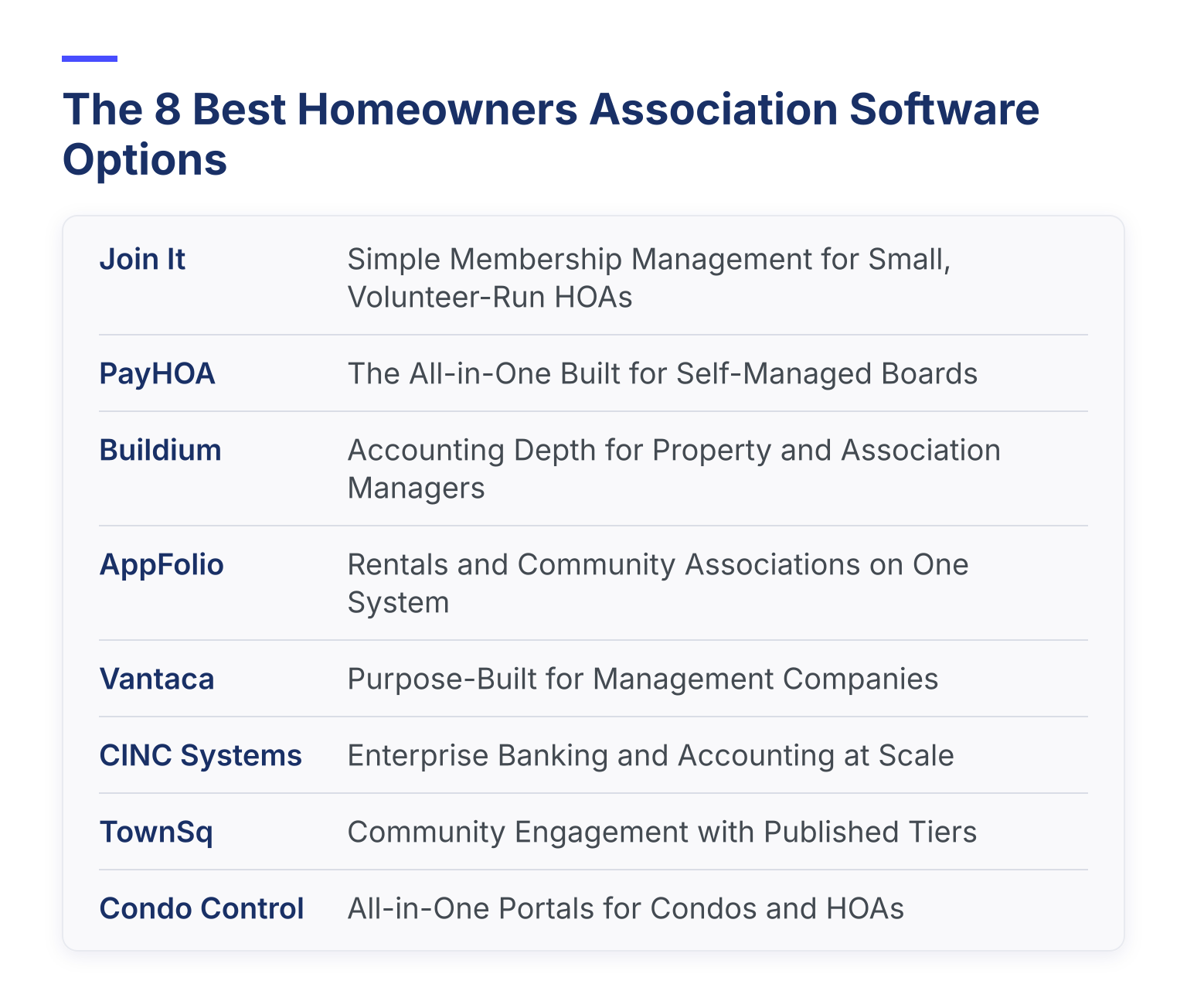
1. Join It: Simple Membership Management for Small, Volunteer-Run HOAs
Join It is cloud-based membership management software. It centralizes member records, dues, payments, notes, and activity in a searchable database, collects one-time and recurring payments, automates renewal reminders, runs free and paid events with registration and attendance tracking, accepts donations, and gives members a self-service portal. Members also get digital membership cards through Apple Wallet and Google Wallet, which works nicely as a proof-of-resident ID for amenity access. Email and notification tools, plus integrations with email marketing platforms, cover board-to-owner communication.
Best for: smaller, volunteer-run associations whose real workload is collecting dues, keeping an owner roster current, and communicating. If your community runs itself without a management company, this is the low-effort path.
Watch for: Join It is membership-first, not HOA-native. It does not include violations tracking, architectural review workflows, or reserve accounting. If those are your heaviest jobs, pick an HOA-specific tool below. Check current plans on the Join It pricing page before comparing.
2. PayHOA: The All-in-One Built for Self-Managed Boards
PayHOA is designed specifically for self-managed communities. Its published pricing is a flat plan by unit count: $49 a month billed yearly ($54 billed monthly) for 1 to 25 units, rising to $249 a month billed yearly for 401 to 500 units, with a per-unit rate above that. Every plan includes the same features: unlimited homeowners and admins, bank sync, 40-plus reports, communications, violations, and free onboarding and data import. PayHOA also supports multiple communities at $0.55 per unit a month for management companies.
Best for: self-managed boards from about 25 to 500 units that want HOA-specific features with transparent pricing and no long-term contract.
Watch for: online payment fees ($2.45 per bank transfer, 3.5% plus $0.50 per card) add up at scale, and the Gable AI assistant is on by default, free for three months, then billed monthly unless you turn it off.
3. Buildium: Accounting Depth for Property and Association Managers
Buildium is property management software with association management capability and serious accounting behind it. Its published plans start at $65 a month (Essential), with Growth at $202 and Premium at $420, priced by portfolio size with add-ons for services like tenant screening and eSignatures. For community associations specifically, Buildium routes you to custom pricing by phone.
Best for: management companies, or larger self-managed associations that need fund accounting, collections tracking, and structured reporting.
Watch for: this is a professional-grade system. A volunteer treasurer may find it more machine than needed, and the association quote is not published, so you will not know your real number until you call.
4. AppFolio: Rentals and Community Associations on One System
AppFolio runs residential portfolios and community associations on a single platform. Its pricing page lists Core from $1.49 per unit per month for residential portfolios and a Community Associations Core rate of $0.85 per unit per month, both with a 50-unit minimum and a minimum spend the page does not quantify. Its community association feature set covers online dues and assessment payments, a portal for owners and board members, mobile violations, online architectural review, and multiple fund accounting with cost centers.
Best for: management companies that already run rentals in AppFolio and want associations in the same system, or large associations well above 50 units.
Watch for: the 50-unit minimum and unpublished minimum spend rule out most small communities, and your real bill can land above the per-unit math. Ask for the dollar minimum before the per-unit rate.
5. Vantaca: Purpose-Built for Management Companies
Vantaca is built exclusively for professional community association management: multi-association accounting, workflow automation, homeowner and vendor portals, and implementation support with a dedicated team. Pricing is configured per portfolio and requires a conversation; there are no published plans.
Best for: management companies that plan to grow a portfolio and do not want to re-platform later.
Watch for: Vantaca says so itself: it is not the right choice for a self-managed association looking for a simple portal. The investment is higher than entry-level tools by design.
6. CINC Systems: Enterprise Banking and Accounting at Scale
CINC Systems targets professional management companies with fully integrated banking and accounting: receivables, digital lockbox, vendor payments through VendorPay, budgeting, and analytics, plus homeowner engagement on the front end. Pricing is by custom quote only.
Best for: established management companies handling large multi-association portfolios with heavy payment volume.
Watch for: quote-only pricing and an enterprise sales process. There is no point running this demo for a 60-home volunteer board.
7. TownSq: Community Engagement with Published Tiers
TownSq publishes its prices by community size: for communities up to 300 units, Pro starts at $90 a month and Advanced at $145 a month, with higher bands for bigger communities and a custom-priced Enterprise tier that adds fully integrated accounting and management. Plans cover announcements, requests, amenity reservations, document storage, architectural reviews, and violations tracking on higher tiers, with optional add-ons such as digital voting and a community website.
Best for: mid-size communities that want strong owner engagement, an app residents actually use, and visible pricing.
Watch for: the feature list varies a lot between tiers, and add-ons are priced per community per month, so a few extras change the bill. The fully integrated accounting layer sits in the Enterprise tier.
8. Condo Control: All-in-One Portals for Condos and HOAs
Condo Control offers a broad all-in-one platform for both self-managed boards and management companies: resident portals and mobile apps, maintenance and violation tracking, architectural change requests, online payments, package and visitor management, and financial modules including operating and reserve funds on upper tiers. Its pricing page shows three tier structures (Standard, Modern, Premium) but no dollar amounts, so expect a custom quote.
Best for: condo and HOA communities, especially ones that want visitor, package, and security management alongside the basics.
Watch for: quote-only pricing and a long feature list, which makes it easy to pay for modules you will never switch on. Ask for the price of just the tier you need.
Quick Comparison
SoftwareBest forPricing modelWhat you can see before you buyJoin ItSmall, volunteer-run HOAsMembership plans, per organizationPublished pricing pagePayHOASelf-managed boards, 25 to 500 unitsFlat plan by unit countFrom $49/month (1-25 units, billed yearly)BuildiumProperty and association managersPlans plus custom association quoteFrom $65/month for general plans; associations quotedAppFolioManagement companies, 50+ unitsPer unit per monthCommunity associations from $0.85/unit; residential Core from $1.49/unit; minimum spend unpublishedVantacaGrowing management companiesQuote onlyNothing publishedCINC SystemsEnterprise management companiesQuote onlyNothing publishedTownSqMid-size communitiesTiered by unit bandPro from $90/month up to 300 unitsCondo ControlCondos and HOAs wanting an all-in-oneQuote onlyNothing published
A Simple Decision Path by HOA Size
A few platforms sit between HOA and association territory. If your organization blurs that line, our best association management software comparison covers eight options built for associations rather than neighborhoods.
FAQ
Can a small HOA run on a spreadsheet?
For a handful of homes with one volunteer collecting checks, maybe. The moment you have recurring dues, late payments, or more than one person touching the records, a spreadsheet becomes the job's bottleneck and the board's liability. Dedicated software automates renewal reminders and gives owners self-service, which removes most of the work.
What do payment fees really cost?
Check the processor rate, not just the plan price. Using PayHOA's published rates as an example: a $300 quarterly dues payment by card costs $11.00 in fees (3.5% plus $0.50) versus $2.45 by bank transfer. Across 100+ homes, that difference is hundreds of dollars a year, which is why encouraging ACH over card is the single cheapest optimization most boards can make.
Do we need a management company to use this software?
No. PayHOA, TownSq, Condo Control, and Join It all serve self-managed boards directly. The quote-only enterprise platforms (Vantaca, CINC) are the ones really built around management companies, and a self-managed board should generally skip them.
The Bottom Line
The best homeowners association software is the one matched to who does the work. Volunteers with a few hundred homes need simple dues collection, clean records, and a portal, not enterprise accounting. If that describes your community, start a free trial of Join It and see whether membership-style management clears your to-do list, or compare PayHOA if you need violations and ARC tracking built in. Whichever way you go, verify current pricing on each vendor's own site before you budget: in this category, the published page and the real quote often differ.

Guides from the Experts
Through our work with 4,000+ organizations - we’ve put together helpful guides to assist; regardless of where you are on your journey.


A Complete Guide to Membership Organizations
Everything you need to know to manage and grow your membership business

Maximize Membership Retention: 10 Proven Strategies
Tried and true strategies that not only win membership, but keep them

Build a Membership Website: A Step-by-Step Guide
Your one-stop resource for knowing all the features your modern membership website needs
Ready to start your free trial?
Our membership software is intuitive to use and even easier to test for yourself.